Fractal assessment of structural changes in cellular concrete under acoustic excitation
DOI:
https://doi.org/10.15587/1729-4061.2026.351508Keywords:
open system, cement slurry, building material, cellular concrete, acoustic activationAbstract
Cellular concrete is this study's object with emphasis on the formation and evolution of its internal structure.
Currently, there is an issue related to the insufficient quantity and quality of tools for assessing the nature of building materials' structure. This does not allow the concept of controlled structure formation to be fully applied. The results reported here confirm that artificial composite materials in the design process follow stages that have the characteristics of open systems. They are capable of self-organization and are sensitive to external energy influences, which is reflected in the change in the nature of the structure.
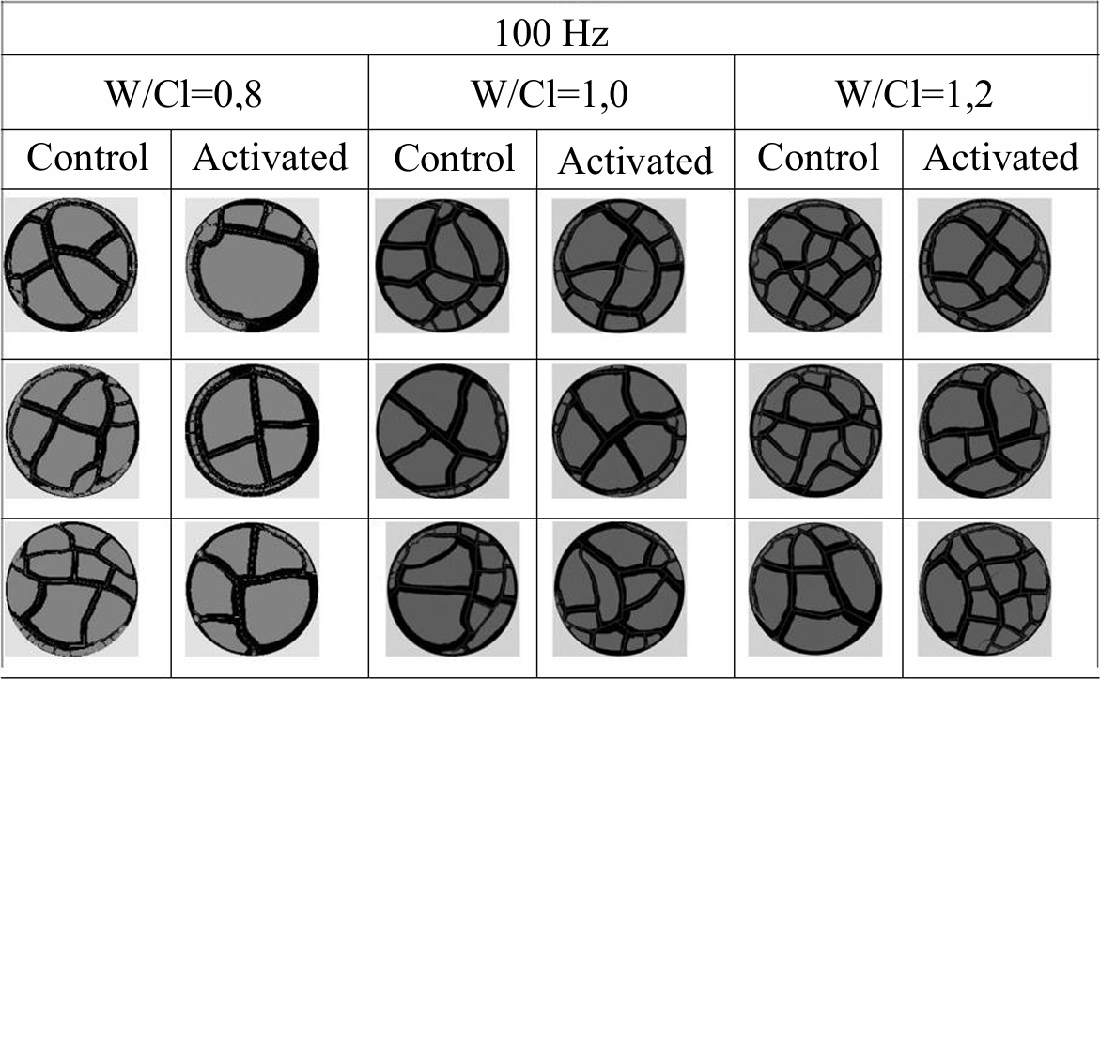
The use of fractal and information dimensionalities as quantitative indicators of the nature of the material structure has been proposed. The influence of water content and acoustic activation parameters on the change in structural characteristics was investigated on physical models in the form of water-clay suspensions, justified as analogs of cement slurry.
The effect of acoustic activation on the properties of foam concrete was established: at a frequency of 12 kHz, the compressive strength was 1.8 MPa, while at a frequency of (22 kHz) the strength decreased to 0.5–0.7 MPa, and the humidity increased to 34–35%, which indicates destabilization of the structure. Changes in the degree of order and complexity of the structure were quantitatively recorded using fractal and information dimensionalities.
The results are attributed to the technology of manufacturing cellular concretes, in particular foam concrete, in which the use of acoustic activation at the early stages of structure formation makes it possible to control the structure of the material and its physical and mechanical properties. The proposed approach could be integrated into industrial technological schemes provided that stable parameters of acoustic influence are ensured; it does not require significant changes to standard equipment
References
- Neville, A. M. (2011). Properties of Concrete. London: Pearson Education Limited, 844. Available at: https://www.pearson.com/en-gb/subject-catalog/p/properties-of-concrete-properties-of-concrete/P200000005116/9780273755807
- Hewlett, P. C., Liska, M. (2019). Lea’s Chemistry of Cement and Concrete. Butterworth-Heinemann, 1256. https://doi.org/10.1016/c2013-0-19325-7
- Nicolis, G., Prigogine, I. (1977). Self-Organization in Nonequilibrium Systems: From Dissipative Structures to Order through Fluctuations. Wiley, 491. Available at: https://archive.org/details/selforganization0000nico
- Haken, H. (1983). Synergetics. In Springer Series in Synergetics. Springer Berlin Heidelberg. https://doi.org/10.1007/978-3-642-88338-5
- Lohmann, J., Kölzer, T., Schaan, G., Schmidt‐Döhl, F. (2023). Self‐organizing systems in the construction industry. Engineering Reports. https://doi.org/10.1002/eng2.12692
- Lan, M., Zhou, J., Li, H., Wang, Y. (2022). Numerical Simulation on Cement Hydration and Microstructure Development in Repair-Substrate Interface. Frontiers in Materials, 9. https://doi.org/10.3389/fmats.2022.829743
- Memon, R. P., Huseien, G. F., Saleh, A. T., K. Ghoshal, S., Memon, U., Alwetaishi, M. et al. (2022). Microstructure and Strength Properties of Sustainable Concrete Using Effective Microorganisms as a Self-Curing Agent. Sustainability, 14 (16), 10443. https://doi.org/10.3390/su141610443
- Danylkiv, A. Ya. (2023). Doslidzhennia mitsnisnykh kharakterystyk betonu ultrazvukovym metodom. Ternopil: TNTU, 71. Available at: https://elartu.tntu.edu.ua/handle/lib/41193
- Cheylitko, A. (2015). The influence of synthesis of the initial mixture and blowing agents on the formation of a porous structure. Eastern-European Journal of Enterprise Technologies, 5 (8 (77)), 35–38. https://doi.org/10.15587/1729-4061.2015.51615
- Zhu, X., Richardson, I. G. (2023). Morphology-structural change of C-A-S-H gel in blended cements. Cement and Concrete Research, 168, 107156. https://doi.org/10.1016/j.cemconres.2023.107156
- Cangemi, L. M., Bhadra, C., Levy, A. (2024). Quantum engines and refrigerators. Physics Reports, 1087, 1–71. https://doi.org/10.1016/j.physrep.2024.07.001
- Basu, S., Sasmal, S., Kundu, T. (2024). Ultrasonic wave characteristics in multiscale cementitious materials at different stages of hydration. Ultrasonics, 142, 107397. https://doi.org/10.1016/j.ultras.2024.107397
- Swartz, M., Mbasha, W., Haldenwang, R. (2023). The Effect of a Blended Polycarboxylate Superplasticizer on the Rheology of Self-Compacting Concrete Paste. Applied Sciences, 13 (7), 4148. https://doi.org/10.3390/app13074148
- Xiong, G., Ren, Y., Fang, Z., Jia, X., Sun, K., Guo, B. et al. (2024). Understanding the cavitation effect of power ultrasound in cement paste. Construction and Building Materials, 438, 137089. https://doi.org/10.1016/j.conbuildmat.2024.137089
- Remus, R., Rößler, C., Peters, S., Sowoidnich, T., Ludwig, H.-M. (2024). Fundamental effects of using power ultrasound to accelerate C3S hydration. Cement and Concrete Research, 180, 107514. https://doi.org/10.1016/j.cemconres.2024.107514
- Ehsani, A., Ganjian, E., Haas, O., Tyrer, M., Mason, T. J. (2023). The positive effects of power ultrasound on Portland cement pastes and mortars; a study of chemical shrinkage and mechanical performance. Cement and Concrete Composites, 137, 104935. https://doi.org/10.1016/j.cemconcomp.2023.104935
- Zhang, P., Ding, J., Guo, J., Wang, F. (2024). Fractal Analysis of Cement-Based Composite Microstructure and Its Application in Evaluation of Macroscopic Performance of Cement-Based Composites: A Review. Fractal and Fractional, 8 (6), 304. https://doi.org/10.3390/fractalfract8060304
- Guan, D., Pan, T., Guo, R., Wei, Y., Qi, R., Fu, C. et al. (2024). Fractal and Multifractal Analysis of Microscopic Pore Structure of UHPC Matrix Modified with Nano Silica. Fractal and Fractional, 8 (6), 360. https://doi.org/10.3390/fractalfract8060360
- Liu, Y., Zhao, Z., Amin, M. N., Ahmed, B., Khan, K., Arifeen, S. U., Althoey, F. (2024). Foam concrete for lightweight construction applications: A comprehensive review of the research development and material characteristics. Reviews on Advanced Materials Science, 63 (1). https://doi.org/10.1515/rams-2024-0022
- Zhang, X., Meng, L., Li, Q., Wang, Y., Liu, D., Wei, K. (2025). Pore size distributions and fractal characteristics of basalt fiber-reinforced coral sand concrete. Scientific Reports, 15 (1). https://doi.org/10.1038/s41598-025-06480-1
- Wu, L., Li, Y., Fu, Z., Su, B.-L. (2020). Hierarchically structured porous materials: synthesis strategies and applications in energy storage. National Science Review, 7 (11), 1667–1701. https://doi.org/10.1093/nsr/nwaa183
- Al-Allaf, M. H., Weekes, L., Augusthus-Nelson, L., Leach, P. (2016). An experimental investigation into the bond-slip behaviour between CFRP composite and lightweight concrete. Construction and Building Materials, 113, 15–27. https://doi.org/10.1016/j.conbuildmat.2016.03.032
- Chen, Y., Wang, Q. (2005). Extended Jacobi elliptic function rational expansion method and abundant families of Jacobi elliptic function solutions to (1 + 1)-dimensional dispersive long wave equation. Chaos, Solitons & Fractals, 24 (3), 745–757. https://doi.org/10.1016/j.chaos.2004.09.014
- Martynov, V. I,, Vyrovoi, V. M., Makarova, S. S. (2021). Nizdriuvati betony. Sklad, tekhnolohiya, struktura, vlastyvosti. Odesa: ODABA, 162.
- Martynov, V., Vyrovoy, V. M., Makarova, S., Taichan, D. (2024). The Influence of the Solid Phase on the Properties of Foam Concrete. Materials Science Forum, 1138, 121–130. https://doi.org/10.4028/p-4maykh
- Martynov, V., Taichan, D. (2025). Informational content of fractal structures of building materials. Science and Construction, 44 (2). https://doi.org/10.33644/2313-6679-2-2025-6
- Chen, Y. (2020). Equivalent relation between normalized spatial entropy and fractal dimension. Physica A: Statistical Mechanics and Its Applications, 553, 124627. https://doi.org/10.1016/j.physa.2020.124627
Downloads
Published
How to Cite
Issue
Section
License
Copyright (c) 2026 Volodymyr Martynov, Ihor Sychov, Dmytro Taichan, Svetlana Makarova, Svetlana Sukhanova

This work is licensed under a Creative Commons Attribution 4.0 International License.
The consolidation and conditions for the transfer of copyright (identification of authorship) is carried out in the License Agreement. In particular, the authors reserve the right to the authorship of their manuscript and transfer the first publication of this work to the journal under the terms of the Creative Commons CC BY license. At the same time, they have the right to conclude on their own additional agreements concerning the non-exclusive distribution of the work in the form in which it was published by this journal, but provided that the link to the first publication of the article in this journal is preserved.
A license agreement is a document in which the author warrants that he/she owns all copyright for the work (manuscript, article, etc.).
The authors, signing the License Agreement with TECHNOLOGY CENTER PC, have all rights to the further use of their work, provided that they link to our edition in which the work was published.
According to the terms of the License Agreement, the Publisher TECHNOLOGY CENTER PC does not take away your copyrights and receives permission from the authors to use and dissemination of the publication through the world's scientific resources (own electronic resources, scientometric databases, repositories, libraries, etc.).
In the absence of a signed License Agreement or in the absence of this agreement of identifiers allowing to identify the identity of the author, the editors have no right to work with the manuscript.
It is important to remember that there is another type of agreement between authors and publishers – when copyright is transferred from the authors to the publisher. In this case, the authors lose ownership of their work and may not use it in any way.








