Development of a lightweight abduction splint for pediatric DDH patients through topological optimization
DOI:
https://doi.org/10.15587/1729-4061.2026.351704Keywords:
dysplasia, abduction splint, optimization, finite element analysis, additive manufacturing, pediatricAbstract
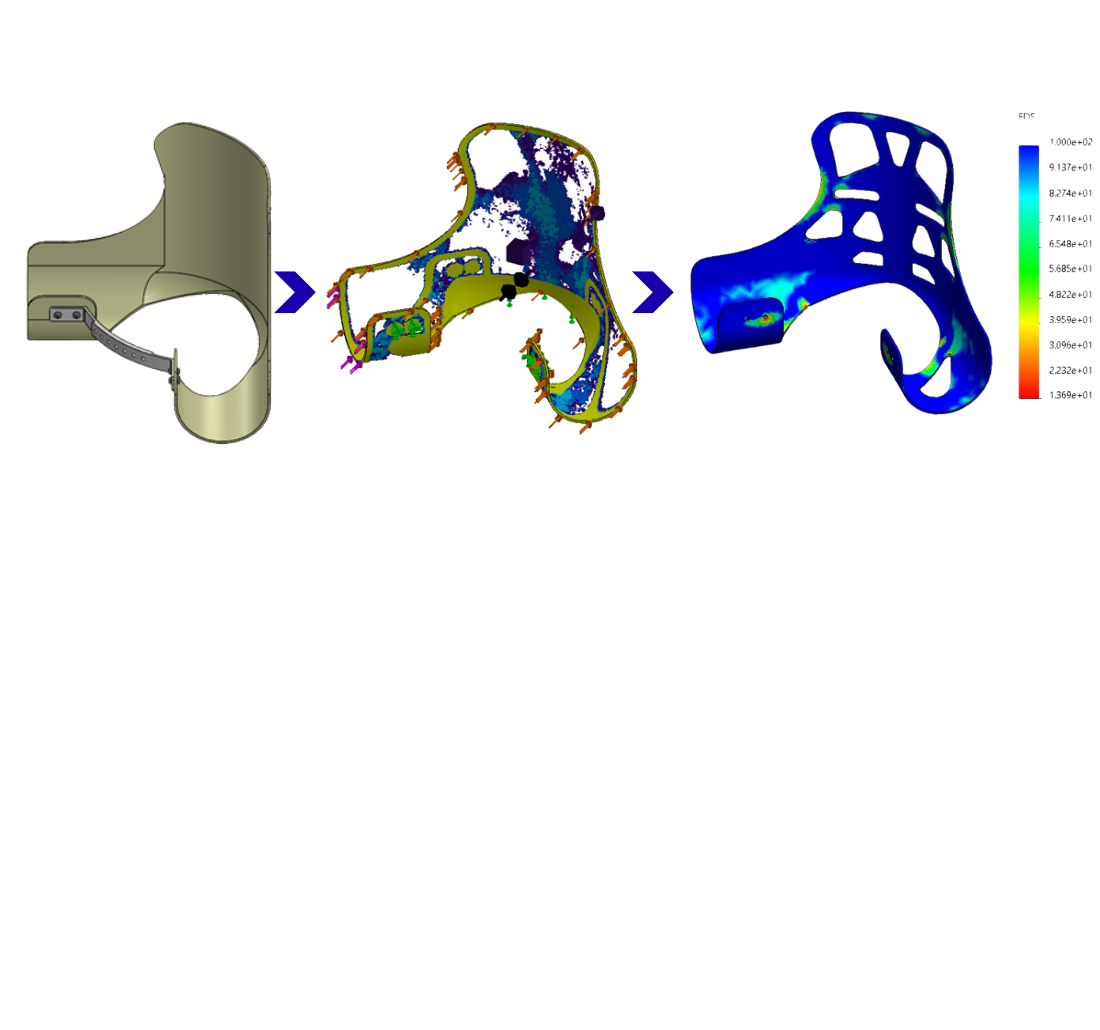
The object of the study is the structural geometry of an abduction splint for pediatric patients with developmental dysplasia. The problem to be solved is the existing commercial orthotic devices exhibit excessive weight and inadequate contact pressure distribution, leading to soft tissue damage, skin irritation, and poor therapeutic compliance in pediatric patients. Main scientific results – topological optimization based on the solid isotropic material with penalization method was applied to redesign the splint geometry. Three medical-grade polymers (ABS medical, PETG medical, and PP) were comparatively evaluated through static finite element analysis (FEA). ABS Medical was selected as the optimal material due to its initial safety factor of 14.95. The iterative optimization process, spanning 81 cycles, achieved a mass reduction of 18.96% (from 395.34 g to 320.38 g) while maintaining a safety factor of 13.69, significantly exceeding the Pugsley-derived minimum of 2.52 established for pediatric medical devices. Peak contact pressure reached 0.962 kPa, well below the critical 5.2 kPa capillary occlusion threshold. Interpretation – weight reduction results from the redistribution of material along principal stress vectors identified through finite element analysis. Distinctive features – the approach achieves nearly double the mass reduction of comparable studies (18.96% vs. 9.58%). Practical value – these results provide a validated framework for manufacturing lightweight and safer orthopedic devices via fused deposition modeling (FDM) additive manufacturing, minimizing dermatological complications
Supporting Agency
- Universidad Nacional de San Agustin de Arequipa
References
- Ionescu, A., Dragomirescu, M.-C., Herdea, A., Ulici, A. (2023). Developmental Dysplasia of the Hip: How Many Risk Factors Are Needed? Children, 10 (6), 968. https://doi.org/10.3390/children10060968
- Burden of Disease. Global Hip Dysplasia Registry. Available at: https://www.hipregistry.com/burden-of-disease
- Tao, Z., Wang, J., Li, Y., Zhou, Y., Yan, X., Yang, J. et al. (2023). Prevalence of developmental dysplasia of the hip (DDH) in infants: a systematic review and meta-analysis. BMJ Paediatrics Open, 7 (1), e002080. https://doi.org/10.1136/bmjpo-2023-002080
- Kraus, T., Chiari, C. (2024). Universal screening for developmental dysplasia of the hip in Austria: what have we learned? Exploration of Musculoskeletal Diseases, 2 (3), 208–215. https://doi.org/10.37349/emd.2024.00049
- Talal Ahmad Amer, M.D., A. R. M. M. D., Elaziz Elsaaid, M.D., M. A. (2021). Role of Ultrasound in Screening of Infantile Developmental HipDysplasia. The Medical Journal of Cairo University, 89 (3), 329–336. https://doi.org/10.21608/mjcu.2021.153946
- Hip dysplasia. Mayo Clinic. Available at: https://www.mayoclinic.org/diseases-conditions/hip-dysplasia/symptoms-causes/syc-20350209
- Guías de Salud. Available at: https://www.lne.es/salud/guia/
- Jacobsen, K. K., Laborie, L. B., Kristiansen, H., Schäfer, A., Gundersen, T., Zayats, T., Rosendahl, K. (2024). Genetics of hip dysplasia – a systematic literature review. BMC Musculoskeletal Disorders, 25 (1). https://doi.org/10.1186/s12891-024-07795-2
- Pavone, V., de Cristo, C., Vescio, A., Lucenti, L., Sapienza, M., Sessa, G. et al. (2021). Dynamic and Static Splinting for Treatment of Developmental Dysplasia of the Hip: A Systematic Review. Children, 8 (2), 104. https://doi.org/10.3390/children8020104
- Drobniewski, M., Gonera, B., Olewnik, Ł., Borowski, A., Ruzik, K., Triantafyllou, G., Borowski, A. (2024). Challenges and Long-Term Outcomes of Cementless Total Hip Arthroplasty in Patients Under 30: A 24-Year Follow-Up Study with a Minimum 8-Year Follow-Up, Focused on Developmental Dysplasia of the Hip. Journal of Clinical Medicine, 13 (21), 6591. https://doi.org/10.3390/jcm13216591
- O’Brien, M. J., Semciw, A. I., Mechlenburg, I., Tønning, L. C., Stewart, C. J., Kemp, J. L. (2023). Pain, function and quality of life are impaired in adults undergoing periacetabular osteotomy (PAO) for hip dysplasia: a systematic review and meta-analysis. HIP International, 34 (1), 96–114. https://doi.org/10.1177/11207000231179610
- Gahleitner, M., Pisecky, L., Gotterbarm, T., Högler, W., Luger, M., Klotz, M. C. (2023). Long-term Results of Developmental Hip Dysplasia Under Therapy With Pavlik Harness. Journal of Pediatric Orthopaedics, 44 (3), 135–140. https://doi.org/10.1097/bpo.0000000000002575
- Rastogi, P., Anant, S., Agarwal, S., Singh Oberoi, I., Tiwari, P. (2025). A Systematic Review on Neonatal Screening and Orthopaedic Management of Developmental Dysplasia of The Hip Through a Synthesis of Diagnostic Yield and Pavlik Harness Outcomes. Journal of Neonatal Surgery, 14 (8S), 968–979. Available at: https://www.jneonatalsurg.com/index.php/jns/article/view/5223
- Imerci, A., Thacker, M. M., Bowen, J. R. (2024). Failure of Pavlik Harness Treatment in Infants Under 6 Months Old with Dislocated Hips: Short- and Intermediate-Term Results of Subsequent Treatment Modalities. Indian Journal of Orthopaedics, 58 (9), 1288–1296. https://doi.org/10.1007/s43465-024-01162-y
- Rakotonandrianina, M. N. H., MG., A. T. R., Tata, T. J. F., Solofomalala, G. D. (2023). Orthosis Treatment for Patients with Congenital Hip Dislocation. Surabaya Physical Medicine and Rehabilitation Journal, 5 (1), 17–24. https://doi.org/10.20473/spmrj.v5i1.36926
- Zhi, X., Xiao, X., Wan, Y., Wei, P., Canavese, F., Xu, H. (2021). Tübingen hip flexion splint for the treatment of developmental dysplasia of the hip in children younger than six months age: A meta-analysis. Journal of Children’s Orthopaedics, 15 (4), 402–408. https://doi.org/10.1302/1863-2548.15.210015
- Wahlen, R., Zambelli, P.-Y. (2015). Treatment of the Developmental Dysplasia of the Hip with an Abduction Brace in Children up to 6 Months Old. Advances in Orthopedics, 2015, 1–6. https://doi.org/10.1155/2015/103580
- Dyskin, E., Ferrick, M. (2015). Semirigid Abduction Bracing is Effective Treatment of Reducible Developmental Dysplastic Hips after Failure of Pavlik Harness. Ann. Orthop. Rheumatol., 3 (2), 1045. Available at: https://www.jscimedcentral.com/jounal-article-pdf/Annals-of-Orthopedics-and-Rheumatology/orthopedics-3-1045.pdf
- Hoopes, R. R. (2020). A Retrospective Study to Identify Factors Contributing to Pressure Ulcers in Pediatric Patients with Lower Extremity Splints. Biomedical Journal of Scientific & Technical Research, 30 (3). https://doi.org/10.26717/bjstr.2020.30.004957
- Grzybowski, G., Bliven, E., Wu, L., Schaeffer, E. K., Gibbard, M., Zomar, B. O. et al. (2022). Caregiver Experiences Using Orthotic Treatment Options for Developmental Dysplasia of the Hip in Children. Journal of Pediatric Orthopaedics, 43 (2), 105–110. https://doi.org/10.1097/bpo.0000000000002312
- Sala, F., D’Urso, G. D., Giardini, C. (2024). Evaluation of the Integration of Topological Optimisation in the Process Chain for Manufacturing Customised Orthopaedic Devices via Additive Manufacturing. Prosthesis, 6 (6), 1510–1528. https://doi.org/10.3390/prosthesis6060109
- Voulgaris, S., Kousiatza, C., Kazakis, G., Ypsilantis, K.-I., Galanis, D., Mitropoulou, C. Ch. et al. (2025). Upper Limb Orthoses: Integrating Topology Optimization and 3D Printing for Custom Fit and Function. Applied Sciences, 15 (2), 827. https://doi.org/10.3390/app15020827
- Salazar Loor, R. B., Martínez-Gómez, J., Sarmiento Anchundia, J. (2025). Material Selection for the Development of Orthoses Using Multicriteria Methods (MCDMs) and Simulation. Processes, 13 (6), 1796. https://doi.org/10.3390/pr13061796
- Kyriakidis, I. F., Kladovasilakis, N., Gavriilopoulos, M., Tzetzis, D., Pechlivani, E. M., Tsongas, K. (2025). Topologically Optimized Anthropomorphic Prosthetic Limb: Finite Element Analysis and Mechanical Evaluation Using Plantogram-Derived Foot Pressure Data. Biomimetics, 10 (5), 261. https://doi.org/10.3390/biomimetics10050261
- Raimann, R., Aguirre, D. (2021). Displasia del desarrollo de la cadera: tamizaje y manejo en el lactante. Revista Médica Clínica Las Condes, 32 (3), 263–270. https://doi.org/10.1016/j.rmclc.2021.04.003
- Legorreta Cuevas, J. G. (2013). Mediciones básicas en displasia del desarrollo de la cadera. Rev. Mex. Ortop. Pediatr., 15 (1), 53–56. Available at: https://www.medigraphic.com/pdfs/opediatria/op-2013/op131j.pdf
- Estimacion del peso ideal en sujetos amputados (Plamp). FRESENIUS KABI. Available at: https://www.nutricionemocional.es/sites/default/files/estimacion_peso_ideal_sujetos_amputados_1.pdf
- ABS Medical (Technical datasheet v2.1). Weerg. Available at: https://www.weerg.com/hubfs/Datasheets/Datasheets%202024/ENG/EN_ABSMedical.pdf
- Zou, R., Xia, Y., Liu, S., Hu, P., Hou, W., Hu, Q., Shan, C. (2016). Isotropic and anisotropic elasticity and yielding of 3D printed material. Composites Part B: Engineering, 99, 506–513. https://doi.org/10.1016/j.compositesb.2016.06.009
- Ciganas, J., Janušas, G. (2023). Investigation of Dynamic Mechanical Properties of PETG Thermoplastic. In Proc. 27th Int. Sci. Conf. MECHANICS, Kaunas University of Technology, Kaunas, Lithuania. Available at: https://mechanic.ktu.edu/wp-content/uploads/sites/296/2023/05/P.5.pdf
- PETG. Technical Data Sheet 05.24. AZUREFILM. Available at: https://3d.nice-cdn.com/upload/file/TDS-PETG.pdf
- PETG (Technical Data). PETG. PT Polimer Tecnic. Available at: https://www.polimertecnic.com/wp-content/uploads/2022/05/1H9L9sb0yOuoFQIHCREpQda92QUpMetsC.pdf
- Technical data sheet: P-filament. PP Print. Available at: https://www.ppprint.de/wp-content/uploads/2019/03/PPprint-data-sheet-eng-21.02.2019.pdf
- Yun, J.-H., Jeon, Y.-J., Kang, M.-S. (2022). Analysis of Elastic Properties of Polypropylene Composite Materials with Ultra-High Molecular Weight Polyethylene Spherical Reinforcement. Materials, 15 (16), 5602. https://doi.org/10.3390/ma15165602
Downloads
Published
How to Cite
Issue
Section
License
Copyright (c) 2026 Alex Condori Lopez, Eber Mejia Tola, Yuri Silva Vidal, Erick Valdeiglesias Flores, Daniela Ponte Lopez, Trunks Vasquez Llave

This work is licensed under a Creative Commons Attribution 4.0 International License.
The consolidation and conditions for the transfer of copyright (identification of authorship) is carried out in the License Agreement. In particular, the authors reserve the right to the authorship of their manuscript and transfer the first publication of this work to the journal under the terms of the Creative Commons CC BY license. At the same time, they have the right to conclude on their own additional agreements concerning the non-exclusive distribution of the work in the form in which it was published by this journal, but provided that the link to the first publication of the article in this journal is preserved.
A license agreement is a document in which the author warrants that he/she owns all copyright for the work (manuscript, article, etc.).
The authors, signing the License Agreement with TECHNOLOGY CENTER PC, have all rights to the further use of their work, provided that they link to our edition in which the work was published.
According to the terms of the License Agreement, the Publisher TECHNOLOGY CENTER PC does not take away your copyrights and receives permission from the authors to use and dissemination of the publication through the world's scientific resources (own electronic resources, scientometric databases, repositories, libraries, etc.).
In the absence of a signed License Agreement or in the absence of this agreement of identifiers allowing to identify the identity of the author, the editors have no right to work with the manuscript.
It is important to remember that there is another type of agreement between authors and publishers – when copyright is transferred from the authors to the publisher. In this case, the authors lose ownership of their work and may not use it in any way.








