Визначення механічного та техноекономічного впливу перероблених відходів знесення цегли у виробництві бруківки
DOI:
https://doi.org/10.15587/1729-4061.2026.352346Ключові слова:
цегляні відходи, циркулярна економіка, бруківка, речовинний заповнювач, стале будівництвоАнотація
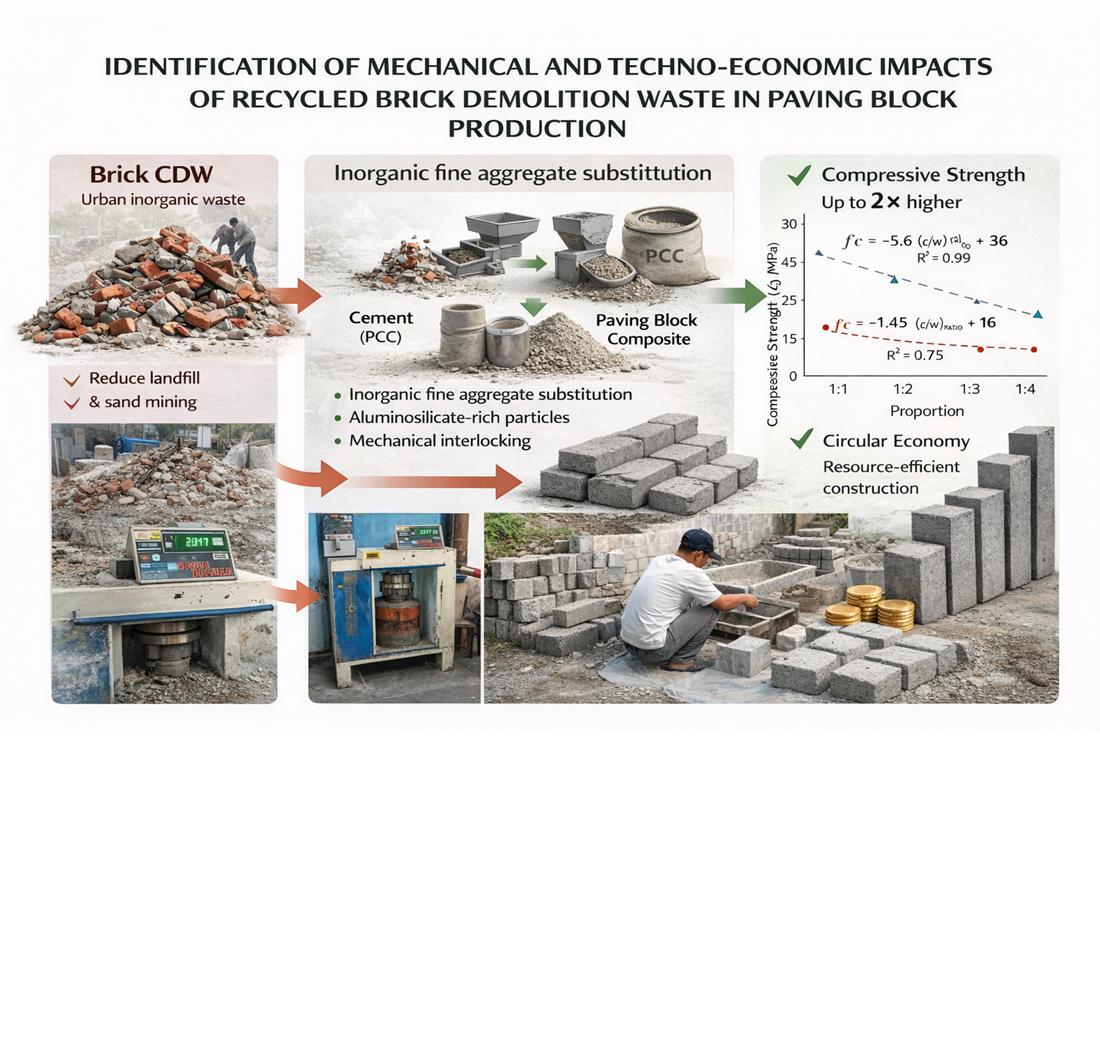
Це дослідження зосереджено на композитах з бруківки з використанням дрібного заповнювача з будівельних та знесених відходів цегли (ЗВЦ). Дослідження розглядає дві проблеми, що сприяють надмірному видобутку ресурсів, погіршенню стану навколишнього середовища та зростанню цін на матеріали в міському будівництві: постійно зростаюче виробництво ЗВЦ з цегли та зростаюча залежність від природного піску у виробництві бруківки. Накопичення ЗВЦ з цегли на звалищах та неконтрольоване утилізація ще більше підкреслює необхідність технічно та економічно доцільних альтернативних матеріальних рішень. Результати показують, що перероблені заповнювачі ЗВЦ з цегли можуть бути безперешкодно включені до цементних композитів для бруківки завдяки їх взаємодоповнюючому мінеральному складу. Механічні випробування підтверджують, що бруківка, виготовлена з перероблених ЗВЦ, має помітно вищу міцність на стиск, ніж природний пісок. Це покращення характеристик зумовлене шорсткою поверхнею та кутовою формою частинок ЗВЦ з цегли. Ці елементи покращують механічне зчеплення цементної матриці та заповнювача, створюючи міцнішу структуру композиту. Крім того, порівняльний аналіз показує, що бруківка, виготовлена з перероблених ЗВЦ з цегли, може досягти до двох разів вищої міцності на стиск, одночасно знижуючи виробничі витрати приблизно на 50% порівняно з традиційними комбінаціями. Ці результати свідчать про те, що перероблені заповнювачі з цегли перевершують природний пісок з точки зору вартості та структурної міцності. Ці результати свідчать про те, що перероблені цегляні заповнювачі перевершують природний пісок з точки зору вартості та структурної міцності. Результати дослідження можуть бути використані для підтримки більш ресурсоефективних та екологічно чистих методів будівництва, особливо в міських районах, де відходи знесення цегли легкодоступні
Посилання
- Goyal, H., Kumar, R., Mondal, P. (2023). Life cycle analysis of paver block production using waste plastics: Comparative assessment with concrete paver blocks. Journal of Cleaner Production, 402, 136857. https://doi.org/10.1016/j.jclepro.2023.136857
- Asif, U., Javed, M. F. (2024). Optimizing plastic waste inclusion in paver blocks: Balancing performance, environmental impact, and cost through LCA and economic analysis. Journal of Cleaner Production, 478, 143901. https://doi.org/10.1016/j.jclepro.2024.143901
- Kovalchuk, O., Zozulynets, V., Popruha, P., Grabovchak, V. (2025). Mix design of the composition of general construction concrete based on recycled aggregates. Eastern-European Journal of Enterprise Technologies, 5 (6 (137)), 49–57. https://doi.org/10.15587/1729-4061.2025.340832
- Iftikhar, B., Alih, S. C., Vafaei, M., Alkhattabi, L., Althoey, F., Ali, M., Javed, M. F. (2024). Sustainable use of plastic waste in plastic sand paver blocks: An experimental and modelling-based study. Structures, 62, 106285. https://doi.org/10.1016/j.istruc.2024.106285
- Sugiharto, K., Marjono, M., Ciptadi, G., Wisnumurti, W. (2025). Evaluating environmental sustainability and ecosystem disruption caused by construction demolition waste in a university precinct: a case study from Malang, Southeast Asia. Eastern-European Journal of Enterprise Technologies, 4 (10 (136)), 28–36. https://doi.org/10.15587/1729-4061.2025.338119
- Viranthy Dian Pertiwi, A., Caronge, M. A., Tjaronge, M. W. (2024). Producing Eco-Friendly Concrete Paving Block Using Waste Refractory Brick Aggregates. International Journal of Pavement Research and Technology, 18 (6), 1399–1411. https://doi.org/10.1007/s42947-024-00425-z
- Agrawal, R., Singh, S. K., Singh, S., Prajapat, D. K., Sudhanshu, S., Kumar, S. et al. (2023). Utilization of Plastic Waste in Road Paver Blocks as a Construction Material. CivilEng, 4 (4), 1071–1082. https://doi.org/10.3390/civileng4040058
- Mohamad, H. M. (2022). Manufacture of concrete paver block using waste materials and by-products: a review. International Journal of GEOMATE, 22 (93). https://doi.org/10.21660/2022.93.j2363
- Christensen, T. B., Johansen, M. R., Buchard, M. V., Glarborg, C. N. (2022). Closing the material loops for construction and demolition waste: The circular economy on the island Bornholm, Denmark. Resources, Conservation & Recycling Advances, 15, 200104. https://doi.org/10.1016/j.rcradv.2022.200104
- Ram, V. G., Kishore, K. C., Kalidindi, S. N. (2020). Environmental benefits of construction and demolition debris recycling: Evidence from an Indian case study using life cycle assessment. Journal of Cleaner Production, 255, 120258. https://doi.org/10.1016/j.jclepro.2020.120258
- López Ruiz, L. A., Roca Ramón, X., Gassó Domingo, S. (2020). The circular economy in the construction and demolition waste sector – A review and an integrative model approach. Journal of Cleaner Production, 248, 119238. https://doi.org/10.1016/j.jclepro.2019.119238
##submission.downloads##
Опубліковано
Як цитувати
Номер
Розділ
Ліцензія
Авторське право (c) 2026 Ketut Sugiharto, Marjono Marjono, Gatot Ciptadi, Wisnumurti Wisnumurti

Ця робота ліцензується відповідно до Creative Commons Attribution 4.0 International License.
Закріплення та умови передачі авторських прав (ідентифікація авторства) здійснюється у Ліцензійному договорі. Зокрема, автори залишають за собою право на авторство свого рукопису та передають журналу право першої публікації цієї роботи на умовах ліцензії Creative Commons CC BY. При цьому вони мають право укладати самостійно додаткові угоди, що стосуються неексклюзивного поширення роботи у тому вигляді, в якому вона була опублікована цим журналом, але за умови збереження посилання на першу публікацію статті в цьому журналі.
Ліцензійний договір – це документ, в якому автор гарантує, що володіє усіма авторськими правами на твір (рукопис, статтю, тощо).
Автори, підписуючи Ліцензійний договір з ПП «ТЕХНОЛОГІЧНИЙ ЦЕНТР», мають усі права на подальше використання свого твору за умови посилання на наше видання, в якому твір опублікований. Відповідно до умов Ліцензійного договору, Видавець ПП «ТЕХНОЛОГІЧНИЙ ЦЕНТР» не забирає ваші авторські права та отримує від авторів дозвіл на використання та розповсюдження публікації через світові наукові ресурси (власні електронні ресурси, наукометричні бази даних, репозитарії, бібліотеки тощо).
За відсутності підписаного Ліцензійного договору або за відсутністю вказаних в цьому договорі ідентифікаторів, що дають змогу ідентифікувати особу автора, редакція не має права працювати з рукописом.
Важливо пам’ятати, що існує і інший тип угоди між авторами та видавцями – коли авторські права передаються від авторів до видавця. В такому разі автори втрачають права власності на свій твір та не можуть його використовувати в будь-який спосіб.