Devising of a system for analysing the dispersed composition of emulsions using computer vision methods
DOI:
https://doi.org/10.15587/1729-4061.2026.352589Keywords:
image segmentation, emulsion analysis, computer vision, droplet distribution, droplet diameterAbstract
The feasibility of applying computer vision sequences to automatically determine the composition of heterogeneous disperse systems, using emulsions as a case study, has been considered. This expands the analytical framework, reduces human factor impact on analysis accuracy and reliability, as well as improves processing speed.
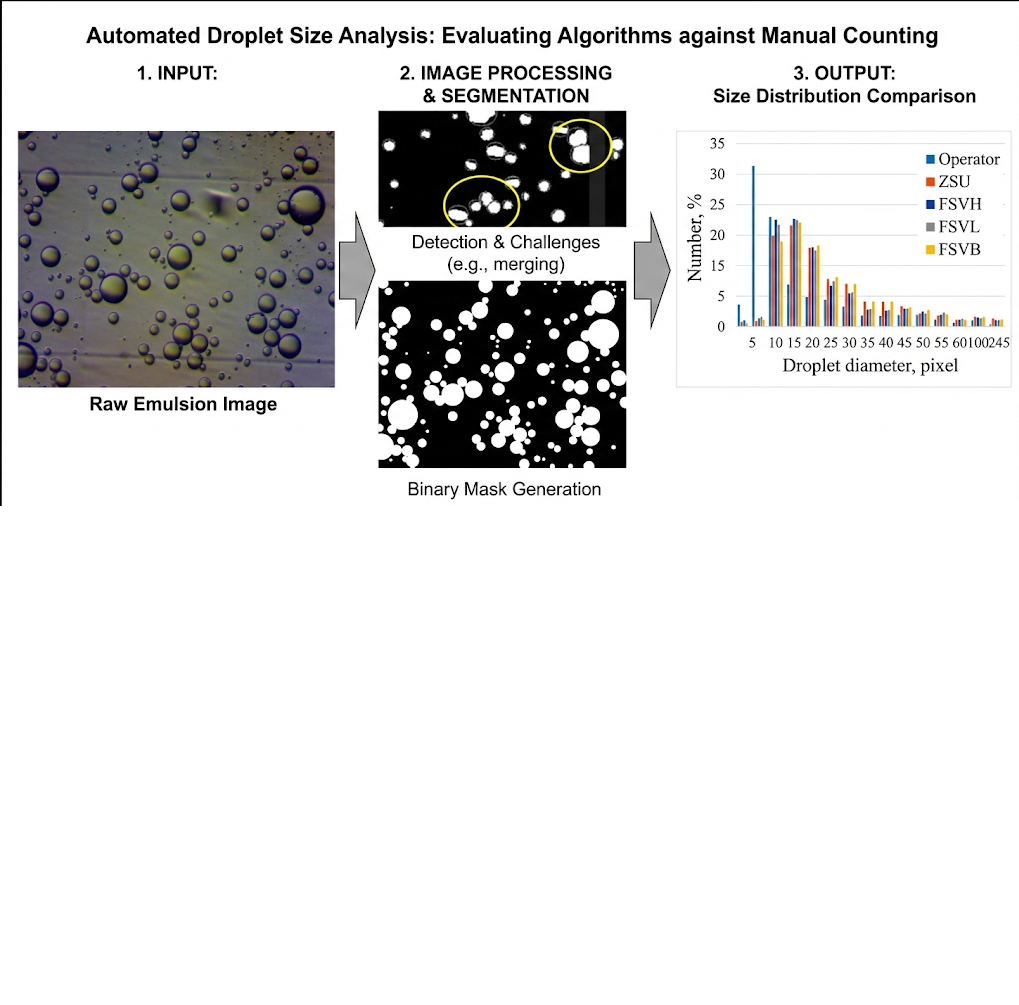
During the study, zero-shot segmentation was performed on microscopy images using four different segmenters. The resulting segments were then fitted to circles using a bounding volume (BV) approach. Segmentation effectiveness was evaluated with the Intersection over Union (IoU) metric by comparing results to manually annotated masks provided by an operator.
The average IoU values for the applied segmentation models range from 0.64 to 0.68. Applying the BV technique improves agreement with reference masks; specifically, the average IoU fitted to circles reaches approximately 0.75.
The overall effectiveness of applying the proposed automatic system in the form of a segmentation and bounding volume sequence was determined by analyzing the emulsion droplet diameter distributions. Comparison of the distributions showed that the data obtained using the automatic system are consistent with the operator's data for fractions larger than 15 px. However, the automatic system underestimates the share of fine fractions, which leads to a systematic shift in the integral assessment.
Importantly, it was established that applying the BV method to each individual mask obtained from segmentation is approximately 40–60% faster than analyzing a single combined mask. This analysis of individual masks is also practically more useful in cases involving touching droplets
References
- Kirillov, A., Mintun, E., Ravi, N., Mao, H., Rolland, C., Gustafson, L. et al. (2023). Segment Anything. 2023 IEEE/CVF International Conference on Computer Vision (ICCV), 3992–4003. https://doi.org/10.1109/iccv51070.2023.00371
- Ma, J., He, Y., Li, F., Han, L., You, C., Wang, B. (2024). Segment anything in medical images. Nature Communications, 15 (1). https://doi.org/10.1038/s41467-024-44824-z
- Zhang, Y., Jiang, H., Ye, T., Juhas, M. (2021). Deep Learning for Imaging and Detection of Microorganisms. Trends in Microbiology, 29 (7), 569–572. https://doi.org/10.1016/j.tim.2021.01.006
- Nartova, A. V., Mashukov, M. Yu., Astakhov, R. R., Kudinov, V. Yu., Matveev, A. V., Okunev, A. G. (2022). Particle Recognition on Transmission Electron Microscopy Images Using Computer Vision and Deep Learning for Catalytic Applications. Catalysts, 12 (2), 135. https://doi.org/10.3390/catal12020135
- Salum, P., Güven, O., Aydemir, L. Y., Erbay, Z. (2022). Microscopy-Assisted Digital Image Analysis with Trainable Weka Segmentation (TWS) for Emulsion Droplet Size Determination. Coatings, 12 (3), 364. https://doi.org/10.3390/coatings12030364
- Richards, K. D., Comish, E., Evans, R. C. (2025). Computer vision for high-throughput analysis of pickering emulsions. Soft Matter, 21 (12), 2339–2348. https://doi.org/10.1039/d4sm01252f
- Saalbrink, J., Loo, T. Y. J., Mertesdorf, J., Xu, P., Pedersen, M. T., Clausen, M. P., Bonilla, J. C. (2025). Quantifying microscopic droplets in colloidal systems through machine learning-based image analysis. Food Hydrocolloids, 166, 111301. https://doi.org/10.1016/j.foodhyd.2025.111301
- Hu, Y.-T., Ting, Y., Hu, J.-Y., Hsieh, S.-C. (2017). Techniques and methods to study functional characteristics of emulsion systems. Journal of Food and Drug Analysis, 25 (1), 16–26. https://doi.org/10.1016/j.jfda.2016.10.021
- Tripathi, S., Bhattacharya, A., Singh, R., Tabor, R. F. (2017). Rheological behavior of high internal phase water-in-oil emulsions: Effects of droplet size, phase mass fractions, salt concentration and aging. Chemical Engineering Science, 174, 290–301. https://doi.org/10.1016/j.ces.2017.09.016
- Marín Castaño, E. P., Leite, R. H. T., de Souza Mendes, P. R. (2021). Microscopic phenomena inferred from the rheological analysis of an emulsion. Physics of Fluids, 33 (7). https://doi.org/10.1063/5.0053408
Downloads
Published
How to Cite
Issue
Section
License
Copyright (c) 2026 Volodymyr Kosenko, Anton Korotynskyi, Oleksandr Seminskyi

This work is licensed under a Creative Commons Attribution 4.0 International License.
The consolidation and conditions for the transfer of copyright (identification of authorship) is carried out in the License Agreement. In particular, the authors reserve the right to the authorship of their manuscript and transfer the first publication of this work to the journal under the terms of the Creative Commons CC BY license. At the same time, they have the right to conclude on their own additional agreements concerning the non-exclusive distribution of the work in the form in which it was published by this journal, but provided that the link to the first publication of the article in this journal is preserved.
A license agreement is a document in which the author warrants that he/she owns all copyright for the work (manuscript, article, etc.).
The authors, signing the License Agreement with TECHNOLOGY CENTER PC, have all rights to the further use of their work, provided that they link to our edition in which the work was published.
According to the terms of the License Agreement, the Publisher TECHNOLOGY CENTER PC does not take away your copyrights and receives permission from the authors to use and dissemination of the publication through the world's scientific resources (own electronic resources, scientometric databases, repositories, libraries, etc.).
In the absence of a signed License Agreement or in the absence of this agreement of identifiers allowing to identify the identity of the author, the editors have no right to work with the manuscript.
It is important to remember that there is another type of agreement between authors and publishers – when copyright is transferred from the authors to the publisher. In this case, the authors lose ownership of their work and may not use it in any way.








