Development of IPSO-TVAC for adaptive control of grid-forming inverters in low SCR grids with hardware constraints
DOI:
https://doi.org/10.15587/1729-4061.2026.354290Keywords:
grid-forming inverter, REGFM-B1, IPSO-TVAC, Low-SCR weak grids, BESS, hardware constraintsAbstract
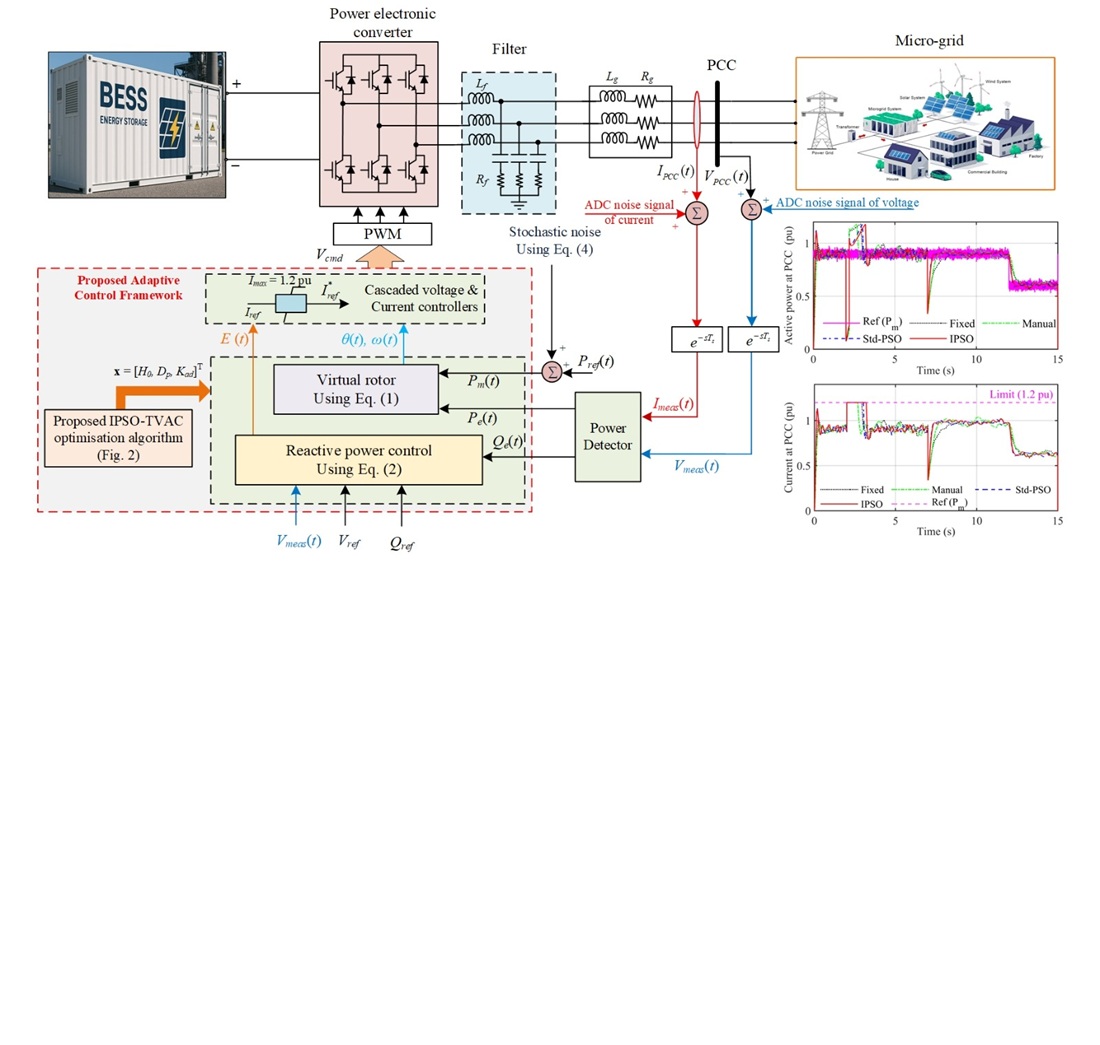
The object of the study is the REGFM-B1-based battery energy storage system (BESS) grid-forming inverter control system operating in weak grids with a short-circuit ratio (SCR) below 2.0. The work focuses on optimizing the virtual synchronous machine (VSM) controller parameters using an improved particle swarm optimization with time-varying acceleration coefficients (IPSO-TVACs). The primary challenge addressed is the failure of conventional tuning methods to converge under three concurrent hardware constraints, including current saturation at 1.2 pu, measurement latency of 10 ms, and ADC quantization noise of 0.01 pu, which form a non-convex search landscape. The proposed IPSO-TVAC is benchmarked against standard PSO (Std-PSO) and gradient-based algorithms, which often converge to physically infeasible solutions under the specified hardware restrictions. The findings reveal that IPSO-TVAC greatly outperforms the standard approaches, with integral of time-weighted absolute error (ITAE) decreased by 16.1%, convergence standard deviation below 1 × 10⁻4, and active power ripple lowered from 0.03 pu to below 0.005 pu. These gains suggest that IPSO-TVAC is highly effective in robust transient performance across all investigated constraint combinations. The method’s major benefit lies in its fractional-order inertia decay and derivative-penalized cost function, which enable simultaneous management of current-saturation non-convexity and ADC noise sensitivity within a single optimization cycle. The findings imply that IPSO-TVAC is especially advantageous for utility-scale battery storage in distant microgrids, island-grid and offshore wind farms, where consistent frequency stability under inverter overcurrent restrictions and ADC noise during grid transitions is critical
References
- Lin, Y., Eto, J. H., Johnson, B. B., Flicker, J. D., Lasseter, R. H., Pico, H. N. V. et al. (2020). Research roadmap on grid-forming inverters. National Renewable Energy Lab. Available at: https://www.nrel.gov/docs/fy21osti/73476.pdf
- Integrating inverter-based resources into low short circuit strength systems (2017). North American Electric Reliability Corporation (NERC) Atlanta, GA, USA.
- -2022 - IEEE Standard for Interconnection and Interoperability of Inverter-Based Resources (IBRs) Interconnecting with Associated Transmission Electric Power Systems. https://doi.org/10.1109/ieeestd.2022.9762253
- Zhong, Q.-C., Weiss, G. (2011). Synchronverters: Inverters That Mimic Synchronous Generators. IEEE Transactions on Industrial Electronics, 58 (4), 1259–1267. https://doi.org/10.1109/tie.2010.2048839
- Bevrani, H., Ise, T., Miura, Y. (2014). Virtual synchronous generators: A survey and new perspectives. International Journal of Electrical Power & Energy Systems, 54, 244–254. https://doi.org/10.1016/j.ijepes.2013.07.009
- Alipoor, J., Miura, Y., Ise, T. (2015). Power System Stabilization Using Virtual Synchronous Generator With Alternating Moment of Inertia. IEEE Journal of Emerging and Selected Topics in Power Electronics, 3 (2), 451–458. https://doi.org/10.1109/jestpe.2014.2362530
- Tang, W., Li, B., Shao, X., Ye, Y., Yu, Y., Chen, J. (2025). An Adaptive Inertia and Damping Control Strategy for Virtual Synchronous Generators to Enhance Transient Performance. Energies, 19 (1), 204. https://doi.org/10.3390/en19010204
- Roveri, A., Mallemaci, V., Mandrile, F., Bojoi, R. (2025). Enhanced Virtual Synchronous Machine With Online Grid Impedance Estimation. IEEE Open Journal of Industry Applications, 6, 427–444. https://doi.org/10.1109/ojia.2025.3584050
- Baeckeland, N., Yang, B., Seo, G.-S. (2025). Transient Stability-Enhancing Method for Grid-Forming Inverters Under Current Limiting. IEEE Transactions on Power Electronics, 40 (5), 6714–6725. https://doi.org/10.1109/tpel.2025.3532490
- Elwakil, M. M., Zoghaby, H. M. E., Sharaf, S. M., Mosa, M. A. (2023). Adaptive virtual synchronous generator control using optimized bang-bang for Islanded microgrid stability improvement. Protection and Control of Modern Power Systems, 8 (1). https://doi.org/10.1186/s41601-023-00333-7
- Baeckeland, N., Chatterjee, D., Lu, M., Johnson, B., Seo, G.-S. (2024). Overcurrent Limiting in Grid-Forming Inverters: A Comprehensive Review and Discussion. IEEE Transactions on Power Electronics, 39 (11), 14493–14517. https://doi.org/10.1109/tpel.2024.3430316
- Oboreh-Snapps, O., She, B., Fahad, S., Chen, H., Kimball, J., Li, F. Et al. (2024). Virtual Synchronous Generator Control Using Twin Delayed Deep Deterministic Policy Gradient Method. IEEE Transactions on Energy Conversion, 39 (1), 214–228. https://doi.org/10.1109/tec.2023.3309955
- Kweon, J., Jing, H., Li, Y., Monga, V. (2024). Small-signal stability enhancement of islanded microgrids via domain-enriched optimization. Applied Energy, 353, 122172. https://doi.org/10.1016/j.apenergy.2023.122172
- Li, X., Clerc, M. (2018). Swarm Intelligence. Handbook of Metaheuristics, 353–384. https://doi.org/10.1007/978-3-319-91086-4_11
- IEC 61400-1: Wind turbines - Part 1: Design requirements (2005). International Electrotechnical Commission. Available at: https://cdn.standards.iteh.ai/samples/12556/5a25eb41347f46b9b293e5f30c8eb7a4/IEC-61400-1-2005.pdf
- Buso, S., Mattavelli, P. (2006). Digital Control in Power Electronics. Springer International Publishing. https://doi.org/10.1007/978-3-031-02495-5
- Nassef, A. M., Abdelkareem, M. A., Maghrabie, H. M., Baroutaji, A. (2023). Review of Metaheuristic Optimization Algorithms for Power Systems Problems. Sustainability, 15 (12), 9434. https://doi.org/10.3390/su15129434
- Rivas-Martínez, G. I., Rodas, J., Herrera, E., Doval-Gandoy, J. (2025). A Novel Approach to Performance Evaluation of Current Controllers in Power Converters and Electric Drives Using Non-Parametric Analysis. IEEE Latin America Transactions, 23 (1), 68–77. https://doi.org/10.1109/tla.2025.10810402
- -2018 - IEEE Standard for Interconnection and Interoperability of Distributed Energy Resources with Associated Electric Power Systems Interfaces. https://doi.org/10.1109/ieeestd.2018.8332112
- Ratnaweera, A., Halgamuge, S. K., Watson, H. C. (2004). Self-Organizing Hierarchical Particle Swarm Optimizer With Time-Varying Acceleration Coefficients. IEEE Transactions on Evolutionary Computation, 8 (3), 240–255. https://doi.org/10.1109/tevc.2004.826071
- Syed, D., Shaikh, G. M., Alshahrani, H. M., Hamdi, M., Alsulami, M., Shaikh, A., Rizwan, S. (2024). A Comparative Analysis of Metaheuristic Techniques for High Availability Systems. IEEE Access, 12, 7382–7398. https://doi.org/10.1109/access.2024.3352078
- Teodorescu, R., Liserre, M., Rodríguez, P. (2010). Grid Converters for Photovoltaic and Wind Power Systems. John Wiley & Sons. https://doi.org/10.1002/9780470667057
- Muñoz-Torrero, D., García-Quismondo, E., Ventosa, E., Prodanovic, M., Palma, J. (2025). On the degradation of lithium-ion batteries over a current ripple effect. Electrochimica Acta, 530, 146326. https://doi.org/10.1016/j.electacta.2025.146326
- Milano, F., Dörfler, F., Hug, G., Hill, D. J., Verbič, G. (2018). Foundations and Challenges of Low-Inertia Systems (Invited Paper). 2018 Power Systems Computation Conference (PSCC), 1–25. https://doi.org/10.23919/pscc.2018.8450880
- Xu, X., Yousefian, R., Elkhatib, M., Choi, B., Huang, L., Mao, Y., Berner, A. (2019). Automatic Underfrequency Load Shedding Study of the PJM System. 2019 IEEE Power & Energy Society General Meeting (PESGM), 1–5. https://doi.org/10.1109/pesgm40551.2019.8973420
- Grigsby, L. L. (Ed.) (2017). Power System Stability and Control. CRC Press. https://doi.org/10.4324/b12113
- Ohuchi, K., Masod, A. F. B., Kato, S., Hirase, Y. (2023). Stability analysis of virtual synchronous generator control in a high-voltage DC transmission system using impedance-based method. Energy Reports, 9, 557–567. https://doi.org/10.1016/j.egyr.2022.11.077
Downloads
Published
How to Cite
Issue
Section
License
Copyright (c) 2026 Pham Hong Thanh, Le Van Dai

This work is licensed under a Creative Commons Attribution 4.0 International License.
The consolidation and conditions for the transfer of copyright (identification of authorship) is carried out in the License Agreement. In particular, the authors reserve the right to the authorship of their manuscript and transfer the first publication of this work to the journal under the terms of the Creative Commons CC BY license. At the same time, they have the right to conclude on their own additional agreements concerning the non-exclusive distribution of the work in the form in which it was published by this journal, but provided that the link to the first publication of the article in this journal is preserved.
A license agreement is a document in which the author warrants that he/she owns all copyright for the work (manuscript, article, etc.).
The authors, signing the License Agreement with TECHNOLOGY CENTER PC, have all rights to the further use of their work, provided that they link to our edition in which the work was published.
According to the terms of the License Agreement, the Publisher TECHNOLOGY CENTER PC does not take away your copyrights and receives permission from the authors to use and dissemination of the publication through the world's scientific resources (own electronic resources, scientometric databases, repositories, libraries, etc.).
In the absence of a signed License Agreement or in the absence of this agreement of identifiers allowing to identify the identity of the author, the editors have no right to work with the manuscript.
It is important to remember that there is another type of agreement between authors and publishers – when copyright is transferred from the authors to the publisher. In this case, the authors lose ownership of their work and may not use it in any way.








