Construction of a model for optimal scheduling of energy storage systems in the day-ahead market considering market strategies and technical constraints
DOI:
https://doi.org/10.15587/1729-4061.2026.355330Keywords:
energy storage systems, price arbitrage, economic dispatch, day-ahead marketAbstract
This study investigates the process of optimal planning of energy storage system operating schedules in the day-ahead market. The task addressed is to prevent unprofitable operation of energy storage systems.
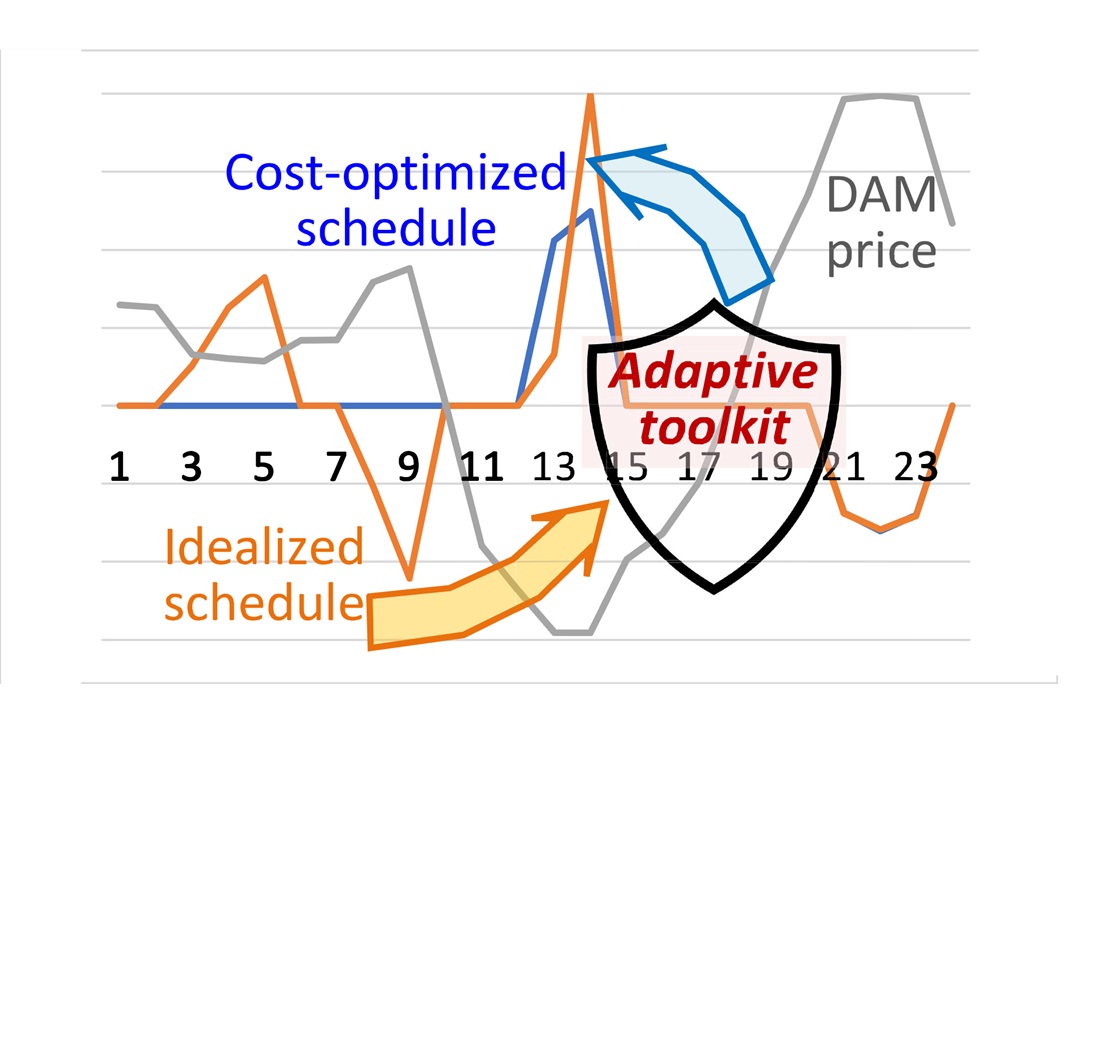
A comprehensive mathematical model of daily planning of energy storage operation modes has been built, which takes into account technological efficiency, hardware wear processes, as well as asymmetry of market payments. This forms an adaptive filter with cutting off cycles of economically inefficient arbitrage. The approach is based on separation of the vector of control variables into two independent charging and discharging flows. This has made it possible to take into account the asymmetry of tariffs and the structure of losses in a differentiated manner.
The study on the sensitivity of the model revealed the existence of areas of adaptive regulation and parametric insensitivity to fluctuations in price signals. In the area of parametric insensitivity, the model forms a stable cost-effective solution regardless of price fluctuations. In the area of adaptive regulation, the model changes the volumes of a separate operating cycle depending on a change in the market price spread. It has been established that ignoring the accompanying payments for the area of adaptive regulation leads to an overestimation of income by 35.6 percent and the formation of unprofitable operations. Under conditions of low market price spread, the deviation in the financial result reaches 91.6 percent; however, the parametric insensitivity of the model guarantees profitable operation.
The scope of model's practical implementation is decision support systems for operators of energy storage systems. The conditions of use assume the presence of deterministic forecasts of market price signals for the calculated operating day. Implementing the model contributes to the extension of the life cycle and increase in the operational profitability of energy storage systems
References
- Kyrylenko, O., Denysiuk, S., Bielokha, H., Dyczko, A., Stecuła, B., Pazynich, Y. (2025). Smart Monitoring and Management of Local Electricity Systems with Renewable Energy Sources. Energies, 18 (16), 4434. https://doi.org/10.3390/en18164434
- Faia, R., Lezama, F., Soares, J., Pinto, T., Vale, Z. (2024). Local electricity markets: A review on benefits, barriers, current trends and future perspectives. Renewable and Sustainable Energy Reviews, 190, 114006. https://doi.org/10.1016/j.rser.2023.114006
- Parus, E., Blinov, I., Rybina, O., Olefir, D., Sala, D., Tora, B., Dychkovskyi, R. (2025). Improving the Electricity Market Participation Management of Hydropower Plants in Ukraine. Inżynieria Mineralna, 1 (1). https://doi.org/10.29227/im-2025-01-26
- Blinov, I., Zaitsev, I., Bajaj, M., Miroshnyk, V., Sychova, V., Shymaniuk, P., Blazek, V., Prokop, L. (2025). Advanced long short-term memory-based forecasting of electricity imbalances in the Ukrainian power system: Enhancing accuracy and stability with comparative model analysis. Energy Exploration & Exploitation. https://doi.org/10.1177/01445987251360272
- Hannan, M. A., Faisal, M., Ker, P. J., Mun, L. H., Parvin, K., Mahlia, T. M. I., Blaabjerg, F. (2018). A Review of Internet of Energy Based Building Energy Management Systems: Issues and Recommendations. IEEE Access, 6, 38997–39014. https://doi.org/10.1109/access.2018.2852811
- Krishnamurthy, D., Uckun, C., Zhou, Z., Thimmapuram, P. R., Botterud, A. (2018). Energy Storage Arbitrage Under Day-Ahead and Real-Time Price Uncertainty. IEEE Transactions on Power Systems, 33 (1), 84–93. https://doi.org/10.1109/tpwrs.2017.2685347
- Zachmann, G., Meissner, F., Riepin, I. (2025). Mitigating Ukraine’s looming electricity crisis. Energy Strategy Reviews, 59, 101724. https://doi.org/10.1016/j.esr.2025.101724
- Metz, D., Saraiva, J. T. (2018). Use of battery storage systems for price arbitrage operations in the 15- and 60-min German intraday markets. Electric Power Systems Research, 160, 27–36. https://doi.org/10.1016/j.epsr.2018.01.020
- Xu, B., Zhao, J., Zheng, T., Litvinov, E., Kirschen, D. S. (2018). Factoring the Cycle Aging Cost of Batteries Participating in Electricity Markets. IEEE Transactions on Power Systems, 33 (2), 2248–2259. https://doi.org/10.1109/tpwrs.2017.2733339
- Blinov, I. V., Parus, Ye. V., Shymaniuk, P. V., Vorushylo, A. O. (2024). Optimization model of microgrid functioning with solar power plant and energy storage system. Tekhnichna Elektrodynamika, 5, 69–78. https://doi.org/10.15407/techned2024.05.069
- He, G., Chen, Q., Kang, C., Pinson, P., Xia, Q. (2016). Optimal Bidding Strategy of Battery Storage in Power Markets Considering Performance-Based Regulation and Battery Cycle Life. IEEE Transactions on Smart Grid, 7 (5), 2359–2367. https://doi.org/10.1109/tsg.2015.2424314
- Vetter, J., Novák, P., Wagner, M. R., Veit, C., Möller, K.-C., Besenhard, J. O. et al. (2005). Ageing mechanisms in lithium-ion batteries. Journal of Power Sources, 147 (1-2), 269–281. https://doi.org/10.1016/j.jpowsour.2005.01.006
- Preto, M., Lucas, A., Benedicto, P. (2024). Hybrid Energy Storage System Dispatch Optimization for Cost and Environmental Impact Analysis. Energies, 17 (12), 2987. https://doi.org/10.3390/en17122987
- Christen, T. (2018). Efficiency and Power in Energy Conversion and Storage. CRC Press. https://doi.org/10.1201/9780429454288
- Chazarra, M., García-González, J., Pérez-Díaz, J. I., Arteseros, M. (2016). Stochastic optimization model for the weekly scheduling of a hydropower system in day-ahead and secondary regulation reserve markets. Electric Power Systems Research, 130, 67–77. https://doi.org/10.1016/j.epsr.2015.08.014
- Blinov, I., Radziukynas, V., Shymaniuk, P., Dyczko, A., Stecuła, K., Sychova, V. et al. (2025). Smart Management of Energy Losses in Distribution Networks Using Deep Neural Networks. Energies, 18 (12), 3156. https://doi.org/10.3390/en18123156
- Bradbury, K., Pratson, L., Patiño-Echeverri, D. (2014). Economic viability of energy storage systems based on price arbitrage potential in real-time U.S. electricity markets. Applied Energy, 114, 512–519. https://doi.org/10.1016/j.apenergy.2013.10.010
- Migliari, L., Cocco, D., Petrollese, M. (2025). Levelized Cost of Storage (LCOS) of Battery Energy Storage Systems (BESS) Deployed for Photovoltaic Curtailment Mitigation. Energies, 18 (14), 3602. https://doi.org/10.3390/en18143602
- Boyd, S., Vandenberghe, L. (2004). Convex Optimization. Cambridge: Cambridge University Press. https://doi.org/10.1017/cbo9780511804441
- Parus, Ye. V., Blinov, I. V. (2025). Optimization of the use of available energy resources of the microgrid under the condition of supporting readiness for isolated mode. Tekhnichna Elektrodynamika, 5, 56–69. https://doi.org/10.15407/techned2025.05.056
Downloads
Published
How to Cite
Issue
Section
License
Copyright (c) 2026 Oleksandr Havva, Yevgene Parus, Ihor Blinov, Volodymyr Evdokimov

This work is licensed under a Creative Commons Attribution 4.0 International License.
The consolidation and conditions for the transfer of copyright (identification of authorship) is carried out in the License Agreement. In particular, the authors reserve the right to the authorship of their manuscript and transfer the first publication of this work to the journal under the terms of the Creative Commons CC BY license. At the same time, they have the right to conclude on their own additional agreements concerning the non-exclusive distribution of the work in the form in which it was published by this journal, but provided that the link to the first publication of the article in this journal is preserved.
A license agreement is a document in which the author warrants that he/she owns all copyright for the work (manuscript, article, etc.).
The authors, signing the License Agreement with TECHNOLOGY CENTER PC, have all rights to the further use of their work, provided that they link to our edition in which the work was published.
According to the terms of the License Agreement, the Publisher TECHNOLOGY CENTER PC does not take away your copyrights and receives permission from the authors to use and dissemination of the publication through the world's scientific resources (own electronic resources, scientometric databases, repositories, libraries, etc.).
In the absence of a signed License Agreement or in the absence of this agreement of identifiers allowing to identify the identity of the author, the editors have no right to work with the manuscript.
It is important to remember that there is another type of agreement between authors and publishers – when copyright is transferred from the authors to the publisher. In this case, the authors lose ownership of their work and may not use it in any way.








