Determining the efficacy of using wheat germ meal as an activator of fermentation microflora for fermented beverages
DOI:
https://doi.org/10.15587/1729-4061.2026.355571Keywords:
soft drinks, sourdough yeast, lactobacilli, wheat germ meal, maltoseAbstract
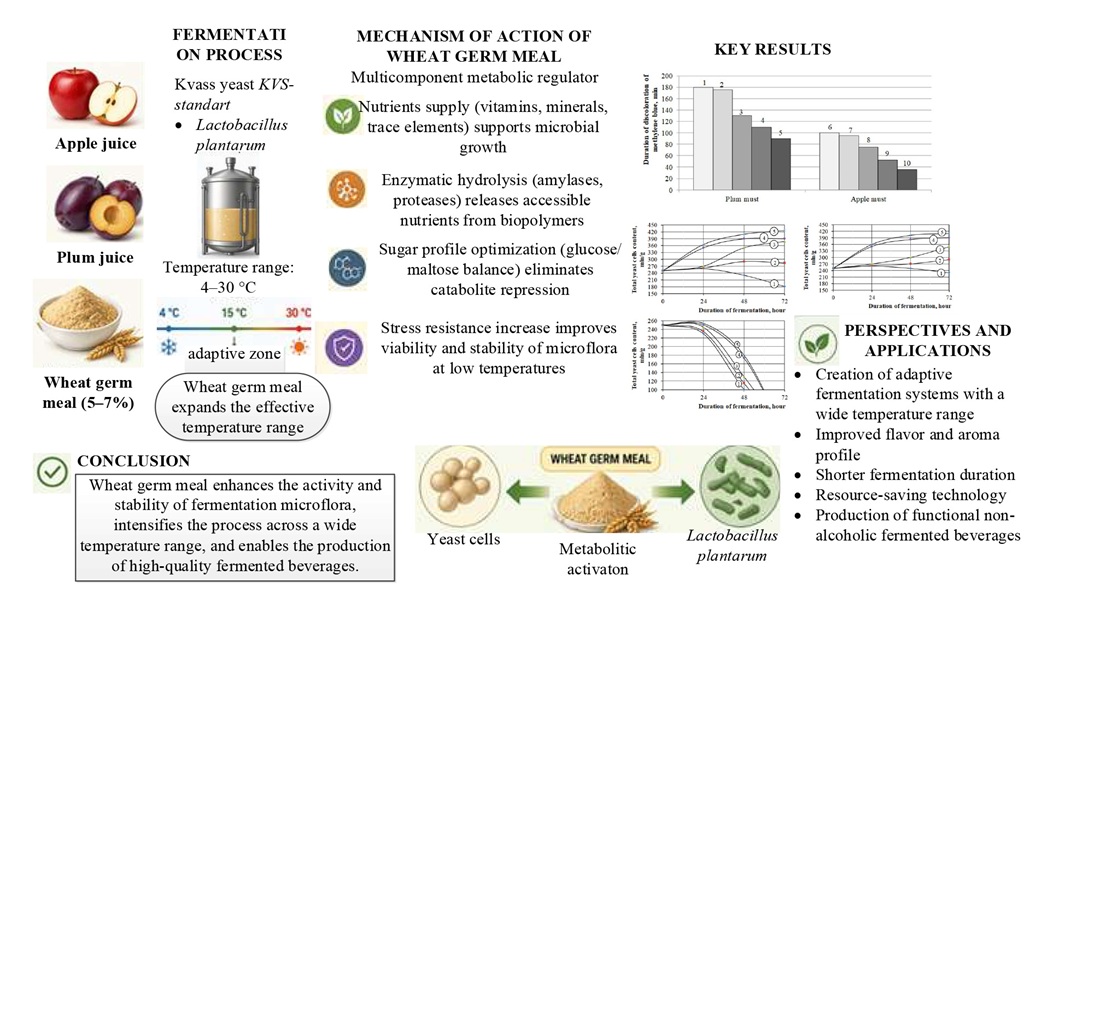
This study investigates the process of fermenting apple and plum juices using kvass yeast and lactic acid bacteria, with modification of the medium with wheat germ meal. The task addressed relates to the insufficient intensity of fermentation and instability of the functioning of the microbial system at temperature fluctuations. This limits the efficiency of fermentation processes and requires using energy-intensive physical intensification methods.
It was established that the introduction of 5–7% of meal provides an increase in yeast biomass by 245–350%, an increase in the specific growth rate to 116%, and a reduction in the duration of cell generation by 48–53% compared to the control. At a temperature of 15°C, growth rates exceeded the control by 4–8 times, and at 4°C, the viability of the population increased by 6–7 times. At the same time, activation of lactic acid bacteria Lactobacillus plantarum was recorded. The discoloration of methylene blue in plum must with the addition of 3–7% wheat germ meal is accelerated by 38.5–100%, and in apple must by 33.3–177.8%, respectively, compared to the control. This indicates the formation of a synergistic fermentation ecosystem and is positive for defining the taste and aroma profile of beverages.
The results are attributed to the complex metabolic action of the meal, which optimizes the carbohydrate profile of the medium, eliminates catabolic limitations, provides cells with trace elements, and increases their resistance to temperature stress. It has been shown that nutrient modification of the medium makes it possible to achieve an increase in kinetic parameters of up to 400%, which exceeds the effectiveness of conventional physical intensification methods.
The results could be used in the production of non-alcoholic fermented beverages of functional purpose and the introduction of resource-saving technologies in the food industry.
References
- Liu, S. (2024). Microorganisms in Fermented Foods and Their Effects on the Human Body. MedScien, 1 (9). https://doi.org/10.61173/0hjc8y96
- Global Apple Production in 2025/26 to Drop to Five-Year Low. Available at: https://agroreview.com/en/newsen/crops/global-apple-production-2025-drop/
- Oliinyk, S., Samokhvalova, O., Lapitska, N., Kucheruk, Z. (2020). Studying the influence of meats from wheat and oat germs, and rose hips, on the formation of quality of ryew heat dough and bread. Eastern-European Journal of Enterprise Technologies, 1 (11 (103)), 59–65. https://doi.org/10.15587/1729-4061.2020.187944
- Morales-de la Peña, M., Miranda-Mejía, G. A., Martín-Belloso, O. (2023). Recent Trends in Fermented Beverages Processing: The Use of Emerging Technologies. Beverages, 9 (2), 51. https://doi.org/10.3390/beverages9020051
- Čakar, U., Petrović, A., Pejin, B., Čakar, M., Živković, M., Vajs, V., Đorđević, B. (2019). Fruit as a substrate for a wine: A case study of selected berry and drupe fruit wines. Scientia Horticulturae, 244, 42–49. https://doi.org/10.1016/j.scienta.2018.09.020
- Berulava, I., Silagadze, M., Kovbasa, V., Pkhakadze, G., Khetsuriani, G., Rukhadze, M. (2024). Fermented drink based on secondary raw milk materials. Ukrainian Food Journal, 13 (4), 708–722. https://doi.org/10.24263/2304-974x-2024-13-4-6
- Vaz Gonçalves, G. C., Costa, G. N., Okagawa, T., Somera, T., Rodrigues da Silva, G. H., Romani, L. C. et al. (2025). Development of fermented beverage based on pistachio (Pistacia vera) extract: Effect of functional compounds on kefir growth and microbial metabolism. Food Bioscience, 71, 107051. https://doi.org/10.1016/j.fbio.2025.107051
- Dulka, O. S., Prybylskyi, V. L., Malkin, R. S., Tkachuk, Y. M., Bulii, Y. V., Boyarchuk, I. A. (2025). The effect of aeration on the bioconversion of clitoria ternatea l. Tea by the culture of microorganisms medusomyces gisevii DP-21. Journal of Chemistry and Technologies, 33 (4), 1191–1198. https://doi.org/10.15421/jchemtech.v33i4.320639
- Dulka, О. S., Prybylskyi, V. L., Fedosov, O. L., Olijnyk, S. I., Kuts, A. М., Sharan, L. О. et al. (2023). Innovative technology of water preparation for the production of fermed beverage kombucha. Journal of Chemistry and Technologies, 31 (1), 82–91. ttps://doi.org/10.15421/jchemtech.v31i1.240014
- Mannaa, M., Han, G., Seo, Y.-S., Park, I. (2021). Evolution of Food Fermentation Processes and the Use of Multi-Omics in Deciphering the Roles of the Microbiota. Foods, 10 (11), 2861. https://doi.org/10.3390/foods10112861
- Oliinyk, S., Samokhvalova, O., Lapitskaya, N., Kucheruk, Z. (2020). Study of the influence of meals of wheat and oat germs and wild rose fruits on the fermenting microflora activity of rye-wheat dough. EUREKA: Life Sciences, 1, 40–47. https://doi.org/10.21303/2504-5695.2020.001114
- Manual of methods of analysis of foods. Fruit and vegetable products (2015). Food safety and standards authority of India Ministry of health and family welfare government of India. New Delhi. Available at: https://fssai.gov.in/upload/uploadfiles/files/FRUITS_AND_VEGETABLE.pdf
- Kasabova, K., Samokhvalova, O., Zagorulko, A., Zahorulko, A., Babaiev, S., Bereza, O. et al. (2022). Improvement of Turkish delight production technology using a developed multi-component fruit and vegetable paste. Eastern-European Journal of Enterprise Technologies, 6 (11 (120)), 51–59. https://doi.org/10.15587/1729-4061.2022.269393
- Meletiev, A. Ye., Todosiychuk, S. R., Koshova, V. M. (2007). Tekhnokhimichnyi kontrol vyrobnytstva solodu, pyva i bezalkoholnykh napoiv. Vinnytsia: Nova Knyha, 392.
- Drobot, V. I., Arsenieva, L. Yu., Bilyk, O. A. et al. (2006). Laboratornyi praktykum z tekhnolohiyi khlibopekarskoho ta makaronnoho vyrobnytstva. Kyiv, 341.
- Pribulsky, V., Mukoid, R., Dong, N. P. (2015). Using rice in technology of non-alcoholic fermented beverages. Eastern-European Journal of Enterprise Technologies, 6 (10 (77)), 33–36. https://doi.org/10.15587/1729-4061.2015.55210
- Kovalchuk, S., Mudrak, T., Kuts, A., Dotsenko, V. (2020). Research of to ultrathin structure of cages of different races of spirit yeasts in dependence on concentration of dry substances of was. Food Science and Technology, 14 (3). https://doi.org/10.15673/fst.v14i3.1798
- Gulyaev, V., Maznytska, O., Anatsky, A., Pasenko, A. (2021). Research of the possibility of using of wort with adding topinambur in the production of yeast saccharomyces. Collection of Scholarly Papers of Dniprovsk State Technical University (Technical Sciences), 2 (37), 124–127. https://doi.org/10.31319/2519-2884.37.2020.22
- Torres-Guardado, R., Esteve-Zarzoso, B., Reguant, C., Bordons, A. (2021). Microbial interactions in alcoholic beverages. International Microbiology, 25 (1), 1–15. https://doi.org/10.1007/s10123-021-00200-1
- Alinovi, M., Mucchetti, G. (2020). Effect of freezing and thawing processes on high-moisture Mozzarella cheese rheological and physical properties. LWT, 124, 109137. https://doi.org/10.1016/j.lwt.2020.109137
- Walker, G., Stewart, G. (2016). Saccharomyces cerevisiae in the Production of Fermented Beverages. Beverages, 2 (4), 30. https://doi.org/10.3390/beverages2040030
- Salvadó, Z., Arroyo-López, F. N., Guillamón, J. M., Salazar, G., Querol, A., Barrio, E. (2011). Temperature Adaptation Markedly Determines Evolution within the GenusSaccharomyces. Applied and Environmental Microbiology, 77 (7), 2292–2302. https://doi.org/10.1128/aem.01861-10
- Aguilera, J., Randez-Gil, F., Prieto, J. A. (2007). Cold response in Saccharomyces cerevisiae: new functions for old mechanisms. FEMS Microbiology Reviews, 31 (3), 327–341. https://doi.org/10.1111/j.1574-6976.2007.00066.x
- Tronchoni, J., Gamero, A., Arroyo-López, F. N., Barrio, E., Querol, A. (2009). Differences in the glucose and fructose consumption profiles in diverse Saccharomyces wine species and their hybrids during grape juice fermentation. International Journal of Food Microbiology, 134 (3), 237–243. https://doi.org/10.1016/j.ijfoodmicro.2009.07.004
- Oliinyk, S., Samokhvalova, O., Lapitskaya, N. (2019). The influence of meal of rose hips on the ripening and quality of rye-wheat bread. Scientific Works of National University of Food Technologies, 25 (6), 249–258. https://doi.org/10.24263/2225-2924-2019-25-6-31
- Helikh, A., Filon, A. (2025). Biochemical variability of vegetable juice powders: a key factor in modulating the physicochemical properties and safety profile of vegan fermented sausages. Technology Audit and Production Reserves, 4 (3 (84)), 52–59. https://doi.org/10.15587/2706-5448.2025.334830
Downloads
Published
How to Cite
Issue
Section
License
Copyright (c) 2026 Nadiia Lapytska, Oleksii Shkliaiev, Аnna Novik, Galyna Stepankova, Yuliіa Voronina-Tuzovskykh, Nataliia Yasna

This work is licensed under a Creative Commons Attribution 4.0 International License.
The consolidation and conditions for the transfer of copyright (identification of authorship) is carried out in the License Agreement. In particular, the authors reserve the right to the authorship of their manuscript and transfer the first publication of this work to the journal under the terms of the Creative Commons CC BY license. At the same time, they have the right to conclude on their own additional agreements concerning the non-exclusive distribution of the work in the form in which it was published by this journal, but provided that the link to the first publication of the article in this journal is preserved.
A license agreement is a document in which the author warrants that he/she owns all copyright for the work (manuscript, article, etc.).
The authors, signing the License Agreement with TECHNOLOGY CENTER PC, have all rights to the further use of their work, provided that they link to our edition in which the work was published.
According to the terms of the License Agreement, the Publisher TECHNOLOGY CENTER PC does not take away your copyrights and receives permission from the authors to use and dissemination of the publication through the world's scientific resources (own electronic resources, scientometric databases, repositories, libraries, etc.).
In the absence of a signed License Agreement or in the absence of this agreement of identifiers allowing to identify the identity of the author, the editors have no right to work with the manuscript.
It is important to remember that there is another type of agreement between authors and publishers – when copyright is transferred from the authors to the publisher. In this case, the authors lose ownership of their work and may not use it in any way.








