Improving methodology for assessing accident indicators involving pedestrians at railroad pedestrian crossings
DOI:
https://doi.org/10.15587/1729-4061.2026.355669Keywords:
railroad crossing, accident rate, pedestrian traffic intensity, train traffic intensityAbstract
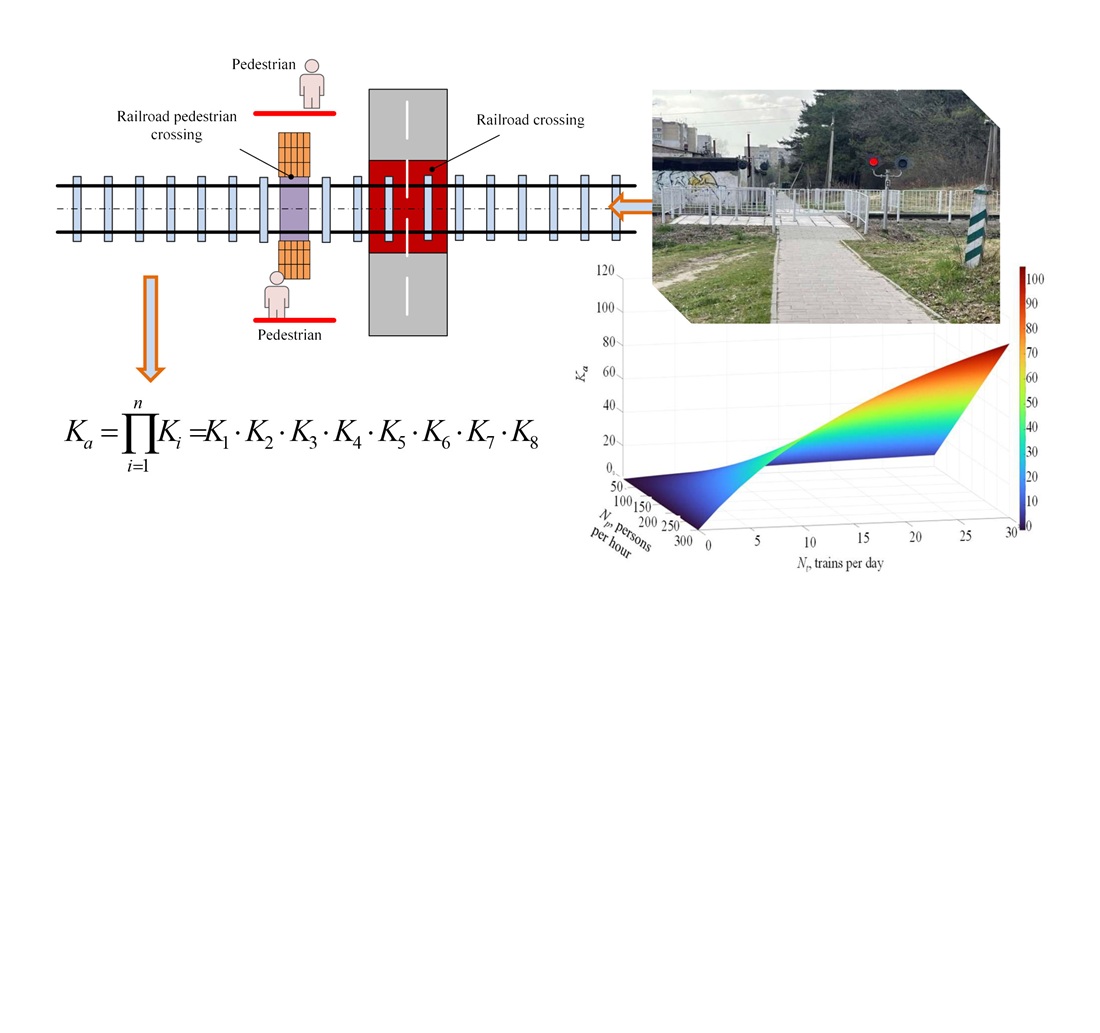
This study assesses a method for estimating the final accident rate at railroad pedestrian crossings depending on the intensity of train and pedestrian traffic and taking into account the geometric and planning features of the pedestrian crossing and information support.
An improved method for estimating the accident rate at railroad pedestrian crossings has been proposed, taking into account the set of factors influencing the safety of pedestrian traffic when crossing railroad tracks. The method is based on determining the final accident rate, which integrates eight key factors that make it possible to define the level of danger of the crossing according to established standards. The method takes into account the intensity of train and pedestrian traffic, the information and technical equipment of the railroad pedestrian crossing, as well as the planning and geometric parameters of the crossing. It also considers the speed of pedestrians depending on their physiological and age characteristics.
Multivariate modeling of the influence of train and pedestrian traffic intensity on the final accident rate has been carried out; the effectiveness of using information systems for warning pedestrians about the approach of a train in the pedestrian traffic safety system was also assessed.
It was established that the average value of the reduction in the accident rate at railroad pedestrian crossings within the existing railroad crossings depends on the intensity of train and pedestrian traffic. When using an additional information system for warning pedestrians about train traffic, taking into account the influence of train traffic intensity, it is up to 22.1, and taking into account the influence of pedestrian traffic intensity with a constant number of train pairs, it is 27.74. The use of the information system for warning pedestrians about train traffic ensures a reduction in the accident rate of up to 30%. This increases the safety of pedestrian traffic when crossing railroad tracks
References
- Kovalchuk, V. (2024). Problems of ensuring the safety of pedestrian traffic across railway tracks and ways to solve them. Collection of Scientific Works of the State University of Infrastructure and Technologies Series “Transport Systems and Technologies,” 43, 8–20. https://doi.org/10.32703/2617-9059-2024-43-1
- Kovalchuk, V., Lesiv, Y. (2024). Devising a method for improving pedestrian traffic safety when crossing railroad tracks by implementing an information system with a fixed warning time. Eastern-European Journal of Enterprise Technologies, 2 (3 (128)), 50–59. https://doi.org/10.15587/1729-4061.2024.300168
- Lesiv, Yu. Z., Kovalchuk, V. V. (2025). Relevance of provision and methods of improving pedestrian traffic safety at railway crossing. Visnik of the Volodymyr Dahl East Ukrainian National University, 1 (287), 83–90. https://doi.org/10.33216/1998-7927-2025-287-1-83-90
- Vivek, A. K., Mohapatra, S. S. (2023). An observational study on pedestrian and bicyclist violations at railroad grade crossings: Exploring the impact of geometrical and operational attributes. Journal of Safety Research, 87, 395–406. https://doi.org/10.1016/j.jsr.2023.08.011
- M 218-03450778-652:2008. Metodyka otsinky rivniv bezpeky rukhu na avtomobilnykh dorohakh Ukrainy. Available at: https://online.budstandart.com/ua/catalog/doc-page.html?id_doc=24959
- Larue, G. S., Watling, C. N. (2022). Prevalence and dynamics of distracted pedestrian behaviour at railway level crossings: Emerging issues. Accident Analysis & Prevention, 165, 106508. https://doi.org/10.1016/j.aap.2021.106508
- Ahmed, J., Robinson, A., Miller, E. E. (2024). Effectiveness of signs for pedestrian-railroad crossings: Colors, shapes, and messaging strategies. Journal of Safety Research, 89, 141–151. https://doi.org/10.1016/j.jsr.2024.01.003
- Lesiv, Yu. (2024). Zaliznychnyi pishokhidnyi perekhid, yak barier v transportnykh marshrutakh pishokhodiv. Zbirnyk tez I Kyivskoi naukovo – praktychnoi konferentsiyi studentiv, aspirantiv ta molodykh vchenykh «Innovatsiyi ta bezpeka na zaliznychnomu transporti: vyklyky ta ryzyky». Kyiv, 58–60. Available at: https://files.duit.edu.ua/uploads/%D0%A1%D0%B0%D0%B9%D1%82/3_%D0%9D%D0%90%D0%A3%D0%9A%D0%90/conferences/all-ukrainian-scientific-practical-conferences/collection-10-01-2024.pdf
- Lesiv, Yu. (2024). Aktualnist ta dotsilnist vprovadzhennia terminu: «Zaliznychnyi pishokhidnyi perekhid». Materialy 16-yi Mizhnarodnoi naukovo-praktychnoi konferentsiyi studentiv ta molodykh vchenykh imeni H. M. Kirpy «Suchasni transportni tekhnolohiyi». Lviv, 72–75.
- Lesiv, J., Kovalchuk, V. (2025). Assessment of the accident rate coefficient at pedestrian railway crossings. Transport Technologies, 6 (1), 61–72. https://doi.org/10.23939/tt2025.01.061
- Vozniak, O. M., Havryliuk, V. I. (2019). Zabezpechennia bezpeky rukhu na zaliznychnykh pereizdakh. Dnipro, 282. Available at: https://crust.ust.edu.ua/items/a62c8ffc-0951-4c16-a69e-d78ed47fc7d0
- Vozniak, O. M. (2015). Otsinka stanu bezpeky rukhu na zaliznychnykh pereizdakh. Elektromahnitna sumisnist ta bezpeka na zaliznychnomu transporti, 10, 69–76. Available at: https://www.researchgate.net/publication/311323149_Ocinka_stanu_bezpeki_ruhu_na_zaliznicnih_pereizdah_Evaluation_of_state_of_traffic_safety_on_level_crossings
- Kurhan, M. B., Kurhan, D. M., Husak, M. A., Havrylov, M. O., Luzhytskyi, O. F. (2022). Vehicle Traffic Safety Assessment at the Intersection of Highways and Railways at the Same Level. Science and Transport Progress, 2 (98), 45–58. https://doi.org/10.15802/stp2022/267978
- Kurhan, M. B., Luzhytskyi, O. F., Ivanov, R. V., Khmelevskyi, V. S. (2024). Implementation of Innovative Technologies During the Modernization of Existing Level Crossings for High-Speed Train Traffic (N. P. Khmelevska, Trans.). Science and Transport Progress, 1 (105), 62–83. https://doi.org/10.15802/stp2024/303191
- Document 32004L0049. DIRECTIVE 2004/49/EC OF THE EUROPEAN PARLIAMENT AND OF THE COUNCIL of 29 April 2004 on safety on the Community's railways and amending Council Directive 95/18/EC on the licensing of railway undertakings and Directive 2001/14/EC on the allocation of railway infrastructure capacity and the levying of charges for the use of railway infrastructure and safety certification (Railway Safety Directive). Available at: https://eur-lex.europa.eu/eli/dir/2004/49/oj/eng
- Ezsias, L., Brautigam, A., Kocsis Szurke, S., Szalai, S., Fischer, S. (2023). Sustainability in Railways – A Review. Chemical engineering transactions, 107. https://doi.org/10.3303/CET23107002
- Ézsiás, L., Tompa, R., Fischer, S. (2024). Investigation of the Possible Correlations between Specific Characteristics of Crushed Stone Aggregates. Spectrum of Mechanical Engineering and Operational Research, 1 (1), 10–26. https://doi.org/10.31181/smeor1120242
- Yang, J., Gauli, N., Shiwakoti, N., Tay, R., Deng, H., Chen, J. et al. (2025). Examining the Factors Influencing Pedestrian Behaviour and Safety: A Review with a Focus on Culturally and Linguistically Diverse Communities. Sustainability, 17 (13), 6007. https://doi.org/10.3390/su17136007
- Magyari, Z., Fischer, S., Koren, C. (2018). Visibility investigations at railway crossings. 14th Miklós Iványi International PhD&DLA Symposium. Available at: https://www.researchgate.net/publication/328860619_Visibility_investigations_at_railway_crossings
- Liubarskyi, K., Borshсhevskyi, P., Babina, I. (2018). Modern approaches to assessing the vehicle speed at hitting to a pedestrian. Kryminalistyka i sudova ekspertyza, 63 (2), 3–8. Available at: http://nbuv.gov.ua/UJRN/krise_2018_63(2)__3
- Hawlena-Gądek, T., Wróbel, M. (2020). Intelligent Transport Systems in selected cities in Poland. Ekonomika i Organizacja Logistyki, 5 (1), 95–105. https://doi.org/10.22630/eiol.2020.5.1.8
Downloads
Published
How to Cite
Issue
Section
License
Copyright (c) 2026 Vitalii Kovalchuk, Yulia Lesiv, Ihor Mohyla, Andrii Kuzyshyn

This work is licensed under a Creative Commons Attribution 4.0 International License.
The consolidation and conditions for the transfer of copyright (identification of authorship) is carried out in the License Agreement. In particular, the authors reserve the right to the authorship of their manuscript and transfer the first publication of this work to the journal under the terms of the Creative Commons CC BY license. At the same time, they have the right to conclude on their own additional agreements concerning the non-exclusive distribution of the work in the form in which it was published by this journal, but provided that the link to the first publication of the article in this journal is preserved.
A license agreement is a document in which the author warrants that he/she owns all copyright for the work (manuscript, article, etc.).
The authors, signing the License Agreement with TECHNOLOGY CENTER PC, have all rights to the further use of their work, provided that they link to our edition in which the work was published.
According to the terms of the License Agreement, the Publisher TECHNOLOGY CENTER PC does not take away your copyrights and receives permission from the authors to use and dissemination of the publication through the world's scientific resources (own electronic resources, scientometric databases, repositories, libraries, etc.).
In the absence of a signed License Agreement or in the absence of this agreement of identifiers allowing to identify the identity of the author, the editors have no right to work with the manuscript.
It is important to remember that there is another type of agreement between authors and publishers – when copyright is transferred from the authors to the publisher. In this case, the authors lose ownership of their work and may not use it in any way.








