Substantiating the criteria for selecting rectifier diodes for low-power rectenna energy harvesting systems
DOI:
https://doi.org/10.15587/1729-4061.2026.355841Keywords:
rectenna, RF energy harvesting, Schottky diode, impedance matching, conversion efficiencyAbstract
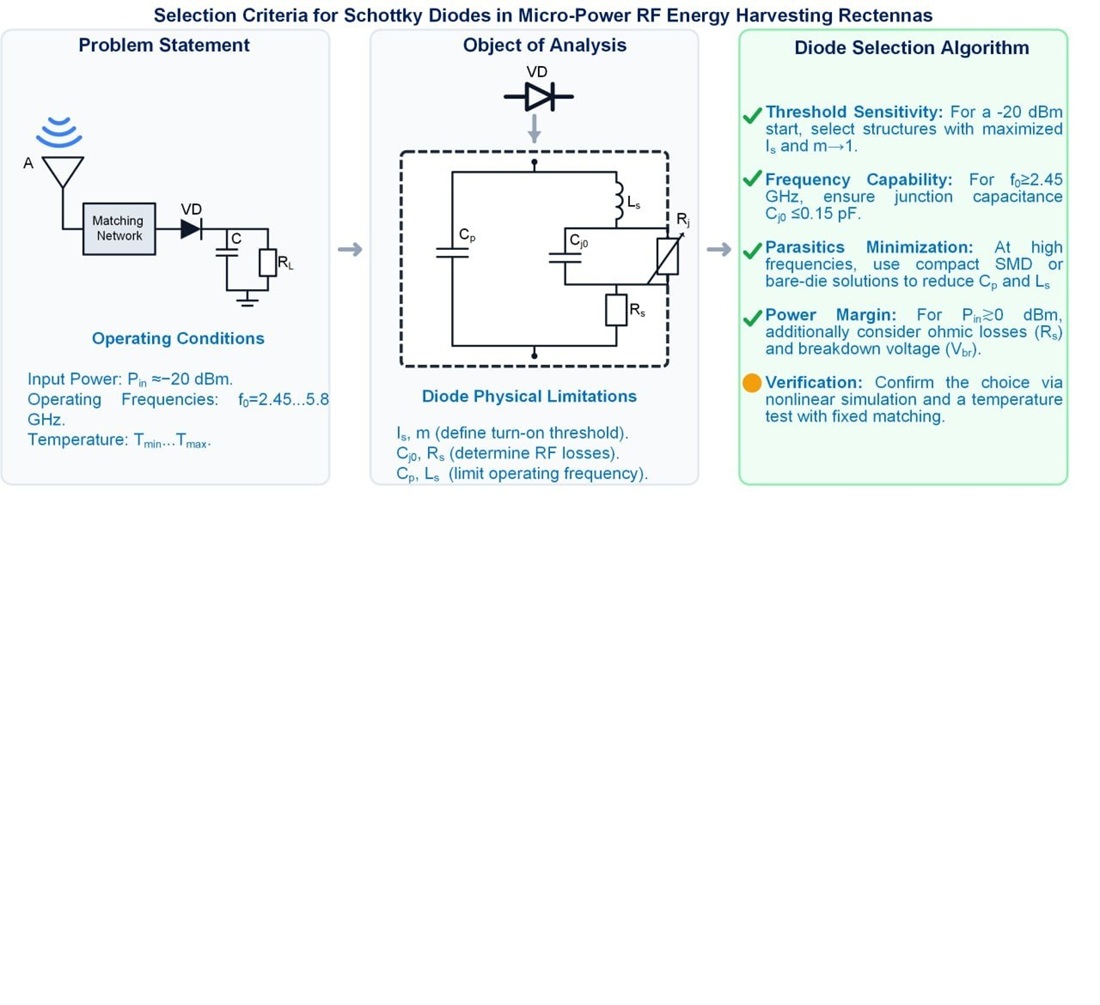
The process of rectifying electromagnetic field energy in micropower rectennas based on Schottky diodes has been investigated in this study. One of the challenges in designing such rectennas is the lack of a consistent system of quantitative criteria for selecting a rectifier diode capable of providing high conversion efficiency at ultra-low input power levels while accounting for its intrinsic and parasitic parameters. The practical relevance of this task is predetermined by the need to autonomously power Internet of Things sensors in weak electromagnetic fields.
Decomposition of loss mechanisms was performed, which made it possible to distinguish the fundamental limitations caused by the current-voltage characteristic from the frequency-dependent and parasitic diode parameters. The study was carried out using the harmonic balance method in AWR Design Environment.
The calculations showed that, in the microwatt regime, higher conversion efficiency is achieved for diodes with increased saturation current due to the dominant role of the junction threshold properties. For low-barrier structures, an increase in temperature above 50°C is accompanied by a sharp rise in reverse leakage currents, which leads to a decrease in efficiency. As the frequency increases, the junction barrier capacitance and the package parasitics increasingly limit the achievable efficiency, especially at 2.45 and 5.8 GHz.
Comparative modeling of commercial Schottky diodes revealed that, under the micropower regime, preference should be given to low-barrier structures with minimized parasitic reactances, whereas at higher input power levels the advantage may shift to structures with a medium barrier height.
Underlying the practical value of this study is the compilation of recommendations for the justified selection of components when designing battery-free power supply systems for Internet of Things sensors operating in weak electromagnetic fields.
References
- Tran, L.-G., Cha, H.-K., Park, W.-T. (2017). RF power harvesting: a review on designing methodologies and applications. Micro and Nano Systems Letters, 5 (1). https://doi.org/10.1186/s40486-017-0051-0
- Nikoletseas, S., Yang, Y., Georgiadis, A. (Eds.) (2016). Wireless Power Transfer Algorithms, Technologies and Applications in Ad Hoc Communication Networks. Springer International Publishing. https://doi.org/10.1007/978-3-319-46810-5
- Shinohara, N. (2013). Wireless Power Transfer via Radiowaves. John Wiley & Sons. https://doi.org/10.1002/9781118863008
- Hemour, S., Wu, K. (2014). Radio-Frequency Rectifier for Electromagnetic Energy Harvesting: Development Path and Future Outlook. Proceedings of the IEEE, 102 (11), 1667–1691. https://doi.org/10.1109/jproc.2014.2358691
- Costanzo, A., Masotti, D. (2017). Energizing 5G: Near- and Far-Field Wireless Energy and Data Trantransfer as an Enabling Technology for the 5G IoT. IEEE Microwave Magazine, 18 (3), 125–136. https://doi.org/10.1109/mmm.2017.2664001
- Valenta, C. R., Durgin, G. D. (2014). Harvesting Wireless Power: Survey of Energy-Harvester Conversion Efficiency in Far-Field, Wireless Power Transfer Systems. IEEE Microwave Magazine, 15 (4), 108–120. https://doi.org/10.1109/mmm.2014.2309499
- Zhang, Z., Pang, H., Georgiadis, A., Cecati, C. (2019). Wireless Power Transfer – An Overview. IEEE Transactions on Industrial Electronics, 66 (2), 1044–1058. https://doi.org/10.1109/tie.2018.2835378
- Popovic, Z. (2017). Near- and far-field wireless power transfer. 2017 13th International Conference on Advanced Technologies, Systems and Services in Telecommunications (TELSIKS), 3–6. https://doi.org/10.1109/telsks.2017.8246215
- Gu, X., Hemour, S., Wu, K. (2022). Far-Field Wireless Power Harvesting: Nonlinear Modeling, Rectenna Design, and Emerging Applications. Proceedings of the IEEE, 110 (1), 56–73. https://doi.org/10.1109/jproc.2021.3127930
- Smith, D. R., Gowda, V. R., Yurduseven, O., Larouche, S., Lipworth, G., Urzhumov, Y., Reynolds, M. S. (2017). An analysis of beamed wireless power transfer in the Fresnel zone using a dynamic, metasurface aperture. Journal of Applied Physics, 121 (1). https://doi.org/10.1063/1.4973345
- Fowler, C., Silva, S., Thapa, G., Zhou, J. (2022). High efficiency ambient RF energy harvesting by a metamaterial perfect absorber. Optical Materials Express, 12 (3), 1242. https://doi.org/10.1364/ome.449494
- Visser, H. J., Vullers, R. J. M. (2013). RF Energy Harvesting and Transport for Wireless Sensor Network Applications: Principles and Requirements. Proceedings of the IEEE, 101 (6), 1410–1423. https://doi.org/10.1109/jproc.2013.2250891
- Pinuela, M., Mitcheson, P. D., Lucyszyn, S. (2013). Ambient RF Energy Harvesting in Urban and Semi-Urban Environments. IEEE Transactions on Microwave Theory and Techniques, 61 (7), 2715–2726. https://doi.org/10.1109/tmtt.2013.2262687
- Saito, K., Nishiyama, E., Toyoda, I. (2022). A 2.45- and 5.8-GHz Dual-Band Stacked Differential Rectenna With High Conversion Efficiency in Low Power Density Environment. IEEE Open Journal of Antennas and Propagation, 3, 627–636. https://doi.org/10.1109/ojap.2022.3171035
- Chandravanshi, S., Sarma, S. S., Akhtar, M. J. (2018). Design of Triple Band Differential Rectenna for RF Energy Harvesting. IEEE Transactions on Antennas and Propagation, 66 (6), 2716–2726. https://doi.org/10.1109/tap.2018.2819699
- Contreras, A., Urdaneta, M. (2021). Analysis of Variance of the Diode Parameters in Multiband Rectifiers for RF Energy Harvesting. Radioengineering, 30 (1), 150–156. https://doi.org/10.13164/re.2021.0150
- Paz, H. P. D., Silva, V. S. D., Diniz, R., Trevisoli, R., Capovilla, C. E., Casella, I. R. S. (2023). Temperature Analysis of Schottky Diodes Rectifiers for Low-Power RF Energy Harvesting Applications. IEEE Access, 11, 54122–54132. https://doi.org/10.1109/access.2023.3281794
- Sze, S. M., Ng, K. K. (2006). Physics of Semiconductor Devices. John Wiley & Sons. https://doi.org/10.1002/0470068329
- Maas, S. A. (2003). Nonlinear Microwave and RF Circuits. Boston: Artech House, 608. Available at: https://us.artechhouse.com/Nonlinear-Microwave-and-RF-Circuits-Second-Edition-P1097.aspx
- Quarles, T., Newton, A. R., Pederson, D. O., Sangiovanni-Vincentelli, A. (1993). SPICE3 Version 3f3 User’s Manual. Berkeley, 145. Available at: http://www.gianlucafiori.org/appunti/Spice_3f3_Users_Manual.pdf
- Gretskih, D. V., Luchaninov, A. I., Vishniakova, J. V., Katrich, V. A., Nesterenko, M. V. (2018). Electrodynamic Model of a Wireless Power Transmission System. 2018 XXIIIrd International Seminar/Workshop on Direct and Inverse Problems of Electromagnetic and Acoustic Wave Theory (DIPED), 80–85. https://doi.org/10.1109/diped.2018.8543290
- Luchaninov, A. I., Gretskih, D. V., Gomozov, A. V., Katrich, V. A., Nesterenko, M. V. (2019). Electrodynamic Approach to Designing WPT Systems with Accounting for Non-system Interactions. 2019 IEEE 2nd Ukraine Conference on Electrical and Computer Engineering (UKRCON), 107–111. https://doi.org/10.1109/ukrcon.2019.8879788
- Gretskih, D., Luchaninov, A., Katrich, V., Nesterenko, M. (2019). Electrodynamic Approach to Designing Wireless Power Transfer Systems (Internal System Processes). 2019 International Conference on Information and Telecommunication Technologies and Radio Electronics (UkrMiCo), 1–6. https://doi.org/10.1109/ukrmico47782.2019.9165536
- Gretskih, D., Luchaninov, A., Katrich, V., Nesterenko, M., Gomozov, A. (2019). Extemal Parameters of Wireless Power Transmission Systems. 2019 XXIVth International Seminar/Workshop on Direct and Inverse Problems of Electromagnetic and Acoustic Wave Theory (DIPED), 117–121. https://doi.org/10.1109/diped.2019.8882592
- Alieksieiev, V., Gretskih, D., Luchaninov, A., Lykhograi, V., Shcherbina, A. (2021). Applying the Electrodynamic Approach to Modeling Wireless Power Transmission Systems. 2021 IEEE 26th International Seminar/Workshop on Direct and Inverse Problems of Electromagnetic and Acoustic Wave Theory (DIPED), 111–115. https://doi.org/10.1109/diped53165.2021.9552254
- AWR Design Environment Platform (2026). Cadence Design Systems. Available at: https://www.cadence.com/en_US/home.html
- Roberg, M., Falkenstein, E., Popovic, Z. (2012). High-efficiency harmonically-terminated rectifier for wireless powering applications. 2012 IEEE/MTT-S International Microwave Symposium Digest, 1–3. https://doi.org/10.1109/mwsym.2012.6259641
- Nelder, J. A., Mead, R. (1965). A Simplex Method for Function Minimization. The Computer Journal, 7 (4), 308–313. https://doi.org/10.1093/comjnl/7.4.308
- The Zero Bias Schottky Detector Diode: Application Note 969. San Avago Technologies, 6. Available at: https://people.ee.ethz.ch/~mzahner/PPS-EMrad/material/literature/RF-Detectors_Receivers/The%20Zero%20Bias%20Schottky%20Detector%20Diode%20(Avago%20AN%20969).pdf
- SMS7630 Series. Surface Mount Mixer and Detector Schottky Diodes. Available at: https://www.skyworksinc.com/Products/Diodes/SMS7630-Series
- El Mattar, S., Baghdad, A., Ballouk, A. (2022). A 2.45/5.8 GHz high-efficiency dual-band rectifier for low radio frequency input power. International Journal of Electrical and Computer Engineering (IJECE), 12 (3), 2169. https://doi.org/10.11591/ijece.v12i3.pp2169-2176
- Bhatt, K., Kumar, S., Kumar, P., Tripathi, C. C. (2019). Highly Efficient 2.4 and 5.8 GHz Dual-Band Rectenna for Energy Harvesting Applications. IEEE Antennas and Wireless Propagation Letters, 18 (12), 2637–2641. https://doi.org/10.1109/lawp.2019.2946911
Downloads
Published
How to Cite
Issue
Section
License
Copyright (c) 2026 Vasyl Alieksieiev, Dmytro Hretskykh, Dmytro Havva, Mikhail Nesterenko, Olena Ivanova

This work is licensed under a Creative Commons Attribution 4.0 International License.
The consolidation and conditions for the transfer of copyright (identification of authorship) is carried out in the License Agreement. In particular, the authors reserve the right to the authorship of their manuscript and transfer the first publication of this work to the journal under the terms of the Creative Commons CC BY license. At the same time, they have the right to conclude on their own additional agreements concerning the non-exclusive distribution of the work in the form in which it was published by this journal, but provided that the link to the first publication of the article in this journal is preserved.
A license agreement is a document in which the author warrants that he/she owns all copyright for the work (manuscript, article, etc.).
The authors, signing the License Agreement with TECHNOLOGY CENTER PC, have all rights to the further use of their work, provided that they link to our edition in which the work was published.
According to the terms of the License Agreement, the Publisher TECHNOLOGY CENTER PC does not take away your copyrights and receives permission from the authors to use and dissemination of the publication through the world's scientific resources (own electronic resources, scientometric databases, repositories, libraries, etc.).
In the absence of a signed License Agreement or in the absence of this agreement of identifiers allowing to identify the identity of the author, the editors have no right to work with the manuscript.
It is important to remember that there is another type of agreement between authors and publishers – when copyright is transferred from the authors to the publisher. In this case, the authors lose ownership of their work and may not use it in any way.








