Construction of a digital twin model for a system that monitors the technical condition of a nuclear power plant power unit
DOI:
https://doi.org/10.15587/1729-4061.2026.356915Keywords:
continuous monitoring system, system-cluster approach, fractal analysis, digital twin modelAbstract
This study investigates the process of continuous monitoring and control of the technological process parameters at a nuclear power plant power unit using a digital twin model implemented on the basis of a system-cluster approach.
The task addressed relates to the lack of a comprehensive, integrated system for continuous monitoring of the technical condition of the power unit, capable of collecting, processing, and analyzing information from sensors and diagnostic subsystems in real time.
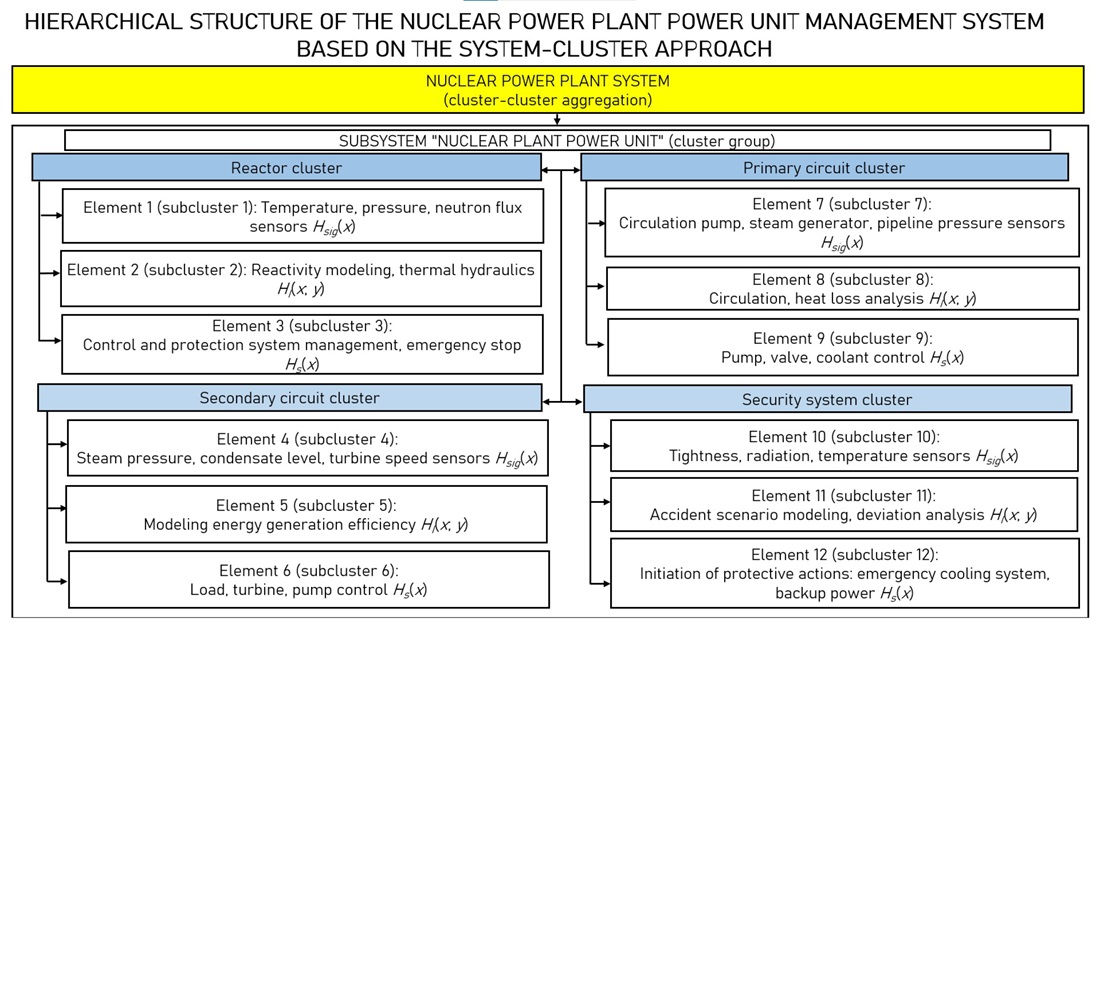
It is proposed to model the state of the technological equipment at a power unit using a digital twin and a system-cluster approach. Within the framework of the study, a system-cluster architecture of a digital twin was designed, which reflects the interaction among the physical, analytical, and control levels of the power unit at a nuclear power plant.
The work involved processing the technological process parameters coming from a sensor network with a frequency of 1–2 Hz, with a processing delay of no more than 1–3 s. The proposed information-fractal criterion provided an increase in the sensitivity of pre-accident detection by 15–25% compared to conventional methods, as well as made it possible to identify complex operating modes in the range of .
The results have made it possible to solve the set tasks by integrating multi-scale fractal analysis, cluster organization of technical systems, and self-similarity modeling. The practical implementation of the digital twin has proven its capability to detect changes in the structure of the technological process with diagnostic accuracy at the level of 85–92%.
The implementation of the digital twin model in the information-control systems of the power unit makes it possible to increase the reliability, safety, and efficiency of control.
References
- van Dinter, R., Tekinerdogan, B., Catal, C. (2022). Predictive maintenance using digital twins: A systematic literature review. Information and Software Technology, 151, 107008. https://doi.org/10.1016/j.infsof.2022.107008
- Song, H., Song, M., Liu, X. (2022). Online autonomous calibration of digital twins using machine learning with application to nuclear power plants. Applied Energy, 326, 119995. https://doi.org/10.1016/j.apenergy.2022.119995
- Kochunas, B., Huan, X. (2021). Digital Twin Concepts with Uncertainty for Nuclear Power Applications. Energies, 14 (14), 4235. https://doi.org/10.3390/en14144235
- Xu, Q., Zhou, G., Zhang, C., Chang, F., Huang, Q., Zhang, M., Zhi, Y. (2025). A Digital Twin Framework for Nuclear Power Equipment Maintenance: Design, Prototyping, and Preliminary Validation. Digital Twin, 2 (1). https://doi.org/10.12688/digitaltwin.17695.2
- Lin, L., Bao, H., Dinh, N. (2021). Uncertainty quantification and software risk analysis for digital twins in the nearly autonomous management and control systems: A review. Annals of Nuclear Energy, 160, 108362. https://doi.org/10.1016/j.anucene.2021.108362
- Budanov, P., Brovko, K., Cherniuk, A., Vasyuchenko, P., Khomenko, V. (2018). Improving the reliability of informationcontrol systems at power generation facilities based on the fractalcluster theory. Eastern-European Journal of Enterprise Technologies, 2 (9 (92)), 4–12. https://doi.org/10.15587/1729-4061.2018.126427
- Karnik, N., Abdo, M. G., Estrada-Perez, C. E., Yoo, J. S., Cogliati, J. J., Skifton, R. S. et al. (2024). Constrained Optimization of Sensor Placement for Nuclear Digital Twins. IEEE Sensors Journal, 24 (9), 15501–15516. https://doi.org/10.1109/jsen.2024.3368875
- Daniell, J., Kobayashi, K., Alajo, A., Alam, S. B. (2025). Digital twin-centered hybrid data-driven multi-stage deep learning framework for enhanced nuclear reactor power prediction. Energy and AI, 19, 100450. https://doi.org/10.1016/j.egyai.2024.100450
- Budanov, P., Brovko, K., Melnikov, V., Yakymchuk, M., Kononov, V., Kyrysov, I. et al. (2025). Construction of an information model of the digital twin of the technological process in a power unit at a nuclear power plant. Eastern-European Journal of Enterprise Technologies, 4 (8 (136)), 39–49. https://doi.org/10.15587/1729-4061.2025.335712
- Nguyen, T. N., Ponciroli, R., Bruck, P., Esselman, T. C., Rigatti, J. A., Vilim, R. B. (2022). A digital twin approach to system-level fault detection and diagnosis for improved equipment health monitoring. Annals of Nuclear Energy, 170, 109002. https://doi.org/10.1016/j.anucene.2022.109002
- Chen, F., Huang, Q., Song, M., Liu, X., Zeng, W., Song, H., Cheng, K. (2025). A study on the development of digital model of digital twin in nuclear power plant based on a hybrid physics and data-driven approach. Applied Thermal Engineering, 271, 126289. https://doi.org/10.1016/j.applthermaleng.2025.126289
- Qi, F., Li, W., Liu, Z., Li, Q., Li, Y., Huang, Y. et al. (2022). Gradient percolation of fission gases in nuclear fuel pellet. Journal of Nuclear Materials, 571, 153993. https://doi.org/10.1016/j.jnucmat.2022.153993
- Chen, M., Liu, H., Zhao, W., Zhang, Y., Yu, W., Peng, Q. et al. (2025). Development of the environmental assisted fatigue assessment method for nuclear plants in digital twin. Nuclear Engineering and Technology, 57 (6), 103402. https://doi.org/10.1016/j.net.2024.103402
- Budanov, P., Khomiak, E., Kyrysov, I., Brovko, K., Kalnoy, S., Karpenko, O. (2022). Building a model of damage to the fractal structure of the shell of the fuel element of a nuclear reactor. Eastern-European Journal of Enterprise Technologies, 4 (8 (118)), 60–70. https://doi.org/10.15587/1729-4061.2022.263374
- Songbo, R., Chao, K., Ying, G., Song, G., Shenghui, Z., Gang, L. et al. (2022). Measurement pitting morphology characteristic of corroded steel surface and fractal reconstruction model. Measurement, 190, 110678. https://doi.org/10.1016/j.measurement.2021.110678
- Budanov, P., Kyrysov, I., Oliinyk, Y., Brovko, K., Zhukov, S. (2025). Fractal Approach for Researching Information Emergency Features of Technological Parameters. International Journal of Computing, 24 (1), 171–177. https://doi.org/10.47839/ijc.24.1.3889
- Budanov, P., Oliinyk, Y., Cherniuk, A., Brovko, K. (2024). Dynamic Fractal Cluster Model of Informational Space Technological Process of Power Station. Information Technology for Education, Science, and Technics, 141–155. https://doi.org/10.1007/978-3-031-71801-4_11
- Ferriol-Galmés, M., Suárez-Varela, J., Paillissé, J., Shi, X., Xiao, S., Cheng, X. et al. (2022). Building a Digital Twin for network optimization using Graph Neural Networks. Computer Networks, 217, 109329. https://doi.org/10.1016/j.comnet.2022.109329
- Husain, A., Nanda, M. N., Chowdary, M. S., Sajid, M. (2022). Fractals: An Eclectic Survey, Part-I. Fractal and Fractional, 6 (2), 89. https://doi.org/10.3390/fractalfract6020089
- Tian, K., Gao, T., Hu, X., Xiao, J., Liu, Y. (2024). Novel optimal sensor placement method towards the high-precision digital twin for complex curved structures. International Journal of Solids and Structures, 302, 113003. https://doi.org/10.1016/j.ijsolstr.2024.113003
- Budanov, P., Kyrysov, I., Brovko, K., Rudenko, D., Vasiuchenko, P., Nosyk, A. (2021). Development of a solar element model using the method of fractal geometry theory. Eastern-European Journal of Enterprise Technologies, 3 (8 (111)), 75–89. https://doi.org/10.15587/1729-4061.2021.235882
- Budanov, P., Oliinyk, Y., Cherniuk, A., Brovko, K. (2024). Fractal approach for the researching of information emergency features of technological parameters. TRANSPORT, ECOLOGY, SUSTAINABLE DEVELOPMENT: EKO VARNA 2023, 3104, 040015. https://doi.org/10.1063/5.0191648
- Stewart, R., Treviño, E., Shields, A., Heaps, K., Darrington, J., Williams, Q. et al. (2025). The AGN-201 Digital Twin: A test bed for remotely monitoring nuclear reactors. Annals of Nuclear Energy, 213, 111041. https://doi.org/10.1016/j.anucene.2024.111041
- Prokhorova, V., Budanov, O., Budanov, P., Slastianykova, K. (2025). Devising a methodology for estimating the information potential of energy enterprises under the conditions of digital coherency. Eastern-European Journal of Enterprise Technologies, 3 (13 (135)), 6–16. https://doi.org/10.15587/1729-4061.2025.332324
- Prokhorova, V., Budanov, O., Budanov, M., Slastianykova, K. (2025). Building a consolidated model of digital coherence for managing the information potential at power enterprises. Eastern-European Journal of Enterprise Technologies, 4 (13 (136)), 58–69. https://doi.org/10.15587/1729-4061.2025.336641
Downloads
Published
How to Cite
Issue
Section
License
Copyright (c) 2026 Viktoriia Prokhorova, Mykola Budanov, Kostiantyn Brovko, Pavlo Budanov, Vyacheslav Melnikov, Ihor Kyrysov, Oleh Velykohorskyi, Andrii Nosyk, Oleh Karpenko

This work is licensed under a Creative Commons Attribution 4.0 International License.
The consolidation and conditions for the transfer of copyright (identification of authorship) is carried out in the License Agreement. In particular, the authors reserve the right to the authorship of their manuscript and transfer the first publication of this work to the journal under the terms of the Creative Commons CC BY license. At the same time, they have the right to conclude on their own additional agreements concerning the non-exclusive distribution of the work in the form in which it was published by this journal, but provided that the link to the first publication of the article in this journal is preserved.
A license agreement is a document in which the author warrants that he/she owns all copyright for the work (manuscript, article, etc.).
The authors, signing the License Agreement with TECHNOLOGY CENTER PC, have all rights to the further use of their work, provided that they link to our edition in which the work was published.
According to the terms of the License Agreement, the Publisher TECHNOLOGY CENTER PC does not take away your copyrights and receives permission from the authors to use and dissemination of the publication through the world's scientific resources (own electronic resources, scientometric databases, repositories, libraries, etc.).
In the absence of a signed License Agreement or in the absence of this agreement of identifiers allowing to identify the identity of the author, the editors have no right to work with the manuscript.
It is important to remember that there is another type of agreement between authors and publishers – when copyright is transferred from the authors to the publisher. In this case, the authors lose ownership of their work and may not use it in any way.








