Development of an interpretable classification method for healthcare disinformation detection: large language model feature extraction and ensemble learning
DOI:
https://doi.org/10.15587/1729-4061.2026.357119Keywords:
disinformation detection, medical fake news, sentiment analysis, emotion recognitionAbstract
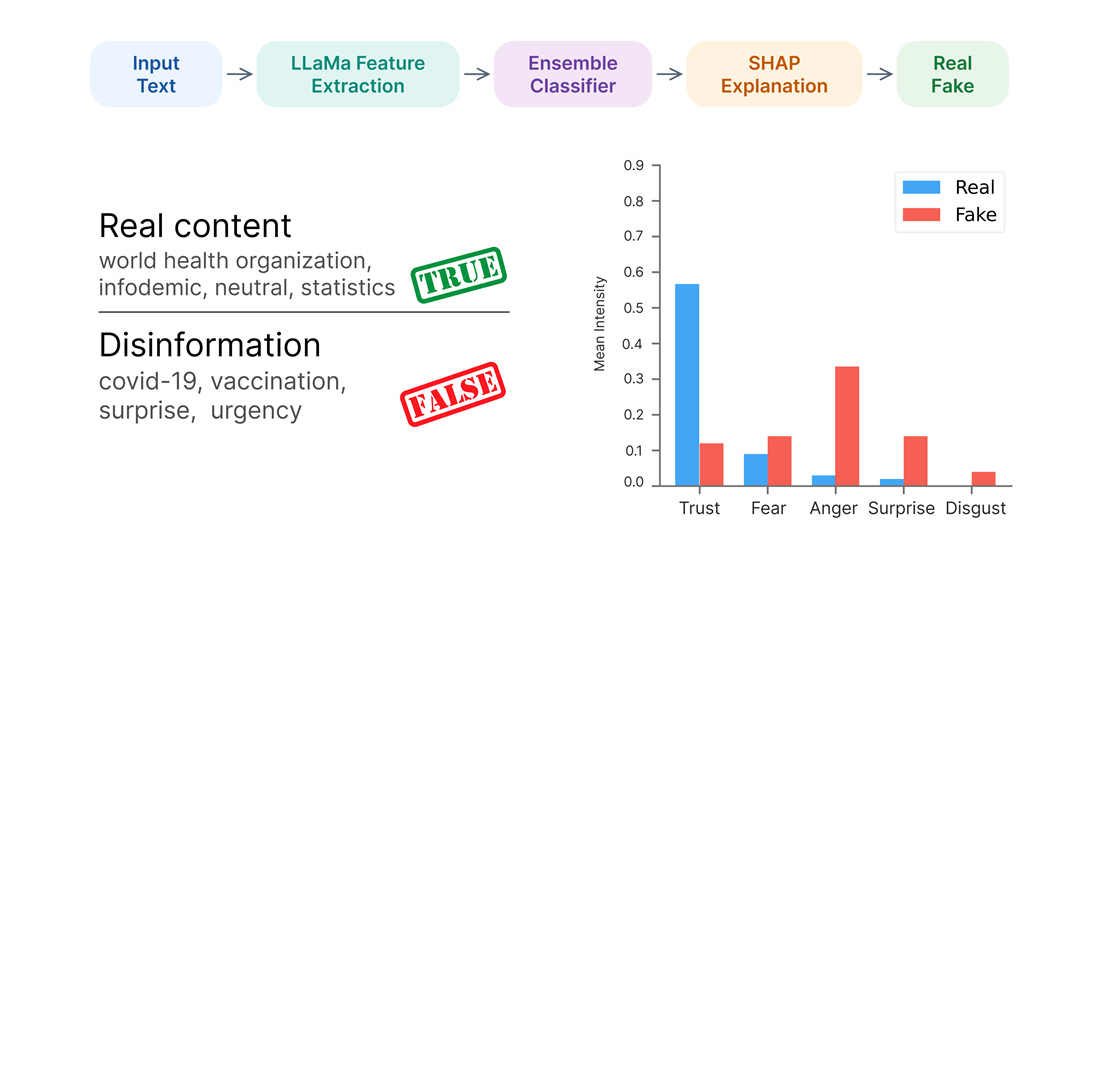
The object of this study is disinformation in the healthcare domain, distributed through social media and online news sources. Disinformation has become one of the most serious threats to individuals and societies, and it is particularly dangerous when it comes to medical disinformation. The rise of false medical claims online has overwhelmed human researchers, and automated detection methods suffer from several issues, such as low accuracy, the inability to explain solutions derived from implicit deep learning methods or relying on strict text features. This work proposes a method based on large language models (LLMs) and a machine learning (ML) approach for the explainable detection of disinformation in the healthcare sector and identifies attributes inherent in false statements, such as emotionality and rhetorical coloring. Large Language Model Meta AI (LLaMA) serves as a layer for identifying key features, and the ML approach classifies the text with explanations. Shapley Additive Explanations (SHAP) were applied to interpret individual predictions and identify which features contribute most to classification decisions. This method demonstrated high results on two publicly available datasets, achieving an F1 score of approximately 96%. The high performance is explained by the fact that medical disinformation relies on emotional manipulation and persuasive rhetorical patterns, which differ from the neutral tone of reliable medical content. Unlike existing approaches that achieve similar accuracy through opaque methods, the proposed approach relies on interpretable features and provides per-prediction explanations. The proposed method can be applied in automated content-moderation systems and public-health monitoring tools
References
- Wang, Y., McKee, M., Torbica, A., Stuckler, D. (2019). Systematic Literature Review on the Spread of Health-related Misinformation on Social Media. Social Science & Medicine, 240, 112552. https://doi.org/10.1016/j.socscimed.2019.112552
- van der Linden, S. (2022). Misinformation: susceptibility, spread, and interventions to immunize the public. Nature Medicine, 28 (3), 460–467. https://doi.org/10.1038/s41591-022-01713-6
- Borges do Nascimento, I. J., Beatriz Pizarro, A., Almeida, J., Azzopardi-Muscat, N., André Gonçalves, M. et al. (2022). Infodemics and health misinformation: a systematic review of reviews. Bulletin of the World Health Organization, 100 (9), 544–561. https://doi.org/10.2471/blt.21.287654
- Fridman, I., Johnson, S., Elston Lafata, J. (2023). Health Information and Misinformation: A Framework to Guide Research and Practice. JMIR Medical Education, 9, e38687. https://doi.org/10.2196/38687
- Suarez-Lledo, V., Alvarez-Galvez, J. (2021). Prevalence of Health Misinformation on Social Media: Systematic Review. Journal of Medical Internet Research, 23 (1), e17187. https://doi.org/10.2196/17187
- Cinelli, M., Quattrociocchi, W., Galeazzi, A., Valensise, C. M., Brugnoli, E., Schmidt, A. L. et al. (2020). The COVID-19 social media infodemic. Scientific Reports, 10 (1). https://doi.org/10.1038/s41598-020-73510-5
- Shu, K., Sliva, A., Wang, S., Tang, J., Liu, H. (2017). Fake News Detection on Social Media. ACM SIGKDD Explorations Newsletter, 19 (1), 22–36. https://doi.org/10.1145/3137597.3137600
- Choraś, M., Demestichas, K., Giełczyk, A., Herrero, Á., Ksieniewicz, P., Remoundou, K. et al. (2021). Advanced Machine Learning techniques for fake news (online disinformation) detection: A systematic mapping study. Applied Soft Computing, 101, 107050. https://doi.org/10.1016/j.asoc.2020.107050
- Liu, Z., Zhang, T., Yang, K., Thompson, P., Yu, Z., Ananiadou, S. (2024). Emotion detection for misinformation: A review. Information Fusion, 107, 102300. https://doi.org/10.1016/j.inffus.2024.102300
- Pröllochs, N., Bär, D., Feuerriegel, S. (2021). Emotions explain differences in the diffusion of true vs. false social media rumors. Scientific Reports, 11 (1). https://doi.org/10.1038/s41598-021-01813-2
- Hamed, S. Kh., Ab Aziz, M. J., Yaakub, M. R. (2023). Fake News Detection Model on Social Media by Leveraging Sentiment Analysis of News Content and Emotion Analysis of Users’ Comments. Sensors, 23 (4), 1748. https://doi.org/10.3390/s23041748
- Murugesan, S., Pachamuthu, K. (2022). Fake News Detection in the Medical Field Using Machine Learning Techniques. International Journal of Safety and Security Engineering, 12 (6), 723–727. https://doi.org/10.18280/ijsse.120608
- Kolluri, N., Liu, Y., Murthy, D. (2022). COVID-19 Misinformation Detection: Machine-Learned Solutions to the Infodemic. JMIR Infodemiology, 2 (2), e38756. https://doi.org/10.2196/38756
- Iwendi, C., Mohan, S., khan, S., Ibeke, E., Ahmadian, A., Ciano, T. (2022). Covid-19 fake news sentiment analysis. Computers and Electrical Engineering, 101, 107967. https://doi.org/10.1016/j.compeleceng.2022.107967
- Sikosana, M., Maudsley-Barton, S., Ajao, O. (2025). Advanced Health Misinformation Detection Through Hybrid CNN-LSTM Models Informed by the Elaboration Likelihood Model (ELM). 2025 International Conference on Artificial Intelligence, Computer, Data Sciences and Applications (ACDSA), 1–11. https://doi.org/10.1109/acdsa65407.2025.11166406
- Alghamdi, J., Lin, Y., Luo, S. (2023). Towards COVID-19 fake news detection using transformer-based models. Knowledge-Based Systems, 274, 110642. https://doi.org/10.1016/j.knosys.2023.110642
- Guo, Y., Ovadje, A., Al-Garadi, M. A., Sarker, A. (2024). Evaluating large language models for health-related text classification tasks with public social media data. Journal of the American Medical Informatics Association, 31 (10), 2181–2189. https://doi.org/10.1093/jamia/ocae210
- Dima, A., Ilis, E., Florea, D., Dascalu, M. (2025). Detection of Fake News in Romanian: LLM-Based Approaches to COVID-19 Misinformation. Information, 16 (9), 796. https://doi.org/10.3390/info16090796
- Bojić, L., Zagovora, O., Zelenkauskaite, A., Vuković, V., Čabarkapa, M., Veseljević Jerković, S., Jovančević, A. (2025). Comparing large Language models and human annotators in latent content analysis of sentiment, political leaning, emotional intensity and sarcasm. Scientific Reports, 15 (1). https://doi.org/10.1038/s41598-025-96508-3
- Patwa, P., Sharma, S., Pykl, S., Guptha, V., Kumari, G., Akhtar, M. S. et al. (2021). Fighting an Infodemic: COVID-19 Fake News Dataset. Combating Online Hostile Posts in Regional Languages during Emergency Situation, 21–29. https://doi.org/10.1007/978-3-030-73696-5_3
- Cui, L., Seo, H., Tabar, M., Ma, F., Wang, S., Lee, D. (2020). DETERRENT: Knowledge Guided Graph Attention Network for Detecting Healthcare Misinformation. Proceedings of the 26th ACM SIGKDD International Conference on Knowledge Discovery & Data Mining, 492–502. https://doi.org/10.1145/3394486.3403092
- Felber, T. (2021). Constraint 2021: Machine Learning Models for COVID-19 Fake News Detection Shared Task. arXiv. https://arxiv.org/abs/2101.03717
- Wani, A., Joshi, I., Khandve, S., Wagh, V., Joshi, R. (2021). Evaluating Deep Learning Approaches for Covid19 Fake News Detection. Combating Online Hostile Posts in Regional Languages during Emergency Situation, 153–163. https://doi.org/10.1007/978-3-030-73696-5_15
- Karnyoto, A. S., Sun, C., Liu, B., Wang, X. (2022). Augmentation and heterogeneous graph neural network for AAAI2021-COVID-19 fake news detection. International Journal of Machine Learning and Cybernetics, 13 (7), 2033–2043. https://doi.org/10.1007/s13042-021-01503-5
Downloads
Published
How to Cite
Issue
Section
License
Copyright (c) 2026 Vusal Shahbazov, Vagif Mammadaliyev

This work is licensed under a Creative Commons Attribution 4.0 International License.
The consolidation and conditions for the transfer of copyright (identification of authorship) is carried out in the License Agreement. In particular, the authors reserve the right to the authorship of their manuscript and transfer the first publication of this work to the journal under the terms of the Creative Commons CC BY license. At the same time, they have the right to conclude on their own additional agreements concerning the non-exclusive distribution of the work in the form in which it was published by this journal, but provided that the link to the first publication of the article in this journal is preserved.
A license agreement is a document in which the author warrants that he/she owns all copyright for the work (manuscript, article, etc.).
The authors, signing the License Agreement with TECHNOLOGY CENTER PC, have all rights to the further use of their work, provided that they link to our edition in which the work was published.
According to the terms of the License Agreement, the Publisher TECHNOLOGY CENTER PC does not take away your copyrights and receives permission from the authors to use and dissemination of the publication through the world's scientific resources (own electronic resources, scientometric databases, repositories, libraries, etc.).
In the absence of a signed License Agreement or in the absence of this agreement of identifiers allowing to identify the identity of the author, the editors have no right to work with the manuscript.
It is important to remember that there is another type of agreement between authors and publishers – when copyright is transferred from the authors to the publisher. In this case, the authors lose ownership of their work and may not use it in any way.








