Identification of artificial intelligence adoption determinants affecting human resource management effectiveness in the Indian information technology sector
DOI:
https://doi.org/10.15587/1729-4061.2026.357122Keywords:
AI adoption in HRM, security/privacy, competitive pressure, Indian IT sectorAbstract
The object of the study focuses on the process of AI adoption in HRM systems in technology-driven organizations of Indian IT sector. Despite a growing investment in AI-enabled HR systems, there is relatively scarce empirical evidence on how organizational and environmental determinants together affect AI adoption and how this translates into actionable workforce effectiveness.
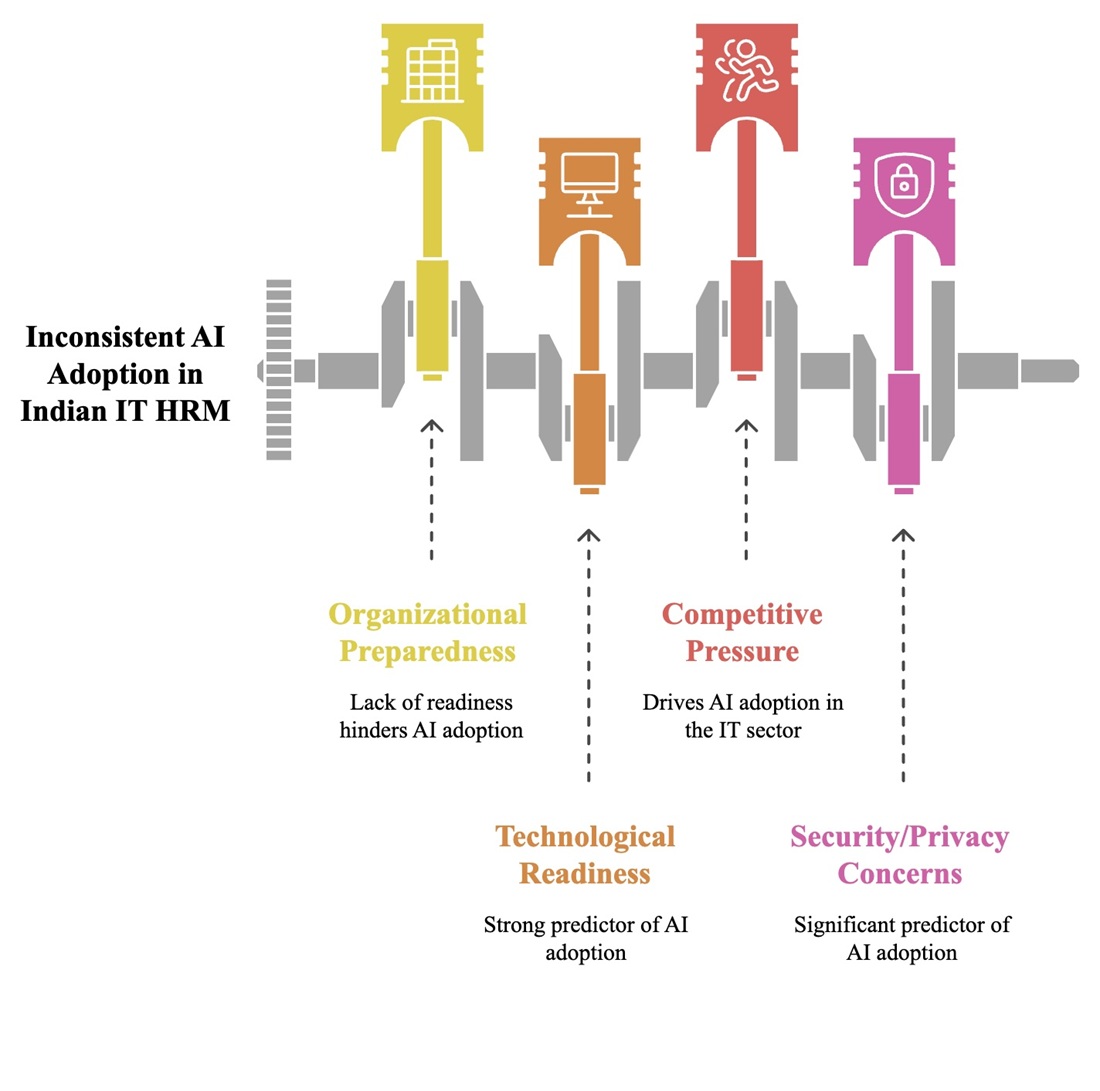
The study addresses this problem by proposing and testing an integrated structural model that investigates organizational preparedness, technological readiness, competitive pressure, and security/privacy concerns in influencing AI adoption and subsequent impact on effective HRM.
To address this problem, an integrated structural model was developed which has been empirically tested through data collected from 378 professionals working in the Indian IT sector and analyzed using partial least squares structural equation modeling. Specifically, the findings indicate that technological readiness (β = 0.464, p = 0.003), competitive pressure (β = 0.308, p = 0.018) and security/privacy concerns (β = 0.303, p < 0.001) are significant predictors of AI adoption, whereas organizational preparedness is not statistically significant in this model. AI adoption has a significant positive effect on effective HRM (β = 0.799, p < 0.001) and explains 63.8% of its variance.
The results show that technology infrastructure and governance assurance, in contrast to mere or formal readiness, explain successful deployment of AI. These outcomes are contingent upon the interaction between technological capability and competitive dynamics and governance mechanisms that permit successful adoption. This study contributes by modelling AI adoption as a strategic mechanism that connects contextual enablers to HRM outcomes instead of adoption intention. The findings are relevant in technologically driven markets that are digitally mature, competitive and sensitive to governance
References
- Jamil, K., Zhang, W., Anwar, A., Mustafa, S. (2025). Exploring the Influence of AI Adoption and Technological Readiness on Sustainable Performance in Pakistani Export Sector Manufacturing Small and Medium-Sized Enterprises. Sustainability, 17 (8), 3599. https://doi.org/10.3390/su17083599
- Mahade, A., Elmahi, A., Alomari, K. M., Abdalla, A. A. (2025). Leveraging AI-driven insights to enhance sustainable human resource management performance: moderated mediation model: evidence from UAE higher education. Discover Sustainability, 6 (1). https://doi.org/10.1007/s43621-025-01114-y
- Madanchian, M., Taherdoost, H., Mohamed, N. (2023). AI-Based Human Resource Management Tools and Techniques; A Systematic Literature Review. Procedia Computer Science, 229, 367–377. https://doi.org/10.1016/j.procs.2023.12.039
- Pedrami, M., Vaezi, S. K. (2025). Factors influencing artificial intelligence adoption in human resource management: a meta-synthesis and systematic review of multidimensional considerations. Journal of Work-Applied Management. https://doi.org/10.1108/jwam-10-2024-0158
- Potluri, R. M., Serikbay, D. (2025). Artificial Intelligence (AI) Adoption in HR Management. International Journal of Asian Business and Information Management, 16 (1), 1–18. https://doi.org/10.4018/ijabim.376012
- Madanchian, M., Taherdoost, H. (2025). Barriers and Enablers of AI Adoption in Human Resource Management: A Critical Analysis of Organizational and Technological Factors. Information, 16 (1), 51. https://doi.org/10.3390/info16010051
- Cahyani, R. R., Musslifah, A. R. (2025). Balancing bytes and biases: A case study of AI adoption in academic human resource management. Journal of Educational Management and Instruction (JEMIN), 5 (2), 437–450. https://doi.org/10.22515/jemin.v5i2.11679
- Singh, A., Shaurya, A. (2021). Impact of Artificial Intelligence on HR practices in the UAE. Humanities and Social Sciences Communications, 8 (1). https://doi.org/10.1057/s41599-021-00995-4
- Uren, V., Edwards, J. S. (2023). Technology readiness and the organizational journey towards AI adoption: An empirical study. International Journal of Information Management, 68, 102588. https://doi.org/10.1016/j.ijinfomgt.2022.102588
- Jöhnk, J., Weißert, M., Wyrtki, K. (2020). Ready or Not, AI Comes – An Interview Study of Organizational AI Readiness Factors. Business & Information Systems Engineering, 63 (1), 5–20. https://doi.org/10.1007/s12599-020-00676-7
- Pumplun, L., Tauchert, C., Heidt, M. (2019). Margareta Heidt. (2019). A New Organizational Chassis for Artificial Intelligence-Exploring Organizational Readiness Factors. Conference: European Conference on Information Systems (ECIS). Stockholm. Available at: https://www.researchgate.net/publication/339974755_A_New_Organizational_Chassis_for_Artificial_Intelligence-Exploring_Organizational_Readiness_Factors
- Goswami, M., Jain, S., Alam, T., Deifalla, A. F., Ragab, A. E., Khargotra, R. (2023). Exploring the antecedents of AI adoption for effective HRM practices in the Indian pharmaceutical sector. Frontiers in Pharmacology, 14. https://doi.org/10.3389/fphar.2023.1215706
- Faustine, P., Rachmawati, R. (2024). AI Adoption Determinants and Its Impacts on HRM Effectiveness within MES in Tanzania. Open Journal of Business and Management, 12 (04), 2532–2552. https://doi.org/10.4236/ojbm.2024.124131
- AlSheibani, S., Cheung, Y., Messom, C. (2018). Artificial Intelligence Adoption: AI-readiness at Firm-Level. PACIS 2018 Proceedings. Available at: https://aisel.aisnet.org/pacis2018/37/
- Jiang, Y., Cai, Z., Wang, X. (2025). Leverage Generative AI for human resource management: integrated risk analysis approach. The International Journal of Human Resource Management, 36 (11), 1929–1959. https://doi.org/10.1080/09585192.2025.2544972
- Nawaz, N., Arunachalam, H., Pathi, B. K., Gajenderan, V. (2024). The adoption of artificial intelligence in human resources management practices. International Journal of Information Management Data Insights, 4 (1), 100208. https://doi.org/10.1016/j.jjimei.2023.100208
- Hair, J. F., Hult, G. T. M., Ringle, C. M., Sarstedt, M. (2021). A primer on partial least squares structural equation modeling (PLS-SEM). Sage Publications. Available at: https://www.researchgate.net/publication/354331182_A_Primer_on_Partial_Least_Squares_Structural_Equation_Modeling_PLS-SEM
- Creswell, J. W. (2009). Research design: Qualitative, quantitative, and mixed methods approaches. Sage Publications. Available at: https://www.ucg.ac.me/skladiste/blog_609332/objava_105202/fajlovi/Creswell.pdf
- Hair, J. F., Hult, G. T. M., Ringle, C. M., Sarstedt, M., Danks, N. P., Ray, S. (2021). Partial Least Squares Structural Equation Modeling (PLS-SEM) Using R. In Classroom Companion: Business. Springer International Publishing. https://doi.org/10.1007/978-3-030-80519-7
- Hair, J. F., Ringle, C. M., Sarstedt, M. (2011). PLS-SEM: Indeed a Silver Bullet. Journal of Marketing Theory and Practice, 19 (2), 139–152. https://doi.org/10.2753/mtp1069-6679190202
- Fornell, C., Larcker, D. F. (1981). Evaluating Structural Equation Models with Unobservable Variables and Measurement Error. Journal of Marketing Research, 18 (1), 39–50. https://doi.org/10.1177/002224378101800104
- Byrne, B. M. (2013). Structural Equation Modeling with Mplus. Routledge. https://doi.org/10.4324/9780203807644
- Bentler, P. M., Bonett, D. G. (1980). Significance tests and goodness of fit in the analysis of covariance structures. Psychological Bulletin, 88 (3), 588–606. https://doi.org/10.1037/0033-2909.88.3.588
- Cohen, J. (2013). Statistical Power Analysis for the Behavioral Sciences. Routledge. https://doi.org/10.4324/9780203771587
Downloads
Published
How to Cite
Issue
Section
License
Copyright (c) 2026 Kevin Durai A, Anbu A

This work is licensed under a Creative Commons Attribution 4.0 International License.
The consolidation and conditions for the transfer of copyright (identification of authorship) is carried out in the License Agreement. In particular, the authors reserve the right to the authorship of their manuscript and transfer the first publication of this work to the journal under the terms of the Creative Commons CC BY license. At the same time, they have the right to conclude on their own additional agreements concerning the non-exclusive distribution of the work in the form in which it was published by this journal, but provided that the link to the first publication of the article in this journal is preserved.
A license agreement is a document in which the author warrants that he/she owns all copyright for the work (manuscript, article, etc.).
The authors, signing the License Agreement with TECHNOLOGY CENTER PC, have all rights to the further use of their work, provided that they link to our edition in which the work was published.
According to the terms of the License Agreement, the Publisher TECHNOLOGY CENTER PC does not take away your copyrights and receives permission from the authors to use and dissemination of the publication through the world's scientific resources (own electronic resources, scientometric databases, repositories, libraries, etc.).
In the absence of a signed License Agreement or in the absence of this agreement of identifiers allowing to identify the identity of the author, the editors have no right to work with the manuscript.
It is important to remember that there is another type of agreement between authors and publishers – when copyright is transferred from the authors to the publisher. In this case, the authors lose ownership of their work and may not use it in any way.








