Determination of multi-criterion optimization features in creating systems for recomplexing anhydrous cosmetics
DOI:
https://doi.org/10.15587/1729-4061.2026.358315Keywords:
multi-criteria optimization, formulation technological systems, Harrington desirability function, eco-oriented designAbstract
This study explores formulation systems for anhydrous cosmetics, specifically, solid shampoos. They have predicted quality indicators and a high level of resource efficiency.
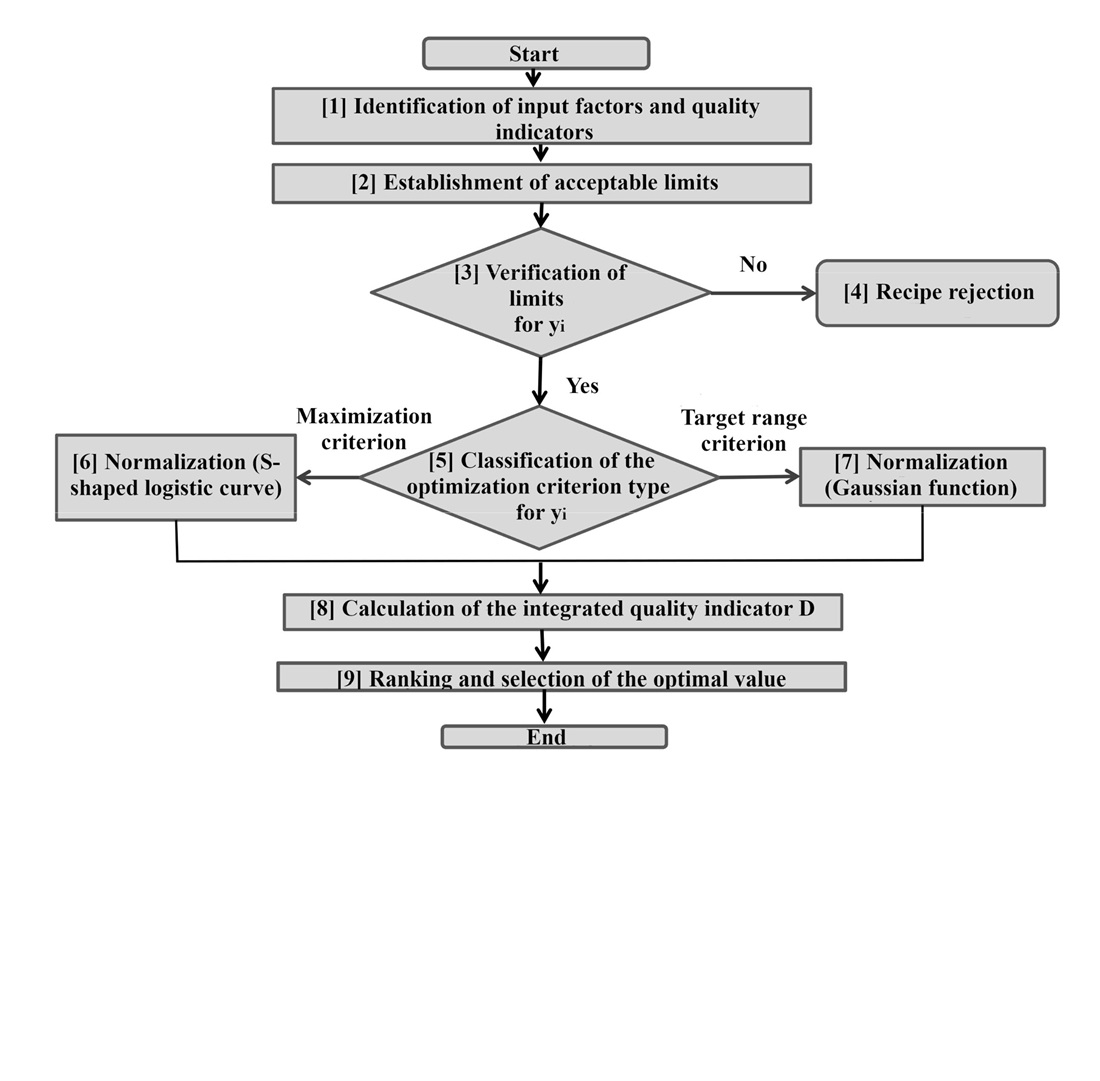
The main issue in designing such systems is the high complexity of optimization, due to technological contradictions between the product’s functional effect, physicochemical stability, environmental safety indicators, and composition. This work identifies features of the multi-criteria optimization method based on the Harrington desirability function for such systems. It involves normalizing experimental indicators and aggregating them into an integrated quality indicator D. Based on this indicator, the formulation composition of sample S2 is the most balanced across all criteria.
The results are attributed to synergistic interactions among composition components and the establishment of a nonlinear dependence between the composition and properties. It has been shown that the desirability function successfully describes such interactions. It is shown that the deviation of at least one criterion beyond the limits of acceptability leads to a sharp decrease in the integrated assessment. The use of multi-criteria optimization based on the Harrington desirability function minimizes subjectivity and enables the comparison of alternative compositions of formulation technological systems.
Multi-criteria optimization using the Harrington desirability function could be applied at the stage of laboratory design of environmentally friendly formulation systems, provided that technological regimes are adhered to and an identical raw material base is used
References
- Pro zatverdzhennia tekhnichnoho rehlamentu na kosmetychnu produktsiyu (2021). Postanova Kabinetu Ministriv Ukrainy No. 65. Available at: https://zakon.rada.gov.ua/laws/show/65-2021-%D0%BF#Text
- Kröhnert, H., Stucki, M. (2021). Life Cycle Assessment of a Plant-Based, Regionally Marketed Shampoo and Analysis of Refill Options. Sustainability, 13 (15), 8478. https://doi.org/10.3390/su13158478
- Bom, S., Jorge, J., Ribeiro, H. M., Marto, J. (2019). A step forward on sustainability in the cosmetics industry: A review. Journal of Cleaner Production, 225, 270–290. https://doi.org/10.1016/j.jclepro.2019.03.255
- Razzouk, K., Elharouni, F., Aamouche, A. (2025). Integrating Sustainability into Cosmetic Product Development: An ANP-QFD Framework for Balancing Technical Excellence and Environmental Performance. Sustainability, 17 (23), 10705. https://doi.org/10.3390/su172310705
- Technical regulation on cosmetic products and its requirements (2024). Available at: https://eba.com.ua/tehnichnyj-reglament-na-kosmetychnu-produktsiyu-ta-jogo-vymogy/
- Escamilla, M., Ferrer, A., Fuentes, N., Hidalgo, C., Kaps, R., Kougoulis, J. S. (2012). Preliminary results from the technical analysis: Revision of European Ecolabel Criteria for Soaps, Shampoos and Hair Conditioners. European Commission.
- Aguiar, J. B., Martins, A. M., Almeida, C., Ribeiro, H. M., Marto, J. (2022). Water sustainability: A waterless life cycle for cosmetic products. Sustainable Production and Consumption, 32, 35–51. https://doi.org/10.1016/j.spc.2022.04.008
- Lukić, M., Krajišnik, D. (2024). Challenges and advances in waterless cosmetic product development: Raising awareness of water sustainability. Arhiv Za Farmaciju, 74 (6), 735–757. https://doi.org/10.5937/arhfarm74-52750
- Ogorzałek, M., Klimaszewska, E., Małysa, A., Czerwonka, D., Tomasiuk, R. (2024). Research on Waterless Cosmetics in the Form of Scrub Bars Based on Natural Exfoliants. Applied Sciences, 14 (23), 11329. https://doi.org/10.3390/app142311329
- Zero-Waste Shampoo (2025). Technavio. Available at: https://www.technavio.com/report/zero-waste-shampoo-market-industry-analysis
- Anastas, P. T., Warner, J. C. (2000). Green Chemistry. Oxford University PressOxford. https://doi.org/10.1093/oso/9780198506980.001.0001
- Sheldon, R. A. (2017). The E factor 25 years on: the rise of green chemistry and sustainability. Green Chemistry, 19 (1), 18–43. https://doi.org/10.1039/c6gc02157c
- Eckelman, M. J., Moroney, M. S., Zimmerman, J. B., Anastas, P. T., Thompson, E., Scott, P. et al. (2022). Applying green chemistry to raw material selection and product formulation at The Estée Lauder Companies. Green Chemistry, 24 (6), 2397–2408. https://doi.org/10.1039/d1gc03081g
- Samadi, S., Amani, H., Najafpour, G. D., Kariminezhad, H., Banaei, A. (2024). Development of shampoo formulations using plant/microbial biosurfactants as an alternative to shampoos formulated with harsh synthetic surfactants. Journal of Surfactants and Detergents, 28 (3), 463–478. https://doi.org/10.1002/jsde.12814
- Thompson, E. C., Anastas, P., Bialk, H., D’Alessandro, D., Hoven, V. P., Kedwards, T. J. et al. (2025). Advancing green chemistry performance assessment: the Estée Lauder Companies’ continuing journey towards meaningful transparency. Green Chemistry, 27 (18), 5015–5026. https://doi.org/10.1039/d4gc04670f
- Golsteijn, L., Lessard, L., Campion, J.-F., Capelli, A., D’Enfert, V., King, H. et al. (2018). Developing Product Environmental Footprint Category Rules (PEFCR) for shampoos: The basis for comparable life cycle assessment. Integrated Environmental Assessment and Management, 14 (5), 649–659. https://doi.org/10.1002/ieam.4064
- Cavalcanti, A. P. B., Araújo, G. P. de, Almeida, F. C. G. de, Bezerra, K. G. O., Silva, M. da G. C. da, Sarubbo, A. et al. (2026). Ecofriendly Biosurfactant-Containing Solid Shampoo Formulation for Pets. Cosmetics, 13 (1), 11. https://doi.org/10.3390/cosmetics13010011
- Pawar, R. S., Chandakavathe, B. N. (2025). A Polyherbal Approach to Hair Care: Development and Evaluation of a Solid Shampoo Bar. International Journal of Innovative Science and Research Technology, 10 (6), 2228–2232. https://doi.org/10.38124/ijisrt/25jun1508
- Mahmoud, M., Abdellatief, T. M. M., Aydin, R., Abdelkareem, M. A. (2025). Multi-Criteria Decision-Making for Selecting Renewable and Sustainable Gasoline Biofuel Additives Based on an Integrated AHP-TOPSIS Model. Renewable and Sustainable Energy Technology, 1. https://doi.org/10.53941/rset.2025.100001
- Howari, H., Parvez, M., Khan, O., Alhodaib, A., Mallah, A., Yahya, Z. (2023). Multi-Objective Optimization for Ranking Waste Biomass Materials Based on Performance and Emission Parameters in a Pyrolysis Process – An AHP-TOPSIS Approach. Sustainability, 15 (4), 3690. https://doi.org/10.3390/su15043690
- Nizhenkovska, I. V., Polova, Zh. M., Roik, O. M. (2021). Pat. No. 149642 UA. Sposib otrymannia tverdoho shampuniu dlia zhyrnoho volossia. No. u202103761; declareted: 01.07.2021; published: 24.07.2021.
- Woźniak, B., Wawrzyńczak, A., Nowak, I. (2025). Analysis of Foaming Properties, Foam Stability, and Basic Physicochemical and Application Parameters of Bio-Based Car Shampoos. Coatings, 15 (8), 907. https://doi.org/10.3390/coatings15080907
- DSTU ISO 696:2005. Rechovyny poverkhnevo-aktyvni. Vyznachennia pinoutvoriuvalnoi zdatnosti modyfikovanym metodom Ross-Mailsa (ISO 696-1975, IDT).
- Somavanshi, D., Sonawane, G., Pansare, K., Saad, M. (2023). Formulation evaluation of the multifunctional paraben free herbal shampoo from household herbs and comparison with the commercial shampoos. International Journal of Pharmaceutical Sciences and Research, 14, 2483–2490. https://doi.org/10.13040/ijpsr.0975-8232.14(5).2483-90
- DSTU EN 1262:2007. Rechovyny poverkhnevo-aktyvni. Metod vyznachannia rN rozchyniv chy dyspersiy (EN 1262:2003, IDT).
- Harrington, E. C. (1965). The desirable function. Industrial Quality Control, 21 (10), 494–498.
Downloads
Published
How to Cite
Issue
Section
License
Copyright (c) 2026 Tetiana Ivanishena, Zoriana Chereshnia, Anna Mahdiichuk

This work is licensed under a Creative Commons Attribution 4.0 International License.
The consolidation and conditions for the transfer of copyright (identification of authorship) is carried out in the License Agreement. In particular, the authors reserve the right to the authorship of their manuscript and transfer the first publication of this work to the journal under the terms of the Creative Commons CC BY license. At the same time, they have the right to conclude on their own additional agreements concerning the non-exclusive distribution of the work in the form in which it was published by this journal, but provided that the link to the first publication of the article in this journal is preserved.
A license agreement is a document in which the author warrants that he/she owns all copyright for the work (manuscript, article, etc.).
The authors, signing the License Agreement with TECHNOLOGY CENTER PC, have all rights to the further use of their work, provided that they link to our edition in which the work was published.
According to the terms of the License Agreement, the Publisher TECHNOLOGY CENTER PC does not take away your copyrights and receives permission from the authors to use and dissemination of the publication through the world's scientific resources (own electronic resources, scientometric databases, repositories, libraries, etc.).
In the absence of a signed License Agreement or in the absence of this agreement of identifiers allowing to identify the identity of the author, the editors have no right to work with the manuscript.
It is important to remember that there is another type of agreement between authors and publishers – when copyright is transferred from the authors to the publisher. In this case, the authors lose ownership of their work and may not use it in any way.








