Identifying patterns of walnut shell fracture under combined loading in a reciprocating millstone system
DOI:
https://doi.org/10.15587/1729-4061.2026.358671Keywords:
walnut, shell fracture, Weibull distribution, strength, walnut shelling machineAbstract
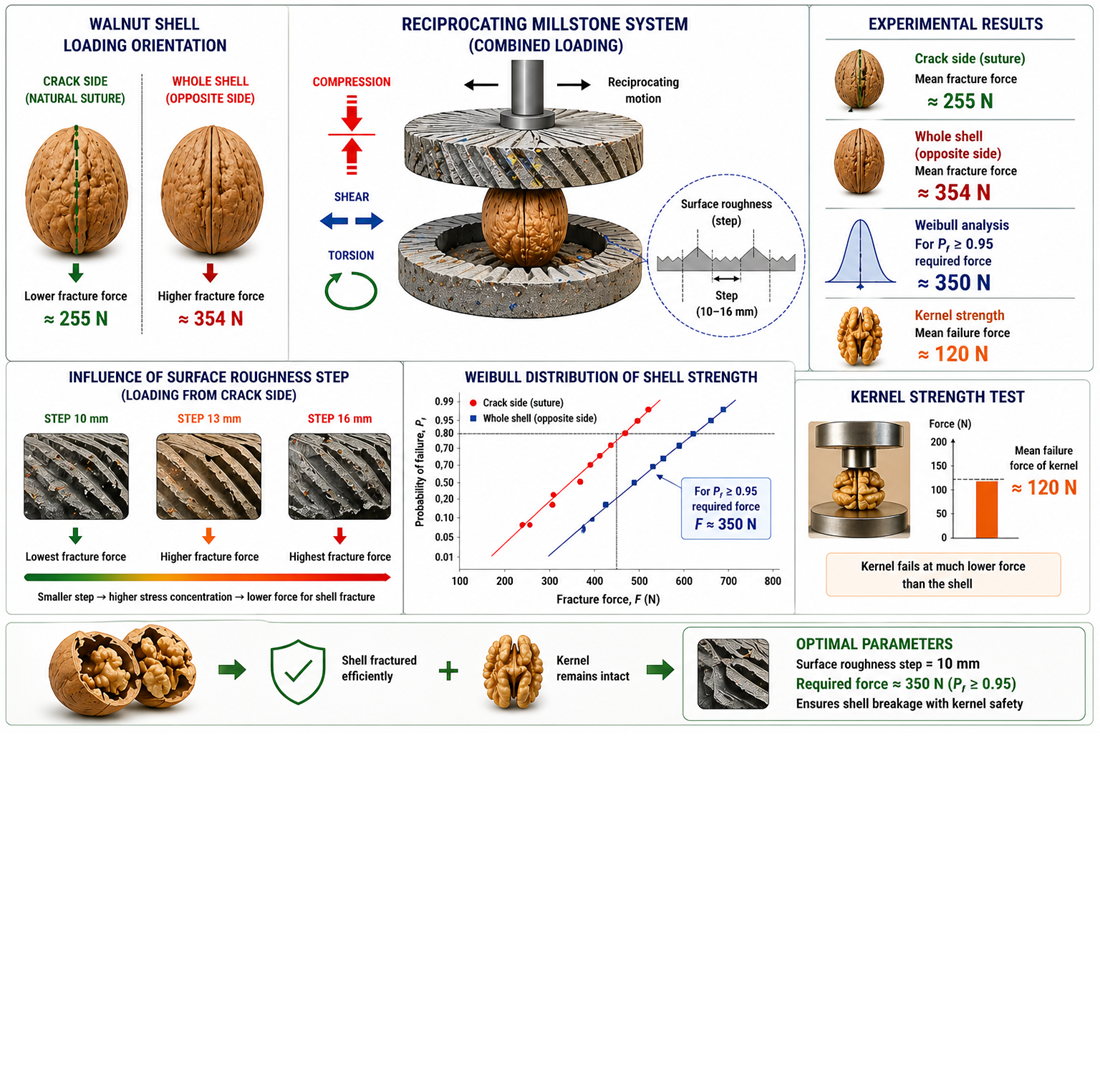
This study explores the process of shell fracture in a locally cultivated walnut variety in a reciprocating millstone setup that implements combined compression, shear, and torsion loading. The task addressed is to enable cracking across the entire shell surface while maintaining kernel integrity, which determines the yield of marketable produce.
In the first stage, shell fracture forces were experimentally determined under localized loading from a natural cleft and a whole shell, followed by statistical processing using a two-parameter Weibull distribution. It was found that fracture from the cleft side occurs at lower loads than from the whole shell side, confirming the anisotropy of the shell's mechanical properties.
In the second stage, the effect of roughness pitches of 10, 13, and 16 mm on the fracture force was studied. Experiments have shown that at a 10 mm pitch, fracture occurs with the lowest force; increasing the pitch to 13 and 16 mm increases the fracture force due to a decrease in local stress concentration.
A comparison of the two experimental stages revealed that the geometry of the working surfaces determines the conditions for fracture without changing the general pattern: when loading from a natural cleft, lower forces are required. For a fracture probability of at least 0.95 for any nut orientation, a load of approximately 350 N is required. Additionally, the strength characteristics of the kernel were determined using an ST-2 structure analyzer; the average fracture force under direct loading is approximately 1200 grams (≈ 120 N).
The results provide a mechanically sound basis for selecting the parameters of the working parts of a nut cracking machine and a safe range of operating loads
References
- Bao, X., Chen, B., Dai, P., Li, Y., Mao, J. (2022). Construction and Verification of Spherical Thin Shell Model for Revealing Walnut Shell Crack Initiation and Expansion Mechanism. Agriculture, 12 (9), 1446. https://doi.org/10.3390/agriculture12091446
- Zhang, H., Shen, L., Lan, H., Li, Y., Liu, Y., Tang, Y. et al. (2018). Mechanical properties and finite element analysis of walnut under different cracking parts. International Journal of Agricultural and Biological Engineering, 11 (6), 81–88. https://doi.org/10.25165/j.ijabe.20181106.3309
- Koyuncu, M. A., Ekinci, K., Savran, E. (2004). Cracking Characteristics of Walnut. Biosystems Engineering, 87 (3), 305–311. https://doi.org/10.1016/j.biosystemseng.2003.11.001
- Altuntas, E., Erkol, M. (2009). The Effects of Moisture Content, Compression Speeds, and Axes on Mechanical Properties of Walnut Cultivars. Food and Bioprocess Technology, 4 (7), 1288–1295. https://doi.org/10.1007/s11947-009-0283-y
- Shahbazi, F. (2013). Effective conditions for extracting higher quality kernels from walnuts. Quality Assurance and Safety of Crops & Foods, 5 (3), 199–206. https://doi.org/10.3920/qas2011.0105
- Han, B., Su, G., Zeng, Y., Yang, J., Fan, X., Zhang, Y. et al. (2023). FDEM investigation on the crack propagation characteristics of walnut shell under multi-contact loadings. Frontiers in Materials, 10. https://doi.org/10.3389/fmats.2023.1293683
- Zhang, H., Liu, H., Zeng, Y., Tang, Y., Zhang, Z., Che, J. (2022). Design and Performance Evaluation of a Multi-Point Extrusion Walnut Cracking Device. Agriculture, 12 (9), 1494. https://doi.org/10.3390/agriculture12091494
- Chengmao, C., Si, S., Ran, D., Bing, L., Shuo, W. (2017). Experimental study on mechanical characteristics of nut rupturing under impact loading. International Journal of Agricultural and Biological Engineering, 10 (1), 53–60. https://doi.org/10.3965/j.ijabe.20171001.2331
- Zhang, H., Ji, S., Shao, M., Pu, H., Zhang, L. (2023). Non-Destructive Internal Defect Detection of In-Shell Walnuts by X-ray Technology Based on Improved Faster R-CNN. Applied Sciences, 13 (12), 7311. https://doi.org/10.3390/app13127311
- Chen, S., Dai, D., Zheng, J., Kang, H., Wang, D., Zheng, X. et al. (2023). Intelligent grading method for walnut kernels based on deep learning and physiological indicators. Frontiers in Nutrition, 9. https://doi.org/10.3389/fnut.2022.1075781
- Temov, B. M., Shalbaev, K. K., Askarov, A. D. (2022). Pat. na poleznuyu model No. 10179 RK. Ustanovka dlya ochistki greckih orehov ot skorlupy. published: 14.02.2022, Bul. No. 7.
Downloads
Published
How to Cite
Issue
Section
License
Copyright (c) 2026 Baurzhan Temov, Baurzhan Nurakhmetov, Ardak Askarov, Ilyas Nurakhmetov, Galymzhan Nasrullin

This work is licensed under a Creative Commons Attribution 4.0 International License.
The consolidation and conditions for the transfer of copyright (identification of authorship) is carried out in the License Agreement. In particular, the authors reserve the right to the authorship of their manuscript and transfer the first publication of this work to the journal under the terms of the Creative Commons CC BY license. At the same time, they have the right to conclude on their own additional agreements concerning the non-exclusive distribution of the work in the form in which it was published by this journal, but provided that the link to the first publication of the article in this journal is preserved.
A license agreement is a document in which the author warrants that he/she owns all copyright for the work (manuscript, article, etc.).
The authors, signing the License Agreement with TECHNOLOGY CENTER PC, have all rights to the further use of their work, provided that they link to our edition in which the work was published.
According to the terms of the License Agreement, the Publisher TECHNOLOGY CENTER PC does not take away your copyrights and receives permission from the authors to use and dissemination of the publication through the world's scientific resources (own electronic resources, scientometric databases, repositories, libraries, etc.).
In the absence of a signed License Agreement or in the absence of this agreement of identifiers allowing to identify the identity of the author, the editors have no right to work with the manuscript.
It is important to remember that there is another type of agreement between authors and publishers – when copyright is transferred from the authors to the publisher. In this case, the authors lose ownership of their work and may not use it in any way.








