Improvement of thermal performance of an indirect flat plate solar collector in solar water heater applications
DOI:
https://doi.org/10.15587/1729-4061.2026.358842Keywords:
solar collector, water tank, indirect system, power plant, water heaterAbstract
The object in this study is the process of heat transfer, energy conversion, and heat distribution through solar collectors in indirect systems. The problem to be solved is to develop sustainable alternatives powered by renewable energy sources, such as solar energy
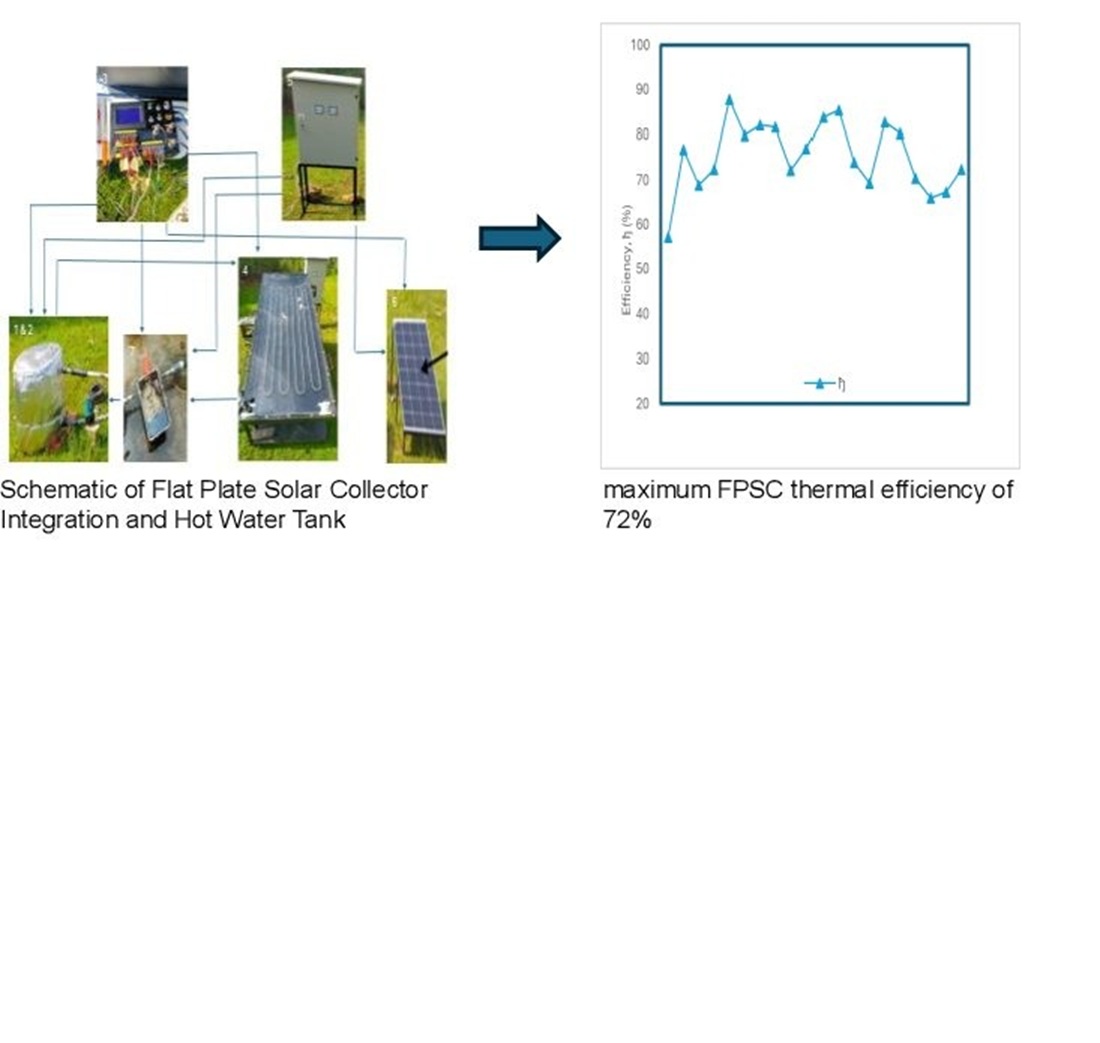
This study is focused on the research of a solar water heater (SWH) system incorporating flat plate solar collectors (FPSC). The system enhances the thermal performance of the FPSC through an indirect, closed-loop configuration. Water from the hot water tank (HWT) is circulated through the FPSC copper pipes by a pump powered by a Solar Power Plant, ensuring continuous heat transfer and efficient thermal performance. The system operates at a flow rate of 0.116 kg/s. A K-type thermocouple connected to a data logger records the water temperatures at the HWT’s inlet and outlet every 30 seconds. In addition to the system, the features of this study also focuses on phase change material (PCM) which uses mannitol material as thermal energy storage (TES) which will be used during cloudy or rainy weather. All equipment such as plunger pumps, heaters for PCM use solar electricity. The feature of this study also uses the Internet of Things (IoT) to find out the temperature in the solar water heater tank. The test results indicate a maximum FPSC thermal efficiency of 72% and a coefficient of performance (COP) of 10 under a pump power of 100 W and an absorbed heat input of 1000 W. The average solar irradiance ranged from 850 to 950 W/m2. These results demonstrate the potential of this technology to efficiently meet domestic hot-water demand and its suitability for deployment in tropical regions.
References
- Syahbana, M. S. L., Kurniawan, Y., Ismail, I. (2024). Experimental Study on the Effect of Different HTF Discharges to Increase Efficiency of a Latent Heat Storage System Using a Spiral Coil Heat Exchanger with Different Fins. International Journal of Thermophysics, 45 (6). https://doi.org/10.1007/s10765-024-03373-9
- Waluyo, J., Dhewangga Putra, R. D., Chandra Adhitya, D., Rahman, R. A. (2025). Parametric operational analysis of hybrid thermo-electric/fluid-active thermal storage for domestic water heating system. Solar Energy Materials and Solar Cells, 286, 113575. https://doi.org/10.1016/j.solmat.2025.113575
- Gunjo, D. G., Mahanta, P., Robi, P. S. (2017). CFD and experimental investigation of flat plate solar water heating system under steady state condition. Renewable Energy, 106, 24–36. https://doi.org/10.1016/j.renene.2016.12.041
- Salman, B., Sanaa Hassan Obaid. (2025). Enhanced Performance of Flat Plate Solar Collector with Twisted Tape Double Cutting Rectangle Shape. Journal of Engineering and Sustainable Development, 29 (1), 68–78. https://doi.org/10.31272/jeasd.3128
- Pambudi, N. A., Nanda, I. R., Putri, A. E., Salsala, R. N., Aziz, M., Rudiyanto, B., Wiyono, A. (2024). An experimental investigation of various trickle collector structures to enhance solar water heater efficiency. Cleaner Engineering and Technology, 21, 100789. https://doi.org/10.1016/j.clet.2024.100789
- Naveenkumar, R., Venkateshkumar, R., Mohanavel, V., Franklin, C., Ismail, S. O., Ravichandran, M. et al. (2025). Recent developments in solar water heaters and solar collectors: A review on experimental and neural network analyses. Results in Engineering, 25, 104394. https://doi.org/10.1016/j.rineng.2025.104394
- Alwan, N. T., Majeed, M. H., Khudhur, I. M., Shcheklein, S. E., Ali, O. M., Yaqoob, S. J., Alayi, R. (2022). Assessment of the performance of solar water heater: an experimental and theoretical investigation. International Journal of Low-Carbon Technologies, 17, 528–539. https://doi.org/10.1093/ijlct/ctac032
- Dhairiyasamy, R., Rajendran, S., Khan, S. A., Aziz Alahmadi, A., Alwetaishi, M., Ağbulut, Ü. (2024). Enhancing thermal efficiency in flat plate solar collectors through internal barrier optimization. Thermal Science and Engineering Progress, 54, 102856. https://doi.org/10.1016/j.tsep.2024.102856
- Amirgaliyev, Y., Kunelbayev, M., Kalizhanova, A., Amirgaliyev, B., Kozbakova, A., Auelbekov, O., Kataev, N. (2019). Study of convective heat transfer in flat plate solar collectors. ITM Web of Conferences, 24, 1009. https://doi.org/10.1051/itmconf/20192401009
- Lin, X., Xia, Y., Cheng, Z., Liu, X., Fu, Y., Li, L., Zhou, W. (2024). Thermal Performance Analysis of Porous Foam-Assisted Flat-Plate Solar Collectors with Nanofluids. Sustainability, 16 (2), 693. https://doi.org/10.3390/su16020693
- Rashid, F. L., Al-Obaidi, M. A., Aljibori, H. S., Mohammed, H. I., Mahdi, A. J., Al-Rubaye, A. H. et al. (2025). Recent advancement in hybrid nanofluids used in flat plate solar collectors and future prospects. Ministry of Science and Technology, Vietnam, 67 (1). https://doi.org/10.31276/vjste.2024.0065
- Abduljleel, M. A., Yasin, N. J., Ghadhban, S. A., Soomro, S. A. (2024). Performance Improving for the Flat Plate Solar Collectors by Using Nanofluids: Review Study. Journal of Techniques, 6 (1), 52–68. https://doi.org/10.51173/jt.v6i1.1891
- Taupek, M. M. M., Awang, M., Ruddin, N. M. B., Hamidon, N., Ahmad, F., Lukiyanto, K. (2025). Performance Evaluation of Energy Collection Using Various Solar Flat Plate Collectors. International Journal of Research and Innovation in Social Science, IX (I), 4209–4220. https://doi.org/10.47772/ijriss.2025.9010328
- Kadam, T. V., Pakhare, S. Y., Godse, A. B. (2025). Performance analysis of solar thermal collectors: A comprehensive review. Measurement: Energy, 7, 100059. https://doi.org/10.1016/j.meaene.2025.100059
- Suyitno, B. M., Ismail, Rahman, R. A. (2023). Improving the performance of a small-scale cascade latent heat storage system by using gradual melting temperature storage tank. Case Studies in Thermal Engineering, 45, 103034. https://doi.org/10.1016/j.csite.2023.103034
- Chekerovska, M., Filkoski, R. (2015). Efficiency of liquid flat-plate solar energy collector with solar tracking system. Thermal Science, 19 (5), 1673–1684. https://doi.org/10.2298/tsci150427099c
- Anshori Hasibuan, A. I., Nurdin, R., Ismail, I., Rahman, R. A. (2025). Experimental evaluation of hybrid electric-heat operation for reliable residential water heating technology using photo-thermal system. Journal of Thermal Engineering, 11 (6), 1717–1728. https://doi.org/10.14744/thermal.0001027
Downloads
Published
How to Cite
Issue
Section
License
Copyright (c) 2026 Mochamad Sugiri, Budhi Muliawan Suyitno, Erlanda Augupta Pane, Gunadi Haryanto, Ismail Ismail

This work is licensed under a Creative Commons Attribution 4.0 International License.
The consolidation and conditions for the transfer of copyright (identification of authorship) is carried out in the License Agreement. In particular, the authors reserve the right to the authorship of their manuscript and transfer the first publication of this work to the journal under the terms of the Creative Commons CC BY license. At the same time, they have the right to conclude on their own additional agreements concerning the non-exclusive distribution of the work in the form in which it was published by this journal, but provided that the link to the first publication of the article in this journal is preserved.
A license agreement is a document in which the author warrants that he/she owns all copyright for the work (manuscript, article, etc.).
The authors, signing the License Agreement with TECHNOLOGY CENTER PC, have all rights to the further use of their work, provided that they link to our edition in which the work was published.
According to the terms of the License Agreement, the Publisher TECHNOLOGY CENTER PC does not take away your copyrights and receives permission from the authors to use and dissemination of the publication through the world's scientific resources (own electronic resources, scientometric databases, repositories, libraries, etc.).
In the absence of a signed License Agreement or in the absence of this agreement of identifiers allowing to identify the identity of the author, the editors have no right to work with the manuscript.
It is important to remember that there is another type of agreement between authors and publishers – when copyright is transferred from the authors to the publisher. In this case, the authors lose ownership of their work and may not use it in any way.








