Improving the inductively coupled plasma technological process of aluminum powder spheroidization
DOI:
https://doi.org/10.15587/1729-4061.2026.359307Keywords:
spheroidization, aluminum powder, additive manufacturing, simulation, inductively coupled plasmaAbstract
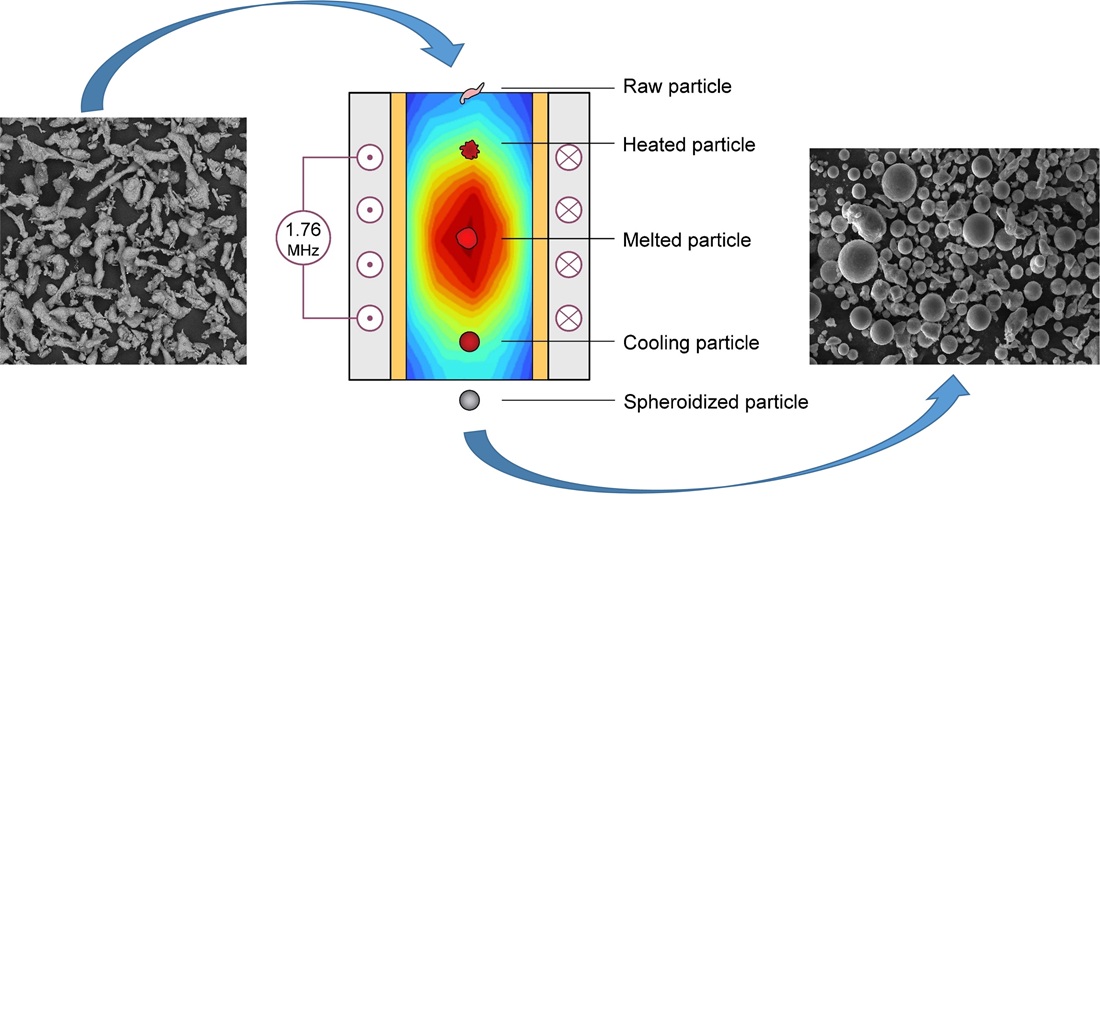
This study explores the process of the inductively coupled plasma spheroidization of aluminum powder. The task addressed relates to the complexity of spheroidization of low-melting materials, as well as to the growing need to use spheroidized powders from new materials in additive manufacturing, powder metallurgy, and gas-thermal coating.
To define the process of particle spheroidization, a comprehensive approach was used, including experimental studies, analytical description of thermal processes, and numerical modeling using the COMSOL Multiphysics software environment.
Based on the simulation results, parameters of the inductively coupled plasma, the regularities of heating, melting and crystallization of aluminum powder particles were determined. It was found that the full cycle of heating to the melting temperature and phase transition occurs over an extremely short time – on the order of 10-5 s to 10-4 s for a particle with a diameter of 50 μm. The temperature gradients inside the particles are insignificant, which contributes to their uniform melting and the formation of a spherical shape under the influence of surface tension forces. The key factors of the process are the plasma temperature and the time the particles spend in the high-temperature zone.
The simulation results made it possible to establish technological modes of spheroidization: inductor current 40–42 A, current frequency 1.76 MHz, gas flow rate 5 l/s, gas pressure at the plasmatron inlet 13×10-3 MPa. The adequacy of the proposed modeling was confirmed by obtaining aluminum powder with a high degree of spheroidization (from 95% to 98%).
The model built could be used to predict the process parameters and its further optimization in order to obtain spherical powders from other materials and fractions
References
- Vafadar, A., Guzzomi, F., Rassau, A., Hayward, K. (2021). Advances in Metal Additive Manufacturing: A Review of Common Processes, Industrial Applications, and Current Challenges. Applied Sciences, 11 (3), 1213. https://doi.org/10.3390/app11031213
- Boulos, M. (2004). Plasma power can make better powders. Metal Powder Report, 59 (5), 16–21. https://doi.org/10.1016/s0026-0657(04)00153-5
- Vert, R., Pontone, R., Dolbec, R., Dionne, L., Boulos, M. I. (2016). Induction Plasma Technology Applied to Powder Manufacturing: Example of Titanium-Based Materials. Key Engineering Materials, 704, 282–286. https://doi.org/10.4028/www.scientific.net/kem.704.282
- Getto, E., Santucci, R. J., Gibbs, J., Link, R., Retzlaff, E., Baker, B. et al. (2023). Powder plasma spheroidization treatment and the characterization of microstructure and mechanical properties of SS 316L powder and L-PBF builds. Heliyon, 9 (6), e16583. https://doi.org/10.1016/j.heliyon.2023.e16583
- Sehhat, M. H., Sutton, A. T., Hung, C.-H., Brown, B., O’Malley, R. J., Park, J., Leu, M. C. (2022). Plasma spheroidization of gas-atomized 304L stainless steel powder for laser powder bed fusion process . Materials Science in Additive Manufacturing, 1 (1), 1. https://doi.org/10.18063/msam.v1i1.1
- Yanko, T., Ovchinnikov, A., Lyutyk, N., Korzhyk, V. (2018). Technology for obtaining of plasma spheroidised hdh titanium alloy powders used in 3D printing. Technological Systems, 85 (4). https://doi.org/10.29010/085.7
- Bao, Q., Yang, Y., Wen, X., Guo, L., Guo, Z. (2021). The preparation of spherical metal powders using the high-temperature remelting spheroidization technology. Materials & Design, 199, 109382. https://doi.org/10.1016/j.matdes.2020.109382
- Kuzmichev, A., Maikut, S., Sydorenko, S. (2024). Study of Near-Threshold Power Discharge in Miniature Low-Pressure Microwave Induction Plasmatron. Radioelectronics and Communications Systems, 67 (3), 157–160. https://doi.org/10.3103/s0735272724010059
- Kuzmichev, A. I., Smirnov, I. V., Tsybulsky, L. Yu. (2025). Study of plasma electron source with multi-cell hollow cathode. Problems of Atomic Science and Technology, 4 (158), 22–24. https://doi.org/10.46813/2025-158-022
- Sharma, S., Krishna, K. V. M., Joshi, S. S., Rabbi, I. A. F., Nartu, M. S. K. K. Y., Banerjee, R., Dahotre, N. B. (2025). Multi-scale numerical modeling of inductively coupled plasma spheroidization of refractory tungsten powders for additive manufacturing. Additive Manufacturing, 105, 104801. https://doi.org/10.1016/j.addma.2025.104801
- Sehhat, M. H., Chandler, J., Yates, Z. (2022). A review on ICP powder plasma spheroidization process parameters. International Journal of Refractory Metals and Hard Materials, 103, 105764. https://doi.org/10.1016/j.ijrmhm.2021.105764
- Iovane, P., Borriello, C., Pandolfi, G., Portofino, S., Rametta, G., Tammaro, L. et al. (2024). Thermal Plasma Spheroidization and Characterization of Stainless Steel Powders Using Direct Current Plasma Technology. Plasma, 7 (1), 76–90. https://doi.org/10.3390/plasma7010006
- Yu, X., Yang, J., Wang, G., Yu, Q., Deng, Y., Yu, W. (2025). Study on the Preparation of Metallic Aluminum Powder by Nitrogen Atomization. Processes, 13 (10), 3264. https://doi.org/10.3390/pr13103264
- Andreytsev, А. Yu., Smyrnov, I. V., Chornyi, A. V., Minakov, S. N. (2021). Modeling the process of spheroidization powder particles by the plasma-arc method. Applied Questions of Mathematical Modeling, 4 (2.2), 25–32. https://doi.org/10.32782/kntu2618-0340/2021.4.2.2.2
- COMSOL Multiphysics®. Available at: https://www.comsol.com
Downloads
Published
How to Cite
Issue
Section
License
Copyright (c) 2026 Mykola Lyutyk, Mykola Skulskyi, Serhii Maikut, Anatoly Kuzmichev, Valeriy Pashchenko, Volodymyr Lysak, Andrii Chornyi, Ihor Sіеliverstov, Igor Smirnov

This work is licensed under a Creative Commons Attribution 4.0 International License.
The consolidation and conditions for the transfer of copyright (identification of authorship) is carried out in the License Agreement. In particular, the authors reserve the right to the authorship of their manuscript and transfer the first publication of this work to the journal under the terms of the Creative Commons CC BY license. At the same time, they have the right to conclude on their own additional agreements concerning the non-exclusive distribution of the work in the form in which it was published by this journal, but provided that the link to the first publication of the article in this journal is preserved.
A license agreement is a document in which the author warrants that he/she owns all copyright for the work (manuscript, article, etc.).
The authors, signing the License Agreement with TECHNOLOGY CENTER PC, have all rights to the further use of their work, provided that they link to our edition in which the work was published.
According to the terms of the License Agreement, the Publisher TECHNOLOGY CENTER PC does not take away your copyrights and receives permission from the authors to use and dissemination of the publication through the world's scientific resources (own electronic resources, scientometric databases, repositories, libraries, etc.).
In the absence of a signed License Agreement or in the absence of this agreement of identifiers allowing to identify the identity of the author, the editors have no right to work with the manuscript.
It is important to remember that there is another type of agreement between authors and publishers – when copyright is transferred from the authors to the publisher. In this case, the authors lose ownership of their work and may not use it in any way.








