Design of a consolidated swirler monopart structure by optimizing the processes of micrometallurgical layer-to-layer fusion of heat-resistant alloys
DOI:
https://doi.org/10.15587/1729-4061.2026.359455Keywords:
additive technologies, L-PBF, swirler, combustion chamber, gas turbine engine, CFD simulationAbstract
This study investigates air flow characteristics and the temperature field in the combustion chamber, which are determined by the geometry of the swirler. The task addressed is predetermined by the fact that swirlers manufactured by conventional casting methods with subsequent assembly are characterized by significant geometric deviations of the flow-through elements. This leads to a dispersion of air flow along the contours, a violation of the uniformity of the fuel-air mixture and, as a result, to increased circular unevenness of the temperature field at the outlet of the combustion chamber, which reduces the resource and reliability of engine operation.
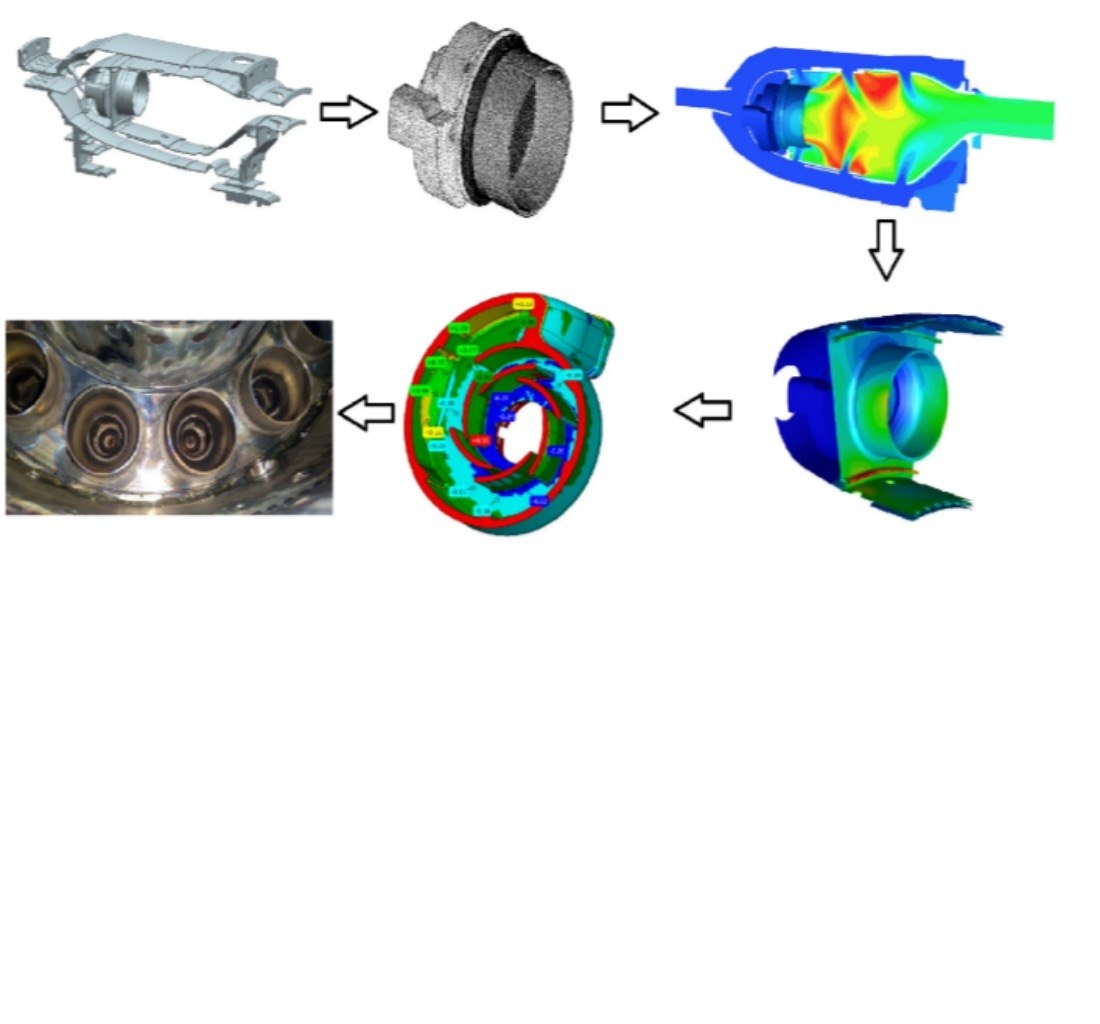
In this work, three-dimensional simulation of the swirler was performed using the Unigraphics NX CAD system; a numerical CFD analysis of processes in the combustion chamber was carried out. Experimental studies on geometric deviations and air flow rates for swirlers manufactured by the conventional casting method and the additive method L-PBF (Laser Powder Bed Fusion) were conducted. The geometric accuracy was assessed using a 3-D scanning method with comparison with a digital model; the flow characteristics were determined by bench tests during the purging of the air and fuel circuits, as well as during the combined operation of the circuits.
It was found that the swirlers manufactured using the L-PBF method provide air flow stability within ±1.5%, which is a better indicator compared to cast analogs. That has made it possible to reduce the circular unevenness of the combustion chamber temperature field to 12.5–18.9% with an allowable value of no more than 21%.
The results confirm the feasibility of using additive technologies for the manufacture of swirlers for combustion chambers in gas turbine engines
References
- Lefebvre, A. H., Ballal, D. R. (2010). Gas Turbine Combustion. CRC Press. https://doi.org/10.1201/9781420086058
- Turns, S. R. (2012). An Introduction to Combustion: Concepts and Applications. McGraw-Hill, 736. Available at: https://www.academia.edu/40886924/An_Introduction_To_Combustion_Concepts_And_Applications_
- Poinsot, T., Veynante, D. (2005). Theoretical and Numerical Combustion. R.T. Edwards, 540. Available at: https://www.researchgate.net/publication/248068931_Theoretical_and_Numerical_Combustion
- Pitsch, H. (2006). Large-eddy simulation of turbulent combustion. Annual Review of Fluid Mechanics, 38 (1), 453–482. https://doi.org/10.1146/annurev.fluid.38.050304.092133
- Lieuwen, T. C., Yang, V. (2006). Combustion Instabilities In Gas Turbine Engines. American Institute of Aeronautics and Astronautics. https://doi.org/10.2514/4.866807
- Mattingly, J. D. (2002). Elements of Gas Turbine Propulsion. AIAA Education Series, 945. Available at: https://soaneemrana.org/onewebmedia/ELEMENTS%20OF%20GAS%20TURBINE%20PROPULTION2.pdf
- Frazier, W. E. (2014). Metal Additive Manufacturing: A Review. Journal of Materials Engineering and Performance, 23 (6), 1917–1928. https://doi.org/10.1007/s11665-014-0958-z
- Herzog, D., Seyda, V., Wycisk, E., Emmelmann, C. (2016). Additive manufacturing of metals. Acta Materialia, 117, 371–392. https://doi.org/10.1016/j.actamat.2016.07.019
- Spierings, A. B., Herres, N., Levy, G. (2011). Influence of the particle size distribution on surface quality and mechanical properties in AM steel parts. Rapid Prototyping Journal, 17 (3), 195–202. https://doi.org/10.1108/13552541111124770
- Vodennikova, O. S., Koval, M. O., Vodennikov, S. A. (2021). Investigation of Mechanical Properties and Structure of Inconel 718 Alloy Obtained by Selective Laser Sintering from Powder Produced by ‘LPW’. Metallofizika I Noveishie Tekhnologii, 43 (7), 925–937. https://doi.org/10.15407/mfint.43.07.0925
- Launder, B. E., Spalding, D. B. (1972). Lectures in Mathematical Models of Turbulence. London: Academic Press, 169.
- Burke, S. P., Schumann, T. E. W. (1928). Diffusion Flames. Industrial & Engineering Chemistry, 20 (10), 998–1004. https://doi.org/10.1021/ie50226a005
- Pope, S. B. (1976). The probability approach to the modelling of turbulent reacting flows. Combustion and Flame, 27, 299–312. https://doi.org/10.1016/0010-2180(76)90035-3
- Crowe, C. T. (1982). Review – Numerical Models for Dilute Gas-Particle Flows. Journal of Fluids Engineering, 104 (3), 297–303. https://doi.org/10.1115/1.3241835
- van Leer, B. (1997). Towards the Ultimate Conservative Difference Scheme. Journal of Computational Physics, 135 (2), 229–248. https://doi.org/10.1006/jcph.1997.5704
- Turbomeca uses metal additive manufacturing for helicopter engine components. Available at: https://www.metal-am.com/turbomeca-uses-metal-additive-manufacturing-for-helicopter-engine-components/
- Pedash, A. A., Klochykhin, V. V., Lysenko, N. A., Shilo, V. G., Kasay, P. A. (2019). Influence of the powder manufacturing technique on the structure and properties of the SLM-parts. Bulletin of Engine Building, 2, 31–39. Available at: https://www.google.com/url?sa=t&rct=j&q=&esrc=s&source=web&cd=&ved=2ahUKEwjln6bLjo6UAxW9ywIHHX86JYgQFnoECBYQAQ&url=https%3A%2F%2Fvd.zp.edu.ua%2Farticle%2Fview%2F180255%2F180181&usg=AOvVaw1kuOs1mY5xtbSOyCCDmrKp&opi=89978449
- Klochikhin, V. V., Kasai, P. A., Naumyk, V. V. (2022). Structure and Properties of Material of Samples, Cultivated by Selective Laser Melting of In718 Alloy Powder after Hot Isostatic Pressing and Subsequent Heat Treatment. Casting Processes, 147 (1), 19–29. https://doi.org/10.15407/plit2022.01.019
- Klochikhin, V. V., Kasay, P. A., Balushok, K. B., Shilo, V. G., Naumyk, V. V. (2021). Study of the Material Quality of Samples Obtained by Selective Laser Melting (SLM) Method from IN718 Alloy Powder. Casting Processes, 144 (2), 12–22. https://doi.org/10.15407/plit2021.02.012
- WZ16/Ardiden 3C. ENGINES. Safran-Group JSC. Available at: https://www.safran-group.com/products-services/ardiden-3c-first-jointly-developed-aero-engine-be-entirely-certified-china
- Nozzles Ariane 6. Ariane-Group JSC. Available at: https://www.ariane.group/en/space-transportation/ariane-6/
- Hahn, J. (2020). Hyperganic uses AI to design 3D-printed rocket engine. Available at: https://www.dezeen.com/2020/03/30/hyperganic-ai-rocket-engine-3d-printed/
- D printing a rocket engine. Available at: https://www.etmm-online.com/3d-printing-arocket-engine-a-886960/
- Giant Satellite Fuel Tank Sets New Record for 3-D Printed Space Parts. Available at: https://news.lockheedmartin.com/2018-07-11-Giant-Satellite-Fuel-Tank-Sets-New-Record-for-3-D-Printed-Space-Parts#assets_115
- Yadroitsev, I., Yadroitsava, I., du Plessis, A., MacDonald, E. (2021). Fundamentals of Laser Powder Bed Fusion of Metals. Elsevier, 654. Available at: https://www.researchgate.net/publication/350007655_Fundamentals_of_Laser_Powder_Bed_Fusion_of_Metals
- Kuts, D., Yefanov, V., Halienkova, O., Ovchynnykov, O., Tepla, T., Lemishka, I., Mierzwiński, D. (2025). Additive technologies for manufacturing swirlers of the combustion chamber of aircraft engines from nickel superalloy powders. Archives of Materials Science and Engineering. https://doi.org/10.5604/01.3001.0055.0368
Downloads
Published
How to Cite
Issue
Section
License
Copyright (c) 2026 Volodymyr Yefanov, Oleh Kalinichenko, Dmytro Kuts, Oleg Ovchynnykov, Hanna Laptieva

This work is licensed under a Creative Commons Attribution 4.0 International License.
The consolidation and conditions for the transfer of copyright (identification of authorship) is carried out in the License Agreement. In particular, the authors reserve the right to the authorship of their manuscript and transfer the first publication of this work to the journal under the terms of the Creative Commons CC BY license. At the same time, they have the right to conclude on their own additional agreements concerning the non-exclusive distribution of the work in the form in which it was published by this journal, but provided that the link to the first publication of the article in this journal is preserved.
A license agreement is a document in which the author warrants that he/she owns all copyright for the work (manuscript, article, etc.).
The authors, signing the License Agreement with TECHNOLOGY CENTER PC, have all rights to the further use of their work, provided that they link to our edition in which the work was published.
According to the terms of the License Agreement, the Publisher TECHNOLOGY CENTER PC does not take away your copyrights and receives permission from the authors to use and dissemination of the publication through the world's scientific resources (own electronic resources, scientometric databases, repositories, libraries, etc.).
In the absence of a signed License Agreement or in the absence of this agreement of identifiers allowing to identify the identity of the author, the editors have no right to work with the manuscript.
It is important to remember that there is another type of agreement between authors and publishers – when copyright is transferred from the authors to the publisher. In this case, the authors lose ownership of their work and may not use it in any way.








