Designing an adaptive-predictive system to control hydrodynamic modes of oil transportation
DOI:
https://doi.org/10.15587/1729-4061.2026.359626Keywords:
Kalman filter, recursive identification, control over hydrodynamic modes, adaptive control, mathematical modelAbstract
This study investigates the process of automated control over the operation of pumping stations along the main oil pipeline during start-up, stop, and pressure maintenance while oil pumping. Disturbances are considered as deterministic parametric variations of the coefficient of hydraulic resistance, which depend on changes in pressures, flows, including oil viscosity.
A control system has been designed that solves the problem of integrating recursive identification of model parameters with predictive formation of control effects in a single loop that covers start-up, operating mode, and compensation for disturbances. The main idea of automation is to transfer the functions of controlling the oil pipeline from pumping station operators to the dispatch center.
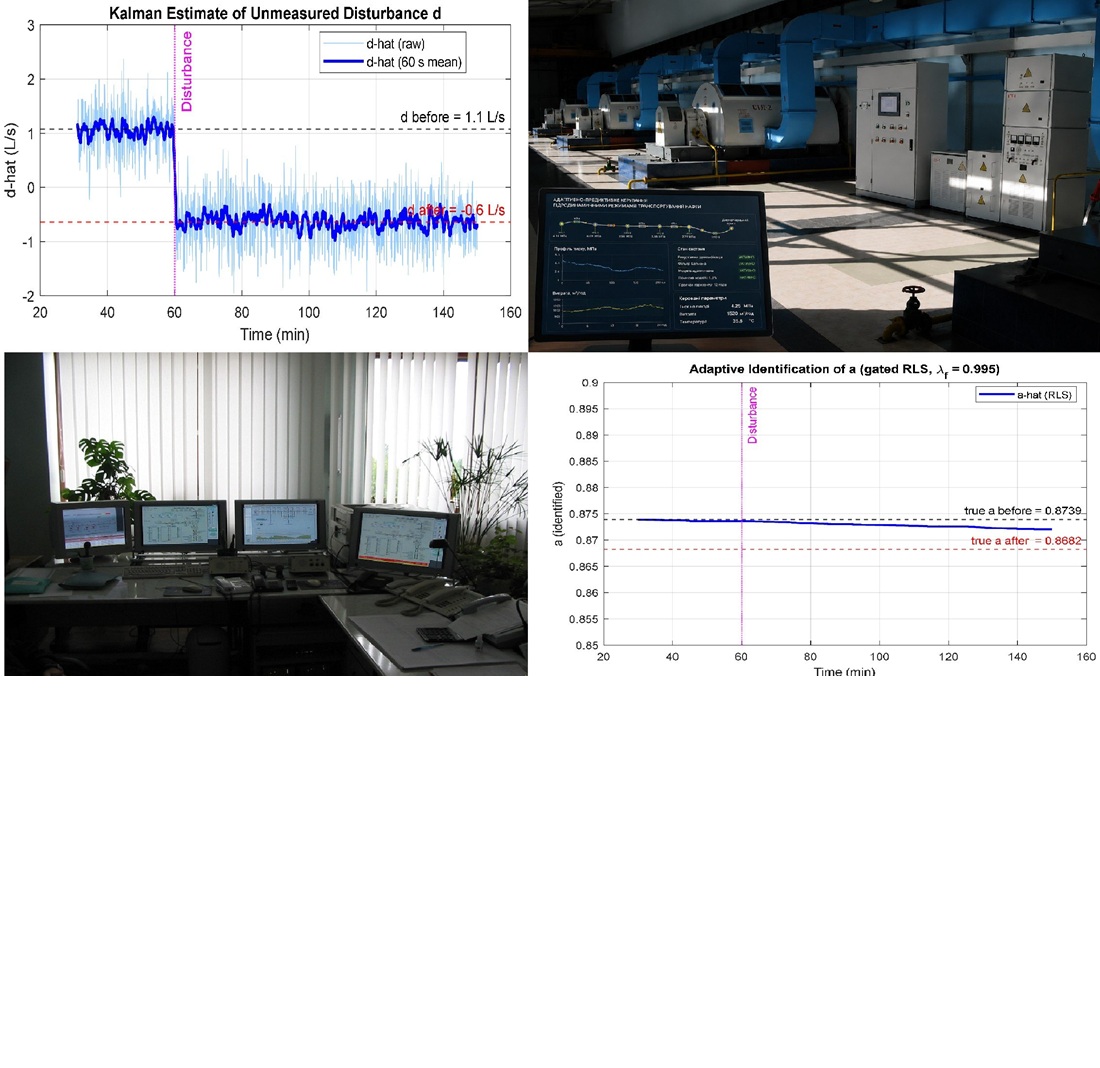
An adaptive-predictive control structure has been proposed that combines recursive identification of parameters, state assessment, and optimization predictive formation of control effects. The system integrates a Kalman filter for real-time state assessment and a module for recursive updating of model parameters. This provides online adaptation of the mathematical model of the facility without personnel intervention.
The application of the proposed approach reduces the accumulation of the integrated error in flow control under the operating mode by approximately 87 percent. After a viscosity jump, the flow does not go beyond the technological tolerance of ± 2 percent. The improvement in control quality is explained by the system's capability to predict the dynamics of the facility and compensate for uncertainties before their impact on the controlled variables. The algorithm automatically processes the full cycle: controlled start-up, entry into the operating mode, and maintaining pressures within the specified limits.
The results could be implemented in SCADA systems for oil pumping stations to be controlled from the dispatch center. This would increase the economic efficiency and stability of oil transportation modes
References
- Chaudhry, M. H. (2014). Applied Hydraulic Transients. Springer New York. https://doi.org/10.1007/978-1-4614-8538-4
- Zeghadnia, L., Robert, J. L., Achour, B. (2019). Explicit solutions for turbulent flow friction factor: A review, assessment and approaches classification. Ain Shams Engineering Journal, 10 (1), 243–252. https://doi.org/10.1016/j.asej.2018.10.007
- Tentis, E., Margaris, D., Papanikas, D. (2003). Transient gas flow simulation using an Adaptive Method of Lines. Comptes Rendus. Mécanique, 331 (7), 481–487. https://doi.org/10.1016/s1631-0721(03)00106-2
- Muñoz, J. A. D., Ancheyta, J., Castañeda, L. C. (2016). Required Viscosity Values To Ensure Proper Transportation of Crude Oil by Pipeline. Energy & Fuels, 30 (11), 8850–8854. https://doi.org/10.1021/acs.energyfuels.6b01908
- Azizi, N., Homayoon, R., Hojjati, M. R. (2018). Predicting the Colebrook–White Friction Factor in the Pipe Flow by New Explicit Correlations. Journal of Fluids Engineering, 141 (5). https://doi.org/10.1115/1.4041232
- Simon, D. (2006). Optimal State Estimation. Wiley. https://doi.org/10.1002/0470045345
- Simon, D. (2010). Kalman filtering with state constraints: a survey of linear and nonlinear algorithms. IET Control Theory & Applications, 4 (8), 1303–1318. https://doi.org/10.1049/iet-cta.2009.0032
- Borase, R. P., Maghade, D. K., Sondkar, S. Y., Pawar, S. N. (2020). A review of PID control, tuning methods and applications. International Journal of Dynamics and Control, 9 (2), 818–827. https://doi.org/10.1007/s40435-020-00665-4
- Wang, L. (2004). A Tutorial on Model Predictive Control: Using a Linear Velocity‐Form Model. Developments in Chemical Engineering and Mineral Processing, 12 (5-6), 573–614. https://doi.org/10.1002/apj.5500120511
- Qin, S. J., Badgwell, T. A. (2003). A survey of industrial model predictive control technology. Control Engineering Practice, 11 (7), 733–764. https://doi.org/10.1016/s0967-0661(02)00186-7
- Mayne, D. Q., Rawlings, J. B., Rao, C. V., Scokaert, P. O. M. (2000). Constrained model predictive control: Stability and optimality. Automatica, 36 (6), 789–814. https://doi.org/10.1016/s0005-1098(99)00214-9
- Zeng, W., Wang, C., Yang, J. (2022). Hydraulic Transient Simulation of Pipeline-Open Channel Coupling Systems and Its Applications in Hydropower Stations. Water, 14 (18), 2897. https://doi.org/10.3390/w14182897
- Allgöwer, F., Zheng, A. (Eds.) (2000). Nonlinear Model Predictive Control. Birkhäuser Basel. https://doi.org/10.1007/978-3-0348-8407-5
- Gopalakrishnan, A., Kaisare, N. S., Narasimhan, S. (2011). Incorporating delayed and infrequent measurements in Extended Kalman Filter based nonlinear state estimation. Journal of Process Control, 21 (1), 119–129. https://doi.org/10.1016/j.jprocont.2010.10.013
- Ljung, L. (1998). System Identification. Signal Analysis and Prediction, 163–173. https://doi.org/10.1007/978-1-4612-1768-8_11
- Ioannou, P., Fidan, B. (2006). Adaptive Control Tutorial. SIAM. https://doi.org/10.1137/1.9780898718652
- Gülich, J. F. (2014). Centrifugal Pumps. Springer Berlin Heidelberg. https://doi.org/10.1007/978-3-642-40114-5
- Bikmukhametov, T., Jäschke, J. (2020). Combining machine learning and process engineering physics towards enhanced accuracy and explainability of data-driven models. Computers & Chemical Engineering, 138, 106834. https://doi.org/10.1016/j.compchemeng.2020.106834
- Nelles, O. (2001). Nonlinear System Identification. Springer Berlin Heidelberg. https://doi.org/10.1007/978-3-662-04323-3
- Camacho, E. F., Bordons, C. (2007). Model Predictive control. Springer London. https://doi.org/10.1007/978-0-85729-398-5
- Pannocchia, G., Rawlings, J. B. (2003). Disturbance models for offset‐free model‐predictive control. AIChE Journal, 49 (2), 426–437. https://doi.org/10.1002/aic.690490213
Downloads
Published
How to Cite
Issue
Section
License
Copyright (c) 2026 Oleksandr Kuchmystenko, Mykhailo Shavranskyi, Yuriy Puk

This work is licensed under a Creative Commons Attribution 4.0 International License.
The consolidation and conditions for the transfer of copyright (identification of authorship) is carried out in the License Agreement. In particular, the authors reserve the right to the authorship of their manuscript and transfer the first publication of this work to the journal under the terms of the Creative Commons CC BY license. At the same time, they have the right to conclude on their own additional agreements concerning the non-exclusive distribution of the work in the form in which it was published by this journal, but provided that the link to the first publication of the article in this journal is preserved.
A license agreement is a document in which the author warrants that he/she owns all copyright for the work (manuscript, article, etc.).
The authors, signing the License Agreement with TECHNOLOGY CENTER PC, have all rights to the further use of their work, provided that they link to our edition in which the work was published.
According to the terms of the License Agreement, the Publisher TECHNOLOGY CENTER PC does not take away your copyrights and receives permission from the authors to use and dissemination of the publication through the world's scientific resources (own electronic resources, scientometric databases, repositories, libraries, etc.).
In the absence of a signed License Agreement or in the absence of this agreement of identifiers allowing to identify the identity of the author, the editors have no right to work with the manuscript.
It is important to remember that there is another type of agreement between authors and publishers – when copyright is transferred from the authors to the publisher. In this case, the authors lose ownership of their work and may not use it in any way.