Determining the influence of surface energy of polymer films on the wetting and adhesion of flexographic inks
DOI:
https://doi.org/10.15587/1729-4061.2026.360827Keywords:
wetting, adhesion, polymer films, polypropylene, polyethylene terephthalate, surface energy, Owens-Wendt-Rabel-Kaelble (OWRK) methodAbstract
This study investigates the process of wetting and adhesive interaction between flexographic inks and polymer films of different nature and surface structure. An issue related to flexographic printing on polymer films is insufficient surface wettability and low stability of adhesion of the ink layer, which worsens the print quality. This work explores the wetting of the surface of films with liquids of different polarity and with UV flexographic ink.
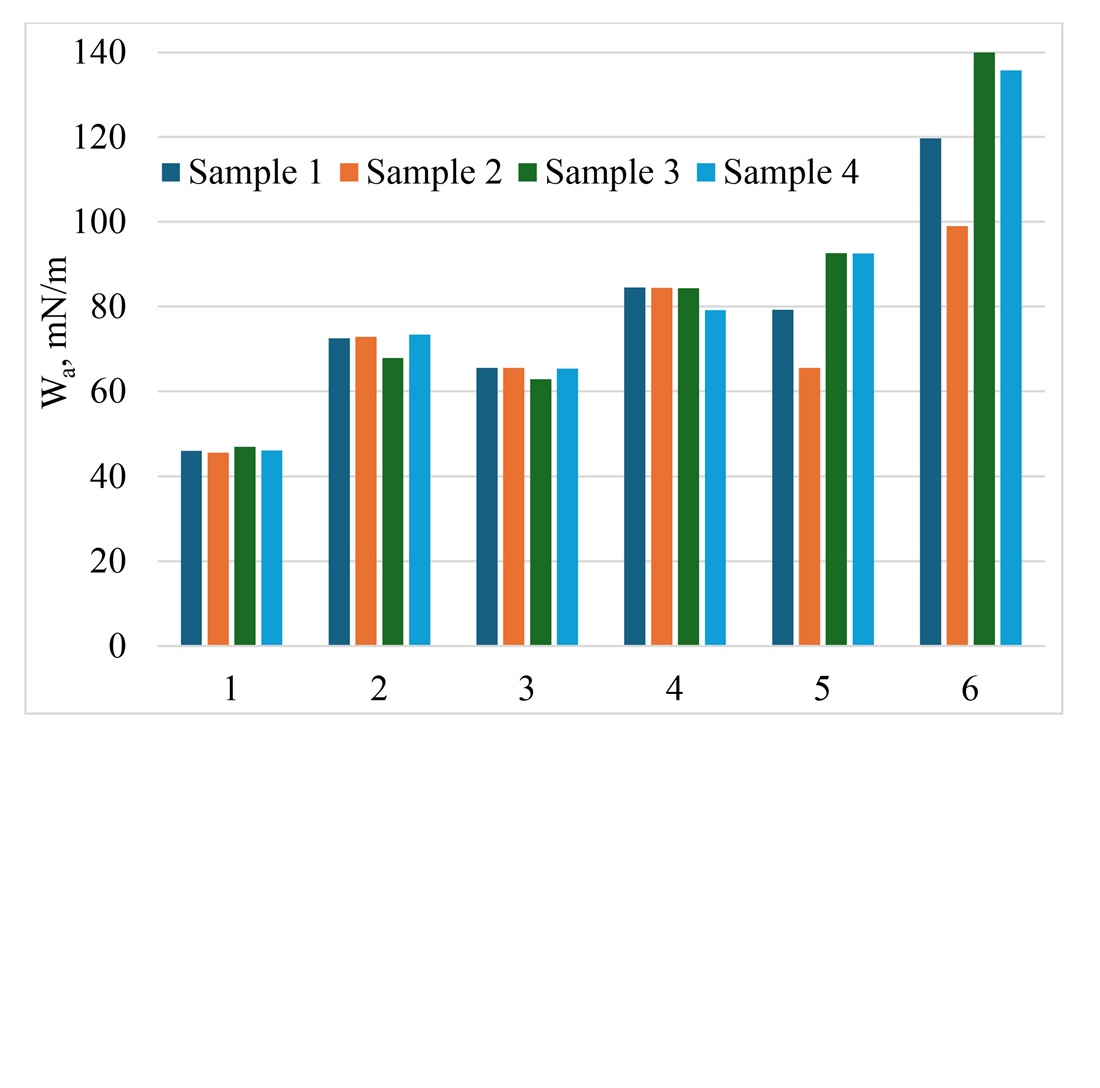
The equilibrium values of the cosine of the wetting angle for non-polar and polar liquids have been experimentally determined. The cosθ values for non-polar liquids are 0.90–0.99, while for polar liquids they decrease to 0.36–0.92 depending on the type of film surface. The thermodynamic characteristics of wetting, in particular the work of adhesion and cohesion, were calculated. It was established that the work of adhesion varies within 45–140 mN/m.
It has been shown that wetting is determined by the ratio of the dispersive and polar components of surface energy. For non-polar liquids, dispersive interactions dominate, while for polar liquids, polar ones. The influence of the structural characteristics of the surface on wetting has been established. The matte polypropylene film is characterized by worse wettability compared to glossy samples.
The components of the surface energy were determined by the Owens-Wendt method, which made it possible to establish their influence on adhesive interaction. The surface energy values of polymer films are 42–53 mN/m, while the proportion of the polar component increases to 0.19 for samples with better wettability. It has been shown that the adhesive behavior of UV flexographic ink is comparable to polar liquids.
The results could be used to predict the wetting of polymer materials and to optimize flexographic printing processes
References
- Aydemir, C., Altay, B. N., Akyol, M. (2020). Surface analysis of polymer films for wettability and ink adhesion. Color Research & Application, 46 (2), 489–499. https://doi.org/10.1002/col.22579
- Wynne, A. C., Smith, M. A., Foley, K., Chu, I.-W., Johnston, M. A., Walters, K. B., Kundu, S. (2025). Improving Water‐Based Ink Adhesion on Commercial Polymers by Corona Treatment. Polymer Engineering & Science, 65 (12), 6823–6835. https://doi.org/10.1002/pen.70167
- Wang, Y., Hansen, C. J., Wu, C.-C., Robinette, E. J., Peterson, A. M. (2021). Effect of surface wettability on the interfacial adhesion of a thermosetting elastomer on glass. RSC Advances, 11 (49), 31142–31151. https://doi.org/10.1039/d1ra05916e
- Wang, D., Cornelius, C. J. (2016). Ionomer thermodynamic interrelationships associated with wettability, surface energy, swelling, and water transport. European Polymer Journal, 85, 126–138. https://doi.org/10.1016/j.eurpolymj.2016.10.024
- Repeta, V. (2013). Influence of surface energy of polymer films on spreading and adhesion of UV-flexo inks. Acta Graphica, 23 (3-4), 79–84. Available at: https://hrcak.srce.hr/en/138185
- Kukura, T. Yu., Varkholyak, V. I. (2024). Adhesive interaction of flexographic inks with the photopolymer printing plate surface. Printing and Publishing, 1 (87), 133–139. https://doi.org/10.32403/0554-4866-2024-1-87-133-139
- Beketov, G. V., Shynkarenko, O. V. (2022). Surface wetting and contact angle: basics and characterisation. Himia, Fizika Ta Tehnologia Poverhni, 13 (1), 3–35. https://doi.org/10.15407/hftp13.01.003
- Owens, D. K., Wendt, R. C. (1969). Estimation of the surface free energy of polymers. Journal of Applied Polymer Science, 13 (8), 1741–1747. https://doi.org/10.1002/app.1969.070130815
- Guo, W., Ye, C., ten Brink, G. H., Loos, K., Svetovoy, V. B., Palasantzas, G. (2021). Tunable wettability of polymer films by partial engulfment of nanoparticles. Physical Review Materials, 5 (1). https://doi.org/10.1103/physrevmaterials.5.015604
- Jorge, A. M. S., Coutinho, J. A. P., Pereira, J. F. B. (2025). Owens-Wendt method as a tool to evaluate polarity of polymer-polymer aqueous two-phase systems. Colloids and Surfaces A: Physicochemical and Engineering Aspects, 726, 138080. https://doi.org/10.1016/j.colsurfa.2025.138080
- Krykhovets, O. V., Slobodyanyk, V. G. (2022). Study of surface properties of biodegrading films based on polyvinyl alcohol. Bulletin of Lviv State University of Life Safety, 25, 13–18. https://doi.org/10.32447/20784643.25.2022.02
- Repeta, V., Kukura, Т., Havrylyshyn, V., Kukura, Y. (2023). Analysis of factors and construction of prognostic quality models of flexographic printing process of packaging with solvent based inks. Journal of Graphic Engineering and Design, 14 (3), 37–44. https://doi.org/10.24867/jged-2023-3-037
- Nogalska, A., Trojanowska, A., Tylkowski, B., Garcia-Valls, R. (2019). Surface characterization by optical contact angle measuring system. Physical Sciences Reviews, 5 (2). https://doi.org/10.1515/psr-2019-0083
- Law, K.-Y., Zhao, H. (2015). Contact Angle Measurements and Surface Characterization Techniques. Surface Wetting, 7–34. https://doi.org/10.1007/978-3-319-25214-8_2
- Chai, J., Ming, C., Zeng, Y., Liu, Z., Sun, Y.-Y. (2025). Surface energy of glass and interfacial energy of glass with metals. Physical Review B, 111 (3). https://doi.org/10.1103/physrevb.111.035433
- Chen, X., Cao, Y., Chen, C., Bian, H., Song, X., Fu, W. et al. (2024). Insight into the wetting behavior and interfacial evolution of Sn-xZr/ZrO2 systems at 850-950 ℃. Journal of the European Ceramic Society, 44 (6), 4008–4017. https://doi.org/10.1016/j.jeurceramsoc.2024.01.029
- Kang, Y., Jung, I.-H. (2024). Model for Surface Tension of Pure Liquid Metals: Revisit to Iida’s Model. Metallurgical and Materials Transactions B, 55 (5), 3698–3710. https://doi.org/10.1007/s11663-024-03209-9
- Zhang, Z., Wang, W., Korpacz, A. N., Dufour, C. R., Weiland, Z. J., Lambert, C. R., Timko, M. T. (2019). Binary Liquid Mixture Contact-Angle Measurements for Precise Estimation of Surface Free Energy. Langmuir, 35 (38), 12317–12325. https://doi.org/10.1021/acs.langmuir.9b01252
- Lide, D. R. (Ed.) (2005). CRC handbook of chemistry and physics. CRC Press. Available at: https://webdelprofesor.ula.ve/ciencias/isolda/libros/handbook.pdf
- Repeta, V. B. (2009). Kompiuterna prohrama «Analiz kinetyky roztikannia ridyn» (Svidotstvo pro avtorske pravo No. 28766). Ukrainska akademiya drukarstva.
- Kłonica, M., Kuczmaszewski, J. (2017). Determining the value of surface free energy on the basis of the contact angle. Advances in Science and Technology Research Journal, 11 (1), 66–74. https://doi.org/10.12913/22998624/68800
- Borah, R., Kumar, A., Das, M. K., Ramteke, A. (2015). Surface functionalization-induced enhancement in surface properties and biocompatibility of polyaniline nanofibers. RSC Advances, 5 (60), 48971–48982. https://doi.org/10.1039/c5ra01809a
- Slobodianyk, V. H., Nazar, I. M., Koniukhova, I. I., Koniukhov, O. D. (2025). Impact of low temperatures and UV irradiation on the mechanical properties of polymer films for packaging. Book Qualilogy, 1 (47), 107–116. https://doi.org/10.32403/2411-3611-2025-1-47-107-116
- Slobodianyk, V. H., Koniukhova, I. I., Koniukhov, O. D. (2025). Determination of surface properties of films for packaging. Book Qualilogy, 2 (48), 175–182. https://doi.org/10.32403/2411-3611-2025-2-48-175-182
Downloads
Published
How to Cite
Issue
Section
License
Copyright (c) 2026 Valentyna Slobodianyk, Ivanna Koniukhova

This work is licensed under a Creative Commons Attribution 4.0 International License.
The consolidation and conditions for the transfer of copyright (identification of authorship) is carried out in the License Agreement. In particular, the authors reserve the right to the authorship of their manuscript and transfer the first publication of this work to the journal under the terms of the Creative Commons CC BY license. At the same time, they have the right to conclude on their own additional agreements concerning the non-exclusive distribution of the work in the form in which it was published by this journal, but provided that the link to the first publication of the article in this journal is preserved.
A license agreement is a document in which the author warrants that he/she owns all copyright for the work (manuscript, article, etc.).
The authors, signing the License Agreement with TECHNOLOGY CENTER PC, have all rights to the further use of their work, provided that they link to our edition in which the work was published.
According to the terms of the License Agreement, the Publisher TECHNOLOGY CENTER PC does not take away your copyrights and receives permission from the authors to use and dissemination of the publication through the world's scientific resources (own electronic resources, scientometric databases, repositories, libraries, etc.).
In the absence of a signed License Agreement or in the absence of this agreement of identifiers allowing to identify the identity of the author, the editors have no right to work with the manuscript.
It is important to remember that there is another type of agreement between authors and publishers – when copyright is transferred from the authors to the publisher. In this case, the authors lose ownership of their work and may not use it in any way.








