Identification of impact of digital technologies on business management systems and reducing innovation risks in the digital age
DOI:
https://doi.org/10.15587/1729-4061.2026.361355Keywords:
digitalization , innovation, management systems, business, economic, features, financial resultsAbstract
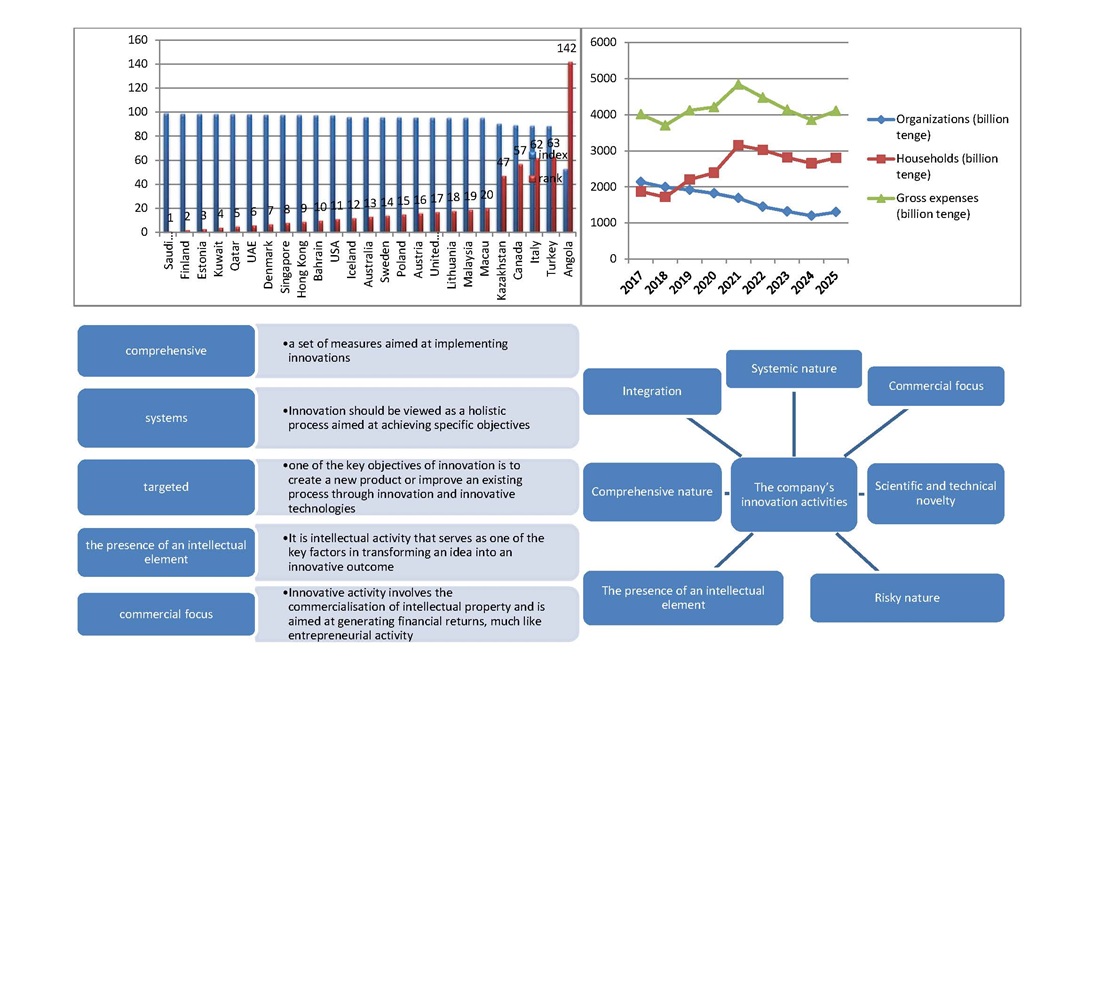
The object of this study is the innovative activity of enterprises and mechanisms for managing innovation risks in the context of the digital transformation of the economy of the Republic of Kazakhstan. The problem to be solved is the cost-effectiveness of integrating digital technologies into innovation risk management systems. This paper examines theoretical approaches to defining innovation activity, broadens its concept, and investigates the impact of digitalization on innovation risk management processes at enterprises. An analysis of the dynamics of the country's gross domestic expenditure, innovation activity indicators, and the international ICT development index was conducted, revealing trends in Republic of Kazakhstan’s sustainable digital development.
The study's results demonstrate that digitalization is a driving force for innovation and a tool for improving the effectiveness of innovation risk management. To this end, the costs associated with the development of the digital economy were analyzed, revealing that these expenditures in the Republic of Kazakhstan increased by 63.8% between 2019 and 2024. The study also found that the level of innovation activity at enterprises increased from 10.1% to 14.2%. A key finding of the study is that the implementation of digital solutions reduces losses from innovation risks by 18–34%, while the economic benefits for enterprises, depending on their size, range from 2.16 to 267.2 thousand USD.
Therefore, the scope of application includes enterprises of various sizes that need to improve their financial performance through the development of various innovation risk management systems and the implementation of digital transformation programs
References
- Smith, A. (1776). An Inquiry into the Nature and Causes of the Wealth of Nations. The Glasgow Edition of the Works and Correspondence of Adam Smith, Vol. 2: An Inquiry into the Nature and Causes of the Wealth of Nations, Vol. 1. https://doi.org/10.1093/oseo/instance.00043218
- Senior, N. W. (1850). Political Economy. London: John Murray. Available at: https://babel.hathitrust.org/cgi/pt?id=nyp.33433007253754&seq=29
- Knight, F. H. (1921). Risk, Uncertainty and Profit. Boston: Houghton Mifflin. Available at: https://papers.ssrn.com/sol3/papers.cfm?abstract_id=1496192
- Marshall, A. (1890). Principles of Economics. London: Macmillan. Available at: https://eet.pixel-online.org/files/etranslation/original/Marshall,%20Principles%20of%20Economics.pdf
- Croitoru, A. (2012). Schumpeter, J.A., 1934 (2008), The Theory of Economic Development: An Inquiry into Profits, Capital, Credit, Interest and the Business Cycle, New Brunswick (U.S.A) and London (U.K.): Transaction Publishers. Journal of Comparative Research In Anthropology and Sociology, 3, 137–148. Available at: https://www.researchgate.net/publication/272398717_Schumpeter_JA_1934_2008_The_Theory_of_Economic_Development_An_Inquiry_into_Profits_Capital_Credit_Interest_and_the_Business_Cycle_New_Brunswick_USA_and_London_UK_Transaction_Publishers
- Drucker, P. F. (1984). Innovation and Entrepreneurship: Practice and Principles. New York: Harper & Row. Available at: https://rudyct.com/InovBis/Peter%20F.%20Drucker%20-%20Innovation%20and%20Entrepreneurship-1985.pdf
- Soete, L., Freeman, C. (2012). The Economics of Industrial Innovation. Routledge. https://doi.org/10.4324/9780203357637
- Oslo Manual 2018: Guidelines for Collecting, Reporting and Using Data on Innovation (2018). The Measurement of Scientific, Technological and Innovation Activities. OECD. https://doi.org/10.1787/9789264304604-en
- Chen, A., Li, L., Shahid, W. (2024). Digital transformation as the driving force for sustainable business performance: A moderated mediation model of market-driven business model innovation and digital leadership capabilities. Heliyon, 10 (8), e29509. https://doi.org/10.1016/j.heliyon.2024.e29509
- Wu, H., Wang, Y. (2024). Digital transformation and corporate risk taking: Evidence from China. Global Finance Journal, 62, 101012. https://doi.org/10.1016/j.gfj.2024.101012
- Sarfraz, M., Ivascu, L., Belu, R., Artene, A. (2021). Accentuating the interconnection between business sustainability and organizational performance in the context of the circular economy: The moderating role of organizational competitiveness. Business Strategy and the Environment, 30 (4), 2108–2118. https://doi.org/10.1002/bse.2735
- Measuring digital development. The ICT Development Index 2025. ITU Publications. Available at: https://www.itu.int/dms_pub/itu-d/opb/ind/D-IND-ICT_MDD-2025-1-PDF-E.pdf
- Huang, H., Wang, C., Wang, L., Yarovaya, L. (2023). Corporate digital transformation and idiosyncratic risk: Based on corporate governance perspective. Emerging Markets Review, 56, 101045. https://doi.org/10.1016/j.ememar.2023.101045
- Oficialnye kursy valyut v srednem za period. Available at: https://nationalbank.kz/ru/news/oficialnye-kursy
- Bureau of National Statistics of the Agency for Strategic Planning and Reforms of the Republic of Kazakhstan for 2017-2025. Available at: https://stat.gov.kz/en/
- Kopbolsyn, B., Jakupova, A., Bazarova, B., Ibyzhanova, A., Abdeshova, A., Tyumambayeva, A., Duskaliyev, A. (2025). Identifying opportunities to improve sustainable supply chains through digital transformation of transport and logistics infrastructure. Eastern-European Journal of Enterprise Technologies, 5 (13 (137)), 62–71. https://doi.org/10.15587/1729-4061.2025.337817
- Ibyzhanova, A., Bogdashkina, I., Jakupova, A., Kopbulsynova, B., Bazarova, B. (2022). Top trends of agriculture in Kazakhstan under transformation of economics. Industrial, Mechanical and Electrical Engineering, 2676, 20001. https://doi.org/10.1063/5.0107512
- Rustenova, E., Ibyzhanova, A., Akhmetzhanova, N., Talapbayeva, G., Yerniyazova, Z., Aidaraliyeva, A. (2025). Strategic modeling of enterprise business processes for successful digital transformation. Business, Management and Economics Engineering, 23 (01), 148–163. https://doi.org/10.3846/bmee.2025.21587
- Dossanova, A., Gabbassova, Z., Tuleugaliyeva, N., Zhangaliyeva, Y., Dzhakupova, A. (2022). Problems and prospects of agricultural development in the West Kazakhstan region. Industrial, Mechanical and Electrical Engineering, 2676, 20004. https://doi.org/10.1063/5.0107469
- OECD Science, Technology and Innovation Outlook 2023. OECD. Available at: https://www.oecd.org/en/publications/oecd-science-technology-and-innovation-outlook-2023_0b55736e-en.html
- Wang, L., Yan, J. (2023). Effect of digital transformation on innovation performance in China: corporate social responsibility as a moderator. Frontiers in Environmental Science, 11. https://doi.org/10.3389/fenvs.2023.1215866
- Augustine, A., Chike, N., Chigozie, U., Muhammed, I. (2025). Artificial Intelligence Adoption and Business Performance: Evidence from Small and Medium Enterprises in Emerging Markets. International Journal of Public Administration and Management Research, 11, 69–86. Available at: https://www.researchgate.net/publication/391738598_Artificial_Intelligence_Adoption_and_Business_Performance_Evidence_from_Small_and_Medium_Enterprises_in_Emerging_Markets
- You, Z., Zhao, S. (2023). Enterprise Digital Transformation and Financial Risk. Advances in Economics and Management Research, 4 (1), 114. https://doi.org/10.56028/aemr.4.1.114.2023
- Ibyzhаnova, A., Rustenova, E., Sultanova, Z., Talapbayeva, G., Yerniyazova, Z. (2023). Evaluation of the effectiveness of government support for technology entrepreneurship. Eastern-European Journal of Enterprise Technologies, 5 (13 (125)), 36–46. https://doi.org/10.15587/1729-4061.2023.286390
Downloads
Published
How to Cite
Issue
Section
License
Copyright (c) 2026 Bibigul Kopbolsyn, Assel Jakupova, Bakytgul Bazarova, Gulnar Talapbayeva, Zhanat Yerniyazova

This work is licensed under a Creative Commons Attribution 4.0 International License.
The consolidation and conditions for the transfer of copyright (identification of authorship) is carried out in the License Agreement. In particular, the authors reserve the right to the authorship of their manuscript and transfer the first publication of this work to the journal under the terms of the Creative Commons CC BY license. At the same time, they have the right to conclude on their own additional agreements concerning the non-exclusive distribution of the work in the form in which it was published by this journal, but provided that the link to the first publication of the article in this journal is preserved.
A license agreement is a document in which the author warrants that he/she owns all copyright for the work (manuscript, article, etc.).
The authors, signing the License Agreement with TECHNOLOGY CENTER PC, have all rights to the further use of their work, provided that they link to our edition in which the work was published.
According to the terms of the License Agreement, the Publisher TECHNOLOGY CENTER PC does not take away your copyrights and receives permission from the authors to use and dissemination of the publication through the world's scientific resources (own electronic resources, scientometric databases, repositories, libraries, etc.).
In the absence of a signed License Agreement or in the absence of this agreement of identifiers allowing to identify the identity of the author, the editors have no right to work with the manuscript.
It is important to remember that there is another type of agreement between authors and publishers – when copyright is transferred from the authors to the publisher. In this case, the authors lose ownership of their work and may not use it in any way.








