The identification of hydrogen embrittlement and the role of intergranular brittle fracture of API 5DP G105 drill pipe failure on onshore drilling activity
DOI:
https://doi.org/10.15587/1729-4061.2026.361514Keywords:
high-density completion fluid, hydrogen embrittlement, high-strength steel failure analysis, drilling completionAbstract
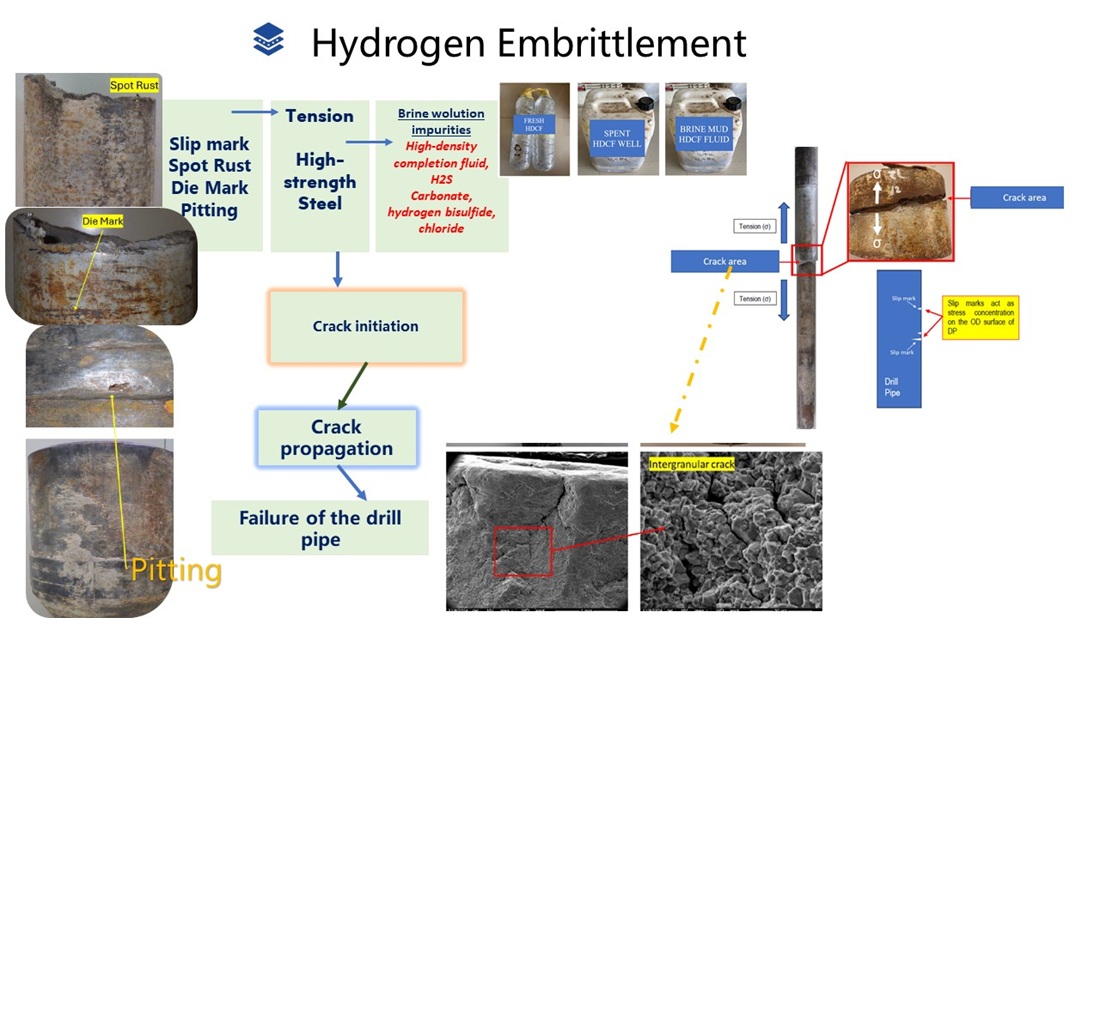
The object of this study is high-strength steel of API 5DP Gr 105 that has been used during well completion in a corrosive environment. This work emphasizes key factors affecting material damage caused by slip marks, tensile load, and hydrogen content in contaminated brine and completion fluid, which were not addressed in previous studies. Several tests, including chemical, mechanical, and surface characterization, were conducted. The chemical composition test of the fluid shows that the brine has been contaminated by H2S gas and sulfur, with inevitable traces of chloride, bicarbonate, carbonate, bisulfide, and sulfide, providing active sites for hydrogen atom diffusion at the slip marks. The material composition test confirms that the failed material is API 5DP Gr 105. A noticeable amount of phosphorus increases grain boundary segregation and weakens the cohesive metallic bond. A hardness at 28 Rockwell C is inevitable and increases the material’s vulnerability to embrittlement, despite the Charpy energy test showing a manageable level, confirming local brittleness. The high tensile strength of 914 MPa is evidence of embrittlement, even though the material remains ductile, with a noticeable elongation of 20%. An intergranular crack was observed in the microstructure, and slip marks serve as stress concentrators for the crack. Thus, it can be concluded that the combination of tensile load, hydrogen gas content, local slip marks, and completion fluid in the well weakened the grain boundaries and served as an initial crack with a high hydrogen-atom concentration. This work models the root-cause analysis of high-strength steel during well-completion operations in an onshore facility
References
- Laureys, A., Depraetere, R., Cauwels, M., Depover, T., Hertelé, S., Verbeken, K. (2022). Use of existing steel pipeline infrastructure for gaseous hydrogen storage and transport: A review of factors affecting hydrogen induced degradation. Journal of Natural Gas Science and Engineering, 101, 104534. https://doi.org/10.1016/j.jngse.2022.104534
- Aditiyawarman, T., Soedarsono, J. W., Kaban, A. P. S., Riastuti, R., Rahmadani, H. (2022). The Study of Artificial Intelligent in Risk-Based Inspection Assessment and Screening: A Study Case of Inline Inspection. ASCE-ASME Journal of Risk and Uncertainty in Engineering Systems, Part B: Mechanical Engineering, 9 (1). https://doi.org/10.1115/1.4054969
- Sridharan, V. S., Verma, V. K., Narayan, R. L., Lu, X., Siwei, D., Chaudhary, V. et al. (2025). Hydrogen embrittlement of additively manufactured metallic materials. International Journal of Hydrogen Energy, 121, 245–272. https://doi.org/10.1016/j.ijhydene.2025.03.222
- Mokhtari, E., Heidarpour, A., Javidan, F. (2024). Mechanical performance of high strength steel under corrosion: A review study. Journal of Constructional Steel Research, 220, 108840. https://doi.org/10.1016/j.jcsr.2024.108840
- Oriani, R. A. (1972). A mechanistic theory of hydrogen embrittlement of steels. Berichte Der Bunsengesellschaft Für Physikalische Chemie, 76 (8), 848–857. Portico. https://doi.org/10.1002/bbpc.19720760864
- Damage Mechanisms Affecting fixed Equipment in the Refining Industry (2003). Recommended Practice 571 First Edition. API.
- Wu, X., Song, Z., Tan, M., Jia, W., Liu, J. (2026). Hydrogen-induced failure mechanism of X80 pipeline steel welded joints based on macro-and micro-scale experimental analysis: Embrittlement enhancement effect caused by high hydrogen trap density. Engineering Failure Analysis, 183, 110190. https://doi.org/10.1016/j.engfailanal.2025.110190
- Zekun, Y., Zhanli, Y., Hao, Y., Yan, Z., Kai, X. (2025). Hydrogen embrittlement in welded joints of high-strength pipeline steels: A review of mechanisms, characterization, and mitigation strategies. International Journal of Pressure Vessels and Piping, 218, 105615. https://doi.org/10.1016/j.ijpvp.2025.105615
- Kawamori, M., Shibata, K., Yoda, R., Morita, S., Fujita, Y., Kuroda, S. et al. (2025). Dual effects of deformation on hydrogen embrittlement of austenitic stainless steels revealed by hydrogen visualization combined with microstructural analysis. International Journal of Hydrogen Energy, 145, 559–577. https://doi.org/10.1016/j.ijhydene.2025.05.426
- Kawamori, M., Yuse, F. (2023). In-situ measurement of hydrogen entry and hydrogen embrittlement of steel by atmospheric corrosion. Corrosion Science, 219, 111212. https://doi.org/10.1016/j.corsci.2023.111212
- Lan, X., Okada, K., Ueji, R., Shibata, A. (2025). Improving hydrogen embrittlement resistance in high-strength martensitic steels via thermomechanical processing. Scripta Materialia, 264, 116711. https://doi.org/10.1016/j.scriptamat.2025.116711
- Hwang, Y., Park, H., Yun, H. S., Bae, K.-O., Baek, U. B., Lee, J. (2025). Effects of sensitization on hydrogen embrittlement behavior in 304 stainless steel. Materials & Design, 260, 115130. https://doi.org/10.1016/j.matdes.2025.115130
- Dong, X., Wang, D., Thoudden-Sukumar, P., Tehranchi, A., Ponge, D., Sun, B., Raabe, D. (2022). Hydrogen-associated decohesion and localized plasticity in a high-Mn and high-Al two-phase lightweight steel. Acta Materialia, 239, 118296. https://doi.org/10.1016/j.actamat.2022.118296
- Asadipoor, M., Pourkamali Anaraki, A., Kadkhodapour, J., Sharifi, S. M. H., Barnoush, A. (2020). Macro- and microscale investigations of hydrogen embrittlement in X70 pipeline steel by in-situ and ex-situ hydrogen charging tensile tests and in-situ electrochemical micro-cantilever bending test. Materials Science and Engineering: A, 772, 138762. https://doi.org/10.1016/j.msea.2019.138762
- Singh, R., Sharma, R., Rao, G. R. (2023). A comprehensive review on the high-density clear completion fluids for applications in HPHT well completion. International Journal of Oil, Gas and Coal Technology, 32 (1), 70. https://doi.org/10.1504/ijogct.2023.127337
- Peng, X., Yu, H., Lian, Z., Dong, B., Zhong, W., Zhang, Y., Hu, Z. (2021). Material optimization of drill pipe in complex wellbore environments by comparing fatigue life and cost. Energy Reports, 7, 5420–5430. https://doi.org/10.1016/j.egyr.2021.08.135
- Zamani, S. M., Hassanzadeh-Tabrizi, S. A., Sharifi, H. (2016). Failure analysis of drill pipe: A review. Engineering Failure Analysis, 59, 605–623. https://doi.org/10.1016/j.engfailanal.2015.10.012
- Atamashkin, A., Priymak, E., Tulibaev, E., Syomka, Y., Trushov, V. (2024). Influence of force parameters of rotary friction welding on the microstructure and mechanical properties of welded joints of high-strength drill pipes. International Journal on Interactive Design and Manufacturing, 19 (4), 2937–2950. https://doi.org/10.1007/s12008-024-02011-w
- Cho, L., Bradley, P. E., Lauria, D. S., Connolly, M. J., Seo, E. J., Findley, K. O. et al. (2021). Effects of hydrogen pressure and prior austenite grain size on the hydrogen embrittlement characteristics of a press-hardened martensitic steel. International Journal of Hydrogen Energy, 46 (47), 24425–24439. https://doi.org/10.1016/j.ijhydene.2021.05.005
- Yu, H., He, J., Morin, D. D., Ortiz, M., Zhang, Z. (2025). A self-consistent void-based rationale for hydrogen embrittlement. Scripta Materialia, 255, 116403. https://doi.org/10.1016/j.scriptamat.2024.116403
- Kim, K.-S., Kang, J.-H., Kim, S.-J. (2019). Effect of Grain Boundary Carbide on Hydrogen Embrittlement in Stable Austenitic Stainless Steels. ISIJ International, 59 (6), 1136–1144. https://doi.org/10.2355/isijinternational.isijint-2018-639
- Puiggali, M., Zielinski, A., Olive, J. M., Renauld, E., Desjardins, D., Cid, M. (1998). Effect of microstructure on stress corrosion cracking of an Al-Zn-Mg-Cu alloy. Corrosion Science, 40 (4-5), 805–819. https://doi.org/10.1016/s0010-938x(98)00002-x
- Howard, S., Chrenowski, M. (2014). Corrosion in Formate Brines – 20 Years of Laboratory Testing and Field Experience. Offshore Technology Conference-Asia. https://doi.org/10.4043/24983-ms
- Silverman, S. A., Bhavsar, R., Edwards, C., Virally, S., Foxenberg, W. (2003). Use of High-Strength Alloys and Elastomers in Heavy Completion Brines. SPE Annual Technical Conference and Exhibition. https://doi.org/10.2118/84515-ms
- Espinosa-Medina, M. A., la Torre, G. C.-D., Castillo, A. S., Ángeles-Chávez, C., Zeferino-Rodríguez, T., González-Rodríguez, J. G. (2017). Effect of Chloride and Sulfate Ions on the SCC of API-X70 Pipeline Welds in Diluted Carbonated Solutions. International Journal of Electrochemical Science, 12 (8), 6952–6965. https://doi.org/10.20964/2017.08.07
- Komazazki, S.-I., Watanabe, S., Misawa, T. (2003). Influence of Phosphorus and Boron on Hydrogen Embrittlement Susceptibility of High Strength Low Alloy Steel. ISIJ International, 43 (11), 1851–1857. https://doi.org/10.2355/isijinternational.43.1851
- Nanninga, N., Grochowsi, J., Heldt, L., Rundman, K. (2010). Role of microstructure, composition and hardness in resisting hydrogen embrittlement of fastener grade steels. Corrosion Science, 52 (4), 1237–1246. https://doi.org/10.1016/j.corsci.2009.12.020
- Park, H., Yoo, J., Lee, J.-J., Kang, Y., Seo, K. M., Lee, C.-H. et al. (2024). Impact of hydrogen embrittlement on the tensile-shear property of resistance spot-welded advanced high-strength martensitic steels. International Journal of Hydrogen Energy, 71, 319–333. https://doi.org/10.1016/j.ijhydene.2024.05.138
- Li, X., Zhang, J., Cui, Y., Djukic, M. B., Feng, H., Wang, Y. (2024). Review of the hydrogen embrittlement and interactions between hydrogen and microstructural interfaces in metallic alloys: Grain boundary, twin boundary, and nano-precipitate. International Journal of Hydrogen Energy, 72, 74–109. https://doi.org/10.1016/j.ijhydene.2024.05.257
- Cui, D., Bai, Y., Xiong, L., Yu, B., Wei, B., Sun, C. (2024). Effects of hydrogen blending ratios and CO2 on hydrogen embrittlement of X65 steel in high-pressure offshore hydrogen-blended natural gas pipelines. Journal of Materials Research and Technology, 33, 4763–4771. https://doi.org/10.1016/j.jmrt.2024.10.150
- Tong, Z., Wang, H., Zheng, W., Zhou, H. (2024). Change in Hydrogen Trapping Characteristics and Influence on Hydrogen Embrittlement Sensitivity in a Medium-Carbon, High-Strength Steel: The Effects of Heat Treatments. Materials, 17 (8), 1854. https://doi.org/10.3390/ma17081854
Downloads
Published
How to Cite
Issue
Section
License
Copyright (c) 2026 Sidhi Aribowo, Johny Wahyuadi Soedarsono, Suryadi Suryadi, Slamet Nurhadi, Warneri Warneri, Sopar Mangarapot Simanullang, Agus Kaban, Raajwa Ayudhia Kamila

This work is licensed under a Creative Commons Attribution 4.0 International License.
The consolidation and conditions for the transfer of copyright (identification of authorship) is carried out in the License Agreement. In particular, the authors reserve the right to the authorship of their manuscript and transfer the first publication of this work to the journal under the terms of the Creative Commons CC BY license. At the same time, they have the right to conclude on their own additional agreements concerning the non-exclusive distribution of the work in the form in which it was published by this journal, but provided that the link to the first publication of the article in this journal is preserved.
A license agreement is a document in which the author warrants that he/she owns all copyright for the work (manuscript, article, etc.).
The authors, signing the License Agreement with TECHNOLOGY CENTER PC, have all rights to the further use of their work, provided that they link to our edition in which the work was published.
According to the terms of the License Agreement, the Publisher TECHNOLOGY CENTER PC does not take away your copyrights and receives permission from the authors to use and dissemination of the publication through the world's scientific resources (own electronic resources, scientometric databases, repositories, libraries, etc.).
In the absence of a signed License Agreement or in the absence of this agreement of identifiers allowing to identify the identity of the author, the editors have no right to work with the manuscript.
It is important to remember that there is another type of agreement between authors and publishers – when copyright is transferred from the authors to the publisher. In this case, the authors lose ownership of their work and may not use it in any way.








