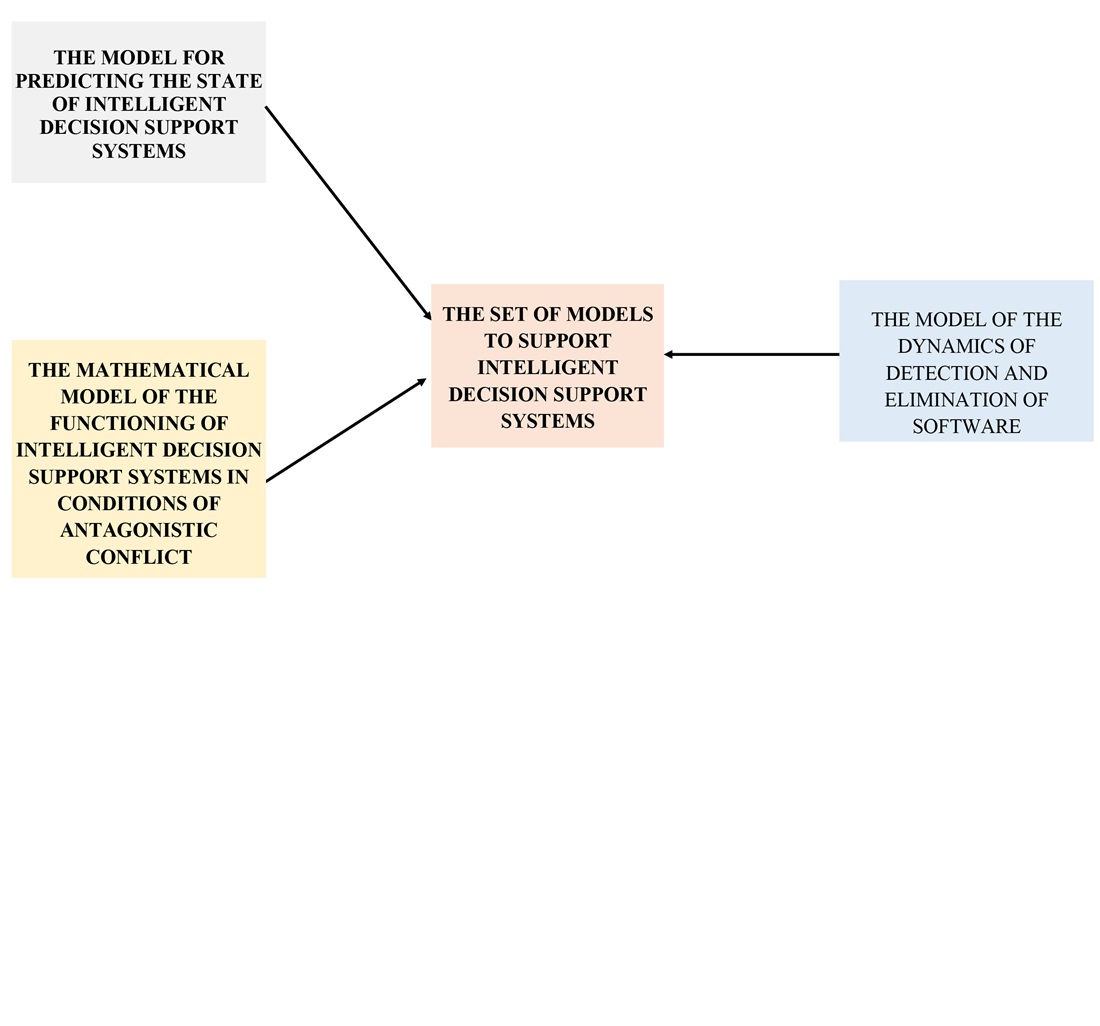
Developing a set of models to support intelligent decision support systems
DOI:
https://doi.org/10.15587/1729-4061.2026.362504Keywords:
destabilizing factors, complex systems, efficiency of decision-making, modeling of complex systemsAbstract
Intelligent decision support systems are the object of the study. The problem addressed in the study is the improvement of the validity of the functioning of intelligent decision support systems. The hypothesis of the study is the possibility of increasing the efficiency of the functioning of intelligent decision support systems due to the development of a set of mathematical models of their functioning.
The originality of the study consists of:
– comprehensive assessment of the state of functioning of intelligent decision support systems due to multi-level assessment;
– modeling of possible states of functioning of intelligent decision support systems;
– reconfiguring the number of input parameters to model the functioning process of intelligent decision support systems due to the use of evolving artificial neural networks, which achieves an increase in the efficiency and reliability of the received decisions and evaluations;
– setting the number of input channels of destructive influence for their accurate assessment due to the use of queuing theory;
– setting the input parameters of the models by adjusting the parameters of the membership function of evolving artificial neural networks, which achieves an increase in the accuracy of modeling the state of functioning of intelligent decision support systems.
Modeling of the proposed set of mathematical models of the functioning of intelligent decision support systems was carried out. In the course of modeling, it was established that an average of up to 20% gain is ensured in the efficiency and reliability of calculations, while ensuring an average level of use of hardware resources
References
- Sova, O., Radzivilov, H., Shyshatskyi, A., Shvets, P., Tkachenko, V., Nevhad, S. et al. (2022). Development of a method to improve the reliability of assessing the condition of the monitoring object in special-purpose information systems. Eastern-European Journal of Enterprise Technologies, 2 (3 (116)), 6–14. https://doi.org/10.15587/1729-4061.2022.254122
- Dudnyk, V., Sinenko, Y., Matsyk, M., Demchenko, Y., Zhyvotovskyi, R., Repilo, I. et al. (2020). Development of a method for training artificial neural networks for intelligent decision support systems. Eastern-European Journal of Enterprise Technologies, 3 (2 (105)), 37–47. https://doi.org/10.15587/1729-4061.2020.203301
- Sova, O., Shyshatskyi, A., Salnikova, O., Zhuk, O., Trotsko, O., Hrokholskyi, Y. (2021). Development of a method for assessment and forecasting of the radio electronic environment. EUREKA: Physics and Engineering, 4, 30–40. https://doi.org/10.21303/2461-4262.2021.001940
- Pievtsov, H., Turinskyi, O., Zhyvotovskyi, R., Sova, O., Zvieriev, O., Lanetskii, B., Shyshatskyi, A. (2020). Development of an advanced method of finding solutions for neuro-fuzzy expert systems of analysis of the radioelectronic situation. EUREKA: Physics and Engineering, 4, 78–89. https://doi.org/10.21303/2461-4262.2020.001353
- Zuiev, P., Zhyvotovskyi, R., Zvieriev, O., Hatsenko, S., Kuprii, V., Nakonechnyi, O. et al. (2020). Development of complex methodology of processing heterogeneous data in intelligent decision support systems. Eastern-European Journal of Enterprise Technologies, 4 (9 (106)), 14–23. https://doi.org/10.15587/1729-4061.2020.208554
- Dahiya, A., Gupta, B. B. (2021). A reputation score policy and Bayesian game theory based incentivized mechanism for DDoS attacks mitigation and cyber defense. Future Generation Computer Systems, 117, 193–204. https://doi.org/10.1016/j.future.2020.11.027
- Matheu-García, S. N., Hernández-Ramos, J. L., Skarmeta, A. F., Baldini, G. (2019). Risk-based automated assessment and testing for the cybersecurity certification and labelling of IoT devices. Computer Standards & Interfaces, 62, 64–83. https://doi.org/10.1016/j.csi.2018.08.003
- Henriques de Gusmão, A. P., Mendonça Silva, M., Poleto, T., Camara e Silva, L., Cabral Seixas Costa, A. P. (2018). Cybersecurity risk analysis model using fault tree analysis and fuzzy decision theory. International Journal of Information Management, 43, 248–260. https://doi.org/10.1016/j.ijinfomgt.2018.08.008
- Folorunso, O., Mustapha, O. A. (2015). A fuzzy expert system to Trust-Based Access Control in crowdsourcing environments. Applied Computing and Informatics, 11 (2), 116–129. https://doi.org/10.1016/j.aci.2014.07.001
- Mohammad, A. (2020). Development of the concept of electronic government construction in the conditions of synergetic threats. Technology Audit and Production Reserves, 3 (2 (53)), 42–46. https://doi.org/10.15587/2706-5448.2020.207066
- Morales-Sáenz, F. I., Medina-Quintero, J. M., Reyna-Castillo, M. (2024). Beyond Data Protection: Exploring the Convergence between Cybersecurity and Sustainable Development in Business. Sustainability, 16 (14), 5884. https://doi.org/10.3390/su16145884
- Cormier, A., Ng, C. (2020). Integrating cybersecurity in hazard and risk analyses. Journal of Loss Prevention in the Process Industries, 64, 104044. https://doi.org/10.1016/j.jlp.2020.104044
- Hoffmann, R., Napiórkowski, J., Protasowicki, T., Stanik, J. (2020). Risk based approach in scope of cybersecurity threats and requirements. Procedia Manufacturing, 44, 655–662. https://doi.org/10.1016/j.promfg.2020.02.243
- Perrine, K. A., Levin, M. W., Yahia, C. N., Duell, M., Boyles, S. D. (2019). Implications of traffic signal cybersecurity on potential deliberate traffic disruptions. Transportation Research Part A: Policy and Practice, 120, 58–70. https://doi.org/10.1016/j.tra.2018.12.009
- Shmatko, O., Yevseiev, S., Dudykevych, V., Milevskyi, S., Solnyshkova, S., Havrylova, A. et al. (2024). Development of a method for synthesizing an information-analytical system for assessing the level of information transmission channels protection. Eastern-European Journal of Enterprise Technologies, 2 (9 (128)), 36–43. https://doi.org/10.15587/1729-4061.2024.302495
- Zarreh, A., Wan, H., Lee, Y., Saygin, C., Janahi, R. A. (2019). Cybersecurity Concerns for Total Productive Maintenance in Smart Manufacturing Systems. Procedia Manufacturing, 38, 532–539. https://doi.org/10.1016/j.promfg.2020.01.067
- Zhuravskyi, Y. (Ed.) (2026). Intelligent decision support systems: methods for optimizing and supporting management decisions. Kharkiv: TECHNOLOGY CENTER PC. https://doi.org/10.15587/978-617-8360-23-8
- Koval, M., Sova, O., Shyshatskyi, A., Artabaiev, Y., Garashchuk, N., Yivzhenko, Y. et al. (2022). Improving the method for increasing the efficiency of decision-making based on bio-inspired algorithms. Eastern-European Journal of Enterprise Technologies, 6 (4 (120)), 6–13. https://doi.org/10.15587/1729-4061.2022.268621
- Shyshatskyi, A. (Ed.) (2024). Information and control systems: modelling and optimizations. Kharkiv: TECHNOLOGY CENTER PC. https://doi.org/10.15587/978-617-8360-04-7
- Voznytsia, A., Sharonova, N., Babenko, V., Ostapchuk, V., Neronov, S., Feoktystov, S. et al. (2025). Development of methods for intelligent assessment of parameters in decision support systems. Eastern-European Journal of Enterprise Technologies, 4 (4 (136)), 73–82. https://doi.org/10.15587/1729-4061.2025.337528
Downloads
Published
How to Cite
Issue
Section
License
Copyright (c) 2026 Hennadii Shapovalov, Vladyslav Shostak, Oleg Sova, Viktor Pokaliuk, Oleksandr Yefymenko, Elena Odarushchenko, Olesia Zhuk, Bohdan Molodetskyi, Yevhen Sudnikov, Roman Lazuta

This work is licensed under a Creative Commons Attribution 4.0 International License.
The consolidation and conditions for the transfer of copyright (identification of authorship) is carried out in the License Agreement. In particular, the authors reserve the right to the authorship of their manuscript and transfer the first publication of this work to the journal under the terms of the Creative Commons CC BY license. At the same time, they have the right to conclude on their own additional agreements concerning the non-exclusive distribution of the work in the form in which it was published by this journal, but provided that the link to the first publication of the article in this journal is preserved.
A license agreement is a document in which the author warrants that he/she owns all copyright for the work (manuscript, article, etc.).
The authors, signing the License Agreement with TECHNOLOGY CENTER PC, have all rights to the further use of their work, provided that they link to our edition in which the work was published.
According to the terms of the License Agreement, the Publisher TECHNOLOGY CENTER PC does not take away your copyrights and receives permission from the authors to use and dissemination of the publication through the world's scientific resources (own electronic resources, scientometric databases, repositories, libraries, etc.).
In the absence of a signed License Agreement or in the absence of this agreement of identifiers allowing to identify the identity of the author, the editors have no right to work with the manuscript.
It is important to remember that there is another type of agreement between authors and publishers – when copyright is transferred from the authors to the publisher. In this case, the authors lose ownership of their work and may not use it in any way.








