Devising a cross-project learning method for software defect prediction based on fuzzy algorithmic models
DOI:
https://doi.org/10.15587/1729-4061.2026.362735Keywords:
software defect prediction, fuzzy algorithmic model, cross-project transfer learningAbstract
This work investigates fuzzy algorithmic models for predicting software defects. An issue related to conventional machine (deep) learning models is complexity and interpretability. In addition, cross-project learning of such models requires solving the problem of heterogeneity in the initial and target data distributions.
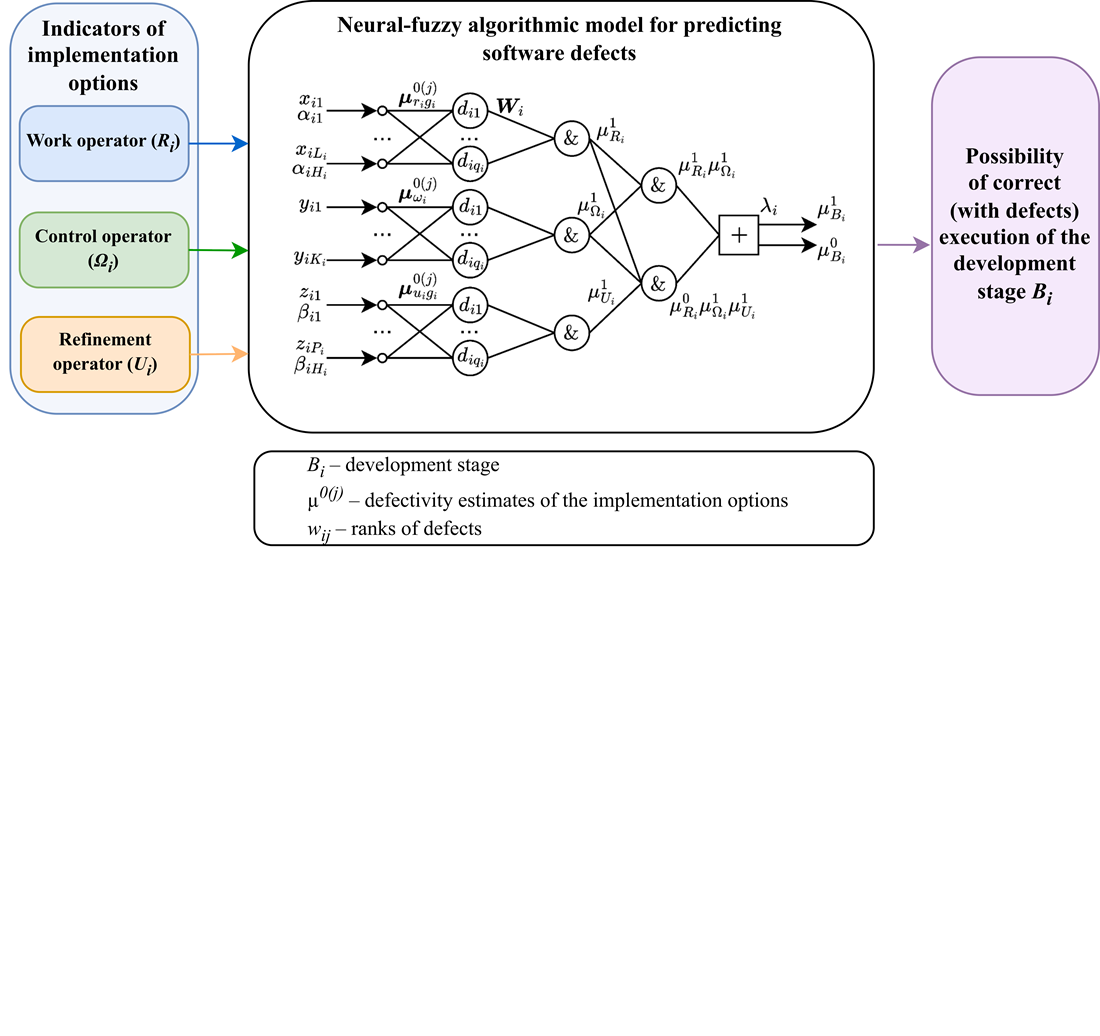
A fuzzy algorithmic model for predicting software defects with an integrated distribution of implementation options for development stages has been proposed. A genetic-neural method for tuning a fuzzy algorithmic model to cross-project data has been devised.
Unlike machine learning models, the interpretability of the prediction model was achieved by assessing the correctness (defectivity) of development stages using fuzzy rules. The model is built on the basis of “work-control-refinement” algorithmic structures, which is an analog of a fuzzy knowledge base. Fuzzy estimates of the defectivity of the execution of work, control, and refinement operators are subject to tuning, where defect ranks model the distribution of resources. The training sample is formed on the basis of estimates of the correctness of implementation options for algorithmic structures.
The integration of indicators for implementation options for work, control, and refinement operators has made it possible to solve the issue of heterogeneity in the initial and target data distributions. Unlike known methods for training neural-fuzzy models of software reliability, simplification of the tuning process was achieved by transferring cross-project data.
The scope of practical application includes predicting the quality of new software based on the experience of completed projects. The condition of use is a discrete algorithmic model of the development process
References
- Malhotra, R., Chawla, S., Sharma, A. (2023). Software defect prediction using hybrid techniques: a systematic literature review. Soft Computing, 27 (12), 8255–8288. https://doi.org/10.1007/s00500-022-07738-w
- Pal, S., Sillitti, A. (2022). Cross-Project Defect Prediction: A Literature Review. IEEE Access, 10, 118697–118717. https://doi.org/10.1109/access.2022.3221184
- Rotshtein, O. P., Shtovba, S. D., Kozachko, O. M. (2007). Modeliuvannia ta optymizatsiya nadiynosti bahatovymirnykh alhorytmichnykh protsesiv. Vinnytsia: «UNIVERSUM», 211. Available at: http://ir.lib.vntu.edu.ua/handle/123456789/2296
- Rotshtein, A. P., Rakytyanska, H. B. (2012). Fuzzy Evidence in Identification, Forecasting and Diagnosis. Studies in Fuzziness and Soft Computing. Springer Berlin Heidelberg. https://doi.org/10.1007/978-3-642-25786-5
- Rakytyanska, H., Prus, B. (2025). Fuzzy-algorithmic analysis of software reliability. Information Technology and Computer Engineering, 22, 136–147. https://doi.org/10.31649/vitce/3.2025.136
- Rakytyanska, H. (2023). Knowledge Distillation in Granular Fuzzy Models by Solving Fuzzy Relation Equations. Advancements in Knowledge Distillation: Towards New Horizons of Intelligent Systems, 95–133. https://doi.org/10.1007/978-3-031-32095-8_4
- Singh, M., Chhabra, J. K. (2024). Machine learning based improved cross-project software defect prediction using new structural features in object oriented software. Applied Soft Computing, 165, 112082. https://doi.org/10.1016/j.asoc.2024.112082
- Abbas, S., Aftab, S., Adnan Khan, M., M. Ghazal, T., Al Hamadi, H., Yeob Yeun, C. (2023). Data and Ensemble Machine Learning Fusion Based Intelligent Software Defect Prediction System. Computers, Materials & Continua, 75 (3), 6083–6100. https://doi.org/10.32604/cmc.2023.037933
- Sharma, T., Jatain, A., Bhaskar, S., Pabreja, K. (2023). Ensemble Machine Learning Paradigms in Software Defect Prediction. Procedia Computer Science, 218, 199–209. https://doi.org/10.1016/j.procs.2023.01.002
- Dong, X., Wang, J., Liang, Y. (2025). A Novel Ensemble Classifier Selection Method for Software Defect Prediction. IEEE Access, 13, 25578–25597. https://doi.org/10.1109/access.2025.3537658
- Omer, A., Rathore, S. S., Kumar, S. (2024). ME-SFP: A Mixture-of-Experts-Based Approach for Software Fault Prediction. IEEE Transactions on Reliability, 73 (1), 710–725. https://doi.org/10.1109/tr.2023.3295012
- Wang, S., Huang, L., Gao, A., Ge, J., Zhang, T., Feng, H. et al. (2023). Machine/Deep Learning for Software Engineering: A Systematic Literature Review. IEEE Transactions on Software Engineering, 49 (3), 1188–1231. https://doi.org/10.1109/tse.2022.3173346
- Goyal, S. R. (2026). Effective software defect prediction with deep neural networks. Results in Engineering, 29, 108378. https://doi.org/10.1016/j.rineng.2025.108378
- Sun, T., Allix, K., Kim, K., Zhou, X., Kim, D., Lo, D. et al. (2023). DexBERT: Effective, Task-Agnostic and Fine-Grained Representation Learning of Android Bytecode. IEEE Transactions on Software Engineering, 49 (10), 4691–4706. https://doi.org/10.1109/tse.2023.3310874
- Villoth, J. P., Zivkovic, M., Zivkovic, T., Abdel-salam, M., Hammad, M., Jovanovic, L. et al. (2025). Two-tier deep and machine learning approach optimized by adaptive multi-population firefly algorithm for software defects prediction. Neurocomputing, 630, 129695. https://doi.org/10.1016/j.neucom.2025.129695
- Abdu, A., Zhai, Z., Abdo, H. A., Algabri, R. (2024). Software Defect Prediction Based on Deep Representation Learning of Source Code From Contextual Syntax and Semantic Graph. IEEE Transactions on Reliability, 73 (2), 820–834. https://doi.org/10.1109/tr.2024.3354965
- Bal, P. R., Kumar, S. (2025). An Approach for Cross Project Defect Prediction Using Identical Metrics Matching and Deep Neural Network. IEEE Transactions on Reliability, 74 (2), 2678–2692. https://doi.org/10.1109/tr.2024.3435709
- Omondiagbe, O. P., Licorish, S. A., MacDonell, S.G. (2024). Improving transfer learning for software cross-project defect prediction. Applied Intelligence, 54, 5593–5616. https://doi.org/10.1007/s10489-024-05459-1
- Nevendra, M., Singh, P. (2025). TRGNet: a deep transfer learning approach for software defect prediction. Expert Systems with Applications, 282, 127799. https://doi.org/10.1016/j.eswa.2025.127799
- Tong, H., Zhang, D., Liu, J., Xing, W., Lu, L., Lu, W., Wu, Y. (2024). MASTER: Multi-Source Transfer Weighted Ensemble Learning for Multiple Sources Cross-Project Defect Prediction. IEEE Transactions on Software Engineering, 50 (5), 1281–1305. https://doi.org/10.1109/tse.2024.3381235
- Elsabagh, M. A., Emam, O. E., Gafar, M. G., Medhat, T. (2023). Handling uncertainty issue in software defect prediction utilizing a hybrid of ANFIS and turbulent flow of water optimization algorithm. Neural Computing and Applications, 36 (9), 4583–4602. https://doi.org/10.1007/s00521-023-09315-0
- Lakshmi, P. J., Krishna, T. V. S., Kumar, N. B., Rao, D. S. N. M., Hosseinpour, A., Lenin, N. C. (2025). Improving Software Fault Prediction With a Hybrid DE-WOA Optimizer and ANFIS-Enhanced Ensemble Learning. IEEE Access, 13, 158194–158209. https://doi.org/10.1109/access.2025.3603980
- Azzeh, M., Elsheikh, Y., Alqasrawi, Y. (2024). Software defect density prediction using grey system theory and fuzzy logic. Soft Computing, 28 (21-22), 12897–12916. https://doi.org/10.1007/s00500-024-10324-x
- Azzeh, M., Abdel-Rahman, M. J. (2026). Cross-project software defects prediction using fuzzy embedding and deep learning. Information and Software Technology, 190, 107968. https://doi.org/10.1016/j.infsof.2025.107968
- Behera, A. K., Panda, M., Dehuri, S. (2024). A recurrent ANFIS tuned by modified differential evolution for efficient prediction of software reliability. Evolutionary Intelligence, 17 (5-6), 3469–3482. https://doi.org/10.1007/s12065-024-00940-9
- Chatterjee, S., Saha, D. (2024). IT2F-SEDNN: an interval type-2 fuzzy logic-based stacked ensemble deep learning approach for early phase software dependability analysis. Innovations in Systems and Software Engineering, 21 (2), 727–746. https://doi.org/10.1007/s11334-024-00563-4
- Rakytyanska, H. (2015). Fuzzy classification knowledge base construction based on trend rules and inverse inference. Eastern-European Journal of Enterprise Technologies, 1 (3 (73)), 25–32. https://doi.org/10.15587/1729-4061.2015.36934
- Rakytyanska, H. (2017). Optimization of fuzzy classification knowledge bases using improving transformations. Eastern-European Journal of Enterprise Technologies, 5 (2 (89)), 33–41. https://doi.org/10.15587/1729-4061.2017.110261
- Rakytyanska, H., Prus, B. (2024). Constructing Prototype-Based Granular Fuzzy Rules for Scene Classification on Mobile Devices. Vol. 1. Lecture Notes in Data Engineering, Computational Intelligence, and Decision-Making, 194–218. https://doi.org/10.1007/978-3-031-70959-3_10
Downloads
Published
How to Cite
Issue
Section
License
Copyright (c) 2026 Hanna Rakytyanska, Bohdan Prus

This work is licensed under a Creative Commons Attribution 4.0 International License.
The consolidation and conditions for the transfer of copyright (identification of authorship) is carried out in the License Agreement. In particular, the authors reserve the right to the authorship of their manuscript and transfer the first publication of this work to the journal under the terms of the Creative Commons CC BY license. At the same time, they have the right to conclude on their own additional agreements concerning the non-exclusive distribution of the work in the form in which it was published by this journal, but provided that the link to the first publication of the article in this journal is preserved.
A license agreement is a document in which the author warrants that he/she owns all copyright for the work (manuscript, article, etc.).
The authors, signing the License Agreement with TECHNOLOGY CENTER PC, have all rights to the further use of their work, provided that they link to our edition in which the work was published.
According to the terms of the License Agreement, the Publisher TECHNOLOGY CENTER PC does not take away your copyrights and receives permission from the authors to use and dissemination of the publication through the world's scientific resources (own electronic resources, scientometric databases, repositories, libraries, etc.).
In the absence of a signed License Agreement or in the absence of this agreement of identifiers allowing to identify the identity of the author, the editors have no right to work with the manuscript.
It is important to remember that there is another type of agreement between authors and publishers – when copyright is transferred from the authors to the publisher. In this case, the authors lose ownership of their work and may not use it in any way.








