Design of an intelligent multi-channel sensor for early detection of thermal decomposition in a lithium-ion battery
DOI:
https://doi.org/10.15587/1729-4061.2026.362949Keywords:
lithium-ion battery, sensor, combustion, thermal decomposition, triggering algorithm, Fuzzy LogicAbstract
This study explores a process underlying the onset and evolution of an irreversible thermochemical reaction that fills a lithium-ion battery (LIB) internally. The issue related to early detection of the onset of thermal decomposition of LIB internal filling is that today there are no unified approaches and clearly defined parameters that would make it possible to predict the failure of LIB. The process of LIB thermal decomposition can occur without visual signs and rapidly develop into intense combustion. Obtaining parameters for the onset of the evolution of LIB’s internal filling thermochemical reaction provides prerequisites for designing a sensor for early detection of LIB thermal decomposition.
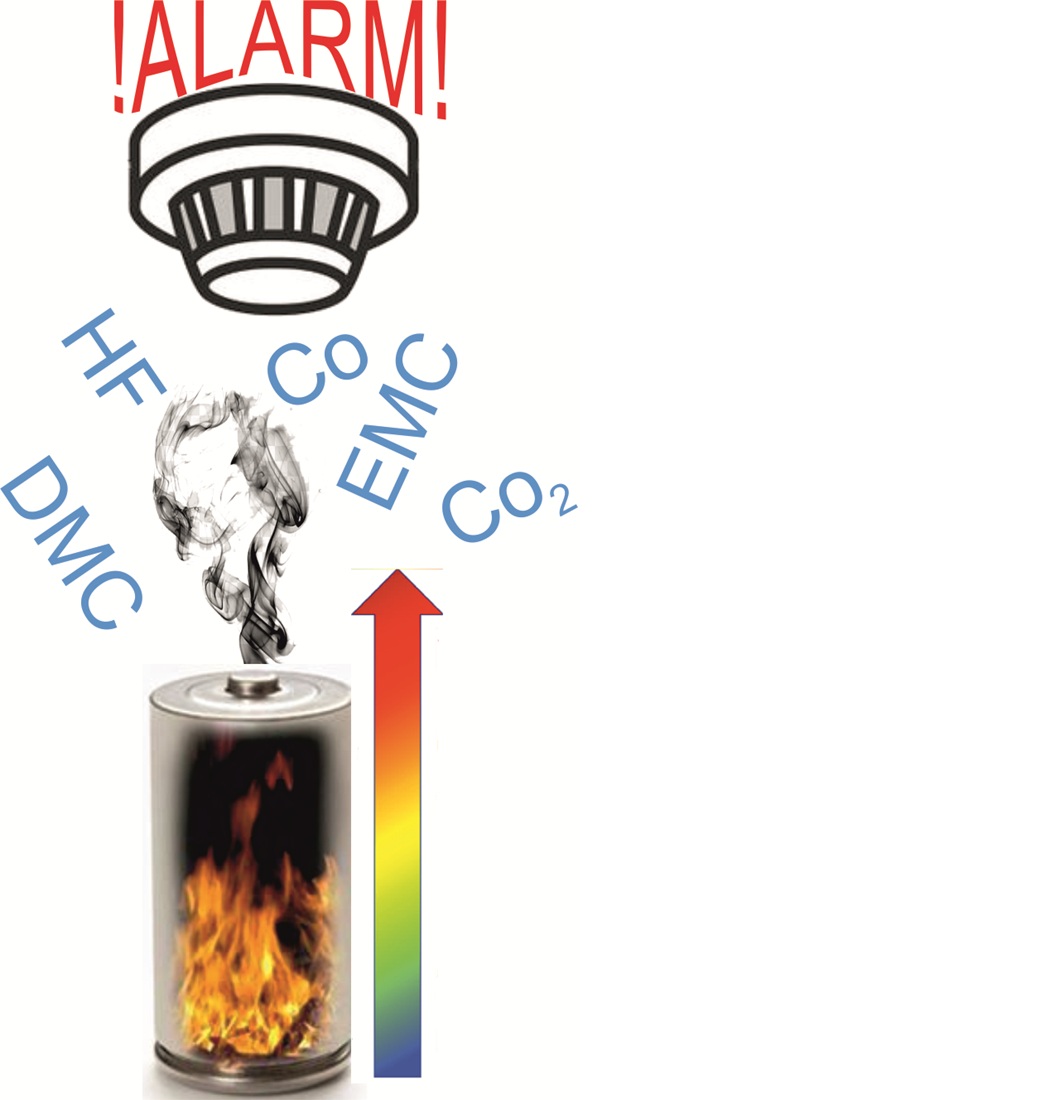
Based on the results from analytical processing of existing experimental studies on determining the chemical composition of the products of LIB thermal decomposition, the basic parameters have been established. In particular, the change in the concentration of CO2, HF, and Pabs was found to be the basis for further advancement of the model (mathematical basis) of the fuzzy correction unit.
A fuzzy correction module using the Mamdani algorithm has been designed for a multi-channel sensor for early detection of thermal decomposition (SEDTD) in LIB. The forms and parameters of the input and output membership functions have been established. A database of fuzzy rules has been compiled that describe LIB’s possible states. Simulation in the Fuzzy Logic Toolbox package in the MATLAB environment (USA) qualitatively reflects the perception of input signals about the onset and evolution of a thermochemical reaction.
The results of simulation studies have confirmed the effectiveness of the proposed approach. It has been established that the sensor, based on a comprehensive analysis of input parameters such as pressure, CO2 and HF concentrations, forms an information output signal that adequately reflects the technical condition of LIB, in particular normal, pre-fire (pre-emergency), and fire (emergency) states
References
- Janik, P., Tępiński, J. (2025). Fire Safety of Lithium-Ion Battery Warehouses – Challenges and Dilemmas. Safety & Fire Technology, 65 (1), 98–107. https://doi.org/10.12845/sft.65.1.2025.8
- Lazarenko, O., Berezhanskyi, T., Pospolitak, V., Pazen, O. (2022). Experimental evaluation of the influence of excessive electric current on the fire hazard of lithium-ion power cell. Eastern-European Journal of Enterprise Technologies, 4 (10 (118)), 67–75. https://doi.org/10.15587/1729-4061.2022.263001
- Management of lithium-ion battery safety risks: A literature review of current knowledge and best practices (2025). SARET Research Program. Available at: https://www.fire.nsw.gov.au/__data/assets/pdf_file/0018/8316/SARET-Report-001-Management-of-Lithium-ion-Battery-Safety-Risks-A-Literature-Review-of-Current-Knowledge-and-Best-Practices-V1.0.pdf
- Wang, J., Jia, J., Zhang, Z. (2022). Research on the Early Warning Mechanism for Thermal Runaway of Lithium-Ion Power Batteries in Electric Vehicles. Security and Communication Networks, 2022, 1–9. https://doi.org/10.1155/2022/8573396
- Zhang, J., Li, Z., Huang, L. (2026). A Review of Gas-Sensitive Materials for Lithium-Ion Battery Thermal Runaway Monitoring. Molecules, 31 (2), 347. https://doi.org/10.3390/molecules31020347
- Han, D., Wang, J., Yin, C., Zhao, Y. (2025). Advances in Early Warning of Thermal Runaway in Lithium‐Ion Battery Energy Storage Systems. Advanced Sensor Research, 4 (5). https://doi.org/10.1002/adsr.202400165
- Wang, K., Ouyang, D., Qian, X., Yuan, S., Chang, C., Zhang, J., Liu, Y. (2023). Early Warning Method and Fire Extinguishing Technology of Lithium-Ion Battery Thermal Runaway: A Review. Energies, 16 (7), 2960. https://doi.org/10.3390/en16072960
- Wu, Y., Wang, Y., Yung, W. K. C., Pecht, M. (2019). Ultrasonic Health Monitoring of Lithium-Ion Batteries. Electronics, 8 (7), 751. https://doi.org/10.3390/electronics8070751
- Yang, L., Li, N., Hu, L., Wang, S., Wang, L., Zhou, J., Song, W.-L. et al. (2021). Internal field study of 21700 battery based on long-life embedded wireless temperature sensor. Acta Mechanica Sinica, 37 (6), 895–901. https://doi.org/10.1007/s10409-021-01103-0
- Dong, P., Liu, Z., Wu, P., Li, Z., Wang, Z., Zhang, J. (2021). Reliable and Early Warning of Lithium-Ion Battery Thermal Runaway Based on Electrochemical Impedance Spectrum. Journal of the Electrochemical Society, 168 (9), 90529. https://doi.org/10.1149/1945-7111/ac239b
- Xie, Z., Zhang, Y., Wang, H., Li, P., Shi, J., Zhang, X., Li, S. (2024). The Multi-Parameter Fusion Early Warning Method for Lithium Battery Thermal Runaway Based on Cloud Model and Dempster–Shafer Evidence Theory. Batteries, 10 (9), 325. https://doi.org/10.3390/batteries10090325
- Miao, H. (2024). Research on accurate fire detection & early warning model for lithium-ion battery packs. Journal of Physics: Conference Series, 2703 (1), 12068. https://doi.org/10.1088/1742-6596/2703/1/012068
- Zhang, L., Wu, Q., Wang, L., Lyu, L., Jiang, L., Shi, Y. (2025). Research on GRU-LSTM-Based Early Warning Method for Electric Vehicle Lithium-Ion Battery Voltage Fault Classification. Energies, 18 (6), 1315. https://doi.org/10.3390/en18061315
- Zhao, L., Watanabe, I., Doi, T., Okada, S., Yamaki, J.-i. (2006). TG-MS analysis of solid electrolyte interphase (SEI) on graphite negative-electrode in lithium-ion batteries. Journal of Power Sources, 161 (2), 1275–1280. https://doi.org/10.1016/j.jpowsour.2006.05.045
- Yang, H., Bang, H., Amine, K., Prakash, J. (2005). Investigations of the Exothermic Reactions of Natural Graphite Anode for Li-Ion Batteries during Thermal Runaway. Journal of the Electrochemical Society, 152 (1), A73. https://doi.org/10.1149/1.1836126
- Gachot, G., Ribière, P., Mathiron, D., Grugeon, S., Armand, M., Leriche, J.-B. et al. (2010). Gas Chromatography/Mass Spectrometry As a Suitable Tool for the Li-Ion Battery Electrolyte Degradation Mechanisms Study. Analytical Chemistry, 83 (2), 478–485. https://doi.org/10.1021/ac101948u
- Arai, H., Tsuda, M., Saito, K., Hayashi, M., Sakurai, Y. (2002). Thermal Reactions Between Delithiated Lithium Nickelate and Electrolyte Solutions. Journal of the Electrochemical Society, 149 (4), A401. https://doi.org/10.1149/1.1452114
- Ping, P., Kong, D., Zhang, J., Wen, R., Wen, J. (2018). Characterization of behaviour and hazards of fire and deflagration for high-energy Li-ion cells by over-heating. Journal of Power Sources, 398, 55–66. https://doi.org/10.1016/j.jpowsour.2018.07.044
- Bugryniec, P. J., Vernuccio, S., Brown, S. F. (2023). Towards a micro-kinetic model of Li-ion battery thermal runaway — Reaction network analysis of dimethyl carbonate thermal decomposition. Journal of Power Sources, 580, 233394. https://doi.org/10.1016/j.jpowsour.2023.233394
- Sun, W., Yang, B., Hansen, N., Westbrook, C. K., Zhang, F., Wang, G., Moshammer, K., Law, C. K. (2016). An experimental and kinetic modeling study on dimethyl carbonate (DMC) pyrolysis and combustion. Combustion and Flame, 164, 224–238. https://doi.org/10.1016/j.combustflame.2015.11.019
- Fernandes, Y., Bry, A., de Persis, S. (2019). Thermal degradation analyses of carbonate solvents used in Li-ion batteries. Journal of Power Sources, 414, 250–261. https://doi.org/10.1016/j.jpowsour.2018.12.077
- Ubaldi, S., Conti, M., Marra, F., Russo, P. (2023). Identification of Key Events and Emissions during Thermal Abuse Testing on NCA 18650 Cells. Energies, 16 (7), 3250. https://doi.org/10.3390/en16073250
- Kushnir, A., Kopchak, B. (2019). Development of Intelligent Point Multi-Sensor Fire Detector with Fuzzy Correction Block. 2019 IEEE XVth International Conference on the Perspective Technologies and Methods in MEMS Design (MEMSTECH), 41–45. https://doi.org/10.1109/memstech.2019.8817395
- Kushnir, A., Kopchak, B. (2021). Development of Multiband Flame Detector with Fuzzy Correction Block. 2021 IEEE XVIIth International Conference on the Perspective Technologies and Methods in MEMS Design (MEMSTECH), 58–63. https://doi.org/10.1109/memstech53091.2021.9468075
Downloads
Published
How to Cite
Issue
Section
License
Copyright (c) 2026 Andrii Kushnir, Oleksandr Lazarenko, Roman Tatsiy, Oleh Bashynskyi, Roman Aleshko

This work is licensed under a Creative Commons Attribution 4.0 International License.
The consolidation and conditions for the transfer of copyright (identification of authorship) is carried out in the License Agreement. In particular, the authors reserve the right to the authorship of their manuscript and transfer the first publication of this work to the journal under the terms of the Creative Commons CC BY license. At the same time, they have the right to conclude on their own additional agreements concerning the non-exclusive distribution of the work in the form in which it was published by this journal, but provided that the link to the first publication of the article in this journal is preserved.
A license agreement is a document in which the author warrants that he/she owns all copyright for the work (manuscript, article, etc.).
The authors, signing the License Agreement with TECHNOLOGY CENTER PC, have all rights to the further use of their work, provided that they link to our edition in which the work was published.
According to the terms of the License Agreement, the Publisher TECHNOLOGY CENTER PC does not take away your copyrights and receives permission from the authors to use and dissemination of the publication through the world's scientific resources (own electronic resources, scientometric databases, repositories, libraries, etc.).
In the absence of a signed License Agreement or in the absence of this agreement of identifiers allowing to identify the identity of the author, the editors have no right to work with the manuscript.
It is important to remember that there is another type of agreement between authors and publishers – when copyright is transferred from the authors to the publisher. In this case, the authors lose ownership of their work and may not use it in any way.








