Construction of a mathematical model for dust transport process at an industrial site with a perforated protective screen
DOI:
https://doi.org/10.15587/1729-4061.2026.363070Keywords:
air pollution, protective screen, mathematical model, physical experiment, computational experimentAbstract
This work considers the process of dust pollution of the air at an industrial site when using a protective perforated screen. The removal of dust from contaminated land surfaces in areas where there are coal storage facilities leads to intensive air pollution in working areas. This poses a threat to the health of workers. Therefore, for practice, an important solution is to reduce the level of dust pollution of the air at industrial sites.
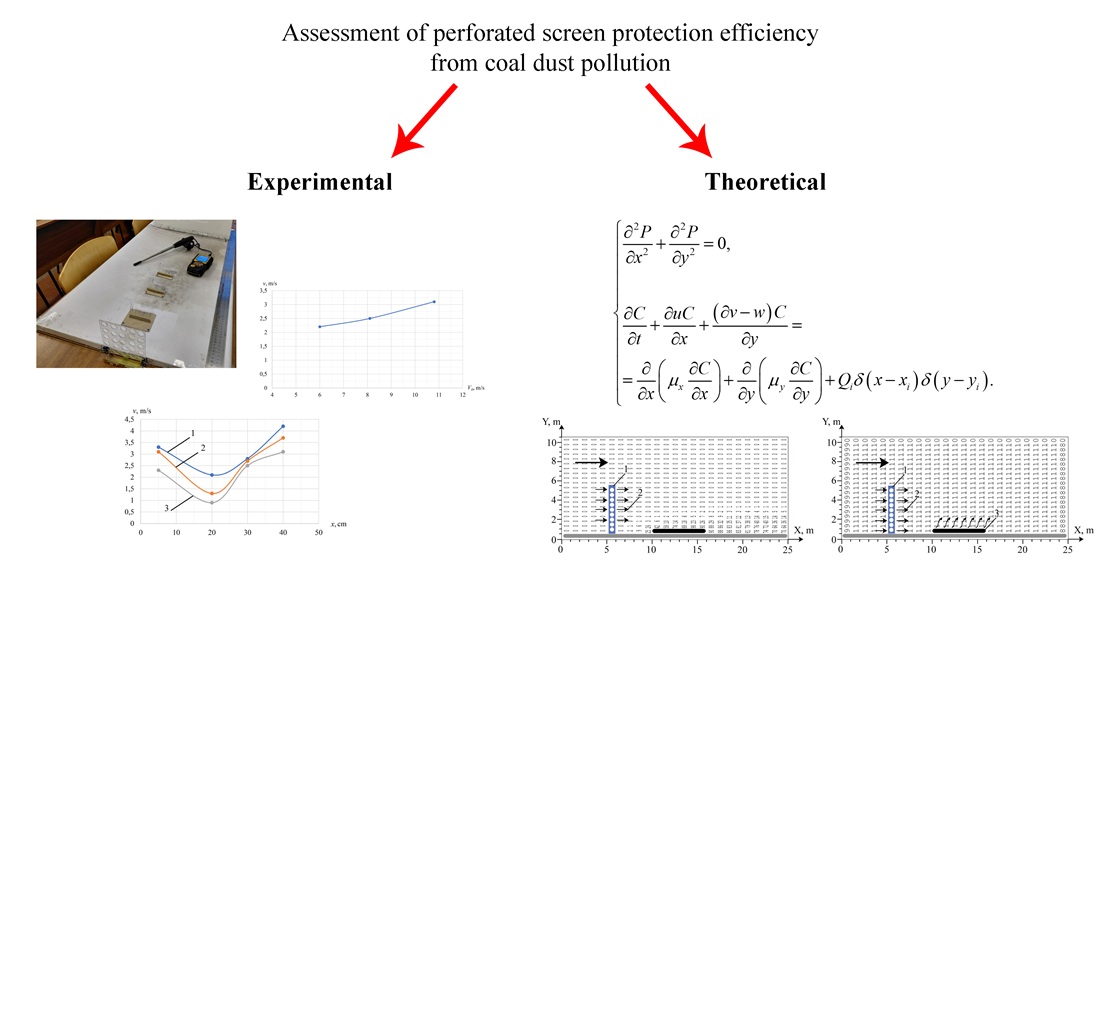
A likely engineering solution to such a task is to use protective screens, in particular, protective screens with perforations. These screens reduce the speed of the oncoming wind flow, which, in turn, reduces the intensity of dust formation. The location of the screens at an industrial site is important.
A laboratory experiment was conducted to determine the patterns of air flow velocity distribution behind a protective screen with perforations. The experimental data showed that the screen makes it possible to reduce the wind flow velocity by 5–6 times over an extension of the order of 2H from the screen (H is the height of the screen). The air flow velocity increases intensively behind the screen in the area 2H–4H. These results make it possible to determine the rational location of the screen relative to the dust formation area.
For theoretical assessment of the effectiveness of these screens, a numerical model was built based on the fundamental equations of continuum mechanics. The modeling equations include the dust mass transfer equation and the potential motion equation. Using the constructed numerical model, a computational experiment was conducted, which confirmed the effectiveness of using perforated protective screens: the area of dust air pollution in height decreased almost 3 times. The cost of computer time for conducting a computational experiment is 2 seconds. This makes it possible, when carrying out design work, to perform a series of calculations in a short period of time
References
- Coal Yard Wind fence. ArcelorMittal Tubarão. YouTube. Available at: https://www.youtube.com/watch?v=8UljAOZM4Cw
- Manufacturing Companies of PVC Coated Perforated Metal Sheet. Available at: https://www.dj-metal-mesh.com/manufacturing-companies-of-pvc-coated-perforated-metal-sheet-products/
- Wang, H., Cheng, W., Sa, Z., Liu, J., Zhang, R., Chen, D. (2021). Experimental study of the effects of air volume ratios on the air curtain dust cleaning in fully mechanized working face. Journal of Cleaner Production, 293, 126109. https://doi.org/10.1016/j.jclepro.2021.126109
- Jing, D., Liu, H., Zhang, T., Ge, S., Ren, S., Ma, M. (2022). Study on coal dust diffusion law and new pneumatic spiral spray dedusting technology at transfer point of mine cross roadway. Plos One, 17 (8), e0272304. https://doi.org/10.1371/journal.pone.0272304
- Nie, W., Yang, B., Du, T., Peng, H., Zhang, X., Zhang, Y. (2022). Dynamic dispersion and high-rise release of coal dust in the working surface of a large-scale mine and application of a new wet dust reduction technology. Journal of Cleaner Production, 351, 131356. https://doi.org/10.1016/j.jclepro.2022.131356
- Zhao, Y., Ambrose, R. P. K. (2022). Predicting continuous dispersion and deposition of explosive dust in confined spaces using a discrete phase model. Powder Technology, 408, 117704. https://doi.org/10.1016/j.powtec.2022.117704
- Zou, C. (2021). Analysis on Dust Control Technology in Open-pit Quarry. Journal of Energy and Natural Resources, 10 (1), 28. https://doi.org/10.11648/j.jenr.20211001.13
- Wua, T., Yanga, Z., Zhanga, K., Wangb, B. (2023). Optimization study on the application of induced dust suppression cover in primary crushing station of open-pit mine. Heliyon, 9 (6), e16492. https://doi.org/10.1016/j.heliyon.2023.e16492
- Appiah, A., Li, Y., Aram, S. A., Utip, I. B., Saalidong, B. M., Li, Z. (2022). A Comparative Assessment of On-Site Application Effects of Mine Dust Prevention and Control Technology. Journal of Geoscience and Environment Protection, 10 (09), 230–250. https://doi.org/10.4236/gep.2022.109014
- Biliaiev, M., Kozachyna, V., Kirichenko, P., Biliaieva, V., Semenenko, P. (2025). Numerical modeling of dust air pollution at industrial sites: Express modeling. Polish Journal of Science, 90, 31–36. https://doi.org/10.5281/zenodo.17170478
- Biliaiev, M., Kozachyna, V., Kirichenko, P., Biliaieva, V., Semenenko, P. (2025). Study of changes in coal moisture content at different air flow rates. Slovak international scientific journal, 99, 25–30. https://doi.org/10.5281/zenodo.17118961
- Venkatram, A., Heist, D. K., Perry, S. G., Brouwer, L. (2021). Dispersion at the edges of near road noise barriers. Atmospheric Pollution Research, 12 (2), 367–374. https://doi.org/10.1016/j.apr.2020.11.017
- Zghurovskyi, M. Z., Skopetskyi, V. V., Khrushch, V. K., Beliaev, N. N. (1997). Chyslennoe modelyrovanye rasprostranenyia zahriaznenyia v okruzhaiushchei srede. Kyiv: Naukova dumka, 368.
Downloads
Published
How to Cite
Issue
Section
License
Copyright (c) 2026 Mykola Biliaiev, Oleksandr Berlov, Viktoriia Biliaieva, Pavlo Kirichenko, Vitalii Kozachyna, Polina Mashykhina, Valerii Savin, Pavlo Semenenko, Andrii Usenko, Svitlana Foris

This work is licensed under a Creative Commons Attribution 4.0 International License.
The consolidation and conditions for the transfer of copyright (identification of authorship) is carried out in the License Agreement. In particular, the authors reserve the right to the authorship of their manuscript and transfer the first publication of this work to the journal under the terms of the Creative Commons CC BY license. At the same time, they have the right to conclude on their own additional agreements concerning the non-exclusive distribution of the work in the form in which it was published by this journal, but provided that the link to the first publication of the article in this journal is preserved.
A license agreement is a document in which the author warrants that he/she owns all copyright for the work (manuscript, article, etc.).
The authors, signing the License Agreement with TECHNOLOGY CENTER PC, have all rights to the further use of their work, provided that they link to our edition in which the work was published.
According to the terms of the License Agreement, the Publisher TECHNOLOGY CENTER PC does not take away your copyrights and receives permission from the authors to use and dissemination of the publication through the world's scientific resources (own electronic resources, scientometric databases, repositories, libraries, etc.).
In the absence of a signed License Agreement or in the absence of this agreement of identifiers allowing to identify the identity of the author, the editors have no right to work with the manuscript.
It is important to remember that there is another type of agreement between authors and publishers – when copyright is transferred from the authors to the publisher. In this case, the authors lose ownership of their work and may not use it in any way.








