Establishing the relationships between C9 hydrocarbon resin properties and radical oligomerization technique
DOI:
https://doi.org/10.15587/1729-4061.2026.363075Keywords:
hydrocarbon resin, C9 fraction, radical oligomerization, styrene, Polydicyclopentadiene, polydispersity, rheologyAbstract
This study investigates the radical oligomerization of the C9 fraction of liquid by-products from diesel fuel pyrolysis. The task addressed is to establish patterns of influence of the radical oligomerization technique on the properties of C9 hydrocarbon resins.
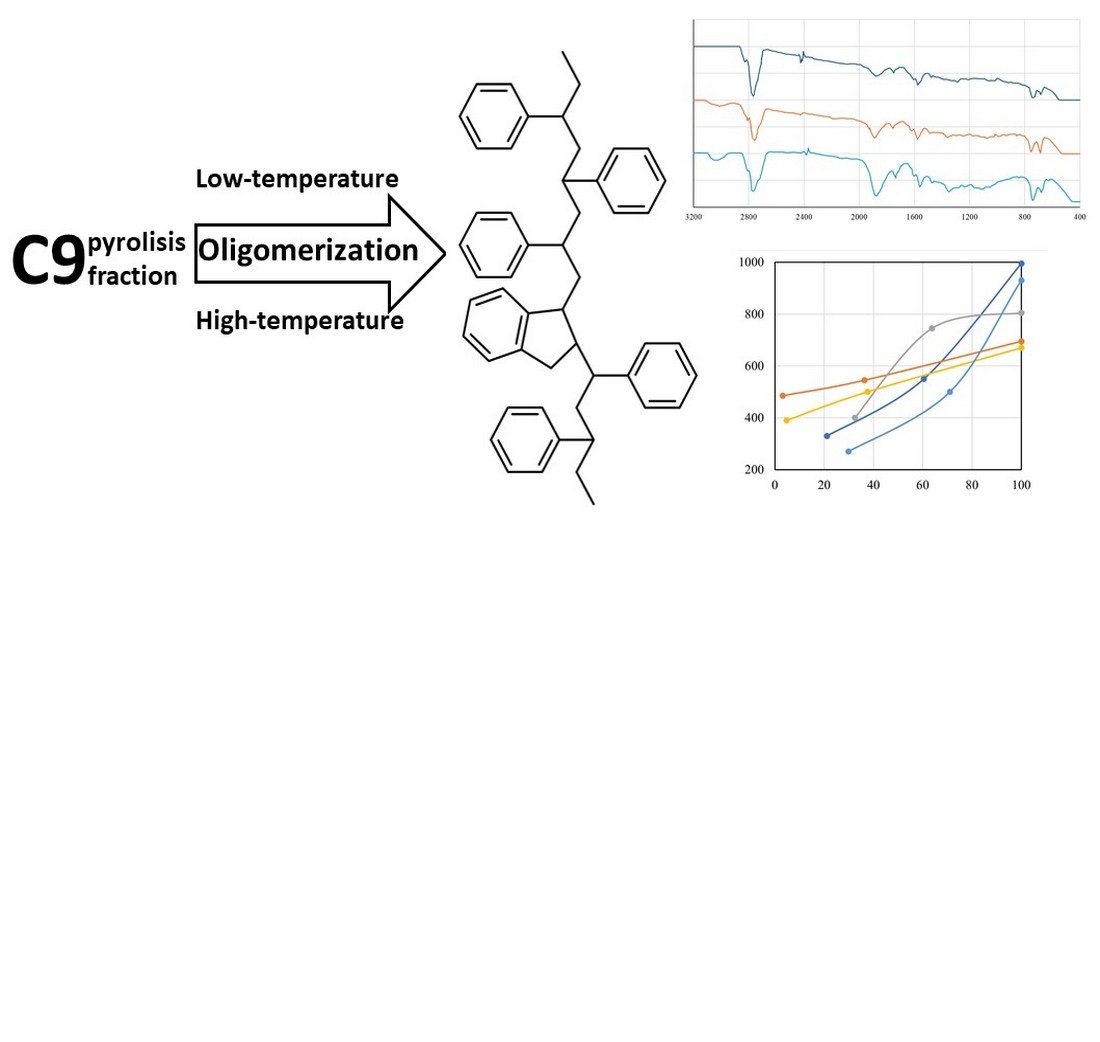
The effect of radical oligomerization technique on the physicochemical, molecular weight, rheological, and structural characteristics of resins obtained by high-temperature (thermal, initiated) and low-temperature (emulsion, suspension) methods has been studied. It was established that high-temperature methods provide higher yields of resins (15–32%), lower average molecular weight (455–670 g/mol), and a wider molecular weight distribution (1.20–1.25). Low-temperature dispersion processes are characterized by lower yields (4–29.3%), higher molecular weight (550–750 g/mol) and narrower distribution (1.02–1.06). Emulsion and suspension methods provide lighter resins (10–40 mg I2/100 ml) compared to high-temperature analogs (40–80 mg I2/100 ml).
The results and structural differences recorded by IR spectroscopy are attributed to the temperature regime of synthesis. High-temperature resins are characterized by a higher content of condensed cyclic structures. This is explained by the intensification of side chain transfer reactions at high temperatures.
Special features of the results are determining the complex relationship between the oligomerization technique and the characteristics of the resins. This allows for a purposeful selection of synthesis conditions for specific product requirements.
The scope of practical implementation of the results includes the chemical and paint industries; as well as the possibility of directed regulation of the properties of C9 resins for their use in adhesives, sealants, and film formers
References
- Rostami, M.-T., Shahverdi, H., Javanbakht, V., Chermahini, A. N., Fakhar, A. (2026). Experimental petroleum resin production and optimization using response surface modeling. Scientific Reports, 16 (1). https://doi.org/10.1038/s41598-026-36409-1
- Mildenberg, R., Zander, M., Collin, G. (1997). Hydrocarbon Resins. Wiley. https://doi.org/10.1002/9783527614653
- Rahmatpour, A., Ghasemi Meymandi, M. (2021). Large-Scale Production of C9 Aromatic Hydrocarbon Resin from the Cracked-Petroleum-Derived C9 Fraction: Chemistry, Scalability, and Techno-economic Analysis. Organic Process Research & Development, 25 (1), 120–135. https://doi.org/10.1021/acs.oprd.0c00474
- Liang, T., Lin, X.-H., Zou, Y.-R., Zhan, Z.-W., Peng, P. (2023). Elucidating the chemical structures of petroleum resin using solid-state 13C NMR. Chemical Geology, 630, 121492. https://doi.org/10.1016/j.chemgeo.2023.121492
- Liang, J., Chang, S., Feng, N. (2013). Effect of C5 petroleum resin content on damping behavior, morphology, and mechanical properties of BIIR/BR vulcanizates. Journal of Applied Polymer Science, 130 (1), 510–515. https://doi.org/10.1002/app.39202
- Zohuriaan-Mehr, M. J., Omidian, H. (2000). Petroleum Resins: An Overview. Journal of Macromolecular Science, Part C: Polymer Reviews, 40 (1), 23–49. https://doi.org/10.1081/mc-100100577
- Subtelnyy, R., Zhuravskyi, Y., Dzinyak, B. (2023). Preparation of hydrocarbon resins by suspension oligomerisation of the C9 fraction of gasoline pyrolysis initiated by amino peroxides. Eastern-European Journal of Enterprise Technologies, 6 (6 (126)), 23–30. https://doi.org/10.15587/1729-4061.2023.292527
- Orobchuk, O., Subtelnyy, R., Dzinyak, B. (2014). Studying the effect of initiator dosing on the process of hydrocarbon fraction suspension co-oligomerization. Eastern-European Journal of Enterprise Technologies, 4 (6 (70)), 14–18. https://doi.org/10.15587/1729-4061.2014.26236
- Mokryi, Ye., Dziniak, B., Nykulyshyn, I., Budzan, B., Salim Khair Salem (1997). Porivnialna otsinka metodiv oderzhannia naftopolimernykh smol. Dopovidi NAN Ukrainy, 5, 153–156.
- Subtelnyy, R., Kichura, D., Dzinyak, B. (2021). Correlation between the emulsion oligomerization parameters for C9 fraction and the characteristics of hydrocarbon resins. Eastern-European Journal of Enterprise Technologies, 3 (6 (111)), 6–11. https://doi.org/10.15587/1729-4061.2021.232684
- Subtelnyy, R. O., Fedotova, O. B., Dzinyak, B. O. (2026). Molecular-weight distribution of C9 hydrocarbon resins. Voprosy Khimii I Khimicheskoi Tekhnologii, 2, 59–67. https://doi.org/10.32434/0321-4095-2026-165-2-59-67
- Xiong, Z., Mi, Z., Zhang, X. (2005). Study on the oligomerization of cyclopentadiene and dicyclopentadiene to tricyclopentadiene through diels-alder reaction. Reaction Kinetics and Catalysis Letters, 85 (1), 89–97. https://doi.org/10.1007/s11144-005-0247-9
- Guo, Y., Liu, J., Lu, Y., Dong, D., Wang, W., Zhang, L. (2018). A combined molecular dynamics simulation and experimental method to study the compatibility between elastomers and resins. RSC Advances, 8 (26), 14401–14413. https://doi.org/10.1039/c8ra00572a
- Zhou, D., Chen, X., Liang, J., Wei, X., Wu, C., He, Y., Wang, L. (2022). Combustion kinetics and fuel performance of tackifying resins by TG-FTIR and DFT analysis. Fuel, 330, 125656. https://doi.org/10.1016/j.fuel.2022.125656
- Subtelnyy, R. O., Balitskyi, I. H., Dzinyak, B. O. (2025). Rheological properties of C9 petroleum resin solutions. Voprosy Khimii I Khimicheskoi Tekhnologii, 2, 17–23. https://doi.org/10.32434/0321-4095-2025-159-2-17-23
- Yan, C., Zhang, T., Hu, K., Gillani, S. T. A., Zhang, W. (2024). Evaluation of the Effect of C9 Petroleum Resin on Rheological Behavior, Microstructure, and Chemical Properties of Styrene–Butadiene–Styrene Modified Asphalt. Buildings, 14 (6), 1599. https://doi.org/10.3390/buildings14061599
- Chen, Z., Wang, W., Abdukadir, A., Lei, J., Yi, J., Pei, Z. (2025). C9 Petroleum Resin and Polyethylene-Based High-Viscosity Modified Asphalt Binder Proportioning Optimization and Performance Study. Coatings, 15 (3), 343. https://doi.org/10.3390/coatings15030343
- Lei, G. Y. (1981). Self‐consistency of fractional precipitation method for determining molecular weight distribution in a polymer sample. Journal of Polymer Science: Polymer Chemistry Edition, 19 (2), 389–396. https://doi.org/10.1002/pol.1981.170190215
- Roswell, M., Dushoff, J., Winfree, R. (2021). A conceptual guide to measuring species diversity. Oikos, 130 (3), 321–338. https://doi.org/10.1111/oik.07202
- Uysal, D. S., Kalıpçılar, H., Karakaş, G. (2025). Kinetic Analysis and Simulation of Dicyclopentadiene/Cyclopentadiene Production by Using Reactive Batch Distillation of Pyrolysis Gasoline. Energy & Fuels, 39 (15), 7592–7604. https://doi.org/10.1021/acs.energyfuels.5c00569
- Yao, Z., Xu, X., Dong, Y., Liu, X., Yuan, B., Wang, K. et al. (2020). Kinetics on thermal dissociation and oligomerization of dicyclopentadiene in a high temperature & pressure microreactor. Chemical Engineering Science, 228, 115892. https://doi.org/10.1016/j.ces.2020.115892
- Wutz, C., Kricheldorf, H. R. (2012). Molecular Weight Distribution of Linear Chains in Step‐Growth Polymerization Under the Influence of Cyclization Reactions. Macromolecular Theory and Simulations, 21 (4), 266–271. https://doi.org/10.1002/mats.201100084
Downloads
Published
How to Cite
Issue
Section
License
Copyright (c) 2026 Roman Subtelnyy, Olha Fedotova, Volodymyr Romaniv, Yevhenii Zhuravskyi, Bohdan Dzinyak

This work is licensed under a Creative Commons Attribution 4.0 International License.
The consolidation and conditions for the transfer of copyright (identification of authorship) is carried out in the License Agreement. In particular, the authors reserve the right to the authorship of their manuscript and transfer the first publication of this work to the journal under the terms of the Creative Commons CC BY license. At the same time, they have the right to conclude on their own additional agreements concerning the non-exclusive distribution of the work in the form in which it was published by this journal, but provided that the link to the first publication of the article in this journal is preserved.
A license agreement is a document in which the author warrants that he/she owns all copyright for the work (manuscript, article, etc.).
The authors, signing the License Agreement with TECHNOLOGY CENTER PC, have all rights to the further use of their work, provided that they link to our edition in which the work was published.
According to the terms of the License Agreement, the Publisher TECHNOLOGY CENTER PC does not take away your copyrights and receives permission from the authors to use and dissemination of the publication through the world's scientific resources (own electronic resources, scientometric databases, repositories, libraries, etc.).
In the absence of a signed License Agreement or in the absence of this agreement of identifiers allowing to identify the identity of the author, the editors have no right to work with the manuscript.
It is important to remember that there is another type of agreement between authors and publishers – when copyright is transferred from the authors to the publisher. In this case, the authors lose ownership of their work and may not use it in any way.








