Determining tension distribution and damage evolution patterns in thread-stitched book blocks under cyclic opening conditions
DOI:
https://doi.org/10.15587/1729-4061.2026.363632Keywords:
thread, binding, book spine, tension, stress, deformation, contact, damage, durability, modelingAbstract
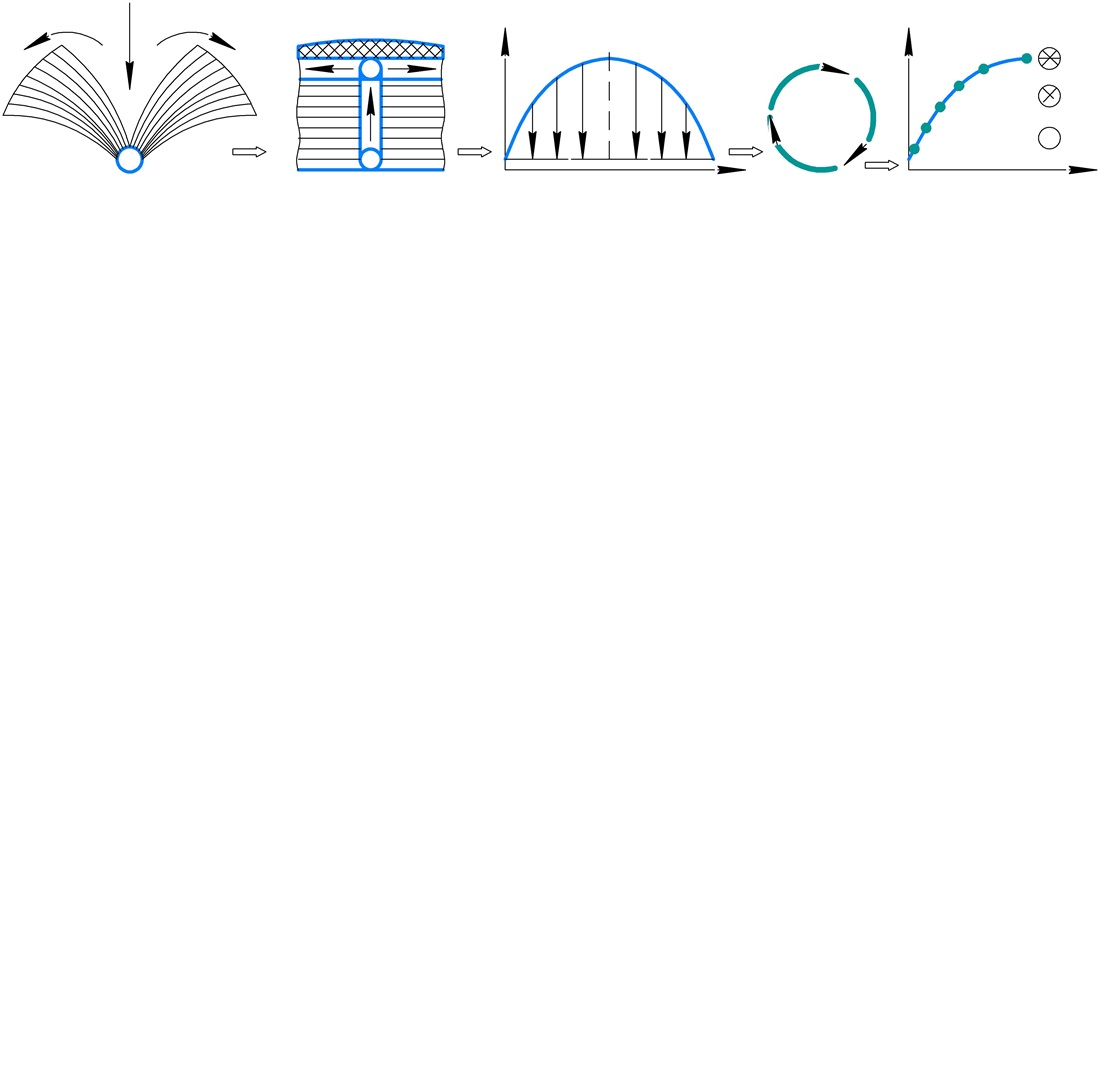
This study investigates the process behind the stressed-strained state of the thread stitching of a spine part of book blocks at their multiple opening. Most attention is on the spatial work of the thread structure and patterns of load distribution in the spine zone of the block, predetermined by the lack of generalized models for the spatial organization of thread stitching; known approaches mainly consider adhesive or simplified connections. This study is carried out based on structural-mechanical and finite element modeling of the thread structure of spine binding.
The proposed model takes into account the spatial trajectory of the thread, the change in direction and tension of the thread in places of bending, as well as its contact interaction with paper. The geometric, force, and finite element models of thread stitching have been constructed. It was established that the tension distribution along the thread trajectory has an exponentially decreasing character. At the same time, the maximum values of the normalized contact pressure p / p0 = 1.0 are observed in the surface stitches of the spine part.
The calculations showed that the working interval of thread tension within the Twork = 35–60 conditional units limits ensures stable operation of the thread structure without noticeable evolution of degradation processes in the paper of the folds. At the same time, exceeding the limit tension level of Tpaper = 72 conditional units is accompanied by the gradual development of local damage in the areas of fold openings. After 1000 load cycles, the damage parameter Dp for polyester threads reached 0.96, for cotton threads – 0.87, and for polyamide threads – 0.78.
The results could be used to optimize the formation modes of the spatial structure of a thread-glue blinding of the spine part of book blocks
References
- Akkasali, N. K., Biswas, S., Sen, S., Anitha, S. (2024). A state-of-the-art review on adhesively bonded joints of similar and dissimilar materials. Journal of Adhesion Science and Technology, 38 (24), 4317–4371. https://doi.org/10.1080/01694243.2024.2384421
- Ramalho, L. D. C., Sánchez-Arce, I. J., Gonçalves, D. C., Belinha, J., Campilho, R. D. S. G. (2022). Numerical analysis of the dynamic behaviour of adhesive joints: A review. International Journal of Adhesion and Adhesives, 118, 103219. https://doi.org/10.1016/j.ijadhadh.2022.103219
- Hoshikawa, Y., Kawagoe, Y., Ryuzono, K., Okabe, T. (2024). Finite element modeling for cohesive/adhesive failure of adhesive structures with a thermosetting resin. Engineering Fracture Mechanics, 311, 110552. https://doi.org/10.1016/j.engfracmech.2024.110552
- Marzi, S. (2023). Experimental determination of coupled cohesive laws with an unsymmetrical stiffness matrix for structural adhesive joints loaded in mixed-mode I+III. Engineering Fracture Mechanics, 283, 109215. https://doi.org/10.1016/j.engfracmech.2023.109215
- Bernardin, P., Sedlacek, F., Kozak, J., Kucerova, L., Lasova, V. (2024). Identification of the Cohesive Parameters for Modelling of Bonded Joints between Flat Composite Adherends with Thick Layer of Adhesive. Materials, 17 (19), 4880. https://doi.org/10.3390/ma17194880
- Ibrahim, A. H., Watson, B., Jahed, H., Rezaee, S., Cronin, D. S. (2024). An experimental-cohesive zone model approach to predict fatigue life of adhesive joints with varying modes of loading and joint configurations for automotive applications. The Journal of Adhesion, 101 (7), 930–956. https://doi.org/10.1080/00218464.2024.2408372
- Calabrese, A. S., Vassilopoulos, A. P. (2025). On the fatigue behavior of thin and thick adhesively bonded composite joints. International Journal of Fatigue, 199, 109065. https://doi.org/10.1016/j.ijfatigue.2025.109065
- Birnie, J., Falaschetti, M. P., Troiani, E. (2025). Comparative Analysis on Modelling Approaches for the Simulation of Fatigue Disbonding with Cohesive Zone Models. Aerospace, 12 (2), 139. https://doi.org/10.3390/aerospace12020139
- Li, Y., Deng, H., Takamura, M., Koyanagi, J. (2023). Durability Analysis of CFRP Adhesive Joints: A Study Based on Entropy Damage Modeling Using FEM. Materials, 16 (20), 6821. https://doi.org/10.3390/ma16206821
- de Queiroz, H. F. M., Banea, M. D. (2022). Methods to increase the mechanical performance of composite adhesive joints: An overview with focus on joints with natural fibre composite adherends. Journal of Composite Materials, 56 (26), 3993–4010. https://doi.org/10.1177/00219983221125906
- Petković, G., Pasanec Preprotić, S., Vukoje, M., Bolanča Mirković, I. (2024). Impact of SiO2 and TiO2 Nanoparticles on the Elasticity and Aging Resistance of Polyvinyl Acetate (PVAc) Adhesive. Materials, 17 (23), 5957. https://doi.org/10.3390/ma17235957
- Jina, W., Nagasawa, S., Yamamoto, T., Nagumo, T. (2023). Analysis of the folding behavior of a paperboard subjected to indentation of a deviated creasing rule using the finite element method. AIMS Materials Science, 10 (2), 313–341. https://doi.org/10.3934/matersci.2023017
- Paliukh, O., Kyrychok, P., Shtefan, Y., Titov, A. (2022). Development of information support for simulation of the process of deformation of root polymer plate in book blocks sewed with threads. Eastern-European Journal of Enterprise Technologies, 5 (1 (119)), 62–73. https://doi.org/10.15587/1729-4061.2022.265869
- Pasanec Preprotić, S., Vukoje, M., Petković, G., Rožić, M. (2023). Novel Approaches to Enhancing Sustainable Adhesive System Solutions in Contemporary Book Binding: An Overview. Heritage, 6 (1), 628–646. https://doi.org/10.3390/heritage6010033
- Bulín, R., Hajžman, M. (2019). Comparison of Detailed Belt - Cylinder Interaction Model with Classical Belt Friction Formula. Strojnícky Časopis - Journal of Mechanical Engineering, 69 (3), 9–16. https://doi.org/10.2478/scjme-2019-0024
Downloads
Published
How to Cite
Issue
Section
License
Copyright (c) 2026 Oleksandr Paliukh, Petro Kyrychok, Volodymyr Oliinyk, Daryna Baranova

This work is licensed under a Creative Commons Attribution 4.0 International License.
The consolidation and conditions for the transfer of copyright (identification of authorship) is carried out in the License Agreement. In particular, the authors reserve the right to the authorship of their manuscript and transfer the first publication of this work to the journal under the terms of the Creative Commons CC BY license. At the same time, they have the right to conclude on their own additional agreements concerning the non-exclusive distribution of the work in the form in which it was published by this journal, but provided that the link to the first publication of the article in this journal is preserved.
A license agreement is a document in which the author warrants that he/she owns all copyright for the work (manuscript, article, etc.).
The authors, signing the License Agreement with TECHNOLOGY CENTER PC, have all rights to the further use of their work, provided that they link to our edition in which the work was published.
According to the terms of the License Agreement, the Publisher TECHNOLOGY CENTER PC does not take away your copyrights and receives permission from the authors to use and dissemination of the publication through the world's scientific resources (own electronic resources, scientometric databases, repositories, libraries, etc.).
In the absence of a signed License Agreement or in the absence of this agreement of identifiers allowing to identify the identity of the author, the editors have no right to work with the manuscript.
It is important to remember that there is another type of agreement between authors and publishers – when copyright is transferred from the authors to the publisher. In this case, the authors lose ownership of their work and may not use it in any way.








