Determining the impact of adversarial cyberattacks on the performance of a comprehensive biometric identification method based on local-texture descriptors
DOI:
https://doi.org/10.15587/1729-4061.2026.363911Keywords:
biometric identification, facial recognition, image processing, software, cyber threats, adversarial attacks, local texture descriptors, HOG, 1DLBP, occlusive perturbationsAbstract
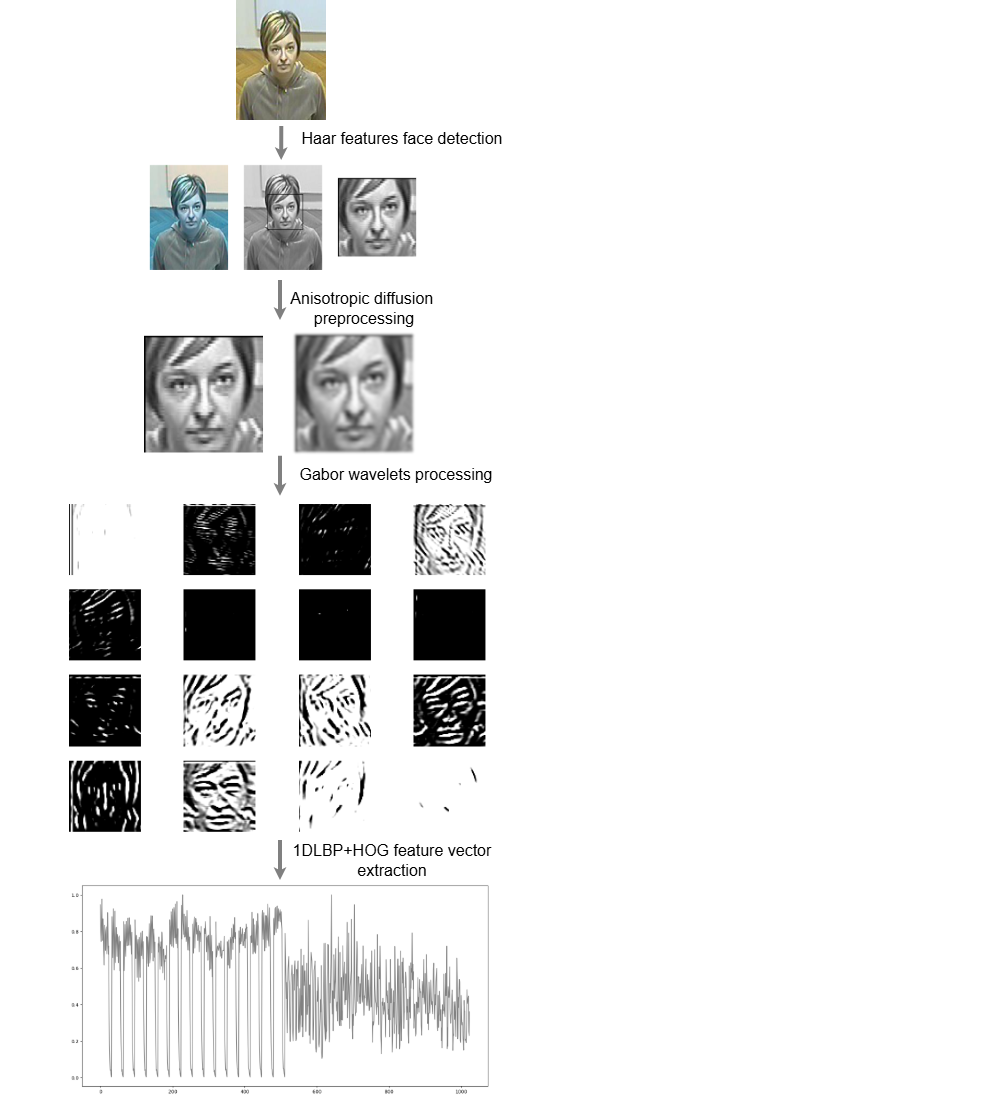
The object of study is a comprehensive biometric identification method based on local-texture descriptors HOG and 1DLBP. The task addressed is to determine the impact of adversarial cyberattacks on the accuracy of biometric identification by facial image.
The results under the predefined research conditions were evaluated in terms of the comprehensive method's efficiency, robustness, and stability. Experiments were conducted on six datasets covering controlled and uncontrolled shooting conditions, using a unified set of metrics. The impact was determined in scenarios of full visibility of facial features and in the presence of local occlusive disturbances characteristic of adversarial attacks.
The efficiency retention coefficient of the comprehensive method when used under controlled shooting conditions is 86.84–92.86% with a sensitivity index of 7.14–13.16%; the decrease in accuracy is statistically insignificant for most image sets. Compared with DNNs whose accuracy degradation under the influence of adversarial attacks reaches 26.45–76%, the comprehensive method's identification accuracy decreases by 1.5%. Such results are due to the features of the algorithmic formation of attribute vectors by descriptors and the comprehensive method's absence of sensitivity to perturbations calculated on the properties of DNN methods.
The HOG and 1DLBP descriptors compute the gradient and texture characteristics of local image regions based on deterministic algorithms without using training parameters and the error backpropagation mechanism. As a result, adversarial perturbations optimized for hierarchical nonlinear representations of DNNs have a limited impact on the feature space formed by descriptors. By conducting a study on face images acquired under variable conditions, the limits of the solution's applicability were determined.
The suitability of the comprehensive method for practical application in cybersecurity complexes, in particular in video surveillance, access control, and checkpoint systems, has been established
References
- Martsenyuk, V., Bychkov, O., Merkulova, K., Zhabska, Y. (2023). Exploring Image Unified Space for Improving Information Technology for Person Identification. IEEE Access, 11, 76347–76358. https://doi.org/10.1109/access.2023.3297488
- Facial Recognition Market Overview and Future Outlook (No. FBI101061) (2026). Fortune Business Insights. Available at: https://www.fortunebusinessinsights.com/industry-reports/facial-recognition-market-101061
- Leyva, R., Gregory, E., Maple, C. (2025). Attack Vectors for Face Recognition Systems: A Comprehensive Review. ACM Computing Surveys, 58 (1), 1–37. https://doi.org/10.1145/3736753
- Wang, M., Zhou, J., Li, T., Meng, G., Chen, K. (2026). A survey on physical adversarial attacks against face recognition systems. Neurocomputing, 669, 132485. https://doi.org/10.1016/j.neucom.2025.132485
- Zolfi, A., Avidan, S., Elovici, Y., Shabtai, A. (2023). Adversarial Mask: Real-World Universal Adversarial Attack on Face Recognition Models. Machine Learning and Knowledge Discovery in Databases, 304–320. https://doi.org/10.1007/978-3-031-26409-2_19
- Liu, X., Shen, F., Zhao, J., Nie, C. (2024). EAP: An effective black-box impersonation adversarial patch attack method on face recognition in the physical world. Neurocomputing, 580, 127517. https://doi.org/10.1016/j.neucom.2024.127517
- Ma, T. (2025). Research on The Security of Face Recognition Systems Based on Digital and Physical Counterattacks. ITM Web of Conferences, 78, 2003. https://doi.org/10.1051/itmconf/20257802003
- Hwang, R.-H., Lin, J.-Y., Hsieh, S.-Y., Lin, H.-Y., Lin, C.-L. (2023). Adversarial Patch Attacks on Deep-Learning-Based Face Recognition Systems Using Generative Adversarial Networks. Sensors, 23 (2), 853. https://doi.org/10.3390/s23020853
- Guesmi, A., Hanif, M. A., Ouni, B., Shafique, M. (2023). Physical Adversarial Attacks for Camera-Based Smart Systems: Current Trends, Categorization, Applications, Research Challenges, and Future Outlook. IEEE Access, 11, 109617–109668. https://doi.org/10.1109/access.2023.3321118
- Zheng, X., Fan, Y., Wu, B., Zhang, Y., Wang, J., Pan, S. (2023). Robust Physical-World Attacks on Face Recognition. Pattern Recognition, 133, 109009. https://doi.org/10.1016/j.patcog.2022.109009
- Birgisdóttir, E. L., Kunkel, M. I., Pleva, L., Papaioannou, M., Choudhary, G., Dragoni, N. (2025). Exploring the Security of Mobile Face Recognition: Attacks, Defenses, and Future Directions. Applied Sciences, 15 (24), 13232. https://doi.org/10.3390/app152413232
- Abidi, S. M. H., Hassan, S. A., Raza, S. M., Beliatis, M. J. (2026). Advances in Face Recognition: A Comprehensive Review of Feature Extraction and Dataset Evaluation. Electronics, 15 (2), 338. https://doi.org/10.3390/electronics15020338
- Bychkov, O., Merkulova, K., Zhabska, Y. (2020). Information Technology of Person’s Identification by Photo Portrait. 2020 IEEE 15th International Conference on Advanced Trends in Radioelectronics, Telecommunications and Computer Engineering (TCSET), 786–790. https://doi.org/10.1109/tcset49122.2020.235542
- Perona, P., Malik, J. (1990). Scale-space and edge detection using anisotropic diffusion. IEEE Transactions on Pattern Analysis and Machine Intelligence, 12 (7), 629–639. https://doi.org/10.1109/34.56205
- Obaida, T. H., Jamil, A. S., Hassan, N. F. (2022). Real-time face detection in digital video-based on Viola-Jones supported by convolutional neural networks. International Journal of Electrical and Computer Engineering (IJECE), 12 (3), 3083. https://doi.org/10.11591/ijece.v12i3.pp3083-3091
- Xia, R., Cheng, Y., Tang, Y., Liu, X., Liu, X., Wang, L., Jiang, P. (2025). S-Diff: An Anisotropic Diffusion Model for Collaborative Filtering in Spectral Domain. Proceedings of the Eighteenth ACM International Conference on Web Search and Data Mining, 70–78. https://doi.org/10.1145/3701551.3703490
- Merkulova, K., Zhabska, Y. (2023). Input Data Requirements for Person Identification Information Technology. Proceedings of the 1st International Workshop on Computer Information Technologies in Industry 4.0 (CITI 2023), 3468, 24–37. Available at: https://ceur-ws.org/Vol-3468/paper3.pdf
- Wang, H., Jing, J., Li, N., Zhang, W. (2023). Multiscale and Multidirectional Gabor Filters for Image Corner Detection. 2023 9th International Conference on Mechanical and Electronics Engineering (ICMEE), 396–405. https://doi.org/10.1109/icmee59781.2023.10525496
- Dalal, N., Triggs, B. (2005). Histograms of Oriented Gradients for Human Detection. 2005 IEEE Computer Society Conference on Computer Vision and Pattern Recognition (CVPR′05), 1, 886–893. https://doi.org/10.1109/cvpr.2005.177
- Legarda, D., Pérez, K., Muñoz, D. M. (2025). A comparative hardware implementation of histogram of oriented gradients as a descriptor in embedded tracking of swarm robots. Journal of Parallel and Distributed Computing, 198, 105026. https://doi.org/10.1016/j.jpdc.2024.105026
- Benzaoui, A., Boukrouche, A., Doghmane, H., Bourouba, H. (2015). Face recognition using 1DLBP, DWT and SVM. 2015 3rd International Conference on Control, Engineering & Information Technology (CEIT), 1–6. https://doi.org/10.1109/ceit.2015.7233002
- The Database of Faces. Available at: https://cam-orl.co.uk/facedatabase.html
- Face Recognition Technology (FERET). Available at: https://www.nist.gov/programs-projects/face-recognition-technology-feret
- Grgic, M., Delac, K., Grgic, S. (2009). SCface – surveillance cameras face database. Multimedia Tools and Applications, 51 (3), 863–879. https://doi.org/10.1007/s11042-009-0417-2
- Moschoglou, S., Papaioannou, A., Sagonas, C., Deng, J., Kotsia, I., Zafeiriou, S. (2017). AgeDB: The First Manually Collected, In-the-Wild Age Database. 2017 IEEE Conference on Computer Vision and Pattern Recognition Workshops (CVPRW), 1997–2005. https://doi.org/10.1109/cvprw.2017.250
- Sengupta, S., Chen, J.-C., Castillo, C., Patel, V. M., Chellappa, R., Jacobs, D. W. (2016). Frontal to profile face verification in the wild. 2016 IEEE Winter Conference on Applications of Computer Vision (WACV), 1–9. https://doi.org/10.1109/wacv.2016.7477558
- Huang, G. B., Ramesh, M., Berg, T., Learned-Mille, E. (2007). Labeled Faces in the Wild: A Database for Studying Face Recognition in Unconstrained Environments. University of Massachusetts. Available at: https://people.cs.umass.edu/~elm/papers/lfw.pdf
- Chethana, H. T., Nagavi, T. C., Mahesha, P., Ravi, V., Al Mazroa, A. (2025). Face Recognition in Unconstrained Images Using Deep Learning Model for Forensics. Security and Privacy, 8 (2). https://doi.org/10.1002/spy2.70012
- Vu, H. N., Nguyen, M. H., Pham, C. (2021). Masked face recognition with convolutional neural networks and local binary patterns. Applied Intelligence, 52 (5), 5497–5512. https://doi.org/10.1007/s10489-021-02728-1
Downloads
Published
How to Cite
Issue
Section
License
Copyright (c) 2026 Yelyzaveta Zhabska, Kateryna Merkulova, Oleksii Bychkov

This work is licensed under a Creative Commons Attribution 4.0 International License.
The consolidation and conditions for the transfer of copyright (identification of authorship) is carried out in the License Agreement. In particular, the authors reserve the right to the authorship of their manuscript and transfer the first publication of this work to the journal under the terms of the Creative Commons CC BY license. At the same time, they have the right to conclude on their own additional agreements concerning the non-exclusive distribution of the work in the form in which it was published by this journal, but provided that the link to the first publication of the article in this journal is preserved.
A license agreement is a document in which the author warrants that he/she owns all copyright for the work (manuscript, article, etc.).
The authors, signing the License Agreement with TECHNOLOGY CENTER PC, have all rights to the further use of their work, provided that they link to our edition in which the work was published.
According to the terms of the License Agreement, the Publisher TECHNOLOGY CENTER PC does not take away your copyrights and receives permission from the authors to use and dissemination of the publication through the world's scientific resources (own electronic resources, scientometric databases, repositories, libraries, etc.).
In the absence of a signed License Agreement or in the absence of this agreement of identifiers allowing to identify the identity of the author, the editors have no right to work with the manuscript.
It is important to remember that there is another type of agreement between authors and publishers – when copyright is transferred from the authors to the publisher. In this case, the authors lose ownership of their work and may not use it in any way.








