Construction of a two-phase model for heating biological tissue and electrosurgical instruments with a split electrode
DOI:
https://doi.org/10.15587/1729-4061.2026.363988Keywords:
electrosurgery, welding of living tissues, hemostasis, electrosurgical instruments, split electrode, ANSYSAbstract
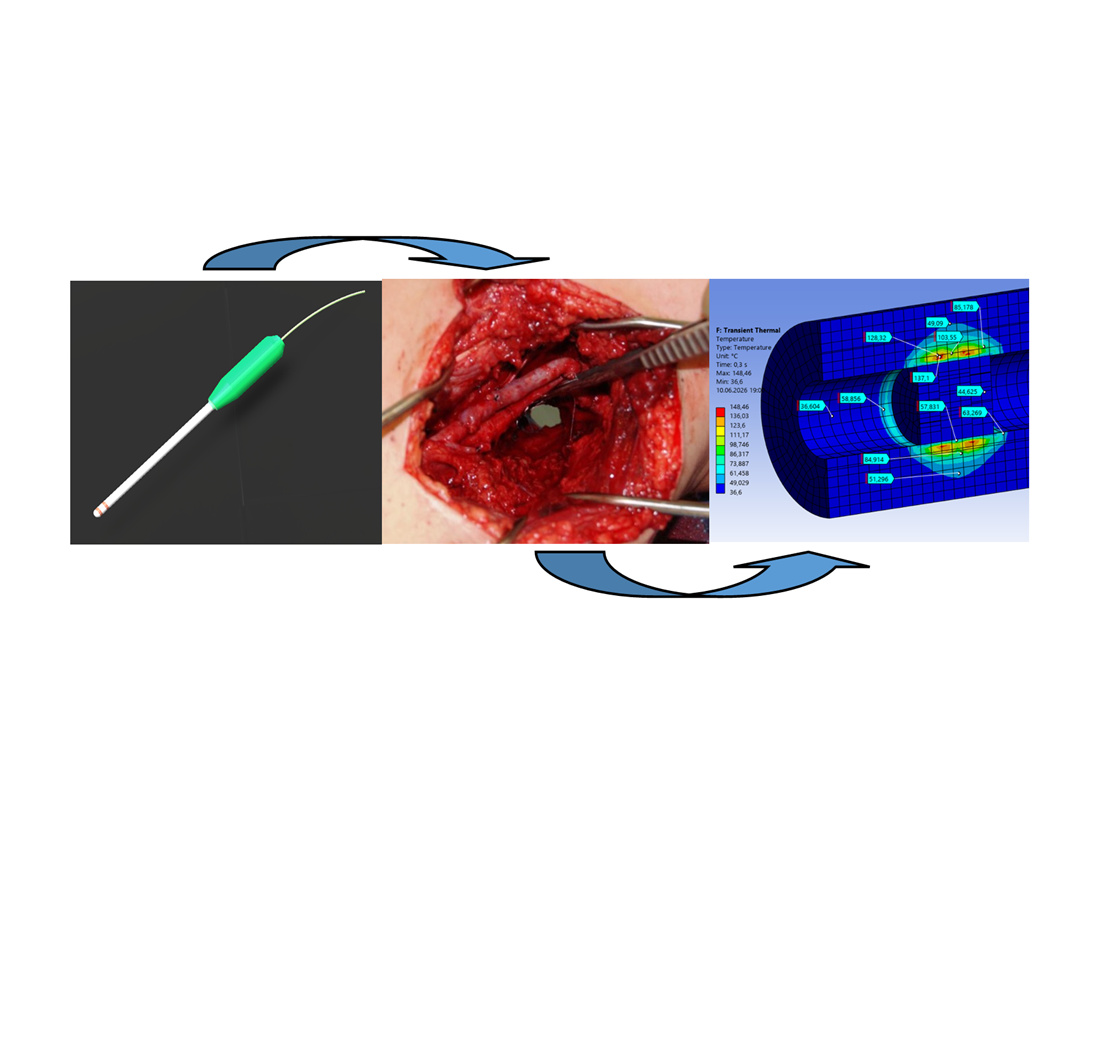
This study develops a two-phase model for heating biological tissue and electrosurgical instruments with a split electrode in the ANSYS program (USA). The distribution of voltage, temperature in the tissue and instruments depending on time and the thickness of the dielectric between the electrodes has been obtained. The dependences of the coagulation area of the parenchyma on the distance between the electrodes and voltage have been determined.
At a dielectric thickness of 3 mm, the tissue is heated to a maximum temperature of 100°C near the ends of the electrodes. Between the electrodes, the temperature decreases to 80–89°C. Coagulation of the tissue begins at a normal temperature of about 80°C. The coagulation zone has a semicircular shape with a width of 6–7 mm and a maximum depth of about 1–1.5 mm.
The resulting model makes it possible to determine the optimal thickness of the dielectric, voltage, and speed of movement of the instrument depending on the diameter of the electrodes and the properties of the tissue. For an electrode diameter of 6 mm, the optimal dielectric thickness is 2–3 mm, voltage – 20–30 V, average speed of movement – 20–30 mm/s. The greatest depth of coagulation and speed of movement of the tool can be obtained at an insulating washer thickness of 3 mm. If the hemostasis zone is within the surgeon's visibility, s/he manually adjusts the voltage and speed of movement of the tool. If the hemostasis zone is hidden from the surgeon, it is necessary to use automatic control systems.
The results are used for the design of electrosurgical tools and technologies
References
- Krivtsun, I., Kvasnytskyi, V., Maksimov, S. (2023). Welding in medicine applications. Welding of Metallic Materials, 399–429. https://doi.org/10.1016/b978-0-323-90552-7.00008-0
- Lebedev, A. V., Dubko, A. G. (2020). Use of Electric Welding of Living Tissues in Surgery (review). Biomedical Engineering, 54 (1), 73–78. https://doi.org/10.1007/s10527-020-09977-3
- Kosakivskyi, A., Kosakivska, I. (2023). Vykorystannia elektrozvariuvalnoi tekhnolohiyi pry zakhvoriuvanniakh limfohlotkovoho kiltsia u ditei. Kyiv: NUOZ Ukrainy imeni P.L. Shupyka, 248. Available at: https://www.nuozu.edu.ua/n/p/11052-monohrafiia-vykorystannia-elektrozvariuvalnoi-tekhnolohii-pry-zakhvoriuvanniakh-limfohlotkovoho-kiltsia-u-ditei#gsc.tab=0
- Umanets, N., Pasyechnikova, N. V., Naumenko, V. A., Henrich, P. B. (2014). High-frequency electric welding: a novel method for improved immediate chorioretinal adhesion in vitreoretinal surgery. Graefe’s Archive for Clinical and Experimental Ophthalmology, 252 (11), 1697–1703. https://doi.org/10.1007/s00417-014-2709-0
- Umanets, N. (2016). High-frequency electric welding of biological tissues versus diode laser photocoagulation as intraoperative retinopexy in vitrectomy for rhegmatogenous retinal detachment. Oftalmologicheskii Zhurnal, 63 (5), 14–17. https://doi.org/10.31288/oftalmolzh201651417
- Umanets, N., Pasyechnikova, N., Naumenko, V., Maletskyi, A., Chabotarev, E., Pukhlik, E. (2016). Endoresection of choroidal melanoma using high-frequency electric welding of biological tissues. Oftalmologicheskii Zhurnal, 62 (4), 11–14. https://doi.org/10.31288/oftalmolzh201641114
- Krestianov, M. Y., Kunkin, D. D., Savytska, I. M., Heilenko, O. A., Kalashnikov, V. A. (2025). Effects of bio-welding on small intestine tissues in automatic mode using artificial intelligence algorithms. The Ukrainian Journal of Clinical Surgery, 92(2), 55–59. https://doi.org/10.26779/2786-832x.2025.2.55
- Muzychenko, P. F., Chernyak, V. A., Savosko, S. I., Lankin, Yu. N., Karpenko, K. K., Dubenko, D. E. et al. (2021). Morphological Assessment of Vascular Anastomoses Performed Using High Frequency Electric Welding. International Journal of Morphology, 39 (4), 1183–1189. https://doi.org/10.4067/s0717-95022021000401183
- Yin, L., Zhu, C., Xu, J., Zhao, H., Qiu, J., Wang, H., Liu, K. (2022). Dynamic Impedance Analysis of Intestinal Anastomosis during High-Frequency Electric Field Welding Process. Sensors, 22 (11), 4101. https://doi.org/10.3390/s22114101
- Dziuba, I., Bondarenko, Y., Koroliuk, T., Dubko, A., Stepenko, S., Bondarenko, O. (2024). Experimental Determination of Biological Tissue Impedance for Electrosurgical Process. 2024 IEEE 6th International Conference on Modern Electrical and Energy System (MEES), 1–7. https://doi.org/10.1109/mees64070.2024.11405055
- Molotkovets, V. Yu., Medvediev, V. V., Korsak, A. V., Chaikovsky, Yu. B., Marynsky, G. S., Tsymbaliuk, V. I. (2020). Restoration of the Integrity of a Transected Peripheral Nerve with the Use of an Electric Welding Technology. Neurophysiology, 52 (1), 31–42. https://doi.org/10.1007/s11062-020-09848-3
- Zabolotnyi, D., Kvasha, O. (2023). Biophysical evaluation of the effectiveness of high-frequency bipolar electric welding for closing defects in the dura mater in frontal sinus tumours with intracranial spread. Bulletin of Medical and Biological Research, 17 (3), 16–24. https://doi.org/10.61751/bmbr.2706-6290.2023.3.16
- Zabolotnyi, D., Kvasha, O. (2023). Experimental development of the method of seamless connection of the dura mater using high-frequency bipolar electric welding and substantiation of its greater tightness, compared to the traditional method of connection using suture material. Grail of Science, 31, 447–458. https://doi.org/10.36074/grail-of-science.15.09.2023.72
- Zabolotnyi, D., Kvasha, O. (2023). Bipolar high-frequency electric welding in radical resection of frontal sinus tumors. Carcinogenesis, 44 (2), 175–181. https://doi.org/10.1093/carcin/bgad018
- Fomin, P. D., Vasylchenko, V. A., Oparin, S. O., Feleshtynskyi, Ya. P., Chvertko, N. A. (2020). Pat. na korysnu model No. 146869 UA. Elektrokhirurhichnyi instrument dlia endoskopichnykh maloinvazyvnykh operatyvnykh vtruchan v abdominalniy khirurhiyi. No. u202004787; zaiavl. 27.07.2020, opubl. 31.03.2021. Available at: https://sis.nipo.gov.ua/uk/search/detail/1585870/
- Dubko, A. G., Chvertko, N. A., Lebedev, O. V. (2021). Electrosurgical instrument for minimally invasive interventions in abdominal surgery. Biomedical Engineering and Technology, 6, 11–18. https://doi.org/10.20535/2617-8974.2021.6.244548
- Wang, H., Yang, X., Madeniyeti, N., Qiu, J., Zhu, C., Yin, L., Liu, K. (2022). Temperature Distribution of Vessel Tissue by High Frequency Electric Welding with Combination Optical Measure and Simulation. Biosensors, 12 (4), 209. https://doi.org/10.3390/bios12040209
- Paton, B. Ye., Lebediev, V. K., Lebediev, O. V. et al. (2007). Pat. No. 29797 UA. Instrument dlia bipoliarnoi vysokochastotnoi koahuliatsiyi zhyvykh miakykh tkanyn tvaryn i liudyny. No. u200711208; declareted: 10.10.2007, published: 25.01.2008. Available at: https://sis.nipo.gov.ua/uk/search/detail/312265/
- Lebediev, V. K., Lebediev, O. V., Vasylchenko, V.A., Paton, B. Ye., Bushtedt, Yu. P. (2007). Pat. No. 32967 UA. Elektroinstrument dlia bipoliarnoi vysokochastotnoi koahuliatsii zhyvykh miakykh tkanyn tvaryn i liudyny. № u200800573; declareted: 10.10.2007, declareted: 10.06.2008. Available at: https://sis.nipo.gov.ua/uk/search/detail/315453/
- Kosakivska, I. A. (2020). Surgical Treatment of Chronic Tonsillitis. Family Medicine, 1-2, 121–124. https://doi.org/10.30841/2307-5112.1-2.2020.20460
- Linchevskyy, O., Makarov, A., Getman, V. (2010). Lung sealing using the tissue-welding technology in spontaneous pneumothorax. European Journal of Cardio-Thoracic Surgery, 37 (5), 1126–1128. https://doi.org/10.1016/j.ejcts.2009.11.017
- Popovic, Z., Popovic, B. (1999). Introductory Electromagnetics. Prentice Hall, 548. Available at: https://www.scribd.com/doc/92105971/Introductory-Electromagnetics-Z-Popovic-B-Popovic
- Paton, B. E., Lebedev, V. K., Vorona, D. S. et al. (2003). Pat. No. US20040068304 A1. Bonding of soft biological tissues by passing high freouency electric current therethrough. No. 10/673,358; declareted: 26.09.2003. Available at: https://patentimages.storage.googleapis.com/11/cd/7f/59bce5b450ff56/US20040068304A1.pdf
Downloads
Published
How to Cite
Issue
Section
License
Copyright (c) 2026 Alexei Lebedev, Vladyslav Shlykov, Andrii Dubko, Stanislav Popov

This work is licensed under a Creative Commons Attribution 4.0 International License.
The consolidation and conditions for the transfer of copyright (identification of authorship) is carried out in the License Agreement. In particular, the authors reserve the right to the authorship of their manuscript and transfer the first publication of this work to the journal under the terms of the Creative Commons CC BY license. At the same time, they have the right to conclude on their own additional agreements concerning the non-exclusive distribution of the work in the form in which it was published by this journal, but provided that the link to the first publication of the article in this journal is preserved.
A license agreement is a document in which the author warrants that he/she owns all copyright for the work (manuscript, article, etc.).
The authors, signing the License Agreement with TECHNOLOGY CENTER PC, have all rights to the further use of their work, provided that they link to our edition in which the work was published.
According to the terms of the License Agreement, the Publisher TECHNOLOGY CENTER PC does not take away your copyrights and receives permission from the authors to use and dissemination of the publication through the world's scientific resources (own electronic resources, scientometric databases, repositories, libraries, etc.).
In the absence of a signed License Agreement or in the absence of this agreement of identifiers allowing to identify the identity of the author, the editors have no right to work with the manuscript.
It is important to remember that there is another type of agreement between authors and publishers – when copyright is transferred from the authors to the publisher. In this case, the authors lose ownership of their work and may not use it in any way.








