Determining the effect of active losses on the thermal state of a high-speed permanent magnet motor
DOI:
https://doi.org/10.15587/1729-4061.2026.364568Keywords:
high-speed motor, losses in the magnetic core, multiphysics model, thermal stateAbstract
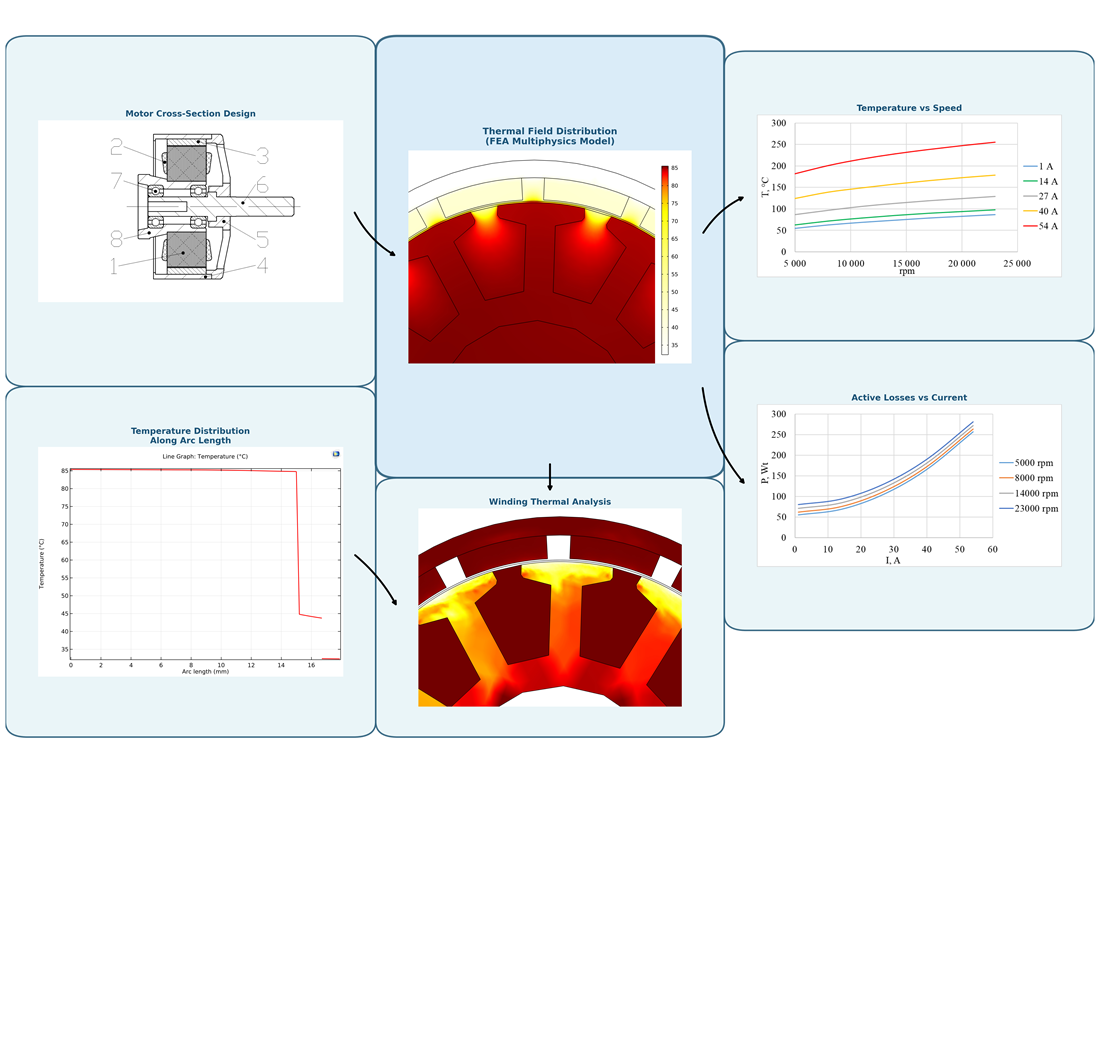
This study considers a high-speed permanent magnet motor designed to drive unmanned aerial vehicles and ground robotic systems. The scientific-practical task addressed is to establish a quantitative relationship between the components of electromagnetic losses and the thermal state of the motor in a wide range of operating modes (5000–23000 rpm, 1–54 A).
A multiphysics numerical field mathematical model of a small-sized high-speed permanent magnet motor operating as part of an unmanned aerial vehicle has been constructed. The model resolves a coupled electromagnetic-thermal problem refining the temperature field distribution and parameters of active materials: the dependence of the residual magnetic induction of permanent magnets.
It was found that the distribution of specific losses in the cross section is deeply uneven: the maximum values are concentrated at the edges of the stator teeth and exceed the losses in the permanent magnets and yoke by 1.5–2.5 orders of magnitude. The distribution of the thermal field with increasing current was established: at I ≤ 14 A, magnetic losses prevail, and at I > 27 A, losses in the winding become predominant and reach 201 W at a current of 54 A. This is 2.5–3.5 times more than magnetic losses. With increasing current, the loss curves for different speeds gradually coincide: at I = 54 A, the difference between 5000 and 23000 rpm is only ≈ 20 W (≈ 7% of the total losses of 260–280 W).
At speeds above 17,000 rpm, the temperature of permanent magnets exceeds 80°C, the residual induction decreases by 6–8% of the rated value, which leads to a decrease in the electromagnetic torque by 3–4%. A critical value of the average motor heating has been established, at which the risk of irreversible demagnetization of magnets occurs, which corresponds to ≈ 216°C, at a speed of n > 11,000 rpm and at maximum current.
The results could be used to optimize high-speed motors with permanent magnets
References
- Ostroverkhov, M., Chumack, V., Falchenko, M., Kovalenko, M. (2022). Development of control algorithms for magnetoelectric generator with axial magnetic flux and double stator based on mathematical modeling. Eastern-European Journal of Enterprise Technologies, 6 (5 (120)), 6–17. https://doi.org/10.15587/1729-4061.2022.267265
- Shen, Q., Zhou, Z., Li, S., Liao, X., Wang, T., He, X., Zhang, J. (2022). Design and Analysis of the High-Speed Permanent Magnet Motors: A Review on the State of the Art. Machines, 10 (7), 549. https://doi.org/10.3390/machines10070549
- Li, Z., Wang, P., Liu, L., Xu, Q., Che, S., Zhang, L. et al. (2022). Loss calculation and thermal analysis of ultra-high speed permanent magnet motor. Heliyon, 8 (11), e11350. https://doi.org/10.1016/j.heliyon.2022.e11350
- Gundabattini, E., Mystkowski, A. (2021). Review of air-cooling strategies, combinations and thermal analysis (experimental and analytical) of a permanent magnet synchronous motor. Proceedings of the Institution of Mechanical Engineers, Part C: Journal of Mechanical Engineering Science, 236 (1), 655–668. https://doi.org/10.1177/0954406220987267
- Meng, T., Zhang, P. (2021). A Review of Thermal Monitoring Techniques for Radial Permanent Magnet Machines. Machines, 10 (1), 18. https://doi.org/10.3390/machines10010018
- Du, J., Li, C., Zhao, J., Ren, H., Zhang, K., Song, X., Chen, L. et al. (2022). Investigation of Eddy Current Loss and Structure Design with Magnetic-Thermal Coupling for Toothless BLDC High-Speed PM Motor. Machines, 10 (2), 118. https://doi.org/10.3390/machines10020118
- Dong, J., Huang, Y., Jin, L., Lin, H., Yang, H. (2014). Thermal Optimization of a High-Speed Permanent Magnet Motor. IEEE Transactions on Magnetics, 50 (2), 749–752. https://doi.org/10.1109/tmag.2013.2285017
- Zhang, M., Luo, S., Liu, X., Li, W. (2021). The eddy current loss segmentation model of permanent magnet for temperature analysis in high‐speed permanent magnet motor. IET Power Electronics, 14 (4), 751–759. https://doi.org/10.1049/pel2.12009
- Pan, B., Tao, D., Ge, B., Wang, L., Hou, P. (2022). Analysis of Eddy Current Loss of 120-kW High-Speed Permanent Magnet Synchronous Motor. Machines, 10 (5), 346. https://doi.org/10.3390/machines10050346
- Yu, Y., Liang, D., Liu, X. (2017). Optimal Design of the Rotor Structure of a HSPMSM Based on Analytic Calculation of Eddy Current Losses. Energies, 10 (4), 551. https://doi.org/10.3390/en10040551
- Jumayev, S., Merdzan, M., Boynov, K. O., Paulides, J. J. H., Pyrhonen, J., Lomonova, E. A. (2015). The Effect of PWM on Rotor Eddy-Current Losses in High-Speed Permanent Magnet Machines. IEEE Transactions on Magnetics, 51 (11), 1–4. https://doi.org/10.1109/tmag.2015.2438637
- Schmidt, E., Kaltenbacher, M., Wolfschluckner, A. (2017). Eddy current losses in permanent magnets of surface mounted permanent magnet synchronous machines – Analytical calculation and high order finite element analyses. E & I Elektrotechnik Und Informationstechnik, 134 (2), 148–155. https://doi.org/10.1007/s00502-017-0498-y
- Kovalenko, M., Tkachuk, I., Kovalenko, I., Zhuk, S., Kryshnov, O. (2024). Double stator axial flux magnetoelectric generator for conversion of low potential mechanical energy. Vidnovluvana Energetika, 2 (77), 13–20. https://doi.org/10.36296/1819-8058.2024.2(77).13-20
- Moradian, K., Sheikholeslami, T. F., Raghebi, M. (2022). Investigation of a spherical pendulum electromagnetic generator for harvesting energy from environmental vibrations and optimization using response surface methodology. Energy Conversion and Management, 266, 115824. https://doi.org/10.1016/j.enconman.2022.115824
- Chumack, V., Tsyvinskyi, S., Kovalenko, M., Ponomarev, A., Tkachuk, I. (2020). Mathemathical modeling of a synchronous generator with combined excitation. Eastern-European Journal of Enterprise Technologies, 1 (5 (103)), 30–36. https://doi.org/10.15587/1729-4061.2020.193495
Downloads
Published
How to Cite
Issue
Section
License
Copyright (c) 2026 Mykhailo Kovalenko, Yurii Haidenko, Serhii Tsyvinskyi, Oleksandr Semeniuk, Oleh Bazarov

This work is licensed under a Creative Commons Attribution 4.0 International License.
The consolidation and conditions for the transfer of copyright (identification of authorship) is carried out in the License Agreement. In particular, the authors reserve the right to the authorship of their manuscript and transfer the first publication of this work to the journal under the terms of the Creative Commons CC BY license. At the same time, they have the right to conclude on their own additional agreements concerning the non-exclusive distribution of the work in the form in which it was published by this journal, but provided that the link to the first publication of the article in this journal is preserved.
A license agreement is a document in which the author warrants that he/she owns all copyright for the work (manuscript, article, etc.).
The authors, signing the License Agreement with TECHNOLOGY CENTER PC, have all rights to the further use of their work, provided that they link to our edition in which the work was published.
According to the terms of the License Agreement, the Publisher TECHNOLOGY CENTER PC does not take away your copyrights and receives permission from the authors to use and dissemination of the publication through the world's scientific resources (own electronic resources, scientometric databases, repositories, libraries, etc.).
In the absence of a signed License Agreement or in the absence of this agreement of identifiers allowing to identify the identity of the author, the editors have no right to work with the manuscript.
It is important to remember that there is another type of agreement between authors and publishers – when copyright is transferred from the authors to the publisher. In this case, the authors lose ownership of their work and may not use it in any way.








