Determination of the anodic dissolution dependencies of a multicomponent alloy as the product of printed circuit board processing in electrolytes based on sulphuric and methanesulfonic acid
DOI:
https://doi.org/10.15587/1729-4061.2026.364664Keywords:
anodic dissolution, methanesulfonic acid, sulfuric acid, printed circuit boardsAbstract
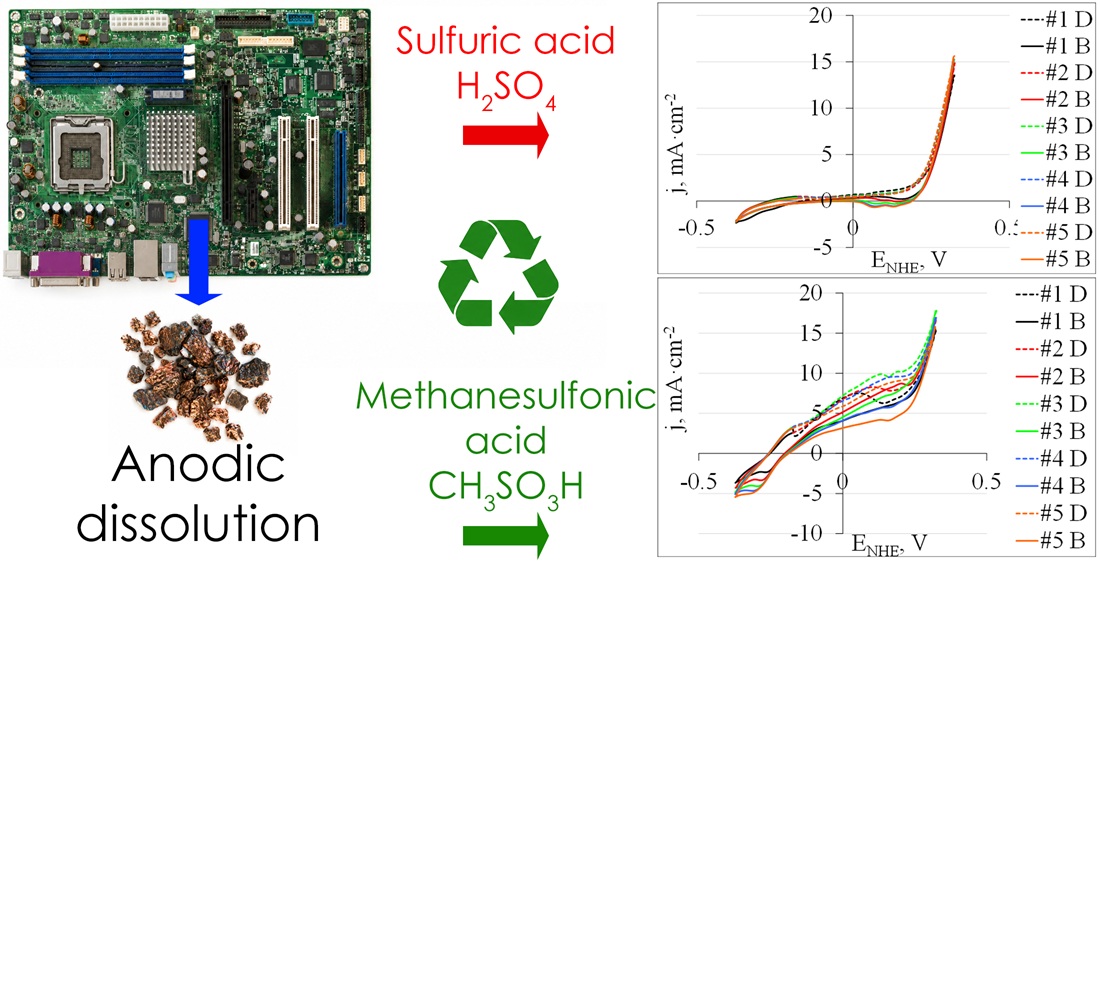
The object of the study is the process of anodic dissolution of a multicomponent metallic alloy obtained from the recycling of printed circuit boards (PCBs). Such feedstock consists mainly of copper, tin, nickel, lead, and iron, which complicates its subsequent hydrometallurgical processing and requires the selection of an efficient electrolyte for the initial dissolution stage. A key challenge of the first processing stage is converting alloy components into a soluble form, which can be intensified by selecting an appropriate electrolyte composition and current density. To enhance the rate of electrochemical dissolution, a methanesulfonic acid electrolyte was used for this alloy composition. The results were compared with those obtained in a sulfuric acid electrolyte. Electrochemical characteristics were determined using cyclic voltammetry at different potential scan rates. Qualitative and quantitative evaluation of the anodic process was performed by analyzing cyclic voltammograms and the specific charge consumed during dissolution. The surface composition of the alloy before and after dissolution was determined by X-ray fluorescence analysis, while the composition of the electrolyte after electrolysis was used to evaluate the relative amounts of metals transferred into solution.
It was shown that anodic dissolution of the alloy proceeds more intensively in the methanesulfonic acid electrolyte than in the sulfuric acid medium. The specific charge associated with the anodic process was found to be 2–3 times higher in the methanesulfonic acid solution. It was established that during dissolution in a 1 M methanesulfonic acid electrolyte, copper and nickel dissolve mainly, whereas tin and lead accumulate on the surface as low-soluble products. After electrolysis, the alloy surface became enriched in tin and nickel, while the surface deposit contained elevated amounts of tin and lead. These findings indicate the selective nature of the process and the possibility of partial component separation as early as the first stage of electrochemical processing. The results obtained may be applied to the development of recycling technologies for multicomponent alloys, generally consisting of copper, nickel, tin, and lead
References
- Yang, Y. W., Sun, F. W., Tie, Z. X. (2014). The Status Quo of Mechanical Methods Recycling Waste Printed Circuit Boards. Applied Mechanics and Materials, 666, 383–387. https://doi.org/10.4028/www.scientific.net/amm.666.383
- Huang, T., Zhu, J., Huang, X., Ruan, J., Xu, Z. (2022). Assessment of precious metals positioning in waste printed circuit boards and the economic benefits of recycling. Waste Management, 139, 105–115. https://doi.org/10.1016/j.wasman.2021.12.030
- The global E-waste Monitor 2024 – Electronic Waste Rising Five Times Faster than Documented E-waste Recycling: UN. Available at: https://ewastemonitor.info/the-global-e-waste-monitor-2024/
- Oke, E. A., Potgieter, H. (2024). Discarded e-waste/printed circuit boards: a review of their recent methods of disassembly, sorting and environmental implications. Journal of Material Cycles and Waste Management, 26 (3), 1277–1293. https://doi.org/10.1007/s10163-024-01917-7
- Wang, X., Huang, W., Yan, B., Zhou, S., Zhu, X., Wang, Z. et al. (2025). E-waste recycling: Integrated life cycle assessment and techno-economic analysis unravels pyrometallurgy’s edge and delivers an optimization framework for recovering waste printed circuit boards. Waste Management, 207, 115135. https://doi.org/10.1016/j.wasman.2025.115135
- Ishchenko, V., Sydoruk, T. (2024). Waste electrical and electronic equipment flows in Ukraine. Proceedings of the Institution of Civil Engineers - Waste and Resource Management, 177 (3), 114–121. https://doi.org/10.1680/jwarm.23.00016
- Mvokwe, S. A., Oyedeji, O. O., Agoro, M. A., Meyer, E. L., Rono, N. (2025). A Critical Review of the Hydrometallurgy and Pyrometallurgical Recovery Processes of Platinum Group Metals from End-of-Life Fuel Cells. Membranes, 15 (1), 13. https://doi.org/10.3390/membranes15010013
- Bizzo, W., Figueiredo, R., De Andrade, V. (2014). Characterization of Printed Circuit Boards for Metal and Energy Recovery after Milling and Mechanical Separation. Materials, 7 (6), 4555–4566. https://doi.org/10.3390/ma7064555
- Yang, H., Liu, J., Yang, J. (2011). Leaching copper from shredded particles of waste printed circuit boards. Journal of Hazardous Materials, 187 (1-3), 393–400. https://doi.org/10.1016/j.jhazmat.2011.01.051
- Marković, B., Mihajlović, I., Stevanović, Z., Jegdić, B. (2025). Electrochemical behavior of copper with non-standard impurities content. ISIRR 2009 – 10th INTERNATIONAL SYMPOSIUM “INTERDISCIPLINARY REGIONAL RESEARCH” – ROMANIA – HUNGARY – SERBIA. Hunedoara. Available at: http://test.greenmetallurgy.rwth-aachen.de/wp-content/uploads/2025/08/s6_02_id_9157.pdf
- Bounoughaz, M., Manzini, M., Ghali, E. (1995). Behaviour of Copper Anodes Containing Oxygen, Silver and Selenium Impurities During Electro-Refining. Canadian Metallurgical Quarterly, 34 (1), 21–26. https://doi.org/10.1179/cmq.1995.34.1.21
- Ilkhchi, M. O., Yoozbashizadeh, H., Safarzadeh, M. S. (2007). The effect of additives on anode passivation in electrorefining of copper. Chemical Engineering and Processing: Process Intensification, 46 (8), 757–763. https://doi.org/10.1016/j.cep.2006.10.005
- Guan, Y., Han, K. N. (1994). An electrochemical study on the dissolution of gold and copper from gold/copper alloys. Metallurgical and Materials Transactions B, 25 (6), 817–827. https://doi.org/10.1007/bf02662764
- Muthukumaran, A., Venkataraman, N., Tamilmani, S., Raghavan, S. (2009). Anodic dissolution of copper in dilute hydroxylamine solutions: application to electrochemical mechanical planarisation of copper. Corrosion Engineering, Science and Technology, 44 (2), 101–107. https://doi.org/10.1179/174327808x315669
- Laitinen, T., Salmi, K., Sundholm, G., Viinikka, P., Yli-Pentti, A. (1992). The anodic behaviour of tin in sulphuric acid solutions. Electrochimica Acta, 37 (10), 1797–1803. https://doi.org/10.1016/0013-4686(92)85083-w
- Giannetti, B. F., Sumodjo, P. T. A., Rabockai, T., Souza, A. M., Barboza, J. (1992). Electrochemical dissolution and passivation of tin in citric acid solution using electron microscopy techniques. Electrochimica Acta, 37 (1), 143–148. https://doi.org/10.1016/0013-4686(92)80023-f
- Wang, D., Fu, M., Wang, T., Miao, W., Xiang, L., Le, T., Zhang, L. (2025). Ultrasonic Enhancement of Tin Dissolution in NaOH/H2O2 System: Electrochemical and Passivation Modulation. Metals, 15 (9), 1016. https://doi.org/10.3390/met15091016
- Taninouchi, Y.-k., Uda, T. (2021). Rapid Oxidative Dissolution of Metallic Tin in Alkaline Solution Containing Iodate Ions. Journal of Sustainable Metallurgy, 7 (4), 1762–1771. https://doi.org/10.1007/s40831-021-00450-3
- El-Sherif, R. M., Badawy, W. A. (2011). Mechanism of Corrosion and Corrosion Inhibition of Tin in Aqueous Solutions Containing Tartaric Acid. International Journal of Electrochemical Science, 6 (12), 6469–6482. https://doi.org/10.1016/s1452-3981(23)19694-5
- Gernon, M. D., Wu, M., Buszta, T., Janney, P. (1999). Environmental benefits of methanesulfonic acid. Green Chemistry, 1 (3), 127–140. https://doi.org/10.1039/a900157c
- Binnemans, K., Jones, P. T. (2024). Methanesulfonic acid (MSA) in clean processes and applications: a tutorial review. Green Chemistry, 26 (15), 8583–8614. https://doi.org/10.1039/d4gc02031f
- Bengoa, L. N., Pary, P., Conconi, M. S., Egli, W. A. (2017). Electrodeposition of Cu-Sn alloys from a methanesulfonic acid electrolyte containing benzyl alcohol. Electrochimica Acta, 256, 211–219. https://doi.org/10.1016/j.electacta.2017.10.027
- Tang, C., Deng, X., Chen, Y., Li, Y., Deng, C., Zhu, Q. et al. (2021). Electrochemical dissolution and recovery of tin from printed circuit board in methane–sulfonic acid solution. Hydrometallurgy, 205, 105726. https://doi.org/10.1016/j.hydromet.2021.105726
- Kotok, V., Sknar, Y., Butyrina, T., Sknar, I., Sukha, I., Demchyshyna, O. (2025). Determination of the efficiency and selectivity of anodic dissolution of a heat-resistant rhenium-containing superalloy in chloride-containing media with sulfuric or methanesulfonic acids. Eastern-European Journal of Enterprise Technologies, 5 (6 (137)), 32–40. https://doi.org/10.15587/1729-4061.2025.342421
- Kotok, V., Sknar, Y., Butyrina, T., Sknar, I., Demchyshyna, O., Chasova, E. (2025). Determination of the electrochemical dissolution feasibility of a superalloy used in turbine components in alkaline solutions with additives. Eastern-European Journal of Enterprise Technologies, 4 (12 (136)), 12–20. https://doi.org/10.15587/1729-4061.2025.337836
- Kovalenko, V., Kotok, V. (2017). Selective anodic treatment of W(WC)-based superalloy scrap. Eastern-European Journal of Enterprise Technologies, 1 (5 (85)), 53–58. https://doi.org/10.15587/1729-4061.2017.91205
- Kovalenko, V., Kotok, V. (2020). Investigation of the anodic behavior of w-based superalloy for electrochemical selective treatment. Eastern-European Journal of Enterprise Technologies, 6 (12 (108)), 55–60. https://doi.org/10.15587/1729-4061.2020.218355
- Kovalenko, V., Kotok, V. (2021). Comparative investigation of different types of nickel foam samples for application in supercapacitors and other electrochemical devices. Eastern-European Journal of Enterprise Technologies, 3 (12 (111)), 32–38. https://doi.org/10.15587/1729-4061.2021.234251
- Mecucci, A., Scott, K. (2002). Leaching and electrochemical recovery of copper, lead and tin from scrap printed circuit boards. Journal of Chemical Technology & Biotechnology, 77 (4), 449–457. https://doi.org/10.1002/jctb.575
Downloads
Published
How to Cite
Issue
Section
License
Copyright (c) 2026 Valerii Kotok, Vadym Kucher, Yuri Sknar, Irina Sknar, Oksana Demchyshyna, Ella Chasova

This work is licensed under a Creative Commons Attribution 4.0 International License.
The consolidation and conditions for the transfer of copyright (identification of authorship) is carried out in the License Agreement. In particular, the authors reserve the right to the authorship of their manuscript and transfer the first publication of this work to the journal under the terms of the Creative Commons CC BY license. At the same time, they have the right to conclude on their own additional agreements concerning the non-exclusive distribution of the work in the form in which it was published by this journal, but provided that the link to the first publication of the article in this journal is preserved.
A license agreement is a document in which the author warrants that he/she owns all copyright for the work (manuscript, article, etc.).
The authors, signing the License Agreement with TECHNOLOGY CENTER PC, have all rights to the further use of their work, provided that they link to our edition in which the work was published.
According to the terms of the License Agreement, the Publisher TECHNOLOGY CENTER PC does not take away your copyrights and receives permission from the authors to use and dissemination of the publication through the world's scientific resources (own electronic resources, scientometric databases, repositories, libraries, etc.).
In the absence of a signed License Agreement or in the absence of this agreement of identifiers allowing to identify the identity of the author, the editors have no right to work with the manuscript.
It is important to remember that there is another type of agreement between authors and publishers – when copyright is transferred from the authors to the publisher. In this case, the authors lose ownership of their work and may not use it in any way.