Identifying the structure-property relationships in recycled expanded polystyrene-coconut coir fiber biocomposites for acoustic applications
DOI:
https://doi.org/10.15587/1729-4061.2026.364889Keywords:
expanded polystyrene waste, coconut coir fibers, polymer composites, sound absorption, flexural propertiesAbstract
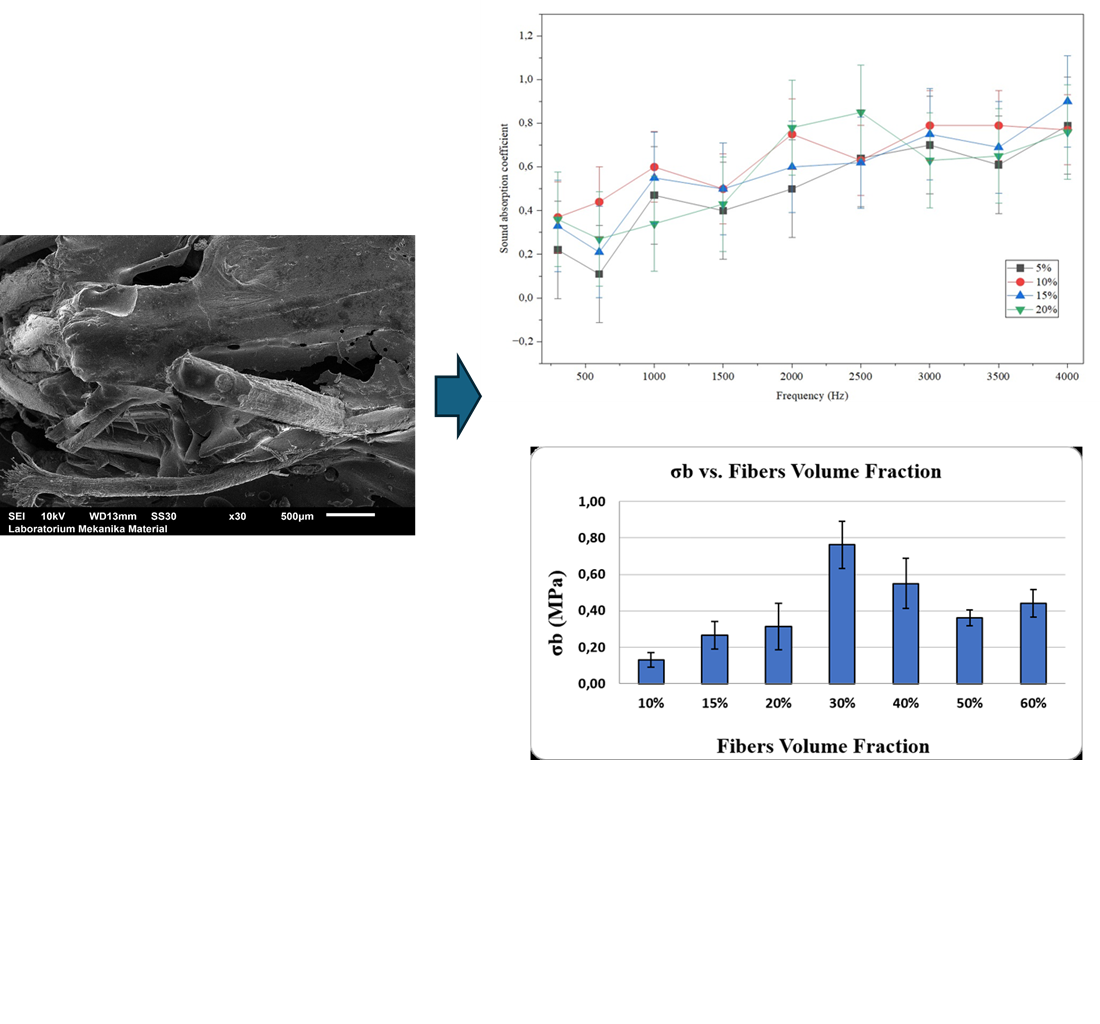
The object of this study is sustainable acoustic panel materials for building noise-control and sound-insulation applications. The large-scale generation of expanded polystyrene (EPS) waste presents a significant environmental challenge due to its inherent resistance to natural degradation. Recycled expanded polystyrene (EPS) reinforced with coconut coir fibers was investigated as a potential material for these applications. The EPS waste was first dissolved in commercial gasoline (Pertalite) via cold dissolution, subsequently blended with 5–60 vol% coconut coir fibers, and fabricated into composites using standard casting techniques. The acoustic and mechanical properties of the resulting materials were evaluated using an impedance tube (ASTM E1050-98) and flexural testing (ASTM D790-03), respectively. Experimental results demonstrated that the optimal solvent-to-EPS ratio was 3:1, yielding a highly homogeneous matrix ideal for composite fabrication. Acoustic analysis revealed that most specimens achieved a sound absorption coefficient exceeding 0.2; the sole exception was the composite containing a 5 vol% fiber fraction, which recorded a value of 0.1 at 500 Hz. Furthermore, the sound absorption capacity consistently improved with increasing frequency, highlighting the efficacy of the composites across the mid- to high-frequency spectrum. Regarding mechanical performance, evaluations indicated that the composite incorporating a 30 vol% fiber fraction achieved the maximum flexural strength and modulus. Overall, these findings establish that bio composites derived from EPS waste and coconut coir fibers possess substantial potential as sustainable acoustic materials, delivering both functional performance and tangible environmental benefits
References
- Curiac, A. S., Petre, A., Stoica, A., Sandu, S. (2017). Preparation of adhesives from the expandable polystyrene waste. Journal of Young Scientist, V. Available at: https://journalofyoungscientist.usamv.ro/pdf/vol_V_2017/Art3.pdf
- A Global Call for Climate Action. Available at: https://www.un.org/it/node/71013
- Seghiri, M., Boutoutaou, D., Kriker, A., Hachani, M. I. (2017). The Possibility of Making a Composite Material from Waste Plastic. Energy Procedia, 119, 163–169. https://doi.org/10.1016/j.egypro.2017.07.065
- Brahmakumar, M., Pavithran, C., Pillai, R. (2005). Coconut fibre reinforced polyethylene composites: effect of natural waxy surface layer of the fibre on fibre/matrix interfacial bonding and strength of composites. Composites Science and Technology, 65 (3-4), 563–569. https://doi.org/10.1016/j.compscitech.2004.09.020
- Suardana, N. P. G., Sugita, I. K. G., Wardana, I. G. N. (2020). Hybrid acoustic panel: the effect of fiber volume fraction and panel thickness. Materials Physics and Mechanics, 44 (1), 77–82. https://dx.doi.org/10.18720/MPM.4412020_9
- Moreno, A., Lejnieks, J., Galià, M., Lligadas, G., Percec, V. (2018). Acetone: a solvent or a reagent depending on the addition order in SET-LRP. Polymer Chemistry, 9 (45), 5411–5417. https://doi.org/10.1039/c8py01331d
- García, M. T., Gracia, I., Duque, G., Lucas, A. d., Rodríguez, J. F. (2009). Study of the solubility and stability of polystyrene wastes in a dissolution recycling process. Waste Management, 29 (6), 1814–1818. https://doi.org/10.1016/j.wasman.2009.01.001
- Allard, J. F., Atalla, N. (2009). Propagation of Sound in Porous Media. John Wiley & Sons. https://doi.org/10.1002/9780470747339
- Asdrubali, F., Schiavoni, S., Horoshenkov, K. V. (2012). A Review of Sustainable Materials for Acoustic Applications. Building Acoustics, 19 (4), 283–311. https://doi.org/10.1260/1351-010x.19.4.283
- Yang, H.-S., Kim, D.-J., Kim, H.-J. (2003). Rice straw–wood particle composite for sound absorbing wooden construction materials. Bioresource Technology, 86 (2), 117–121. https://doi.org/10.1016/s0960-8524(02)00163-3
- Bai, P., Yang, X., Shen, X., Zhang, X., Li, Z., Yin, Q. et al. (2019). Sound absorption performance of the acoustic absorber fabricated by compression and microperforation of the porous metal. Materials & Design, 167, 107637. https://doi.org/10.1016/j.matdes.2019.107637
- Venegas, R., Zieliński, T. G., Núñez, G., Bécot, F.-X. (2021). Acoustics of porous composites. Composites Part B: Engineering, 220, 109006. https://doi.org/10.1016/j.compositesb.2021.109006
- Zaafarani, N. N., Nour, M., El-Kassas, A. M., Elsheikh, A. (2023). A new recycled high-impact polystyrene-rice straw composite: eco-friendly fabrication and characterization. International Journal of Environmental Science and Technology, 21 (2), 1193–1202. https://doi.org/10.1007/s13762-023-05039-9
- Karaoui, M., Hsissou, R., Alami, M., Assouag, M. (2023). Thermal, flow, and mechanical properties of composites based on polystyrene (PS) and snail shell powder (SSP) biofiller (PS/SSP). Iranian Polymer Journal, 32 (5), 621–631. https://doi.org/10.1007/s13726-023-01151-2
- Zhang, J., Shen, Y., Jiang, B., Li, Y. (2018). Sound Absorption Characterization of Natural Materials and Sandwich Structure Composites. Aerospace, 5 (3), 75. https://doi.org/10.3390/aerospace5030075
- Hassan, T., Jamshaid, H., Mishra, R., Khan, M. Q., Petru, M., Novak, J. et al. (2020). Acoustic, Mechanical and Thermal Properties of Green Composites Reinforced with Natural Fibers Waste. Polymers, 12 (3), 654. https://doi.org/10.3390/polym12030654
- Hou, Z., Ma, X., Pan, L., Zhang, R., Wang, L. (2024). Study on the sound absorption characteristics and noise reduction mechanism of coconut-shell-activated carbon particles and coconut fiber composite biomass sound-absorption materials. Materials Research Express, 11 (11), 115603. https://doi.org/10.1088/2053-1591/ad923f
- Suardana, N. P. G., Lokantara, I. P., Lim, J. K. (2011). Influence of water absorption on mechanical properties of coconut coir fiber/poly-lactic acid biocomposites. Materials Physics and Mechanics, 12 (2), 113–125. Available at: https://www.researchgate.net/publication/268267847_Influence_of_water_absorption_on_mechanical_properties_of_coconut_coir_FiberPolyLactic_acid_biocomposites
- ASTM E1050-98. Standard Test Method for Impedance and Absorption of Acoustical Materials Using a Tube, Two Microphones, and a Digital Frequency Analysis System (1998). ASTM International.
- Rusli, M., Nanda, R. S., Dahlan, H., Bur, M., Okuma, M. (2021). Sound Absorption Characteristics of Composite Panel Made from Coconut Coir and Oil Palm Empty Fruit Bunches Fibre with Polyester. International Journal of Automotive and Mechanical Engineering, 18 (3), 9022–9028. https://doi.org/10.15282/ijame.18.3.2021.14.0691
- ASTM D790-25. Standard Test Methods for Flexural Properties of Unreinforced and Reinforced Plastics and Electrical Insulating Materials. ASTM International. http://doi.org/10.1520/D0790-25
- Sun, W., Pan, B., Song, X., Xiao, H., Zhou, J., Sui, D. (2022). A novel sound absorber design of nanofibrous composite porous material. Materials & Design, 214, 110418. https://doi.org/10.1016/j.matdes.2022.110418
- Hosseini, M., H., M., Ghassem, M., Shamel, M., Yeng, S., Yi, S., Zong, P., Mohd Nor, M. J. (2013). Utilizing Malaysian Natural Fibers as Sound Absorber. Modeling and Measurement Methods for Acoustic Waves and for Acoustic Microdevices. https://doi.org/10.5772/53197
- Kiran, M. C., Mamatha, B. S., Anand, N., Prakash, V., Murthy, N. (2019). Efficiency of Coir Particle Board for Acoustic & Thermal Applications. Open Journal of Acoustics, 09 (03), 39–47. https://doi.org/10.4236/oja.2019.93004
- Chin Vui Sheng, D. D., Yahya, M. N. B., Che Din, N. B. (2020). Sound Absorption of Microperforated Panel Made from Coconut Fiber and Polylactic Acid Composite. Journal of Natural Fibers, 19 (7), 2719–2729. https://doi.org/10.1080/15440478.2020.1821290
- Mohammed, A., Rao, D. N. (2023). Investigation on mechanical properties of flax fiber/expanded polystyrene waste composites. Heliyon, 9 (3), e13310. https://doi.org/10.1016/j.heliyon.2023.e13310
Downloads
Published
How to Cite
Issue
Section
License
Copyright (c) 2026 I Ketut Gede Sugita, Ngakan Putu Gede Suardana, Jefri S. Bale, Cipk Kencanawati, Putu Lokantara

This work is licensed under a Creative Commons Attribution 4.0 International License.
The consolidation and conditions for the transfer of copyright (identification of authorship) is carried out in the License Agreement. In particular, the authors reserve the right to the authorship of their manuscript and transfer the first publication of this work to the journal under the terms of the Creative Commons CC BY license. At the same time, they have the right to conclude on their own additional agreements concerning the non-exclusive distribution of the work in the form in which it was published by this journal, but provided that the link to the first publication of the article in this journal is preserved.
A license agreement is a document in which the author warrants that he/she owns all copyright for the work (manuscript, article, etc.).
The authors, signing the License Agreement with TECHNOLOGY CENTER PC, have all rights to the further use of their work, provided that they link to our edition in which the work was published.
According to the terms of the License Agreement, the Publisher TECHNOLOGY CENTER PC does not take away your copyrights and receives permission from the authors to use and dissemination of the publication through the world's scientific resources (own electronic resources, scientometric databases, repositories, libraries, etc.).
In the absence of a signed License Agreement or in the absence of this agreement of identifiers allowing to identify the identity of the author, the editors have no right to work with the manuscript.
It is important to remember that there is another type of agreement between authors and publishers – when copyright is transferred from the authors to the publisher. In this case, the authors lose ownership of their work and may not use it in any way.








