Devising a combined spectrum spreading method for timer signal structures to improve covert information transmission
DOI:
https://doi.org/10.15587/1729-4061.2026.365354Keywords:
timer signals, spread spectrum, covert structuring, pseudo-random reconfiguration of operating frequencyAbstract
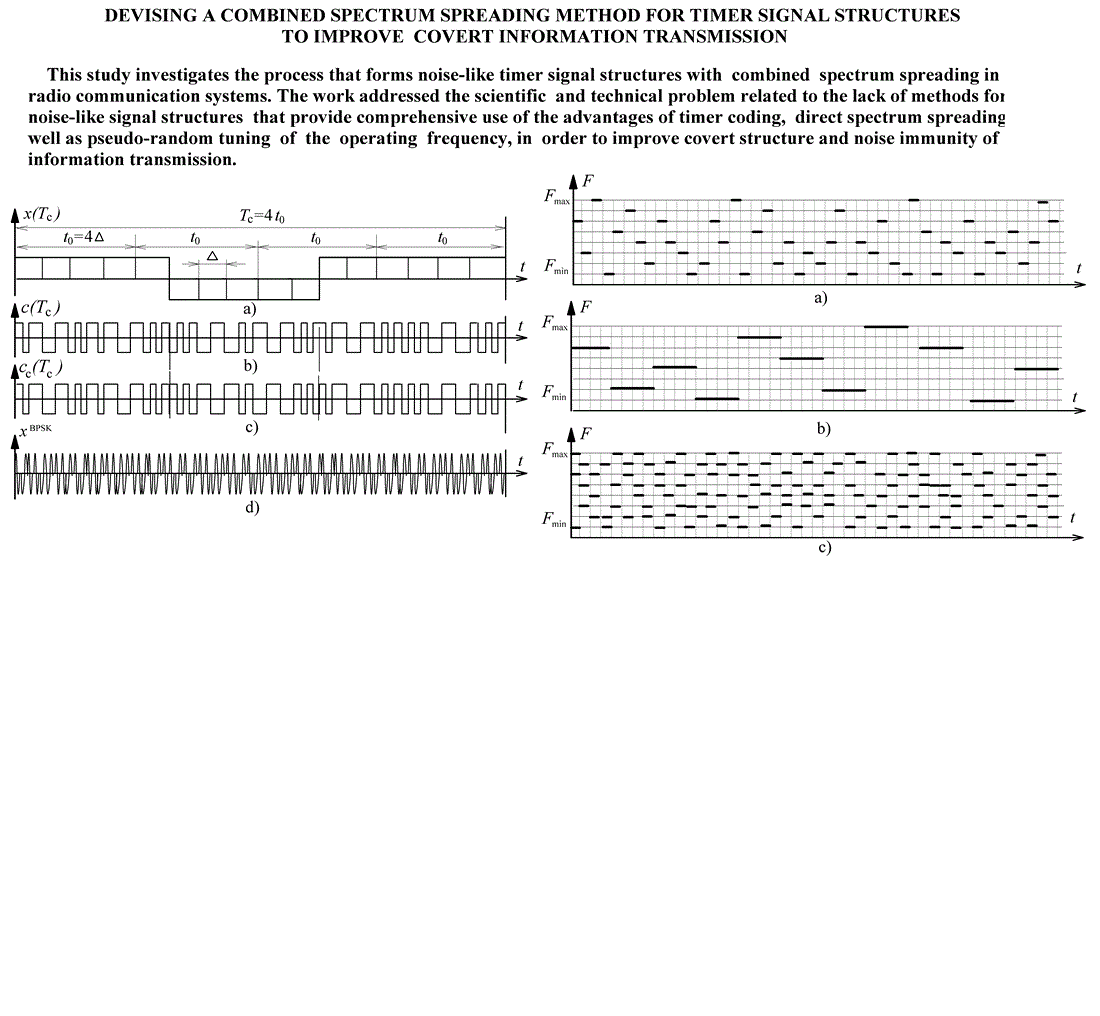
This study investigates the process that forms noise-like timer signal structures with combined spectrum spreading in secure radio communication systems. The work addressed the scientific and technical problem related to the lack of methods for forming noise-like signal structures that provide comprehensive use of the advantages of timer coding, direct spectrum spreading, as well as pseudo-random tuning of the operating frequency, in order to improve covert structure and noise immunity of information transmission.
The results include a combined method devised for spectrum spreading of non-positional timer signals based on a combination of direct spectrum spreading and pseudo-random tuning of the operating frequency. The method provides spectrum spreading in the time and frequency domains, as well as the generation of multidimensional signal structures by varying the time intervals between pulses, using pseudo-random sequences, and tuning of the operating frequencies.
An analytical approach to assessing covert structuring of a combined signal has been proposed, taking into account the parameters of timer coding, manipulation, and spectrum spreading. It was established that even with relatively small values of the signal parameters, a high level of structural covertness was achieved, which significantly complicated its reproduction by means of electronic reconnaissance.
The results are attributed to the combination of timer coding with spread spectrum methods, which ensured the generation of time, code, and frequency uncertainty of the signal. Changing the timer coding parameters made it possible to adapt signal structures depending on the level of interference in the communication channel. The proposed method could be implemented when designing promising secure radio communication systems under conditions of random and intentional interference
References
- Zaitsev, D. V., Yafonkin, A. O., Yarema, V. V. (2021). Osnovy zviazku ta radioelektronna borotba yak vyd boiovoho zabezpechennia. Irpin, 280. Available at: https://ir.dpu.edu.ua/entities/publication/931c8879-4752-4096-a76d-6ab33b3b95e7/full
- Sholokhov, S. M., Samborskyi, I. I., Vakulenko, O. V., Nikolaienko, B. A. (2021). Zavadozakhyst radioelektronnykh zasobiv. Chastyna 1. Osnovy zavadozakhystu system zviazku. Kyiv: ISZZI KPI im. Ihoria Sikorskoho, 210. Available at: https://ela.kpi.ua/handle/123456789/63622
- Horbatyi, I., Usatyi, O. (2025). Investigation of spread spectrum signal analysis methods in modern communication systems. Information and Communication Technologies, Electronic Engineering, 5 (1), 125–135. https://doi.org/10.23939/ictee2025.01.125
- Stasev, Y., Netrenko, K., Khmelnichenko, K. (2022). Method of synthesis of signals with pseudorandom tuning of the operating frequency. Information Processing Systems, 3 (170), 52–57. https://doi.org/10.30748/soi.2022.170.07
- Hrynenko, О., Kalchenko, V., Obodyak, V., Pugach, І., Savchenko, Т. (2025). Adaptive pseudo-random reconfiguration of the operating frequency with information-extreme control for protected unmanned networks. COMPUTER-INTEGRATED TECHNOLOGIES: EDUCATION, SCIENCE, PRODUCTION, 60, 112–119. https://doi.org/10.36910/6775-2524-0560-2025-60-11
- Zaharchenko, M., Hadzhyiev, M., Salmanov, N., Shvets, N., Havel, S. (2021). Analysis and evaluation of qualitative and quantitative indicators of information when solving problems of construction systems of data transmission and transformation. Cybersecurity: Education, Science, Technique, 3 (11), 136–143. https://doi.org/10.28925/2663-4023.2021.11.136143
- Maleki, A., Nguyen, H. H., Bedeer, E., Barton, R. (2024). A Tutorial on Chirp Spread Spectrum Modulation for LoRaWAN: Basics and Key Advances. IEEE Open Journal of the Communications Society, 5, 4578–4612. https://doi.org/10.1109/ojcoms.2024.3433502
- Hordiichuk, V., Shyshatskyi, A., Korchinskyi, V., Kildishev, V., Pozdniakov, P. (2021). Timing pulse code modulation as a tool for quantization noise reduction in special-purpose IT systems. Journal of Physics: Conference Series, 1839 (1), 12005. https://doi.org/10.1088/1742-6596/1839/1/012005
- Burkinsky, B. V., Nazarenko, O., Laiko, O. I., Khadzhyradieva, S. (Eds.) (2024). Sustainable development and digital innovations. Odesa. https://doi.org/10.31520/978-617-14-0253-9
- Tian, X., Han, H., Niu, X., Liu, X. (2023). Construction of Optimal Frequency Hopping Sequence Set with Low-Hit-Zone. Entropy, 25 (7), 1044. https://doi.org/10.3390/e25071044
- Hordiichuk, V., Korchynskyi, V., Kildishev, V., Molodetskyi, B., Staikutsa, S., Alfaiomi, K. (2024). Adaptive Synthesis of Wideband Timer Signals in the Conditions of Radio-Electronic Warfare. 2024 IEEE 17th International Conference on Advanced Trends in Radioelectronics, Telecommunications and Computer Engineering (TCSET), 1–4. https://doi.org/10.1109/tcset64720.2024.10755658
- Azim, A. W., Shubair, R., Chafii, M. (2024). Chirp Spread Spectrum-Based Waveform Design and Detection Mechanisms for LPWAN-Based IoT: A Survey. IEEE Access, 12, 24949–25017. https://doi.org/10.1109/access.2024.3352591
- Zakharchenko, M. V., Horokhov, Y. S., Kril, A. S., Kovalchuk, S. V. (2015). Code division multiplexing in timer signals. Modern Information Technologies in the Sphere of Security and Defence, 24 (3), 38–42. Available at: https://sit.nuou.org.ua/article/view/61290/
- Zaharchenko, M., Hadzhyiev, M., Salmanov, N., Golev, D., Shvets, N. (2020). Information parameters of codes that are synthesized on the basis of one module. Cybersecurity: Education, Science, Technique, 3 (7), 95–102. https://doi.org/10.28925/2663-4023.2020.7.95102
- Zakharchenko, N., Korchinsky, V., Radzimovsky, B. (2012). Information security of time-controlled signals in confidential communication systems. Modern problems of radio engineering, telecommunications and computer science: XI Int. Conf. TCSET. Lviv-Slavske. Lviv: Publishing House of Lviv Polytechnic, 317. Available at: https://ena.lpnu.ua/handle/ntb/14569
- Ristić, V., Todorović, B., Stojanović, N. (2022). Frequency hopping spread spectrum: History, principles and applications. Vojnotehnicki Glasnik, 70 (4), 856–876. https://doi.org/10.5937/vojtehg70-38342
- Kaplan, B., Kahraman, I., Ekti, A. R., Yarkan, S., Gorcin, A., Ozdemir, M. K., Cirpan, H. A. (2021). Detection, Identification, and Direction of Arrival Estimation of Drone FHSS Signals With Uniform Linear Antenna Array. IEEE Access, 9, 152057–152069. https://doi.org/10.1109/access.2021.3127199
Downloads
Published
How to Cite
Issue
Section
License
Copyright (c) 2026 Vadym Stepanov, Volodymyr Korchynskyi, Vitalii Kildishev, Ruslan Zarovskyi, Serhii Havel, Vasyl Slavych, Ruslan Petrovskyi

This work is licensed under a Creative Commons Attribution 4.0 International License.
The consolidation and conditions for the transfer of copyright (identification of authorship) is carried out in the License Agreement. In particular, the authors reserve the right to the authorship of their manuscript and transfer the first publication of this work to the journal under the terms of the Creative Commons CC BY license. At the same time, they have the right to conclude on their own additional agreements concerning the non-exclusive distribution of the work in the form in which it was published by this journal, but provided that the link to the first publication of the article in this journal is preserved.
A license agreement is a document in which the author warrants that he/she owns all copyright for the work (manuscript, article, etc.).
The authors, signing the License Agreement with TECHNOLOGY CENTER PC, have all rights to the further use of their work, provided that they link to our edition in which the work was published.
According to the terms of the License Agreement, the Publisher TECHNOLOGY CENTER PC does not take away your copyrights and receives permission from the authors to use and dissemination of the publication through the world's scientific resources (own electronic resources, scientometric databases, repositories, libraries, etc.).
In the absence of a signed License Agreement or in the absence of this agreement of identifiers allowing to identify the identity of the author, the editors have no right to work with the manuscript.
It is important to remember that there is another type of agreement between authors and publishers – when copyright is transferred from the authors to the publisher. In this case, the authors lose ownership of their work and may not use it in any way.








