Improving the strategy for using rechargeable battery energy storage systems to enhance the economic efficiency of photovoltaic power plants in the electricity market
DOI:
https://doi.org/10.15587/1729-4061.2026.365476Keywords:
photovoltaic power plant, electricity storage system, electricity market, optimization of operationAbstract
This study investigates operational process involving rechargeable battery energy storage systems (ESSs) in a combination with photovoltaic power plants (PVPPs) in the competitive electricity market. The task addressed is to improve the functioning efficiency of electric power systems with deep PVPP penetration. This work analyzes scenarios and strategy optimization when using ESSs to increase the economic efficiency of PVPPs operating in a single complex. The research results established those factors that affect the technical and economic indicators of ESS application and helped define a combined management strategy.
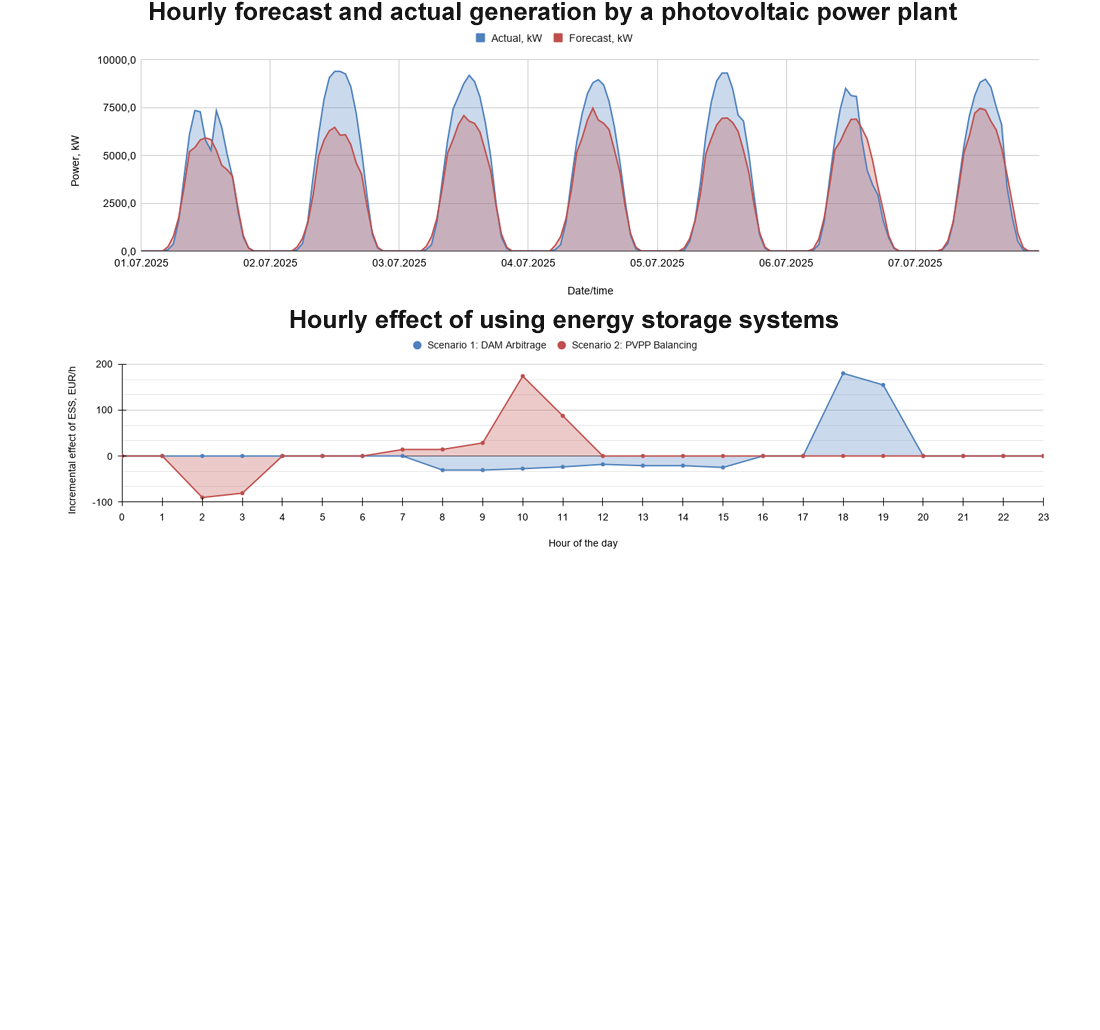
Practical ESS management scenarios with different mechanisms for forming an economic effect were studied, in particular, the day-ahead market arbitrage scenario (DAM) and the PVPP balancing scenario. The latter, in addition to minimizing the costs of settling imbalances, provides for the sale of excess stored energy during hours of maximum price.
The use of an ensemble of machine learning methods (RandomForest + XGBoost + LightGBM) has made it possible to achieve high accuracy in forecasting PVPP generation. Energy indicators were optimized for each scenario of ESS control system; financial results were assessed based on the MILP and MPC methods. That made it possible to quantitatively compare the effectiveness of the arbitrage and balancing strategies and justify the choice of ESS operation mode depending on the volatility of the DAM prices, the level of forecast uncertainty of generation, and the current rules for regulating imbalances in the electricity market.
The results were verified on the example of a real 9.5 MW PVPP, supplemented by ESS with an energy capacity of 2 MWh, which made it possible to take into account the financial responsibility of the producer for imbalances and the impact of price asymmetry on the end result
References
- Pro zatverdzhennia Pravyl rynku. Postanova 14.03.2018 No. 307. Natsionalna komisiya, shcho zdiysniuie derzhavne rehuliuvannia u sferakh enerhetyky ta komunalnykh posluh. Available at: https://zakon.rada.gov.ua/laws/show/v0307874-18#Text
- Pedro, H. T. C., Coimbra, C. F. M. (2012). Assessment of forecasting techniques for solar power production with no exogenous inputs. Solar Energy, 86 (7), 2017–2028. https://doi.org/10.1016/j.solener.2012.04.004
- Voyant, C., Notton, G., Kalogirou, S., Nivet, M.-L., Paoli, C., Motte, F., Fouilloy, A. (2017). Machine learning methods for solar radiation forecasting: A review. Renewable Energy, 105, 569–582. https://doi.org/10.1016/j.renene.2016.12.095
- Yang, D., Kleissl, J., Gueymard, C. A., Pedro, H. T. C., Coimbra, C. F. M. (2018). History and trends in solar irradiance and PV power forecasting: A preliminary assessment and review using text mining. Solar Energy, 168, 60–101. https://doi.org/10.1016/j.solener.2017.11.023
- Fountoulakis, I., Kosmopoulos, P., Papachristopoulou, K., Raptis, I.-P., Mamouri, R.-E., Nisantzi, A. et al. (2021). Effects of Aerosols and Clouds on the Levels of Surface Solar Radiation and Solar Energy in Cyprus. Remote Sensing, 13 (12), 2319. https://doi.org/10.3390/rs13122319
- Poliukhov, A., Gvozdeva, A., Piskunova, D. (2026). The influence of CAMS aerosol climatology on shortwave irradiance and temperature forecasts in the ICON NWP model verified against observational data. Atmospheric Research, 338, 109025. https://doi.org/10.1016/j.atmosres.2026.109025
- Skoplaki, E., Palyvos, J. A. (2009). Operating temperature of photovoltaic modules: A survey of pertinent correlations. Renewable Energy, 34 (1), 23–29. https://doi.org/10.1016/j.renene.2008.04.009
- Jordan, D. C., Kurtz, S. R. (2012). Photovoltaic Degradation Rates – An Analytical Review. National Renewable Energy Laboratory. Available at: https://www.nrel.gov/docs/fy13osti/51664.pdf
- Cole, W., Frazier, A., Augustine, C. (2021). Cost Projections for Utility-Scale Battery Storage: 2021. National Renewable Energy Laboratory. https://doi.org/10.2172/1786976
- Akrami, E., Ameri, M., Rocco, M. V., Sanvito, F. D., Colombo, E. (2020). Thermodynamic and exergo-economic analyses of an innovative semi self-feeding energy system synchronized with waste-to-energy technology. Sustainable Energy Technologies and Assessments, 40, 100759. https://doi.org/10.1016/j.seta.2020.100759
- Batteries and Secure Energy Transitions (2024). IEA. Available at: https://www.iea.org/reports/batteries-and-secure-energy-transitions
- Baumgarte, F., Glenk, G., Rieger, A. (2020). Business Models and Profitability of Energy Storage. iScience, 23 (10), 101554. https://doi.org/10.1016/j.isci.2020.101554
- Inman, R. H., Pedro, H. T. C., Coimbra, C. F. M. (2013). Solar forecasting methods for renewable energy integration. Progress in Energy and Combustion Science, 39 (6), 535–576. https://doi.org/10.1016/j.pecs.2013.06.002
- Diagne, M., David, M., Lauret, P., Boland, J., Schmutz, N. (2013). Review of solar irradiance forecasting methods and a proposition for small-scale insular grids. Renewable and Sustainable Energy Reviews, 27, 65–76. https://doi.org/10.1016/j.rser.2013.06.042
- Antonanzas, J., Osorio, N., Escobar, R., Urraca, R., Martinez-de-Pison, F. J., Antonanzas-Torres, F. (2016). Review of photovoltaic power forecasting. Solar Energy, 136, 78–111. https://doi.org/10.1016/j.solener.2016.06.069
- Denholm, P., Jorgenson, J., Hummon, M., Jenkin, T., Palchak, D., Kirby, B. et al. (2013). The Value of Energy Storage for Grid Applications. National Renewable Energy Laboratory. https://doi.org/10.2172/1220050
- Staffell, I., Rustomji, M. (2016). Maximising the value of electricity storage. Journal of Energy Storage, 8, 212–225. https://doi.org/10.1016/j.est.2016.08.010
- Hesse, H., Schimpe, M., Kucevic, D., Jossen, A. (2017). Lithium-Ion Battery Storage for the Grid – A Review of Stationary Battery Storage System Design Tailored for Applications in Modern Power Grids. Energies, 10 (12), 2107. https://doi.org/10.3390/en10122107
- Parra, D., Gillott, M., Norman, S. A., Walker, G. S. (2015). Optimum community energy storage system for PV energy time-shift. Applied Energy, 137, 576–587. https://doi.org/10.1016/j.apenergy.2014.08.060
- Zhang, Y., Wang, J., Wang, X. (2014). Review on probabilistic forecasting of wind power generation. Renewable and Sustainable Energy Reviews, 32, 255–270. https://doi.org/10.1016/j.rser.2014.01.033
- Burger, S., Chaves-Ávila, J. P., Batlle, C., Pérez-Arriaga, I. J. (2017). A review of the value of aggregators in electricity systems. Renewable and Sustainable Energy Reviews, 77, 395–405. https://doi.org/10.1016/j.rser.2017.04.014
- Kulyk, V. V., Zatkhei, M. V. (2024). Improving the Accuracy of the Forecast of Electricity Production by Photovoltaic Power Station Based on the Random Forest Method. Visnyk of Vinnytsia Politechnical Institute, 177 (6), 52–61. https://doi.org/10.31649/1997-9266-2024-177-6-52-61
Downloads
Published
How to Cite
Issue
Section
License
Copyright (c) 2026 Volodymyr Kulyk, Maksym Zatkhei, Vira Teptia, Yurii Hrytsiuk, Sviatoslav Vishnevskyi, Iryna Hrytsiuk

This work is licensed under a Creative Commons Attribution 4.0 International License.
The consolidation and conditions for the transfer of copyright (identification of authorship) is carried out in the License Agreement. In particular, the authors reserve the right to the authorship of their manuscript and transfer the first publication of this work to the journal under the terms of the Creative Commons CC BY license. At the same time, they have the right to conclude on their own additional agreements concerning the non-exclusive distribution of the work in the form in which it was published by this journal, but provided that the link to the first publication of the article in this journal is preserved.
A license agreement is a document in which the author warrants that he/she owns all copyright for the work (manuscript, article, etc.).
The authors, signing the License Agreement with TECHNOLOGY CENTER PC, have all rights to the further use of their work, provided that they link to our edition in which the work was published.
According to the terms of the License Agreement, the Publisher TECHNOLOGY CENTER PC does not take away your copyrights and receives permission from the authors to use and dissemination of the publication through the world's scientific resources (own electronic resources, scientometric databases, repositories, libraries, etc.).
In the absence of a signed License Agreement or in the absence of this agreement of identifiers allowing to identify the identity of the author, the editors have no right to work with the manuscript.
It is important to remember that there is another type of agreement between authors and publishers – when copyright is transferred from the authors to the publisher. In this case, the authors lose ownership of their work and may not use it in any way.








