Determination of the effect of the electrohydraulic method on the crushing of metallurgical silicon
DOI:
https://doi.org/10.15587/1729-4061.2026.365569Keywords:
metallurgical silicon, electrohydraulics, cell, grinding, voltage, fraction, analysis, microscope, spectrometerAbstract
The object of the study is metallurgical silicon obtained from the «Tau-KenTemir» LLP plant, located in the Karaganda Region of the Republic of Kazakhstan. The problemthatneeds to be solvedin the framework of thisstudyisthehightechnologicalcomplexity, multi-stage natureandsignificantcost of traditionalprocesses for cleaningmetallurgicalsiliconfromrelatedchemicalimpurities.
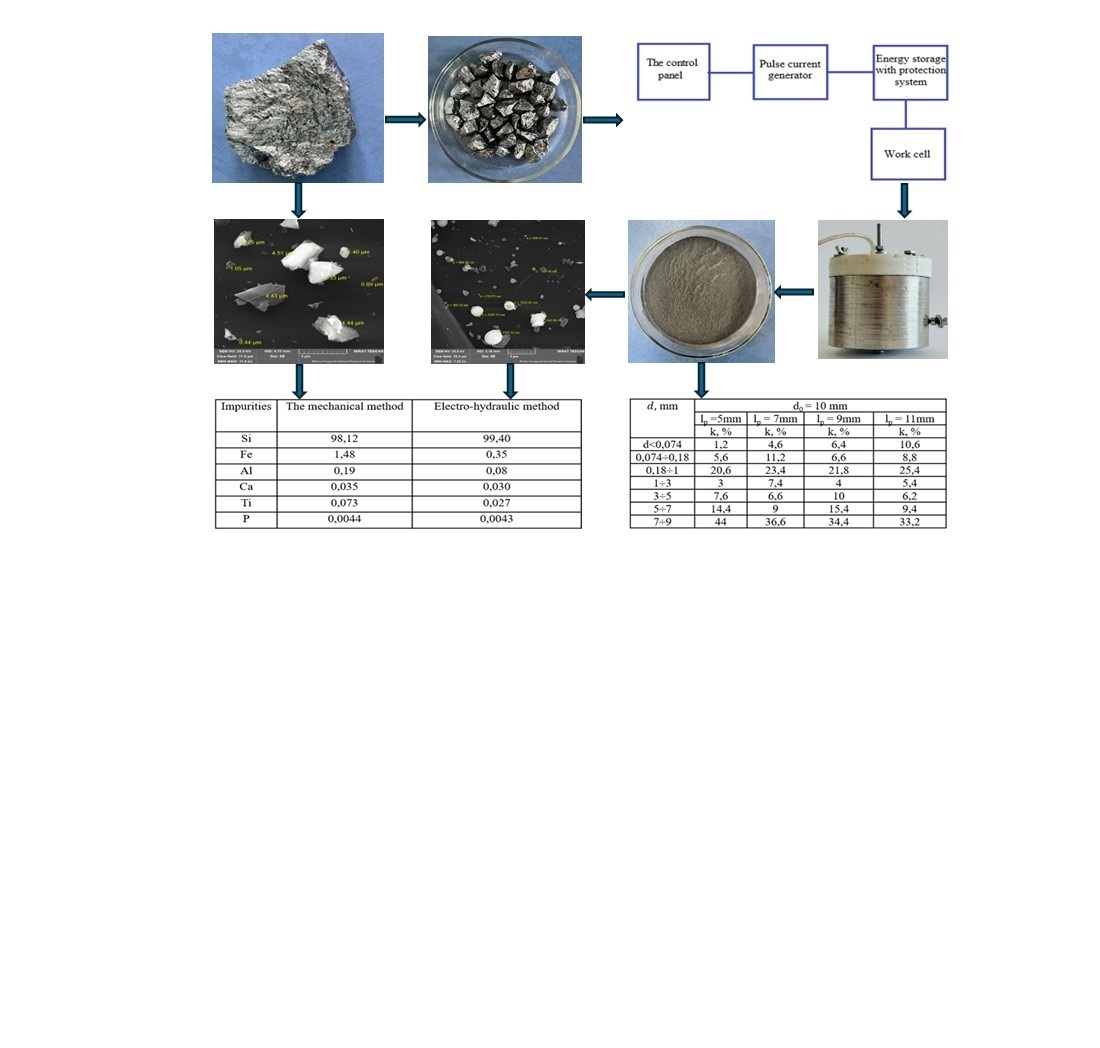
An electrohydraulic unit was designed and assembled for the grinding of metallurgical silicon. The processing of metallurgical silicon was carried out with an increase in the discharge voltage of the storage device from 16 kV to 27 kV, the length of the interelectrode distance from 5mm to 11 mm, the capacitor capacity of 0.4 UF and the processing time of 5 min. Using the electrohydraulic method, particles of metallurgical silicon with an initial fraction of 3 mm, 5 mm and 10 mm were crushed to 0.074 mm. The results of crushing metallurgical silicon under the influence of the electrohydraulic method in a liquid medium allowed to determine the degree of grinding of the material.
Surface and quantitative analyses of powdered metallurgical silicon samples were performed using a scanning electron microscope and a Rigaku Simultix 15 spectrometer (Rigaku Corporation, produced in Japan).
The results obtained can be used in the study of the grinding characteristics of metallurgical silicon. High-purity silicon (polycrystalline and monocrystalline silicon) is widely used as a base material in the production of semiconductor devices and photovoltaic cells. It is also used in ferrous and non-ferrous metallurgy to produce alloys, as well as a raw material to produce high-purity silicon
References
- Mukashev, B., Betekbaev, A., Skakov, D., Pellegrin, I., Pavlov, A., Bektemirov, Zh. (2014). Upgrading Metallurgical Grade Silicon to Solar Grade Silicon. Eurasian Chemico-Technological Journal, 16 (4), 309–313. https://doi.org/10.18321/ectj11
- Serikkanov, A., Pavlov, A., Mukashev, B., Turmagambetov, T., Kantarbayeva, D., Zholdybayev, K. (2022). The Possibility of Silicon Purification by Metallurgical Methods: Part I. Processes, 10 (7), 1353. https://doi.org/10.3390/pr10071353
- Safarian, J., Tranell, G., Tangstad, M. (2012). Processes for Upgrading Metallurgical Grade Silicon to Solar Grade Silicon. Energy Procedia, 20, 88–97. https://doi.org/10.1016/j.egypro.2012.03.011
- Serikkanov, A., Shongalova, A., Zholdybayev, K., Tokmoldin, N., Turmagambetov, T., Pavlov, A., Mukashev, B. (2022). Integration of Kazakhstan Technologies for Silicon and Monosilane Production with the Suitable World Practices for the Production of Solar Cells and Panels. Processes, 10 (7), 1303. https://doi.org/10.3390/pr10071303
- Esfahani, S., Barati, M. (2011). Purification of metallurgical silicon using iron as an impurity getter part I: Growth and separation of Si. Metals and Materials International, 17 (5), 823–829. https://doi.org/10.1007/s12540-011-1021-3
- Yang, J., Zhu, P., Li, H., Li, Z., Huo, X., Ma, S. (2022). Research on the Relationship between Multi-Component Complex Ore and Its Component Minerals’ Grinding Characteristics under Abrasion Force. Minerals, 13 (1), 6. https://doi.org/10.3390/min13010006
- Zeng, R., Wang, Y. H., Zhang, J. X., Xu, J. Q., Li, H. Y., Chen, X. F., Xing, W. D. (2012). Hydrometallurgical Purification of Metallurgy Grade Silicon by Acid Leaching. Advanced Materials Research, 549, 428–431. https://doi.org/10.4028/www.scientific.net/amr.549.428
- Rizun, A. R., Curkin, V. N. (2002). Elektrorazryadnoe razrushenie nemetallicheskih materialov. Elektronnaya obrabotka materialov, 38 (1), 83–85. Available at: https://eom.ifa.md/en/journal/shortview/1638
- Gribov, B. G., Zinov’ev, K. V. (2003). Preparation of High-Purity Silicon for Solar Cells. Inorganic Materials, 39 (7), 653–662. https://doi.org/10.1023/a:1024553420534
- Chigondo, F. (2017). From Metallurgical-Grade to Solar-Grade Silicon: An Overview. Silicon, 10 (3), 789–798. https://doi.org/10.1007/s12633-016-9532-7
- Luo, D. (2017). Study on the Preparation of Solar Grade Silicon by Metallurgical Method. New Research on Silicon - Structure, Properties, Technology. https://doi.org/10.5772/67643
- Li, J.-W., Guo, Z.-C., Tang, H.-Q., Li, J.-C. (2013). Removal of Impurities from Metallurgical Grade Silicon by Liquation Refining Method. Htmp, 32 (5), 503–510. https://doi.org/10.1515/htmp-2012-0157
- Mei, J., Yu, W., Hou, P., Xue, Y., Xin, Y., Yan, K. (2020). Purification of Metallurgical Grade Silicon Via the Mg-Si Alloy Refining and Acid Leaching Process. Silicon, 13 (2), 341–350. https://doi.org/10.1007/s12633-020-00439-9
- Alpysbay Z., Abilkaiyr, Z. (2024). Mechanical gearbox producthion technology. Journal of Energy, Mechanical Engineering and Transport, 1 (3), 6–12. Available at: https://met.journal.satbayev.university/index.php/journal/article/view/1250
- Denisyuk, T. D., Rizun, A. R., Blashchenko, A. D. (2024). Study of Hydrodynamic Characteristics of the Pulse-Wave Action under Various Process Conditions in Electric-Discharge Machines for the Destruction of Nonmetallic Materials. Surface Engineering and Applied Electrochemistry, 60 (6), 874–882. https://doi.org/10.3103/s1068375524700480
- Rizun, A. R., Kosenkov, V. M., Holen, U. V., Denisuk, T. D. (2010). Development and introduction of electro-bit process of metallurgical silicon disintegration металлургического кремния. Nauka ta innovatsiyi, 6 (6), 25–30. Available at: http://scinn.org.ua/sites/default/files/pdf/2010/N6/Rizun.pdf
- Khassenov, A., Bulkairova, G., Karabekova, D., Bolatbekova, M., Alpyssova, G., Kudussov, A., Kissabekova, P. (2024). Identification of the impact of electric pulse action on the disintegration of a natural mineral. Eastern-European Journal of Enterprise Technologies, 1 (1 (127)), 54–59. https://doi.org/10.15587/1729-4061.2024.289556
- Bulkairova, G., Nussupbekov, B., Bolatbekova, M., Khassenov, A., Nussupbekov, U., Karabekova, D. (2023). A research of the effect of an underwater electric explosion on the selectivity of destruction of quartz raw materials. Eastern-European Journal of Enterprise Technologies, 3 (12 (123)), 30–37. https://doi.org/10.15587/1729-4061.2023.279009
- Nussupbekov, B., Duisenbayeva, М., Oshanov, Y., Satybaldin, A., Turlybekova, R. (2025). Identifying the effect of the temperature regime of a heat generating unit on the efficiency of the electrohydroimpulse degreasing of organic materials. Eastern-European Journal of Enterprise Technologies, 6 (10 (138)), 6–13. https://doi.org/10.15587/1729-4061.2025.347018
- Khassenov, A., Karabekova, D., Bolatbekova, M., Nussupbekov, B., Kissabekova, P., Orazbayev, R. (2025). Development of an Electric Pulse Device for Coal Grinding. Applied Sciences, 15 (10), 5548. https://doi.org/10.3390/app15105548
- Wang, C., Niu, X., Wang, D., Zhang, W., Shi, H., Yu, L. et al. (2022). Simple preparation of Si/CNTs/C composite derived from photovoltaic waste silicon powder as high-performance anode material for Li-ion batteries. Powder Technology, 408, 117744. https://doi.org/10.1016/j.powtec.2022.117744
- Marguí, E., Queralt, I., Van Grieken, R. (2016). Sample preparation for X-ray fluorescence analysis. Encyclopedia of Analytical Chemistry: Applications, Theory and Instrumentation. https://doi.org/10.1002/9780470027318.a6806m.pub3
- Pavani, S., Pavani, G., Veit, H. (2025). Separating materials from photovoltaic panels through thermomechanical processes and laser beams for the extraction of metals. Revista Brasileira de Ciências Ambientais, 60. https://doi.org/10.5327/z2176-94782331
- Khassenov, A. K., Karabekova, D. Z., Bolatbekova, M. M., Kudussov, A. S., Kassymov, S. S., Chirkova, L. V. (2025). Development of Electrode of Electric Impulse Chamber for Coal Grinding. Applied Sciences, 15 (7), 3607. https://doi.org/10.3390/app15073607
Downloads
Published
How to Cite
Issue
Section
License
Copyright (c) 2026 Bekbolat Nussupbekov, Gulden Bulkairova, Gulzira Mussina, Saule Sakipova, Aizada Muratova

This work is licensed under a Creative Commons Attribution 4.0 International License.
The consolidation and conditions for the transfer of copyright (identification of authorship) is carried out in the License Agreement. In particular, the authors reserve the right to the authorship of their manuscript and transfer the first publication of this work to the journal under the terms of the Creative Commons CC BY license. At the same time, they have the right to conclude on their own additional agreements concerning the non-exclusive distribution of the work in the form in which it was published by this journal, but provided that the link to the first publication of the article in this journal is preserved.
A license agreement is a document in which the author warrants that he/she owns all copyright for the work (manuscript, article, etc.).
The authors, signing the License Agreement with TECHNOLOGY CENTER PC, have all rights to the further use of their work, provided that they link to our edition in which the work was published.
According to the terms of the License Agreement, the Publisher TECHNOLOGY CENTER PC does not take away your copyrights and receives permission from the authors to use and dissemination of the publication through the world's scientific resources (own electronic resources, scientometric databases, repositories, libraries, etc.).
In the absence of a signed License Agreement or in the absence of this agreement of identifiers allowing to identify the identity of the author, the editors have no right to work with the manuscript.
It is important to remember that there is another type of agreement between authors and publishers – when copyright is transferred from the authors to the publisher. In this case, the authors lose ownership of their work and may not use it in any way.








