Devising a method for determining the workload on a locomotive driver based on a multicriteria additive model to improve railroad transport safety
DOI:
https://doi.org/10.15587/1729-4061.2026.365618Keywords:
railroad transport, traffic safety, traction rolling stock, cognitive load, ergatic systemAbstract
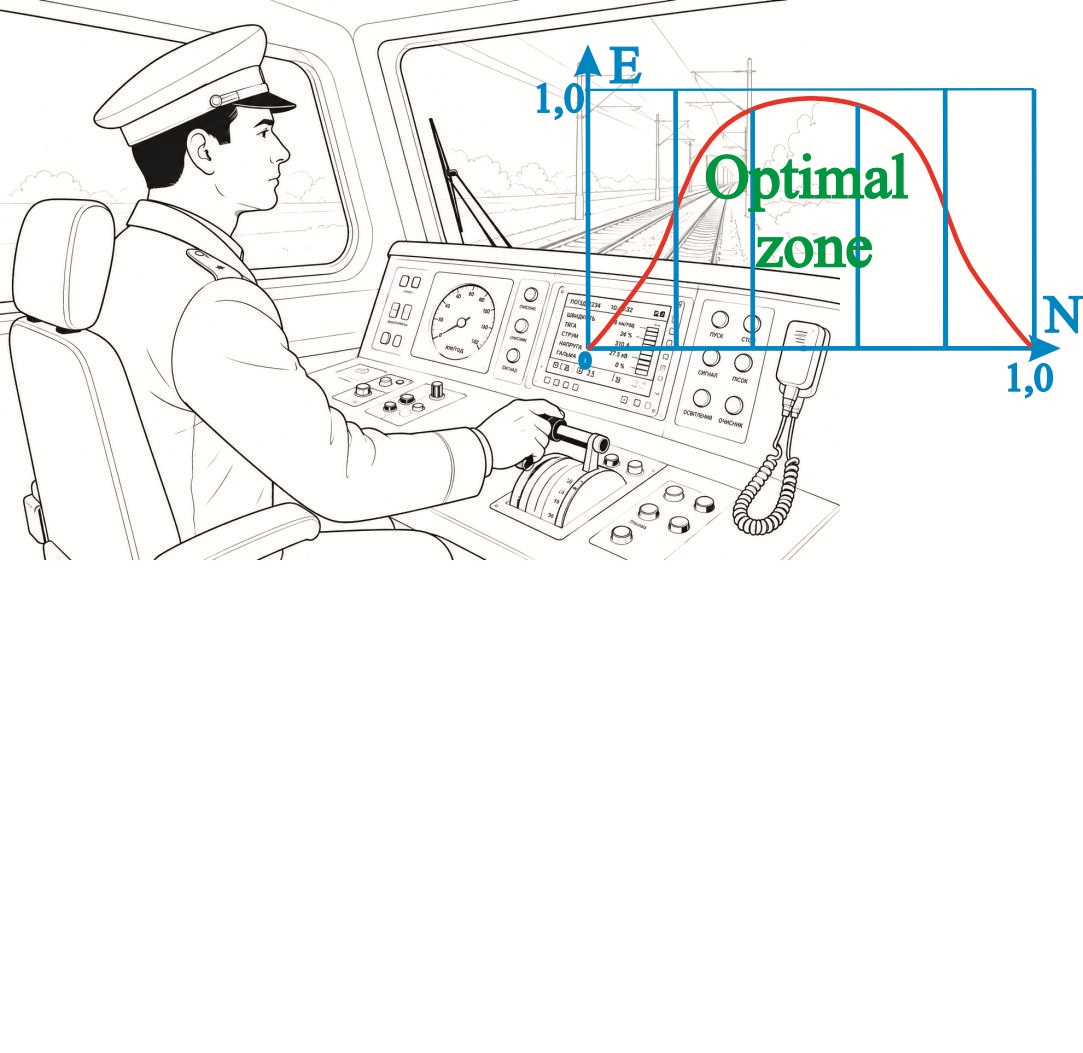
This study investigates the workload on the locomotive driver while driving a train. Up to now, research into the influence of the human factor on train control has not been fully completed. The reasons are the multifactorial nature of the driver’s activity, the limited statistical data, as well as the difficulty of determining the psychophysiological state of a person. A serious issue is the lack of a scientifically substantiated method for determining the level of the driver’s workload during trip. This work addresses this problem and defines quantitative characteristics of the state of the human operator while operating traction rolling stock. By determining the parameters of the environment in which the "driver-train" ergatic system operates and the factors affecting the driver’s workload, it was possible to solve the task. Based on these data, a criterion has been devised to define the workload.
The method is based on an additive approach that combines the flow of information, the complexity of external conditions, as well as the factor of decision-making speed. The advantages of this approach are the relative simplicity of calculations, which ensures the ease of implementation of monitoring the driver’s condition on board the locomotive in real time. It has been established that the total number of signals affecting the driver reaches 20300, of which 165 are critically important. It has been found that the main reserve for reducing the load on a person in the "driver-train" ergatic system is to reduce the amount of information received by the train driver.
In the future, the results of this study could be used to assess different modes of movement along different routes to identify the most dangerous values of the load on the driver. In addition, the research could lay a groundwork for implementing and adjusting the functions of locomotive decision support systems
References
- Shaffer, F., Ginsberg, J. P. (2017). An Overview of Heart Rate Variability Metrics and Norms. Frontiers in Public Health, 5. https://doi.org/10.3389/fpubh.2017.00258
- Chen, J., Li, H., Han, L., Wu, J., Azam, A., Zhang, Z. (2022). Driver vigilance detection for high-speed rail using fusion of multiple physiological signals and deep learning. Applied Soft Computing, 123, 108982. https://doi.org/10.1016/j.asoc.2022.108982
- Abe, T. (2023). PERCLOS-based technologies for detecting drowsiness: current evidence and future directions. SLEEP Advances, 4 (1). https://doi.org/10.1093/sleepadvances/zpad006
- Dankovich, L. J., Joyner, J. S., He, W., Sesay, A., Vaughn-Cooke, M. (2024). CogWatch: An open-source platform to monitor physiological indicators for cognitive workload and stress. HardwareX, 19, e00538. https://doi.org/10.1016/j.ohx.2024.e00538
- Hassanzadeh-Rangi, N., Jalilian, H., Farshad, A.-A., Khosravi, Y. (2023). Correlation of Work Fatigue and Mental Workload in Train Drivers: A Cross-sectional Study. Journal of Research in Health Sciences, 23 (4), e00600. https://doi.org/10.34172/jrhs.2023.135
- Wang, P., Fang, W., Guo, B. (2019). Mental workload evaluation and its application in train driving multitasking scheduling: a Timed Petri Net-based model. Cognition, Technology & Work, 23 (2), 299–313. https://doi.org/10.1007/s10111-019-00608-w
- Wang, H., Chen, D., Huang, Y., Zhang, Y., Qiao, Y., Xiao, J., Xie, N., Fan, H. (2023). Assessment of Vigilance Level during Work: Fitting a Hidden Markov Model to Heart Rate Variability. Brain Sciences, 13 (4), 638. https://doi.org/10.3390/brainsci13040638
- Gorobchenko, O., Matsiuk, V., Holub, H., Gritsuk, I., Nevedrov, O. (2024). Increasing the efficiency of operation and management of railroad transport infrastructure based on maximum levels of fault tolerance. Eastern-European Journal of Enterprise Technologies, 5 (3 (131)), 55–65. https://doi.org/10.15587/1729-4061.2024.311829
- Catelani, M., Ciani, L., Guidi, G., Patrizi, G. (2021). An enhanced SHERPA (E-SHERPA) method for human reliability analysis in railway engineering. Reliability Engineering & System Safety, 215, 107866. https://doi.org/10.1016/j.ress.2021.107866
- Chen, Z., Guo, Z., Feng, G., Shi, L., Zhang, J. (2021). A Qualitative Study on the Workload of High-Speed Railway Dispatchers. Engineering Psychology and Cognitive Ergonomics, 251–260. https://doi.org/10.1007/978-3-030-77932-0_21
- Zoer, I., Sluiter, J. K., Frings-Dresen, M. H. W. (2014). Psychological work characteristics, psychological workload and associated psychological and cognitive requirements of train drivers. Ergonomics, 57 (10), 1473–1487. https://doi.org/10.1080/00140139.2014.938130
- Gorobchenko, O., Holub, H., Zaika, D. (2024). Theoretical basics of the self-learning system of intelligent locomotive decision support systems. Archives of Transport, 71 (3), 169–186. https://doi.org/10.61089/aot2024.gaevsp41
- Goolak, S., Liubarskyi, B., Riabov, I., Chepurna, N., Pohosov, O. (2023). Simulation of a direct torque control system in the presence of winding asymmetry in induction motor. Engineering Research Express, 5 (2), 25070. https://doi.org/10.1088/2631-8695/acde46
- Tverdomed, V., Dmytro, Z., Kokriatska, N., Lukoševičius, V. (2024). The Detection of Railheads: An Innovative Direct Image Processing Method. Sustainability, 16 (12), 5109. https://doi.org/10.3390/su16125109
- Hwang, C.-L., Yoon, K. (1981). Multiple Attribute Decision Making. Springer Berlin Heidelberg. https://doi.org/10.1007/978-3-642-48318-9
- Belton, V., Stewart, T. J. (2002). Multiple Criteria Decision Analysis. Springer US. https://doi.org/10.1007/978-1-4615-1495-4
- Jahan, A., Edwards, K. L. (2016). Multi-criteria decision analysis for supporting the selection of engineering materials in product design. Butterworth-Heinemann. https://doi.org/10.1016/c2012-0-02834-7
- Ishizaka, A., Nemery, P. (2013). Multi‐Criteria Decision Analysis. https://doi.org/10.1002/9781118644898
- Gorobсhenko, O. (2021). Theoretical fundamentals of estimatability assessment of train situation signs for work of intellectual locomotive control systems. Collection of Scientific Works of the State University of Infrastructure and Technologies Series “Transport Systems and Technologies”, 1 (38), 223–231. https://doi.org/10.32703/2617-9040-2021-38-220-21
- Wickens, C. D., Hollands, J. G., Banbury, S., Parasuraman, R. (2015). Engineering Psychology and Human Performance. Psychology Press. https://doi.org/10.4324/9781315665177
- Naweed, A. (2020). Getting mixed signals: Connotations of teamwork as performance shaping factors in network controller and rail driver relationship dynamics. Applied Ergonomics, 82, 102976. https://doi.org/10.1016/j.apergo.2019.102976
- Gorobchenko, O., Nevedrov, O. (2020). Development of the structure of an intelligent locomotive DSS and as-sessment of its efectiveness. Archives of Transport, 56 (4), 47–58. https://doi.org/10.5604/01.3001.0014.5517
- Chambon, T., Guillaume, J.-L., Lallement, J. (2023). Information Complexity Ranking: A New Method of Ranking Images by Algorithmic Complexity. Entropy, 25 (3), 439. https://doi.org/10.3390/e25030439
- Zenil, H., Marshall, J. A. R., Tegnér, J. (2023). Approximations of algorithmic and structural complexity validate cognitive-behavioral experimental results. Frontiers in Computational Neuroscience, 16. https://doi.org/10.3389/fncom.2022.956074
- Lange, C., Ahrens, A. (2025). Digital Transmission Engineering. Springer Fachmedien Wiesbaden. https://doi.org/10.1007/978-3-658-46789-0
- Gibson, J. D. (2023). Digital Communications. Springer International Publishing. https://doi.org/10.1007/978-3-031-19588-4
- Renzo, M. D., Migliore, M. D. (2024). Electromagnetic Signal and Information Theory. IEEE BITS the Information Theory Magazine, 4 (1), 25–39. https://doi.org/10.1109/mbits.2024.3359523
- Кustov, V. (2025). Fundamental limitations of basic dangerous failure models for functional safety assessment in train control systems. Collection of Scientific Works of the Ukrainian State University of Railway Transport, 212, 301–314. https://doi.org/10.18664/1994-7852.212.2025.336537
- Rieger, T., Manzey, D. (2020). Human Performance Consequences of Automated Decision Aids: The Impact of Time Pressure. Human Factors: The Journal of the Human Factors and Ergonomics Society, 64 (4), 617–634. https://doi.org/10.1177/0018720820965019
- Laxar, D., Eitenberger, M., Maleczek, M., Kaider, A., Hammerle, F. P., Kimberger, O. (2023). The influence of explainable vs non-explainable clinical decision support systems on rapid triage decisions: a mixed methods study. BMC Medicine, 21 (1). https://doi.org/10.1186/s12916-023-03068-2
Downloads
Published
How to Cite
Issue
Section
License
Copyright (c) 2026 Oleksandr Gorobchenko, Denys Zaika, Oleksandr Nevedrov, Halyna Holub, Viktor Tkachenko, Serhii Kara

This work is licensed under a Creative Commons Attribution 4.0 International License.
The consolidation and conditions for the transfer of copyright (identification of authorship) is carried out in the License Agreement. In particular, the authors reserve the right to the authorship of their manuscript and transfer the first publication of this work to the journal under the terms of the Creative Commons CC BY license. At the same time, they have the right to conclude on their own additional agreements concerning the non-exclusive distribution of the work in the form in which it was published by this journal, but provided that the link to the first publication of the article in this journal is preserved.
A license agreement is a document in which the author warrants that he/she owns all copyright for the work (manuscript, article, etc.).
The authors, signing the License Agreement with TECHNOLOGY CENTER PC, have all rights to the further use of their work, provided that they link to our edition in which the work was published.
According to the terms of the License Agreement, the Publisher TECHNOLOGY CENTER PC does not take away your copyrights and receives permission from the authors to use and dissemination of the publication through the world's scientific resources (own electronic resources, scientometric databases, repositories, libraries, etc.).
In the absence of a signed License Agreement or in the absence of this agreement of identifiers allowing to identify the identity of the author, the editors have no right to work with the manuscript.
It is important to remember that there is another type of agreement between authors and publishers – when copyright is transferred from the authors to the publisher. In this case, the authors lose ownership of their work and may not use it in any way.








