Determining the impact of digital transformation on the economic efficiency of dairy farms (using the example of the Republic of Kazakhstan)
DOI:
https://doi.org/10.15587/1729-4061.2026.365620Keywords:
digital transformation, dairy farms, digital investments, economic efficiency, Republic of KazakhstanAbstract
The object of the study is the economic efficiency of dairy farms in the context of digital transformation in a developing country (using the example of the Republic of Kazakhstan). The problem of quantifying the impact of digital investments on the productivity and costs of dairy farms has been solved, taking into account the heterogeneity of effects on the size of enterprises.
The results are obtained:
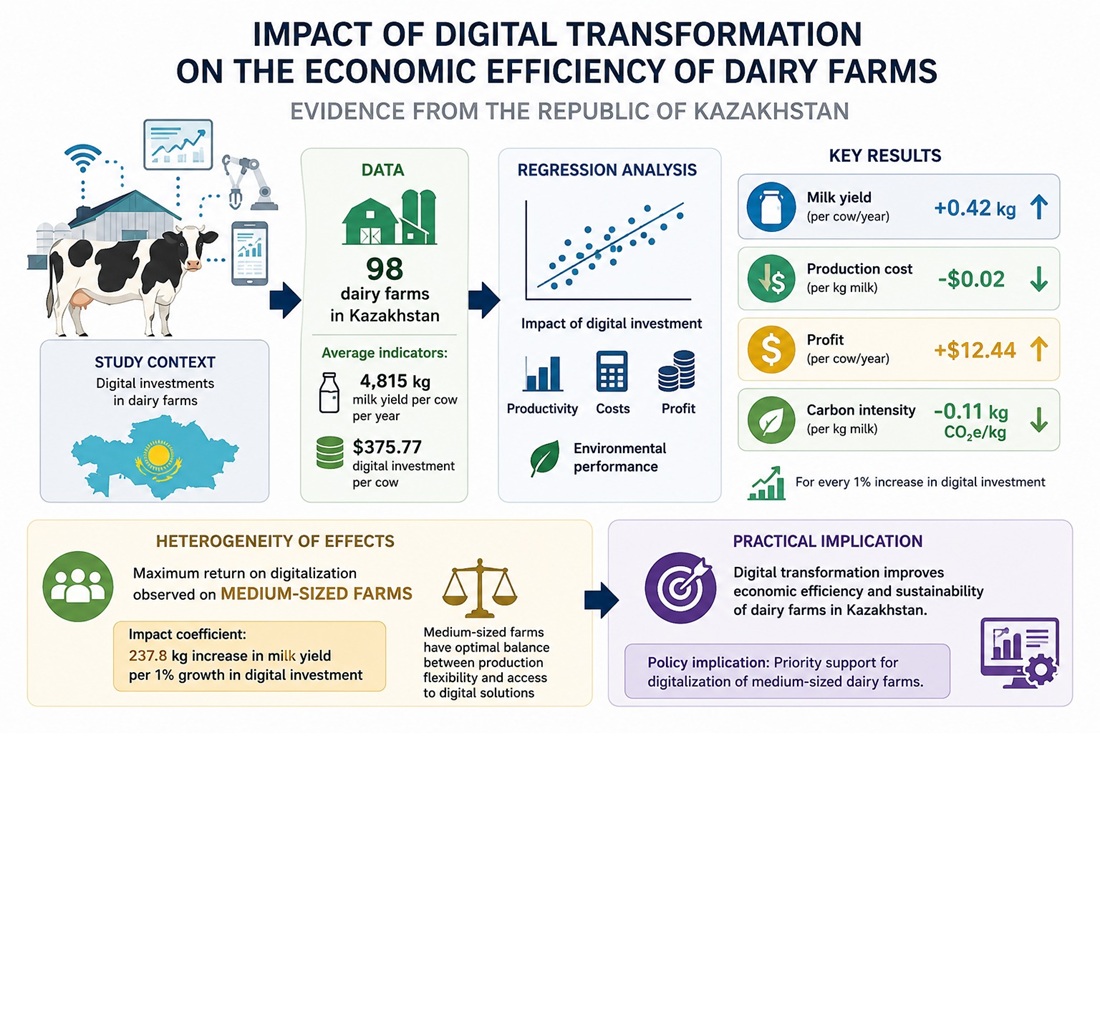
– the data of 98 dairy farms in Republic of Kazakhstan was analyzed: the average milk yield per cow was 4,815 kg/year, the average level of digital investment was 375.77 USD per cow;
– regression analysis revealed that an increase in digital investments by 1 USD per cow leads to an increase in milk yield by 0.42 kg per cow per year, a decrease in the cost of 1 kg of milk by 0.02 USD, and an increase in profit by 12.44 USD per cow per year;
– the heterogeneity of the effects was revealed: the maximum return on digitalization was recorded on medium-sized farms (the impact factor on milk yield was 237.8 kg per 1% of investment growth;
– a 1% increase in digital investments is accompanied by a decrease in the carbon intensity of milk by 0.11 kg CO2e/kg, with the greatest effect on medium-sized farms.
The results obtained are explained by the fact that in Republic of Kazakhstan, it is medium-sized farms that have optimal production flexibility compared to large enterprises and access to digital solutions compared to small enterprises.
The features of the results obtained are that they show, based on empirical data from Kazakhstani farms, a heterogeneity of returns from digital transformation depending on the size of the enterprise, which differs from the patterns observed in other countries.
The practical significance of this study lies in the possibility of using its results to develop investment solutions
References
- Yu, Z., Liu, H., Peng, H., Dong, X. (2025). Digital transformation and farm economic performance: Evidence from Chinese dairy farms. Smart Agricultural Technology, 12, 101346. https://doi.org/10.1016/j.atech.2025.101346
- Wójcicki, K., Młody, M., Sajdak, M. (2025). Opportunities and barriers in the digital transformation of dairy industry and its impact on sustainable production management. Economics and Environment, 94 (3), 1081. https://doi.org/10.34659/eis.2025.94.3.1081
- Eastwood, C. R., Chapman, D. F., Paine, M. S. (2012). Networks of practice for co-construction of agricultural decision support systems: Case studies of precision dairy farms in Australia. Agricultural Systems, 108, 10–18. https://doi.org/10.1016/j.agsy.2011.12.005
- Dela Rue, B. T., Eastwood, C. R., Edwards, J. P., Cuthbert, S. (2019). New Zealand dairy farmers preference investments in automation technology over decision-support technology. Animal Production Science, 60 (1), 133–137. https://doi.org/10.1071/an18566
- Hassoun, A., Garcia-Garcia, G., Trollman, H., Jagtap, S., Parra-López, C., Cropotova, J. et al. (2023). Birth of dairy 4.0: Opportunities and challenges in adoption of fourth industrial revolution technologies in the production of milk and its derivatives. Current Research in Food Science, 7, 100535. https://doi.org/10.1016/j.crfs.2023.100535
- Altybayev, A., Rakhimzhanov, A., Zhanbyrbayev, A., Issayeva, Z., Bekmukhamedov, B. (2025). The State and Prospects of Digital Transformation in the Agricultural Sectors. Agricultural Engineering, 29 (1), 287–309. https://doi.org/10.2478/agriceng-2025-0017
- Matvieiev, M., Getya, A., Nehrey, M., Yakubets, T., Ruban, S., Nazarko, O. et al. (2025). Optimisation of dairy farming in Ukraine: integrating modern information technologies for genetic improvement and sustainable herd management. Agronomy Research, 23 (1), 435–447. doi: https://doi.org/10.15159/AR.25.010
- Balaine, L., Dillon, E. J., Läpple, D., Lynch, J. (2020). Can technology help achieve sustainable intensification? Evidence from milk recording on Irish dairy farms. Land Use Policy, 92, 104437. https://doi.org/10.1016/j.landusepol.2019.104437
- Carillo, F., Abeni, F. (2020). An Estimate of the Effects from Precision Livestock Farming on a Productivity Index at Farm Level. Some Evidences from a Dairy Farms’ Sample of Lombardy. Animals, 10 (10), 1781. https://doi.org/10.3390/ani10101781
- Sargani, G. R., Wang, B., Leghari, S. J., Ruan, J. (2025). Is digital transformation the key to agricultural strength? A novel approach to productivity and supply chain resilience. Smart Agricultural Technology, 10, 100838. https://doi.org/10.1016/j.atech.2025.100838
- Kitole, F. A., Mkuna, E., Sesabo, J. K. (2024). Digitalization and agricultural transformation in developing countries: Empirical evidence from Tanzania agriculture sector. Smart Agricultural Technology, 7, 100379. https://doi.org/10.1016/j.atech.2023.100379
- Neethirajan, S. (2023). Artificial Intelligence and Sensor Technologies in Dairy Livestock Export: Charting a Digital Transformation. Sensors, 23 (16), 7045. https://doi.org/10.3390/s23167045
- McFadden, J., Raff, Z. (2026). Precision dairy farming, robotic milking, and profitability in the United States. Economic Research Report, 356, 71. https://doi.org/10.22004/AG.ECON.388984
- Selvaggi, R., Lusk, J. L., Pappalardo, G. (2025). Eliciting dairy farmers’ willingness to pay for digital devices for Precision Livestock Farming. Journal of Rural Studies, 119, 103772. https://doi.org/10.1016/j.jrurstud.2025.103772
- Espinoza-Sandoval, O. R., Angeles-Hernandez, J. C., Gonzalez-Ronquillo, M., Ghavipanje, N., Zhang, N. et al. (2024). Dairy farming in the era of artificial intelligence: trend or a real game changer? Journal of Dairy Research, 91 (2), 139–145. https://doi.org/10.1017/s0022029924000426
- Bianchi, M. C., Bava, L., Sandrucci, A., Tangorra, F. M., Tamburini, A., Gislon, G., Zucali, M. (2022). Diffusion of precision livestock farming technologies in dairy cattle farms. Animal, 16 (11), 100650. https://doi.org/10.1016/j.animal.2022.100650
- Tadele, E., Worku, D., Yigzaw, D., Muluneh, T., Melese, A. (2025). Precision of dairy farming: navigating challenges and seizing opportunities for sustainable dairy production in Africa. Frontiers in Animal Science, 6. https://doi.org/10.3389/fanim.2025.1541838
- Uskenov, R., Issabekova, S., Mukhanbetkaliyeva, A., Akibekov, O., Zhagipar, F. (2024). Digital technologies in dairy cattle breeding to improve the reproductive function of cows and heifers: A case study in Northern Kazakhstan. Veterinary World, 2385–2397. https://doi.org/10.14202/vetworld.2024.2385-2397
- Shi, X., Liu, C. (2025). Smart Farming Technology, Scale Economies and Carbon Efficiency: Evidence from Chinese Dairy Farms. Agriculture, 15 (21), 2281. https://doi.org/10.3390/agriculture15212281
Downloads
Published
How to Cite
Issue
Section
License
Copyright (c) 2026 Lyailya Akhmetova, Madina Bazhigaliyeva, Gulzhan Zhakenova, Anvar Tulaganov, Almira Saktayeva, Dinara Mamyrbekova, Alma Baiguzhinova, Zhanar Baigireyeva, Assel Apysheva

This work is licensed under a Creative Commons Attribution 4.0 International License.
The consolidation and conditions for the transfer of copyright (identification of authorship) is carried out in the License Agreement. In particular, the authors reserve the right to the authorship of their manuscript and transfer the first publication of this work to the journal under the terms of the Creative Commons CC BY license. At the same time, they have the right to conclude on their own additional agreements concerning the non-exclusive distribution of the work in the form in which it was published by this journal, but provided that the link to the first publication of the article in this journal is preserved.
A license agreement is a document in which the author warrants that he/she owns all copyright for the work (manuscript, article, etc.).
The authors, signing the License Agreement with TECHNOLOGY CENTER PC, have all rights to the further use of their work, provided that they link to our edition in which the work was published.
According to the terms of the License Agreement, the Publisher TECHNOLOGY CENTER PC does not take away your copyrights and receives permission from the authors to use and dissemination of the publication through the world's scientific resources (own electronic resources, scientometric databases, repositories, libraries, etc.).
In the absence of a signed License Agreement or in the absence of this agreement of identifiers allowing to identify the identity of the author, the editors have no right to work with the manuscript.
It is important to remember that there is another type of agreement between authors and publishers – when copyright is transferred from the authors to the publisher. In this case, the authors lose ownership of their work and may not use it in any way.








