Визначення впливу поліморфізму β-казеїну молока-сировини на ефективність виробництва м’якого сиру
DOI:
https://doi.org/10.15587/1729-4061.2024.311236Ключові слова:
м’який сир, вихід сиру, якість, кислотно-сичужний спосіб, термокислотний спосіб, β-казеїн, молоко А2Анотація
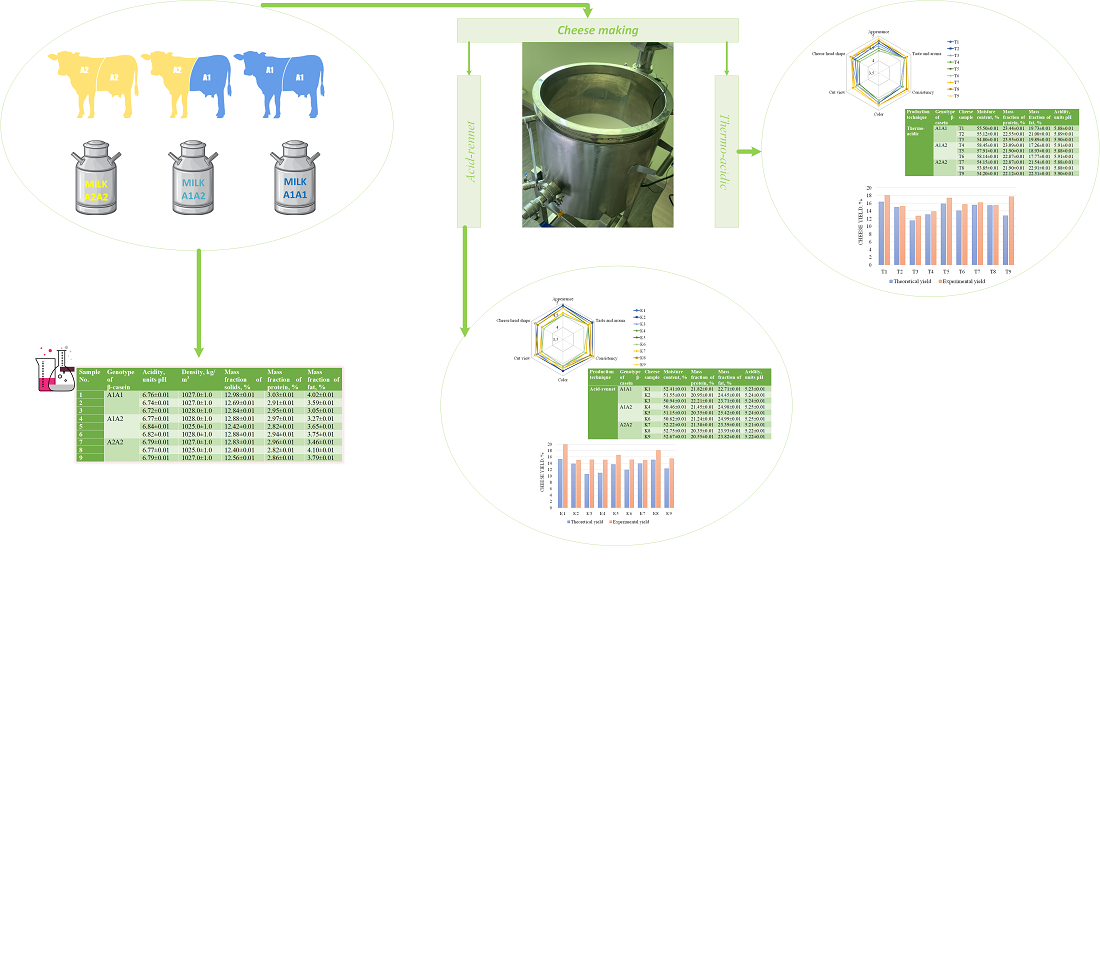
Одним із способів підвищення рентабельності сироробної галузі є генетичний відбір молочних корів для отримання молока з відмінними сиропридатними характеристиками. Об’єктом дослідження є технологія свіжих м’яких сирів виготовлених кислотно-сичужним та термокислотним способом із молока корів з різними генотипами за β-казеїном (А1А1, А1А2, А2А2). Предмети дослідження: фізико-хімічні показники молока-сировини від корів з різними генотипами за β-казеїном (А1А1, А1А2, А2А2); вихід м’яких сирів. Проведеними дослідженнями встановлено, що фізико-хімічні показники молока від корів з різними генотипами β-казеїну є типовими для свіжого коров’ячого молока. Дослідження показало, що при кислотно-сичужному способі склад сирів з молока А1А1 становив 51,60 %, 21,63 % та 23,62 % вологи, білка, та жиру відповідно. Сири з молока А1А2 містили 50,70 % вологи, 20,96 % білка та 25,12 % жиру. Сири з молока А2А2 складалися з 52,50 % вологи, 20,70 % білка та 23,71 % жиру. При термокислотному способі сири з молока А1А1 характеризувалися вмістом вологи – 55,13 %, білків – 23,31 % та жиру – 20,21 %. Сири з молока А1А2 містили 58,13 %, 22,62 % та 17,98 % вологи, білка та жиру відповідно. Сири з молока А2А2 складалися з 54,03 % вологи, 22,33 % білка та 22,25 % жиру. Розрахунок ефективності виробництва м’яких сирів із молока корів з різними генотипами за β-казеїном при кислотно-сичужному способі виробництва в середньому складає 119,3 %, що більше порівняно з молока А1А2 (на 4 %) і А2А2 (на 7 %). При термокислотному способі ефективність виробництва сиру з молока А2А2 складає 107,5 %, що більше порівняно з молока А1А2 (на 9 %) і А1А1 (на 5 %). Отримані висновки показують, що зміни генотипу β-казеїну в молоці-сировині можуть впливати на вихід та якість сиру, а отже, і на прибутковість виробництва
Посилання
- OECD-FAO Agricultural Outlook 2023-2032. OECD-FAO Agricultural Outlook. https://doi.org/10.1787/08801ab7-en
- Sohail, Z., Khan, N., Moazzam, M., Mujahid, S., Tariq Sindhu, A., Khan, H. et al. (2024). Perspective Chapter: Beyond Delicious – The Hidden Functional Benefits of Cheese. Recent Trends on Cheese as Functional Food with Great Nutritive and Health Benefits. https://doi.org/10.5772/intechopen.113047
- Ladyka, V., Pavlenko, Y., Sklyarenko, Y. (2021). β-casein gene polymorphism use in terms of brown dairy cattle preservation. Archivos de Zootecnia, 70 (269), 87–94. https://doi.org/10.21071/az.v70i269.5422
- Samilyk, M., Tsyrulyk, R., Bolgova, N., Vechorka, V., Ryzhkova, T., Severin, R. et al. (2022). Devising a technique for improving the biological value of A2 milk by adding carrot powder. Eastern-European Journal of Enterprise Technologies, 6 (11 (120)), 44–50. https://doi.org/10.15587/1729-4061.2022.266924
- Banerjee, S. (2018). A2 milk: the unknown story about a milk protein. Acta Scientific Nutritional Health, 2 (3), 28–31. Available at: https://actascientific.com/ASNH/pdf/ASNH-02-0057.pdf
- Cipolat-Gotet, C., Cecchinato, A., Malacarne, M., Bittante, G., Summer, A. (2018). Variations in milk protein fractions affect the efficiency of the cheese-making process. Journal of Dairy Science, 101 (10), 8788–8804. https://doi.org/10.3168/jds.2018-14503
- Daniloski, D., McCarthy, N. A., Huppertz, T., Vasiljevic, T. (2022). What is the impact of amino acid mutations in the primary structure of caseins on the composition and functionality of milk and dairy products? Current Research in Food Science, 5, 1701–1712. https://doi.org/10.1016/j.crfs.2022.09.026
- Sebastiani, C., Arcangeli, C., Torricelli, M., Ciullo, M., D’avino, N., Cinti, G. et al. (2022). Marker-assisted selection of dairy cows for β-casein gene A2 variant. Italian Journal of Food Science, 34 (2), 21–27. https://doi.org/10.15586/ijfs.v34i2.2178
- Daniloski, D., McCarthy, N. A., Vasiljevic, T. (2021). Bovine β-Casomorphins: Friends or Foes? A comprehensive assessment of evidence from in vitro and ex vivo studies. Trends in Food Science & Technology, 116, 681–700. https://doi.org/10.1016/j.tifs.2021.08.003
- Hohmann, L. G., Weimann, C., Scheper, C., Erhardt, G., König, S. (2021). Genetic diversity and population structure in divergent German cattle selection lines on the basis of milk protein polymorphisms. Archives Animal Breeding, 64 (1), 91–102. https://doi.org/10.5194/aab-64-91-2021
- Sun, Y., Ding, Y., Liu, B., Guo, J., Su, Y., Yang, X. et al. (2024). Recent advances in the bovine β-casein gene mutants on functional characteristics and nutritional health of dairy products: Status, challenges, and prospects. Food Chemistry, 443, 138510. https://doi.org/10.1016/j.foodchem.2024.138510
- Ladyka, V., Bolgova, N., Synenko, T., Skliarenko, Y., Vechorka, V. (2023). Determining the influence of raw milk protein composition on the yield of cheese and its nutrient content. Eastern-European Journal of Enterprise Technologies, 6 (11 (126)), 33–41. https://doi.org/10.15587/1729-4061.2023.292063
- Juan, B., Trujillo, A.-J. (2022). Acid and Rennet Coagulation Properties of A2 Milk. Foods, 11 (22), 3648. https://doi.org/10.3390/foods11223648
- Nguyen, H. T. H., Schwendel, H., Harland, D., Day, L. (2018). Differences in the yoghurt gel microstructure and physicochemical properties of bovine milk containing A1A1 and A2A2 β-casein phenotypes. Food Research International, 112, 217–224. https://doi.org/10.1016/j.foodres.2018.06.043
- Oliveira Mendes, M., Ferreira de Morais, M., Ferreira Rodrigues, J. (2019). A2A2 milk: Brazilian consumers’ opinions and effect on sensory characteristics of Petit Suisse and Minas cheeses. LWT, 108, 207–213. https://doi.org/10.1016/j.lwt.2019.03.064
- Bisutti, V., Pegolo, S., Giannuzzi, D., Mota, L. F. M., Vanzin, A., Toscano, A. et al. (2022). The β-casein (CSN2) A2 allelic variant alters milk protein profile and slightly worsens coagulation properties in Holstein cows. Journal of Dairy Science, 105 (5), 3794–3809. https://doi.org/10.3168/jds.2021-21537
- Gustavsson, F., Buitenhuis, A. J., Glantz, M., Stålhammar, H., Lindmark-Månsson, H., Poulsen, N. A. et al. (2014). Impact of genetic variants of milk proteins on chymosin-induced gelation properties of milk from individual cows of Swedish Red dairy cattle. International Dairy Journal, 39 (1), 102–107. https://doi.org/10.1016/j.idairyj.2014.05.007
- de Vitte, K., Kerziene, S., Klementavičiūtė, J., de Vitte, M., Dilbiene, V., Stankevičius, R. (2022). Relationship between β-casein genotypes (A1A1, A1A2, and A2A2) and coagulation properties of milk and the fatty acid composition and sensory characteristics of dairy products (soft cheese, sour cream, and butter). Acta Agriculturae Scandinavica, Section A – Animal Science, 71 (1-4), 21–32. https://doi.org/10.1080/09064702.2022.2141308
- Stocco, G., Cipolat-Gotet, C., Gasparotto, V., Cecchinato, A., Bittante, G. (2018). Breed of cow and herd productivity affect milk nutrient recovery in curd, and cheese yield, efficiency and daily production. Animal, 12 (2), 434–444. https://doi.org/10.1017/s1751731117001471
- Vigolo, V., Franzoi, M., Penasa, M., De Marchi, M. (2022). β-Casein variants differently affect bulk milk mineral content, protein composition, and technological traits. International Dairy Journal, 124, 105221. https://doi.org/10.1016/j.idairyj.2021.105221
- Niero, G., Visentin, G., Ton, S., De Marchi, M., Penasa, M., Cassandro, M. (2016). Phenotypic characterisation of milk technological traits, protein fractions, and major mineral and fatty acid composition of Burlina cattle breed. Italian Journal of Animal Science, 15 (4), 576–583. https://doi.org/10.1080/1828051x.2016.1250128
- Ladyka, V. I., Pavlenko, Y. M., Sklyarenko, Y. I., Ladyka, L. M., Levchenko, I. V. (2022). Influence of beta-casein genotype on milk quality indicators in brown cattle. Bulletin of Sumy National Agrarian University. The Series: Livestock, 4 (47), 7–12. https://doi.org/10.32845/bsnau.lvst.2021.4.2
- Guinee, T. P., Mulholland, E. O., Kelly, J., Callaghan, D. J. O. (2007). Effect of Protein-to-Fat Ratio of Milk on the Composition, Manufacturing Efficiency, and Yield of Cheddar Cheese. Journal of Dairy Science, 90 (1), 110–123. https://doi.org/10.3168/jds.s0022-0302(07)72613-9
- Gislon, G., Bava, L., Bisutti, V., Tamburini, A., Brasca, M. (2023). Bovine beta casein polymorphism and environmental sustainability of cheese production: The case of Grana Padano PDO and mozzarella cheese. Sustainable Production and Consumption, 35, 85–94. https://doi.org/10.1016/j.spc.2022.10.017
- Jensen, H. B., Holland, J. W., Poulsen, N. A., Larsen, L. B. (2012). Milk protein genetic variants and isoforms identified in bovine milk representing extremes in coagulation properties. Journal of Dairy Science, 95 (6), 2891–2903. https://doi.org/10.3168/jds.2012-5346
- Sturaro, A., De Marchi, M., Zorzi, E., Cassandro, M. (2015). Effect of microparticulated whey protein concentration and protein-to-fat ratio on Caciotta cheese yield and composition. International Dairy Journal, 48, 46–52. https://doi.org/10.1016/j.idairyj.2015.02.003
- Marko, R., Uros, G., Branislav, V., Milan, M., Danijela, K., Vlado, T., Zoran, S. (2020). Beta-Casein Gene Polymorphism in Serbian Holstein-Friesian Cows and Its Relationship with Milk Production Traits. Acta Veterinaria, 70 (4), 497–510. https://doi.org/10.2478/acve-2020-0037
##submission.downloads##
Опубліковано
Як цитувати
Номер
Розділ
Ліцензія
Авторське право (c) 2024 Volodymyr Ladyka, Nataliia Bolhova, Tetiana Synenko, Yuriy Skliarenko, Viktoriia Vechorka

Ця робота ліцензується відповідно до Creative Commons Attribution 4.0 International License.
Закріплення та умови передачі авторських прав (ідентифікація авторства) здійснюється у Ліцензійному договорі. Зокрема, автори залишають за собою право на авторство свого рукопису та передають журналу право першої публікації цієї роботи на умовах ліцензії Creative Commons CC BY. При цьому вони мають право укладати самостійно додаткові угоди, що стосуються неексклюзивного поширення роботи у тому вигляді, в якому вона була опублікована цим журналом, але за умови збереження посилання на першу публікацію статті в цьому журналі.
Ліцензійний договір – це документ, в якому автор гарантує, що володіє усіма авторськими правами на твір (рукопис, статтю, тощо).
Автори, підписуючи Ліцензійний договір з ПП «ТЕХНОЛОГІЧНИЙ ЦЕНТР», мають усі права на подальше використання свого твору за умови посилання на наше видання, в якому твір опублікований. Відповідно до умов Ліцензійного договору, Видавець ПП «ТЕХНОЛОГІЧНИЙ ЦЕНТР» не забирає ваші авторські права та отримує від авторів дозвіл на використання та розповсюдження публікації через світові наукові ресурси (власні електронні ресурси, наукометричні бази даних, репозитарії, бібліотеки тощо).
За відсутності підписаного Ліцензійного договору або за відсутністю вказаних в цьому договорі ідентифікаторів, що дають змогу ідентифікувати особу автора, редакція не має права працювати з рукописом.
Важливо пам’ятати, що існує і інший тип угоди між авторами та видавцями – коли авторські права передаються від авторів до видавця. В такому разі автори втрачають права власності на свій твір та не можуть його використовувати в будь-який спосіб.