Розроблення математичних моделей теплопровідності для елементів пристроїв з включеннями
DOI:
https://doi.org/10.15587/1729-4061.2024.313747Ключові слова:
термостійкість конструкції, чужорідне напівнаскрізне включення, ідеальний тепловий контакт, конвективний теплообмінАнотація
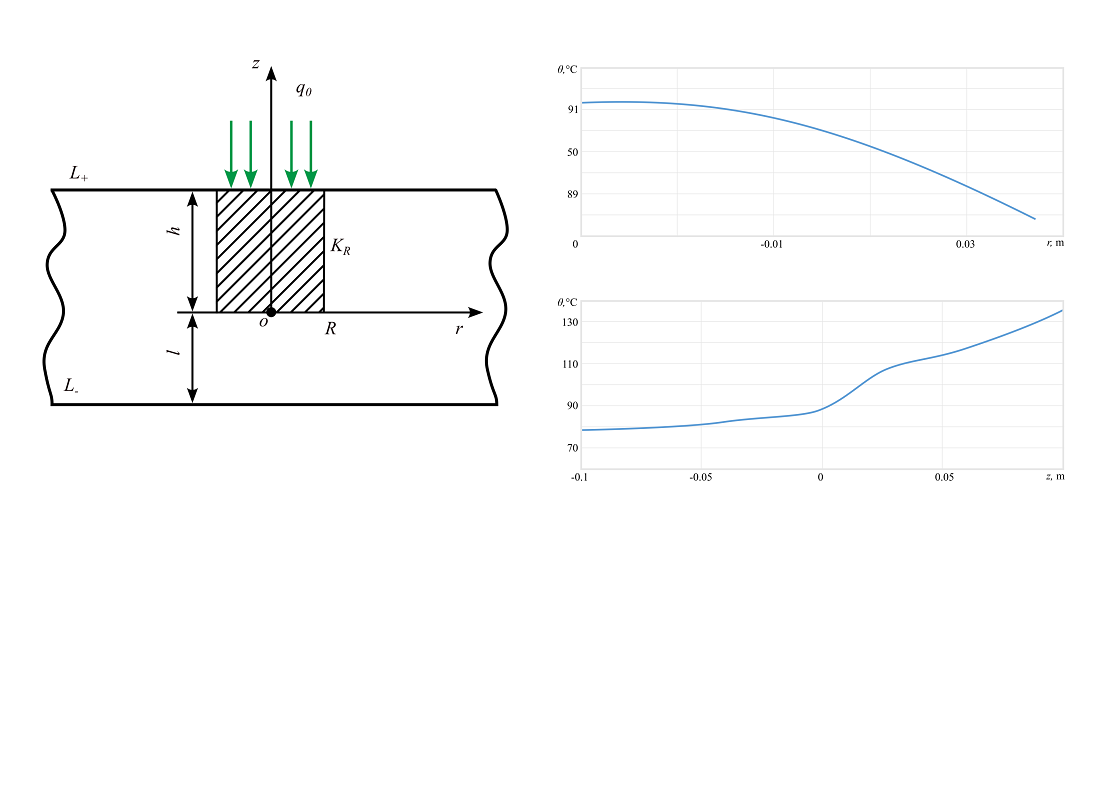
Розглянуто процес теплопровідності для ізотропного середовища, що містить чужорідне напівнаскрізне включення, та нагрівається локально зосередженим тепловим потоком. Для встановлення температурних режимів ефективної роботи електронних пристроїв розроблено лінійну і нелінійну математичні моделі визначення температурного поля. Коефіцієнт теплопровідності неоднорідної конструкції подано як ціле, з використанням асиметричних одиничних функцій, що автоматично забезпечує умови ідеального теплового контакту на поверхнях стику матеріалів. Це приводить до розв’язування одного рівняння теплопровідності з розривними та сингулярними коефіцієнтами. Для лінеаризації нелінійної крайової задачі запроваджено лінеаризуючу функції. У замкнутому вигляді отримано аналітично-числові розв’язки лінійної і нелінійної крайових задач. Для термочутливого середовища вибрано лінійну температурну залежність коефіцієнта теплопровідності конструкційних матеріалів. У результаті отримано аналітично-числовий розв’язок, який визначає розподіл температури у цьому середовищі. На цій основі виконано числовий експеримент, результати якого графічно відображені та підтверджують адекватність розроблених математичних моделей реальному фізичному процесу.
Матеріалом пластини та включення виступають кремній та срібло. Отримані результати для цих матеріалів за лінійною і нелінійною моделлю відрізняються на 7 %. Незначна їх відмінність пояснюється тим, що значення температурного коефіцієнта теплопровідності є невеликими. Розроблені моделі дають змогу аналізувати наведені середовища щодо їх термостійкості. Унаслідок, стає можливим її підвищити, а конструкції захистити від перегрівання, яке може привести до виходу з ладу окремих вузлів та їх елементів і цілого електронного пристрою
Посилання
- Sheikh, Z. (1994). Where do you the cooling vents. Electronics cooling.
- Zhang, Z., Sun, Y., Cao, X., Xu, J., Yao, L. (2024). A slice model for thermoelastic analysis of porous functionally graded material sandwich beams with temperature-dependent material properties. Thin-Walled Structures, 198, 111700. https://doi.org/10.1016/j.tws.2024.111700
- Zhang, Z., Zhou, D., Fang, H., Zhang, J., Li, X. (2021). Analysis of layered rectangular plates under thermo-mechanical loads considering temperature-dependent material properties. Applied Mathematical Modelling, 92, 244–260. https://doi.org/10.1016/j.apm.2020.10.036
- Peng, X., Li, X., Gong, Z., Zhao, X., Yao, W. (2022). A deep learning method based on partition modeling for reconstructing temperature field. International Journal of Thermal Sciences, 182, 107802. https://doi.org/10.1016/j.ijthermalsci.2022.107802
- Ren, Y., Huo, R., Zhou, D., Zhang, Z. (2022). Thermo-Mechanical Buckling Analysis of Restrained Columns Under Longitudinal Steady-State Heat Conduction. Iranian Journal of Science and Technology, Transactions of Civil Engineering, 47 (3), 1411–1423. https://doi.org/10.1007/s40996-022-01020-7
- Breukelman, H. J., Santofimia, M. J., Hidalgo, J. (2023). Dataset of a thermal model for the prediction of temperature fields during the creation of austenite/martensite mesostructured materials by localized laser treatments in a Fe-Ni-C alloy. Data in Brief, 48, 109110. https://doi.org/10.1016/j.dib.2023.109110
- Zhang, W., Wu, M., Du, S., Chen, L., Hu, J., Lai, X. (2023). Modeling of Steel Plate Temperature Field for Plate Shape Control in Roller Quenching Process. IFAC-PapersOnLine, 56 (2), 6894–6899. https://doi.org/10.1016/j.ifacol.2023.10.493
- Khan, Z. H., Khan, W. A., Ibrahim, S. M., Mabood, F., Huang, Z. (2024). Effects of thermal boundary conditions on Stokes’ second problem. Results in Physics, 60, 107662. https://doi.org/10.1016/j.rinp.2024.107662
- Evstatieva, N., Evstatiev, B. (2023). Modelling the Temperature Field of Electronic Devices with the Use of Infrared Thermography. 2023 13th International Symposium on Advanced Topics in Electrical Engineering (ATEE), 1–5. https://doi.org/10.1109/atee58038.2023.10108375
- Liu, H., Yu, J., Wang, R. (2023). Dynamic compact thermal models for skin temperature prediction of portable electronic devices based on convolution and fitting methods. International Journal of Heat and Mass Transfer, 210, 124170. https://doi.org/10.1016/j.ijheatmasstransfer.2023.124170
- Ghannad, M., Yaghoobi, M. P. (2015). A thermoelasticity solution for thick cylinders subjected to thermo-mechanical loads under various boundary conditions. International Journal of Advanced Design & Manufacturing Technology, 8 (4).
- Song, H., Song, K., Gao, C. (2019). Temperature and thermal stress around an elliptic functional defect in a thermoelectric material. Mechanics of Materials, 130, 58–64. https://doi.org/10.1016/j.mechmat.2019.01.008
- Parhizkar Yaghoobi, M., Ghannad, M. (2020). An analytical solution for heat conduction of FGM cylinders with varying thickness subjected to non-uniform heat flux using a first-order temperature theory and perturbation technique. International Communications in Heat and Mass Transfer, 116, 104684. https://doi.org/10.1016/j.icheatmasstransfer.2020.104684
- Eker, M., Yarımpabuç, D., Çelebi, K. (2020). Thermal stress analysis of functionally graded solid and hollow thick-walled structures with heat generation. Engineering Computations, 38 (1), 371–391. https://doi.org/10.1108/ec-02-2020-0120
- Wang, H., Qin, Q. (2019). Thermal Analysis of a Functionally Graded Coating/Substrate System Using the Approximated Transfer Approach. Coatings, 9 (1), 51. https://doi.org/10.3390/coatings9010051
- Zhang, Q., Song, H., Gao, C. (2023). The 3-D problem of temperature and thermal flux distribution around defects with temperature-dependent material properties. Thermal Science, 27 (5 Part B), 3903–3920. https://doi.org/10.2298/tsci221003028z
- Havrysh, V. I., Kolyasa, L. I., Ukhanska, O. M., Loik, V. B. (2019). Determination of temperature field in thermally sensitive layered medium with inclusions. Naukovyi Visnyk Natsionalnoho Hirnychoho Universytetu, 1, 76–82. https://doi.org/10.29202/nvngu/2019-1/5
- Havrysh, V. І. (2017). Investigation of Temperature Fields in a Heat-Sensitive Layer with Through Inclusion. Materials Science, 52 (4), 514–521. https://doi.org/10.1007/s11003-017-9984-y
- Havrysh, V. I., Kosach, A. I. (2012). Boundary-value problem of heat conduction for a piecewise homogeneous layer with foreign inclusion. Materials Science, 47 (6), 773–782. https://doi.org/10.1007/s11003-012-9455-4
- Gavrysh, V., Tushnytskyy, R., Pelekh, Y., Pukach, P., Baranetskyi, Y. (2017). Mathematical model of thermal conductivity for piecewise homogeneous elements of electronic systems. 2017 14th International Conference The Experience of Designing and Application of CAD Systems in Microelectronics (CADSM), 50, 333–336. https://doi.org/10.1109/cadsm.2017.7916146
##submission.downloads##
Опубліковано
Як цитувати
Номер
Розділ
Ліцензія
Авторське право (c) 2024 Vasyl Havrysh, Elvira Dzhumelia, Oksana Hrytsai, Stepan Kachan, Viktoria Maikhe

Ця робота ліцензується відповідно до Creative Commons Attribution 4.0 International License.
Закріплення та умови передачі авторських прав (ідентифікація авторства) здійснюється у Ліцензійному договорі. Зокрема, автори залишають за собою право на авторство свого рукопису та передають журналу право першої публікації цієї роботи на умовах ліцензії Creative Commons CC BY. При цьому вони мають право укладати самостійно додаткові угоди, що стосуються неексклюзивного поширення роботи у тому вигляді, в якому вона була опублікована цим журналом, але за умови збереження посилання на першу публікацію статті в цьому журналі.
Ліцензійний договір – це документ, в якому автор гарантує, що володіє усіма авторськими правами на твір (рукопис, статтю, тощо).
Автори, підписуючи Ліцензійний договір з ПП «ТЕХНОЛОГІЧНИЙ ЦЕНТР», мають усі права на подальше використання свого твору за умови посилання на наше видання, в якому твір опублікований. Відповідно до умов Ліцензійного договору, Видавець ПП «ТЕХНОЛОГІЧНИЙ ЦЕНТР» не забирає ваші авторські права та отримує від авторів дозвіл на використання та розповсюдження публікації через світові наукові ресурси (власні електронні ресурси, наукометричні бази даних, репозитарії, бібліотеки тощо).
За відсутності підписаного Ліцензійного договору або за відсутністю вказаних в цьому договорі ідентифікаторів, що дають змогу ідентифікувати особу автора, редакція не має права працювати з рукописом.
Важливо пам’ятати, що існує і інший тип угоди між авторами та видавцями – коли авторські права передаються від авторів до видавця. В такому разі автори втрачають права власності на свій твір та не можуть його використовувати в будь-який спосіб.