Розробка методу з’єднання різномірних металів для CP-Ti та SS-316L з використанням gtaw з олов’яним бабітовим наповнювальним стрижнем
DOI:
https://doi.org/10.15587/1729-4061.2025.320930Ключові слова:
з’єднання різнорідних металів, CP-Ti, SS-316L, олов’яний бабіт, GTAWАнотація
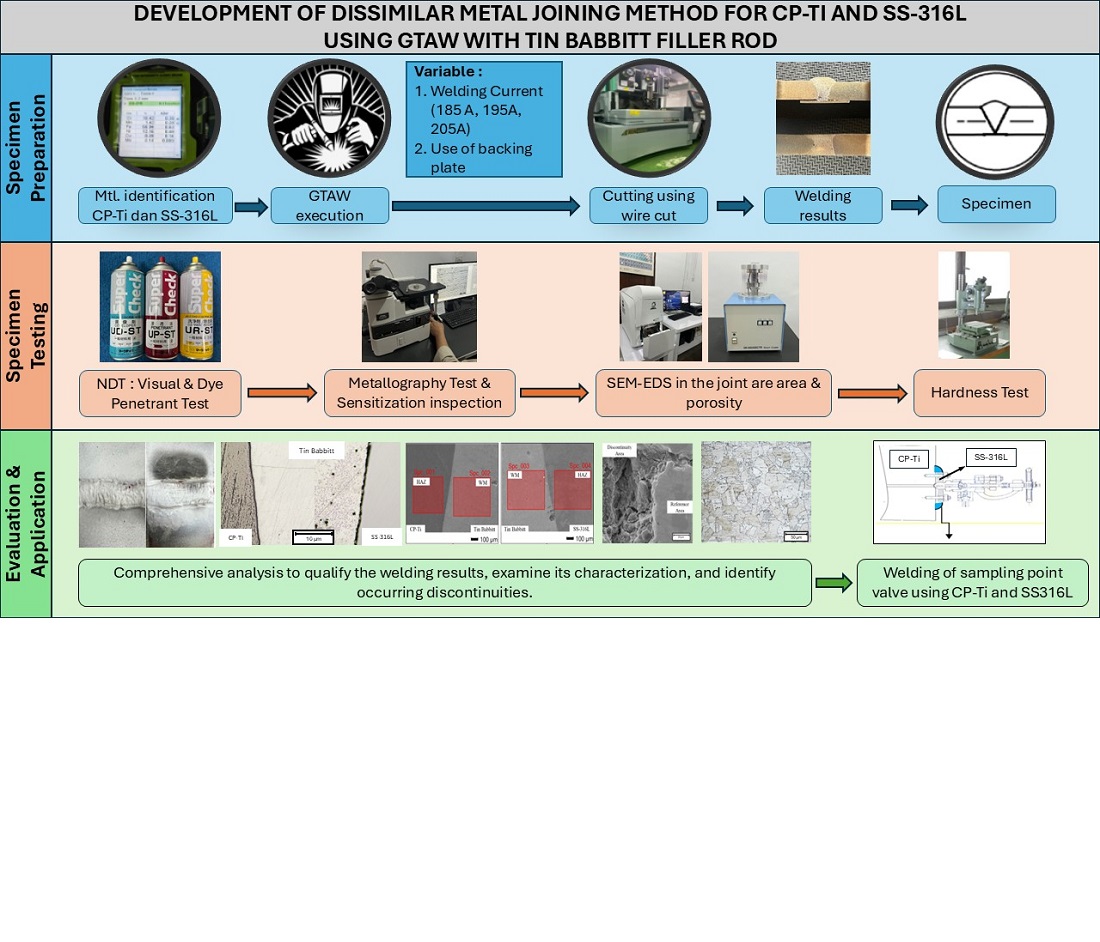
З’єднання різних металів між комерційним чистим титаном (CP-Ti) і нержавіючої сталлю 316L (SS-316L) створює проблеми через відмінності теплових властивостей і утворення крихких інтерметалічних сполук. Це дослідження вивчає зварюваність і характеристики з’єднання за різних зварювальних струмів (185 A, 195 A, 205 A) і умов підкладки. Основним завданням є забезпечення цілісності зварного шва при мінімізації інтерметалічних сполук і дефектів, які погіршують механічні властивості. Були проведені неруйнівний контроль, металографія, SEM-EDS, контроль твердості. Результати показують, що без опорної пластини твердість у зоні термічного впливу (ЗТВ) SS-316L збільшилася зі зварювальним струмом із 160,7 HV при 185 A до 167,5 HV при 205 A. У CP-Ti твердість підвищилася зі 148 HV при 185 A до 160,7 HV при 205 A. З опорною пластиною твердість SS-316L HAZ досягла піку при 185 A (182,7 HV), але знизилася до 167,5 HV при 205 A. Аналогічно, твердість CP-Ti була нижчою з підкладкою (154 HV при 205 A BP). Сенсибілізація в SS-316L була виявлена, але залишалася легкою. Олов'яний бабітовий наповнювальний стрижень пригнічує крихкі інтерметалічні сполуки Fe-Ti завдяки високій теплопровідності та низькій температурі плавлення, забезпечуючи кращий розподіл тепла. Це зменшило ризик розтріскування на лінії зварювання та покращило зчеплення. Проте пористість залишалася проблемою, особливо в з’єднаннях SS-316L, зростаючи при вищих струмах і потенційно призводячи до мікротріщин. Контроль параметрів зварювання та умов екранування був вирішальним для мінімізації пористості та підвищення якості з’єднання. Ці результати підтверджують, що оптимізація параметрів зварювання та контролю навколишнього середовища зменшує інтерметалічні сполуки та пористість, покращуючи можливість використання GTAW для зварювання на місці в таких сферах застосування, як теплообмінники, трубопроводи та резервуари під тиском
Посилання
- Acar, M. T., Kovacı, H., Çelik, A. (2022). Comparison of the structural properties, surface wettability and corrosion resistance of TiO2 nanotubes fabricated on Cp-Ti, Ti6Al4V and Ti45Nb. Materials Today Communications, 33, 104396. https://doi.org/10.1016/j.mtcomm.2022.104396
- Chen, T., Lu, H. Z., Lin, J. A., Cai, W. S., Zhu, D. Z., Yang, C. (2023). Tailoring microstructure and mechanical properties of CP-Ti through combined treatment of pressure and pulsed electric current. Journal of Materials Research and Technology, 25, 3496–3506. https://doi.org/10.1016/j.jmrt.2023.06.147
- Li, B., Wang, X., Min, Y., Liang, C., Li, H., Guo, L. et al. (2016). Corrosion resistance and mechanical properties of titanium with hierarchical micro-nanostructure. Materials Letters, 182, 43–46. https://doi.org/10.1016/j.matlet.2016.06.079
- Chao, Q., Thomas, S., Birbilis, N., Cizek, P., Hodgson, P. D., Fabijanic, D. (2021). The effect of post-processing heat treatment on the microstructure, residual stress and mechanical properties of selective laser melted 316L stainless steel. Materials Science and Engineering: A, 821, 141611. https://doi.org/10.1016/j.msea.2021.141611
- Kong, D., Dong, C., Ni, X., Zhang, L., Yao, J., Man, C. et al. (2019). Mechanical properties and corrosion behavior of selective laser melted 316L stainless steel after different heat treatment processes. Journal of Materials Science & Technology, 35 (7), 1499–1507. https://doi.org/10.1016/j.jmst.2019.03.003
- Gao, Y., Tsumura, T., Nakata, K. (2012). Dissimilar welding of Titanium Alloys to Steels. Transactions of JWRI, 41 (2). Available at: http://nakata-wjs.info/assets/pdf/jwri/078.pdf
- Tomashchuk, I., Sallamand, P., Belyavina, N., Pilloz, M. (2013). Evolution of microstructures and mechanical properties during dissimilar electron beam welding of titanium alloy to stainless steel via copper interlayer. Materials Science and Engineering: A, 585, 114–122. https://doi.org/10.1016/j.msea.2013.07.050
- Mannucci, A., Tomashchuk, I., Mathieu, A., Cicala, E., Boucheron, T., Bolot, R., Lafaye, S. (2018). Direct laser welding of pure titanium to austenitic stainless steel. Procedia CIRP, 74, 485–490. https://doi.org/10.1016/j.procir.2018.08.138
- Shanmugarajan, B., Padmanabham, G. (2012). Fusion welding studies using laser on Ti–SS dissimilar combination. Optics and Lasers in Engineering, 50 (11), 1621–1627. https://doi.org/10.1016/j.optlaseng.2012.05.008
- Ranjan Giri, S., Kumar Khamari, B., Ranjan Moharana, B. (2022). Joining of titanium and stainless steel by using different welding processes: A review. Materials Today: Proceedings, 66, 505–508. https://doi.org/10.1016/j.matpr.2022.05.590
- Yu, D., Zhang, Y., Hosseini, S. R. E., Zhou, J., Sun, D. (2023). Element diffusion and microstructure evolution at interface of stainless steel/Ti alloy joint by laser welding with AgCuTi filler metal. Journal of Materials Research and Technology, 24, 6463–6472. https://doi.org/10.1016/j.jmrt.2023.04.217
- Balasubramanian, M., Murali, S., Hemadri, C., Kumar, R. (2021). A new method of dissimilar friction welding of titanium to stainless steel. Materials Today: Proceedings, 46, 3644–3647. https://doi.org/10.1016/j.matpr.2021.01.675
- Hao, X., Dong, H., Yu, F., Li, P., Yang, Z. (2021). Arc welding of titanium alloy to stainless steel with Cu foil as interlayer and Ni-based alloy as filler metal. Journal of Materials Research and Technology, 13, 48–60. https://doi.org/10.1016/j.jmrt.2021.04.054
- Gupta, S. K., Patil, A. P., Rathod, R. C., Tandon, V., Gupta, A. (2023). Characterization of microstructure, mechanical and corrosion response in AISI 304L and Ti-stabilized 439 stainless steels weld joints. Journal of Manufacturing Processes, 101, 721–736. https://doi.org/10.1016/j.jmapro.2023.05.107
- Moazami Goudarzi, M., Jenabali Jahromi, S. A., Nazarboland, A. (2009). Investigation of characteristics of tin-based white metals as a bearing material. Materials & Design, 30 (6), 2283–2288. https://doi.org/10.1016/j.matdes.2008.07.056
- Alcover Junior, P. R. C., Pukasiewicz, A. G. M. (2019). Evaluation of microstructure, mechanical and tribological properties of a Babbitt alloy deposited by arc and flame spray processes. Tribology International, 131, 148–157. https://doi.org/10.1016/j.triboint.2018.10.027
- He, X., Li, G., Song, S., Hua, J. (2025). Effect of deposition current on microstructure and tribological properties of tin-based Babbitt alloy on magnesium alloy deposited by TIG process. Surface and Coatings Technology, 496, 131702. https://doi.org/10.1016/j.surfcoat.2024.131702
- Li, J., Schneiderman, B., Gilbert, S. M., Vivek, A., Yu, Z., Daehn, G. (2020). Process characteristics and interfacial microstructure in spot impact welding of titanium to stainless steel. Journal of Manufacturing Processes, 50, 421–429. https://doi.org/10.1016/j.jmapro.2019.12.036
- Chattopadhyay, A., Muvvala, G., Sarkar, S., Racherla, V., Nath, A. K. (2022). Mitigation of cracks in laser welding of titanium and stainless steel by in-situ nickel interlayer deposition. Journal of Materials Processing Technology, 300, 117403. https://doi.org/10.1016/j.jmatprotec.2021.117403
- Zhang, R., Buchanan, C., Matilainen, V.-P., Daskalaki-Mountanou, D., Britton, T. B., Piili, H. et al. (2021). Mechanical properties and microstructure of additively manufactured stainless steel with laser welded joints. Materials & Design, 208, 109921. https://doi.org/10.1016/j.matdes.2021.109921
- Taufiqurrahman, I., Lenggo Ginta, T., Mustapha, M. (2021). The effect of holding time on dissimilar resistance spot welding of stainless steel 316L and Ti6Al4V titanium alloy with aluminum interlayer. Materials Today: Proceedings, 46, 1563–1568. https://doi.org/10.1016/j.matpr.2020.07.237
- Bi, Y., Zhang, Y., Liu, K., Xu, Y., Xue, R. (2020). Two pass laser welding of 304 stainless to TC4 titanium alloy using monel 400/Nb bilayer. Journal of Materials Research and Technology, 9 (6), 16522–16528. https://doi.org/10.1016/j.jmrt.2020.11.060
- Jin, P., Sun, Q., Liu, Y., Li, J., Li, F., Liu, Y., Hou, S. (2020). Microstructural evolution and mechanical property of TC4/304 stainless steel joined by CMT using a CuSi3 filler wire. Journal of Manufacturing Processes, 60, 308–317. https://doi.org/10.1016/j.jmapro.2020.10.072
##submission.downloads##
Опубліковано
Як цитувати
Номер
Розділ
Ліцензія
Авторське право (c) 2025 Binar Ade Anugra, Raden Dadan Ramdan, Wahyudiono Wahyudiono

Ця робота ліцензується відповідно до Creative Commons Attribution 4.0 International License.
Закріплення та умови передачі авторських прав (ідентифікація авторства) здійснюється у Ліцензійному договорі. Зокрема, автори залишають за собою право на авторство свого рукопису та передають журналу право першої публікації цієї роботи на умовах ліцензії Creative Commons CC BY. При цьому вони мають право укладати самостійно додаткові угоди, що стосуються неексклюзивного поширення роботи у тому вигляді, в якому вона була опублікована цим журналом, але за умови збереження посилання на першу публікацію статті в цьому журналі.
Ліцензійний договір – це документ, в якому автор гарантує, що володіє усіма авторськими правами на твір (рукопис, статтю, тощо).
Автори, підписуючи Ліцензійний договір з ПП «ТЕХНОЛОГІЧНИЙ ЦЕНТР», мають усі права на подальше використання свого твору за умови посилання на наше видання, в якому твір опублікований. Відповідно до умов Ліцензійного договору, Видавець ПП «ТЕХНОЛОГІЧНИЙ ЦЕНТР» не забирає ваші авторські права та отримує від авторів дозвіл на використання та розповсюдження публікації через світові наукові ресурси (власні електронні ресурси, наукометричні бази даних, репозитарії, бібліотеки тощо).
За відсутності підписаного Ліцензійного договору або за відсутністю вказаних в цьому договорі ідентифікаторів, що дають змогу ідентифікувати особу автора, редакція не має права працювати з рукописом.
Важливо пам’ятати, що існує і інший тип угоди між авторами та видавцями – коли авторські права передаються від авторів до видавця. В такому разі автори втрачають права власності на свій твір та не можуть його використовувати в будь-який спосіб.