Розробка методу формування стійкого мобільного кластера туманного шару інтернету речей
DOI:
https://doi.org/10.15587/1729-4061.2025.322263Ключові слова:
Інтернет речей, кластеризація, мобільний пристрій, стійкість, надвисока щільність, хмарна інфраструктура, туманні обчисленняАнотація
Об’єктом дослідження є процес кластеризації туманного шару Інтернету речей (ІоТ) з високою і надвисокою щільністю.
Вирішувалась проблема підвищення стійкості мобільних компонент туманного шару за рахунок модифікації методу кластеризації.
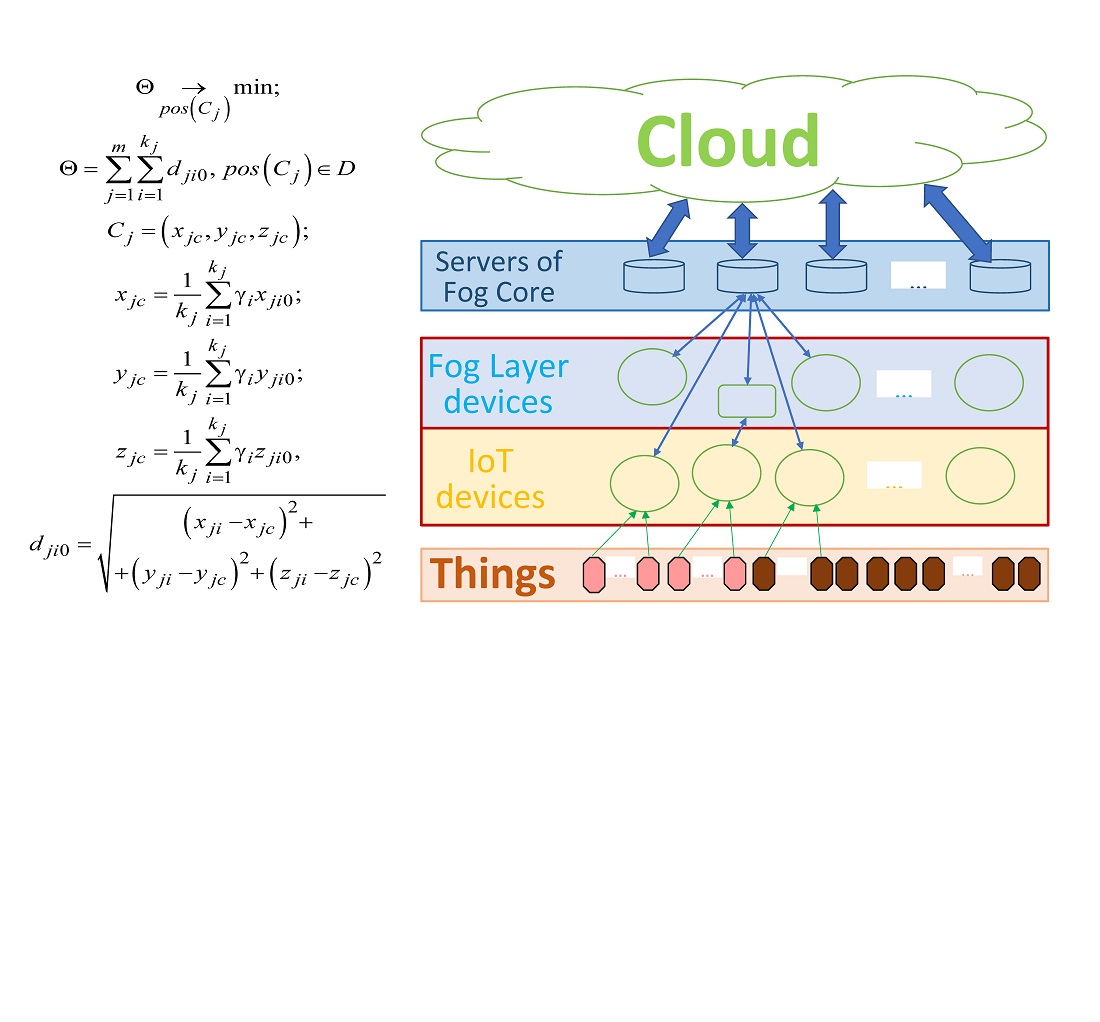
В процесі проведення досліджень розроблений підхід до формування архітектури мобільної компоненти туманного шару ІоТ. При розробці враховувались децентралізованість туманного шару та специфічні особливості мобільних пристроїв ІоТ. Це дозволило запропонувати чотирирівневу архітектуру, яка на відміну від стандартної містить окремі мобільні кластери на нижньому рівні туманних пристроїв.
Запропонована модель мобільного кластера туманного шару, яка враховує випадковість руху мобільних пристроїв ІоТ та базується на точковому процесі Томаса. На відміну від існуючих моделей вона враховує як просторові, так і стійкісні показники компонент мобільного кластера. Дана модель дозволила модифікувати стандартний алгоритм кластеризації FOREL. Модифікація проведена за рахунок введення вагових коефіцієнтів при знаходженні положення центру мобільного кластера. Запропонований метод підвищує стійкість мобільного кластера туманного шару ІоТ з високою і надвисокою щільністю. Дослідження запропонованого методу показали, що з підвищенням середнього відносного відхилення пристроїв ІоТ від запланованого руху стійкість структури мобільного кластера підвищується. Отримані результати дослідження можна пояснити наближенням центру мобільного кластера до найбільш нестійких його компонент. Запропонований метод можна використовувати при кластеризації туманного шару Інтернету речей з мобільними компонентами. Метод є ефективним при середньому відхиленні руху мобільних пристроїв ІоТ від запланованого руху не більшому, ніж 20 % радіусу кластера
Посилання
- Alsadie, D. (2024). Advancements in heuristic task scheduling for IoT applications in fog-cloud computing: challenges and prospects. PeerJ Computer Science, 10, e2128. https://doi.org/10.7717/peerj-cs.2128
- Pardo, C., Wei, R., Ivens, B. S. (2022). Integrating the business networks and internet of things perspectives: A system of systems (SoS) approach for industrial markets. Industrial Marketing Management, 104, 258–275. https://doi.org/10.1016/j.indmarman.2022.04.012
- Mani Kiran, Ch. V. N. S., Jagadeesh Babu, B., Singh, M. K. (2022). Study of Different Types of Smart Sensors for IoT Application Sensors. Proceedings of Second International Conference in Mechanical and Energy Technology, 101–107. https://doi.org/10.1007/978-981-19-0108-9_11
- Fatlawi, A., Al-Dujaili, M. J. (2023). Integrating the internet of things (IoT) and cloud computing challenges and solutions: A review. 4th International Scientific Conference of Alkafeel University (ISCKU 2022), 2977, 020067. https://doi.org/10.1063/5.0181842
- Hu, N. (2024). Internet of things edge data mining technology based on cloud computing model. International Journal of Innovative Computing, Information and Control, 20 (6), 1749–1763. Available at: http://www.ijicic.org/ijicic-200611.pdf
- Hunko, M., Tkachov, V., Kovalenko, A., Kuchuk, H. (2023). Advantages of Fog Computing: A Comparative Analysis with Cloud Computing for Enhanced Edge Computing Capabilities. 2023 IEEE 4th KhPI Week on Advanced Technology (KhPIWeek). https://doi.org/10.1109/khpiweek61412.2023.10312948
- Kuchuk, H., Malokhvii, E. (2024). Integration Of Iot With Cloud, Fog, And Edge Computing: A Review. Advanced Information Systems, 8 (2), 65–78. https://doi.org/10.20998/2522-9052.2024.2.08
- Singh, C., Khilari, S., Taware, R. (2024). Active Machine-to-Machine (M2M) and IoT Communication Architecture for Mobile Devices and Sensor Nodes. Artificial Intelligence in Internet of Things (IoT): Key Digital Trends, 25–38. https://doi.org/10.1007/978-981-97-5786-2_3
- Kuchuk, N., Ruban, I., Zakovorotnyi, O., Kovalenko, A., Shyshatskyi, A., Sheviakov, I. (2023). Traffic Modeling for the Industrial Internet of NanoThings. 2023 IEEE 4th KhPI Week on Advanced Technology (KhPIWeek), 1–5. https://doi.org/10.1109/khpiweek61412.2023.10312856
- Sobchuk, V., Pykhnivskyi, R., Barabash, O., Korotin, S., Omarov, S. (2024). Sequential intrusion detection system for zero-trust cyber defense of iot/iiot networks. Advanced Information Systems, 8 (3), 92–99. https://doi.org/10.20998/2522-9052.2024.3.11
- Ding, H., Ding, X., Xia, F., Zhou, F. (2023). An Efficient Method for Implementing Applications of Smart Devices Based on Mobile Fog Processing in a Secure Environment. International Journal of Advanced Computer Science and Applications, 14 (10). https://doi.org/10.14569/ijacsa.2023.0141011
- Qayyum, T., Trabelsi, Z., Waqar Malik, A., Hayawi, K. (2022). Mobility-aware hierarchical fog computing framework for Industrial Internet of Things (IIoT). Journal of Cloud Computing, 11 (1). https://doi.org/10.1186/s13677-022-00345-y
- Routray, K., Bera, P. (2024). Fog-Assisted Dynamic IoT Device Access Management Using Attribute-Based Encryption. Proceedings of the 25th International Conference on Distributed Computing and Networking, 346–352. https://doi.org/10.1145/3631461.3631466
- Saurabh, Dhanaraj, R. K. (2023). Enhance QoS with fog computing based on sigmoid NN clustering and entropy-based scheduling. Multimedia Tools and Applications, 83 (1), 305–326. https://doi.org/10.1007/s11042-023-15685-3
- Kuchuk, H., Mozhaiev, O., Kuchuk, N., Tiulieniev, S., Mozhaiev, M., Gnusov, Y. et al. (2024). Devising a method for the virtual clustering of the Internet of Things edge environment. Eastern-European Journal of Enterprise Technologies, 1 (9 (127)), 60–71. https://doi.org/10.15587/1729-4061.2024.298431
- Sharma, S., Saini, H. (2019). A novel four-tier architecture for delay aware scheduling and load balancing in fog environment. Sustainable Computing: Informatics and Systems, 24, 100355. https://doi.org/10.1016/j.suscom.2019.100355
- Li, G., Liu, Y., Wu, J., Lin, D., Zhao, S. (2019). Methods of Resource Scheduling Based on Optimized Fuzzy Clustering in Fog Computing. Sensors, 19 (9), 2122. https://doi.org/10.3390/s19092122
- Jamil, B., Shojafar, M., Ahmed, I., Ullah, A., Munir, K., Ijaz, H. (2019). A job scheduling algorithm for delay and performance optimization in fog computing. Concurrency and Computation: Practice and Experience, 32 (7). https://doi.org/10.1002/cpe.5581
- Kuchuk, H., Kalinin, Y., Dotsenko, N., Chumachenko, I., Pakhomov, Y. (2024). Decomposition of integrated high-density IoT data flow. Advanced Information Systems, 8 (3), 77–84. https://doi.org/10.20998/2522-9052.2024.3.09
- Proietti Mattia, G., Beraldi, R. (2023). P2PFaaS: A framework for FaaS peer-to-peer scheduling and load balancing in Fog and Edge computing. SoftwareX, 21, 101290. https://doi.org/10.1016/j.softx.2022.101290
- Lu, S., Wu, J., Wang, N., Duan, Y., Liu, H., Zhang, J., Fang, J. (2021). Resource provisioning in collaborative fog computing for multiple delay‐sensitive users. Software: Practice and Experience, 53 (2), 243–262. https://doi.org/10.1002/spe.3000
- Drabech, Z., Douimi, M., Zemmouri, E. (2024). A Markov random field model for change points detection. Journal of Computational Science, 83, 102429. https://doi.org/10.1016/j.jocs.2024.102429
- Zhu, Q., Hu, L., Wang, R. (2022). Image Clustering Algorithm Based on Predefined Evenly-Distributed Class Centroids and Composite Cosine Distance. Entropy, 24 (11), 1533. https://doi.org/10.3390/e24111533
- Laktionov, O., Yanko, A., Pedchenko, N. (2024). Identification of air targets using a hybrid clustering algorithm. Eastern-European Journal of Enterprise Technologies, 5 (4 (131)), 89–95. https://doi.org/10.15587/1729-4061.2024.314289
- Mutambik, I. (2024). An Entropy-Based Clustering Algorithm for Real-Time High-Dimensional IoT Data Streams. Sensors, 24 (22), 7412. https://doi.org/10.3390/s24227412
- Petrovska, I., Kuchuk, H., Kuchuk, N., Mozhaiev, O., Pochebut, M., Onishchenko, Y. (2023). Sequential Series-Based Prediction Model in Adaptive Cloud Resource Allocation for Data Processing and Security. 2023 13th International Conference on Dependable Systems, Services and Technologies (DESSERT), 1–6. https://doi.org/10.1109/dessert61349.2023.10416496
- Filosi, M., Visintainer, R., Riccadonna, S., Jurman, G., Furlanello, C. (2014). Stability Indicators in Network Reconstruction. PLoS ONE, 9 (2), e89815. https://doi.org/10.1371/journal.pone.0089815
- Petrovska, I., Kuchuk, H., Mozhaiev, M. (2022). Features of the distribution of computing resources in cloud systems. 2022 IEEE 3rd KhPI Week on Advanced Technology (KhPIWeek), 1–5. https://doi.org/10.1109/khpiweek57572.2022.9916459
- Kuchuk, N., Kashkevich, S., Radchenko, V., Andrusenko, Y., Kuchuk, H. (2024). Applying edge computing in the execution IoT operative transactions. Advanced Information Systems, 8 (4), 49–59. https://doi.org/10.20998/2522-9052.2024.4.07
- Thomas, P., Jose, D. V. (2023). Towards Computation Offloading Approaches in IoT-Fog-Cloud Environment: Survey on Concepts, Architectures, Tools and Methodologies. Third Congress on Intelligent Systems, 37–52. https://doi.org/10.1007/978-981-19-9379-4_4
- Petrovska, I., Kuchuk, H. (2023). Adaptive resource allocation method for data processing and security in cloud environment. Advanced Information Systems, 7 (3), 67–73. https://doi.org/10.20998/2522-9052.2023.3.10
- Emami Khansari, M., Sharifian, S. (2024). A scalable modified deep reinforcement learning algorithm for serverless IoT microservice composition infrastructure in fog layer. Future Generation Computer Systems, 153, 206–221. https://doi.org/10.1016/j.future.2023.11.022
##submission.downloads##
Опубліковано
Як цитувати
Номер
Розділ
Ліцензія
Авторське право (c) 2025 Heorhii Kuchuk, Oleksandr Mozhaiev, Serhii Tiulieniev, Mykhailo Mozhaiev, Nina Kuchuk, Liliia Tymoshchyk, Yurii Onishchenko, Volodymyr Tulupov, Tetiana Bykova, Viktoriia Roh

Ця робота ліцензується відповідно до Creative Commons Attribution 4.0 International License.
Закріплення та умови передачі авторських прав (ідентифікація авторства) здійснюється у Ліцензійному договорі. Зокрема, автори залишають за собою право на авторство свого рукопису та передають журналу право першої публікації цієї роботи на умовах ліцензії Creative Commons CC BY. При цьому вони мають право укладати самостійно додаткові угоди, що стосуються неексклюзивного поширення роботи у тому вигляді, в якому вона була опублікована цим журналом, але за умови збереження посилання на першу публікацію статті в цьому журналі.
Ліцензійний договір – це документ, в якому автор гарантує, що володіє усіма авторськими правами на твір (рукопис, статтю, тощо).
Автори, підписуючи Ліцензійний договір з ПП «ТЕХНОЛОГІЧНИЙ ЦЕНТР», мають усі права на подальше використання свого твору за умови посилання на наше видання, в якому твір опублікований. Відповідно до умов Ліцензійного договору, Видавець ПП «ТЕХНОЛОГІЧНИЙ ЦЕНТР» не забирає ваші авторські права та отримує від авторів дозвіл на використання та розповсюдження публікації через світові наукові ресурси (власні електронні ресурси, наукометричні бази даних, репозитарії, бібліотеки тощо).
За відсутності підписаного Ліцензійного договору або за відсутністю вказаних в цьому договорі ідентифікаторів, що дають змогу ідентифікувати особу автора, редакція не має права працювати з рукописом.
Важливо пам’ятати, що існує і інший тип угоди між авторами та видавцями – коли авторські права передаються від авторів до видавця. В такому разі автори втрачають права власності на свій твір та не можуть його використовувати в будь-який спосіб.