Розвиток трансформації продуктивності викладача через конструктивну взаємодію Pro Growth Constructive Interaction з багатовимірним підходом та математичними моделями на основі машинного навчання
DOI:
https://doi.org/10.15587/1729-4061.2025.322723Ключові слова:
оптимізація роботи викладача, математична модель, глибока нейронна мережа, точність, навчанняАнотація
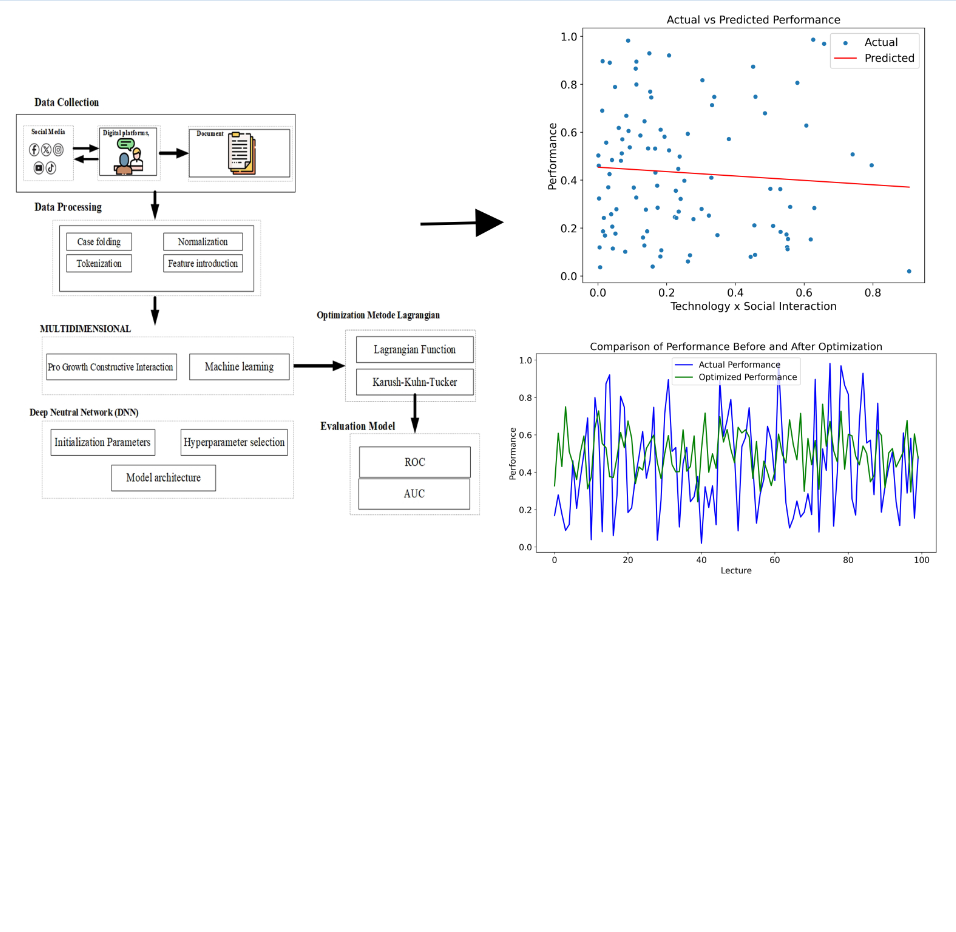
Об'єктом дослідження є зосередження на підході конструктивної взаємодії Pro Growth Constructive Interaction (PGCI) як стратегії покращення продуктивності викладача. PGCI об’єднує багатовимірні взаємодії, що включають академічні, соціальні, технологічні, індивідуальні, зовнішні та часові аспекти для досягнення оптимальної продуктивності та ефективності. У цьому дослідженні існує головна проблема, яку необхідно вирішити, а саме виявлення та оптимізація факторів, які впливають на продуктивність викладача, шляхом розробки комплексної моделі, яка здатна передбачити та покращити ефективність через багатовимірну взаємодію. Отримані результати дослідження полягали в тому, що найбільший внесок у продуктивність викладача показав розмірний внесок (0,177062), потім технологічний (0,174122), соціальний (0,167044), зовнішній (0,165670) та індивідуальний (0,163610) виміри. Отримання математичної моделі за допомогою методу Лагранжа, оптимізованого за допомогою алгоритму машинного навчання, розподілу ваг з акцентом на зовнішні розміри (0,2650) і технології (0,2179), призвело до підвищення продуктивності на 7,35 %. Ця модель здатна досягти точності 92,4 % у прогнозуванні продуктивності викладача за допомогою алгоритму глибокої нейронної мережі. Показано, що часові та технологічні аспекти відіграють важливу роль у визначенні продуктивності викладача. Завдяки пріоритетності цих двох вимірів оптимізована модель дає значні покращення. Характеристики, отримані в результаті дослідження, багатовимірний аналіз, що охоплює різні аспекти продуктивності, а також висока точність і вимірні покращення продуктивності підтверджують надійність моделі. Результати цього дослідження мають значне практичне застосування у вищих навчальних закладах
Посилання
- Weng, A. K.-W., Chang, H.-Y., Lai, K.-K., Lin, Y.-B. (2024). Topic Modeling on Peer Interaction in Online and Mobile Learning of Higher Education: 1993–2022. Education Sciences, 14 (8), 867. https://doi.org/10.3390/educsci14080867
- Chu, W., Liu, H., Fang, F. (2021). A Tale of Three Excellent Chinese EFL Teachers: Unpacking Teacher Professional Qualities for Their Sustainable Career Trajectories from an Ecological Perspective. Sustainability, 13 (12), 6721. https://doi.org/10.3390/su13126721
- Nam, P. S., Tuong, H. A., Weinhandl, R., Lavicza, Z. (2022). Mathematics Teachers’ Professional Competence Component Model and Practices in Teaching the Linear Functional Concept – An Experimental Study. Mathematics, 10 (21), 4007. https://doi.org/10.3390/math10214007
- Suh, J., Matson, K., Seshaiyer, P., Jamieson, S., Tate, H. (2021). Mathematical Modeling as a Catalyst for Equitable Mathematics Instruction: Preparing Teachers and Young Learners with 21st Century Skills. Mathematics, 9 (2), 162. https://doi.org/10.3390/math9020162
- Ponce-Jara, M. A., Ruiz, E., Gil, R., Sancristóbal, E., Pérez-Molina, C., Castro, M. (2017). Smart Grid: Assessment of the past and present in developed and developing countries. Energy Strategy Reviews, 18, 38–52. https://doi.org/10.1016/j.esr.2017.09.011
- Manzhos, S., Ihara, M. (2022). Advanced Machine Learning Methods for Learning from Sparse Data in High-Dimensional Spaces: A Perspective on Uses in the Upstream of Development of Novel Energy Technologies. Physchem, 2 (2), 72–95. https://doi.org/10.20944/preprints202203.0007.v1
- Mystakidis, S., Berki, E., Valtanen, J.-P. (2021). Deep and Meaningful E-Learning with Social Virtual Reality Environments in Higher Education: A Systematic Literature Review. Applied Sciences, 11 (5), 2412. https://doi.org/10.3390/app11052412
- Tang, J., Zhou, X., Wan, X., Daley, M., Bai, Z. (2022). ML4STEM Professional Development Program: Enriching K-12 STEM Teaching with Machine Learning. International Journal of Artificial Intelligence in Education, 33 (1), 185–224. https://doi.org/10.1007/s40593-022-00292-4
- Kyriakides, L., Creemers, B. P. M., Antoniou, P. (2009). Teacher behaviour and student outcomes: Suggestions for research on teacher training and professional development. Teaching and Teacher Education, 25 (1), 12–23. https://doi.org/10.1016/j.tate.2008.06.001
- Antoni, A., Arfah, M., Fachrizal, F., Nugroho, O. (2024). Developing a model of association rules with machine learning in determining user habits on social media. Eastern-European Journal of Enterprise Technologies, 3 (2 (129)), 55–61. https://doi.org/10.15587/1729-4061.2024.305116
- Rahmatika, A., Al-khowarizmi, A., Akrim, A., Nugroho, O., Anu, T. A. (2024). Using relational learning in exploring the effectiveness of using hashtags in future topics and user relations in X. Eastern-European Journal of Enterprise Technologies, 3 (2 (129)), 62–68. https://doi.org/10.15587/1729-4061.2024.306726
- Liu, H., Ding, J., Yang, L. T., Guo, Y., Wang, X., Deng, A. (2020). Multi-Dimensional Correlative Recommendation and Adaptive Clustering via Incremental Tensor Decomposition for Sustainable Smart Education. IEEE Transactions on Sustainable Computing, 5 (3), 389–402. https://doi.org/10.1109/tsusc.2019.2954456
- Yanes, N., Mostafa, A. M., Ezz, M., Almuayqil, S. N. (2020). A Machine Learning-Based Recommender System for Improving Students Learning Experiences. IEEE Access, 8, 201218–201235. https://doi.org/10.1109/access.2020.3036336
- Mahmud, M., Kaiser, M. S., Hussain, A., Vassanelli, S. (2018). Applications of Deep Learning and Reinforcement Learning to Biological Data. IEEE Transactions on Neural Networks and Learning Systems, 29 (6), 2063–2079. https://doi.org/10.1109/tnnls.2018.2790388
- Jdid, B., Hassan, K., Dayoub, I., Lim, W. H., Mokayef, M. (2021). Machine Learning Based Automatic Modulation Recognition for Wireless Communications: A Comprehensive Survey. IEEE Access, 9, 57851–57873. https://doi.org/10.1109/access.2021.3071801
- Kim, J. (2023). Leading teachers’ perspective on teacher-AI collaboration in education. Education and Information Technologies, 29 (7), 8693–8724. https://doi.org/10.1007/s10639-023-12109-5
- Wang, Z. A. (2024). Physical Education Teaching Quality Assessment Model Based on Gaussian Process Machine Learning Algorithm. International Journal of Maritime Engineering, 1 (1). https://doi.org/10.5750/ijme.v1i1.1399
- Phillips, P. A., Wright, C. (2009). E-business’s impact on organizational flexibility. Journal of Business Research, 62 (11), 1071–1080. https://doi.org/10.1016/j.jbusres.2008.09.014
- Arnold, V., Benford, T., Canada, J., Sutton, S. G. (2011). The role of strategic enterprise risk management and organizational flexibility in easing new regulatory compliance. International Journal of Accounting Information Systems, 12 (3), 171–188. https://doi.org/10.1016/j.accinf.2011.02.002
- Okorie, O., Subramoniam, R., Charnley, F., Patsavellas, J., Widdifield, D., Salonitis, K. (2020). Manufacturing in the Time of COVID-19: An Assessment of Barriers and Enablers. IEEE Engineering Management Review, 48 (3), 167–175. https://doi.org/10.1109/emr.2020.3012112
- Shukla, S. K., Sushil, Sharma, M. K. (2019). Managerial Paradox Toward Flexibility: Emergent Views Using Thematic Analysis of Literature. Global Journal of Flexible Systems Management, 20 (4), 349–370. https://doi.org/10.1007/s40171-019-00220-x
- Leelaluk, S., Minematsu, T., Taniguchi, Y., Okubo, F., Shimada, A. (2022). Predicting student performance based on Lecture Materials data using Neural Network Models. Proceedings of the 4th Workshop on Predicting Performance Based on the Analysis of Reading Behavior - DC in LAK22 co-located with 12th International Learning Analytics and Knowledge Conference (LAK22), 11–20. Available at: https://ceur-ws.org/Vol-3120/paper2.pdf
- Kang, W. (2021). Explaining Effects of Transformational Leadership on Teachers’ Cooperative Professional Development through Structural Equation Model and Phantom Model Approach. Sustainability, 13 (19), 10888. https://doi.org/10.3390/su131910888
- Goga, M., Kuyoro, S., Goga, N. (2015). A Recommender for Improving the Student Academic Performance. Procedia - Social and Behavioral Sciences, 180, 1481–1488. https://doi.org/10.1016/j.sbspro.2015.02.296
- Suyatmo, S., Ekohariadi, E., Wardhono, A. (2024). Identify Factors That Influence Hard Skill Competency and Soft Skill Competency Through the Quality of Teaching in Aviation Vocational Education. IJORER : International Journal of Recent Educational Research, 5 (3), 599–611. https://doi.org/10.46245/ijorer.v5i3.584
- Cao, B., Hassan, N. C., Omar, M. K. (2024). The Impact of Social Support on Burnout among Lecturers: A Systematic Literature Review. Behavioral Sciences, 14 (8), 727. https://doi.org/10.3390/bs14080727
##submission.downloads##
Опубліковано
Як цитувати
Номер
Розділ
Ліцензія
Авторське право (c) 2025 Julfansyah Margolang, Yeni Absah, Sirojuzilam Hasyim, Parapat Gultom

Ця робота ліцензується відповідно до Creative Commons Attribution 4.0 International License.
Закріплення та умови передачі авторських прав (ідентифікація авторства) здійснюється у Ліцензійному договорі. Зокрема, автори залишають за собою право на авторство свого рукопису та передають журналу право першої публікації цієї роботи на умовах ліцензії Creative Commons CC BY. При цьому вони мають право укладати самостійно додаткові угоди, що стосуються неексклюзивного поширення роботи у тому вигляді, в якому вона була опублікована цим журналом, але за умови збереження посилання на першу публікацію статті в цьому журналі.
Ліцензійний договір – це документ, в якому автор гарантує, що володіє усіма авторськими правами на твір (рукопис, статтю, тощо).
Автори, підписуючи Ліцензійний договір з ПП «ТЕХНОЛОГІЧНИЙ ЦЕНТР», мають усі права на подальше використання свого твору за умови посилання на наше видання, в якому твір опублікований. Відповідно до умов Ліцензійного договору, Видавець ПП «ТЕХНОЛОГІЧНИЙ ЦЕНТР» не забирає ваші авторські права та отримує від авторів дозвіл на використання та розповсюдження публікації через світові наукові ресурси (власні електронні ресурси, наукометричні бази даних, репозитарії, бібліотеки тощо).
За відсутності підписаного Ліцензійного договору або за відсутністю вказаних в цьому договорі ідентифікаторів, що дають змогу ідентифікувати особу автора, редакція не має права працювати з рукописом.
Важливо пам’ятати, що існує і інший тип угоди між авторами та видавцями – коли авторські права передаються від авторів до видавця. В такому разі автори втрачають права власності на свій твір та не можуть його використовувати в будь-який спосіб.