Development of passive cooling with perforated plates and real-time monitoring for pv efficiency improvement
DOI:
https://doi.org/10.15587/1729-4061.2025.327590Keywords:
passive cooling, perforated aluminum plate, real-time monitoring, solar energy efficiency, natural convection, thermal regulationAbstract
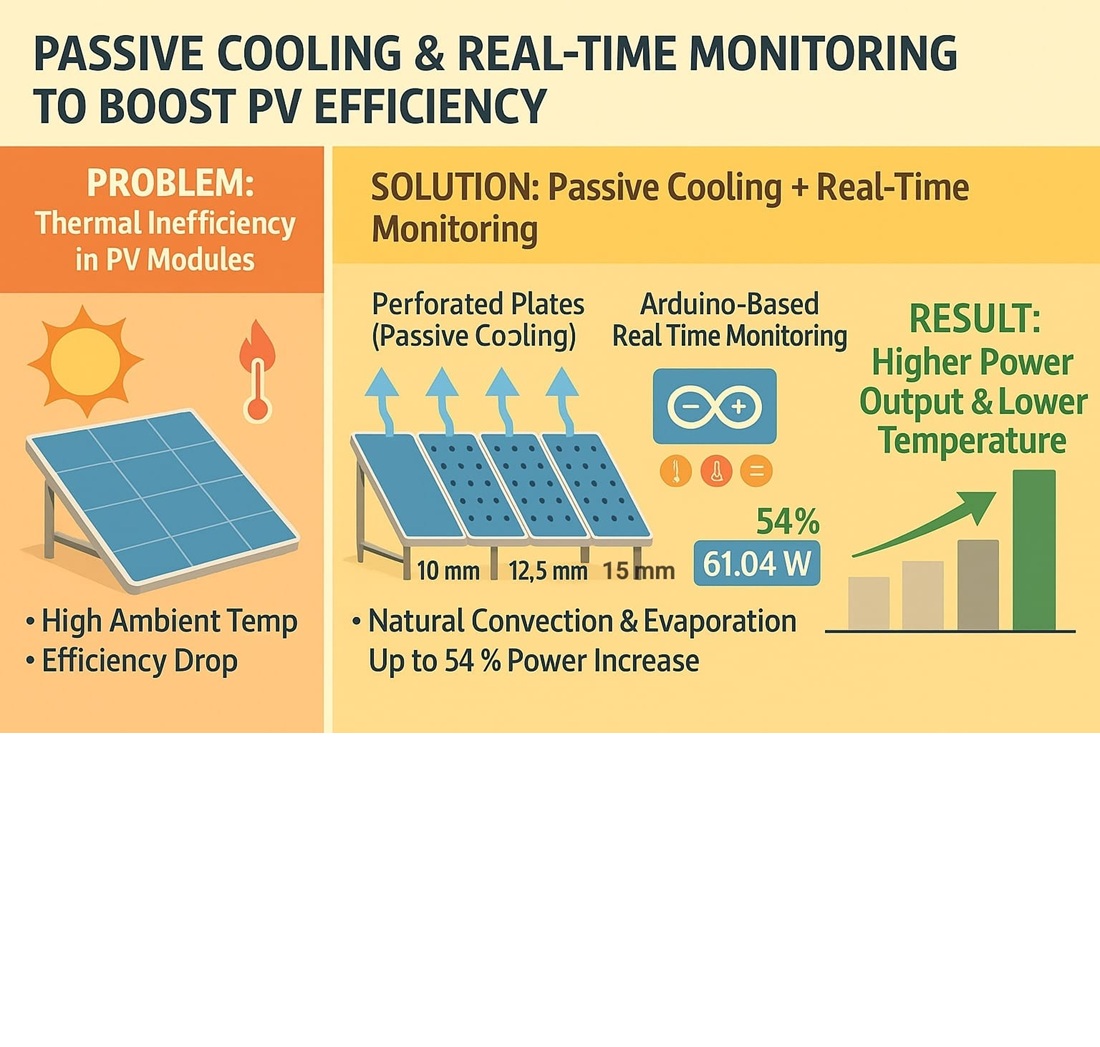
This study focuses on enhancing photovoltaic (PV) module performance through the development of a passive cooling method using perforated aluminum plates, supported by a real-time monitoring system. The core problem addressed is the thermal inefficiency of PV modules operating in hot, humid environments, where heat accumulation lowers energy output. A real-time data acquisition system was developed using Arduino to monitor voltage, current, surface temperature, humidity, and solar irradiance. Four identical polycrystalline PV modules were tested; three were equipped with aluminum plates of varying perforation diameters (10 mm, 12.5 mm, 15 mm), while one remained uncooled as a control. The results showed that the module with 15 mm perforations had the best performance, achieving a 61.04 W output under peak irradiance (1404 W/m2) and reducing surface temperature by nearly 10°C. These outcomes demonstrate that enhanced natural convection and evaporative effects, enabled by the larger perforations, significantly improved thermal regulation. The synchronized monitoring system validated the temperature-power relationship by capturing environmental dynamics in real time. Due to its energy independence, low cost, and simplicity, this integrated solution is particularly applicable in tropical regions or off-grid installations. The findings establish a practical basis for scalable deployment of passive cooling in PV systems, especially where active cooling is unfeasible
References
- Dambhare, M. V., Butey, B., Moharil, S. V. (2021). Solar photovoltaic technology: A review of different types of solar cells and its future trends. Journal of Physics: Conference Series, 1913 (1), 012053. https://doi.org/10.1088/1742-6596/1913/1/012053
- Qazi, A., Hussain, F., Rahim, N. ABD., Hardaker, G., Alghazzawi, D., Shaban, K., Haruna, K. (2019). Towards Sustainable Energy: A Systematic Review of Renewable Energy Sources, Technologies, and Public Opinions. IEEE Access, 7, 63837–63851. https://doi.org/10.1109/access.2019.2906402
- Shvedchykova, I., Trykhlieb, A., Trykhlieb, S., Demishonkova, S., Pavlenko, V. (2024). Determining the efficiency of restored photovoltaic modules under natural lighting conditions. Eastern-European Journal of Enterprise Technologies, 6 (8 (132)), 16–24. https://doi.org/10.15587/1729-4061.2024.317829
- Al-Bashir, A., Al-Dweri, M., Al-Ghandoor, A., Hammad, B., Al-Kouz, W. (2020). Analysis of effects of solar irradiance, cell temperature and wind speed on photovoltaic systems performance. International Journal of Energy Economics and Policy, 10 (1), 353–359. https://doi.org/10.32479/ijeep.8591
- Shaker, L. M., Al-Amiery, A. A., Hanoon, M. M., Al-Azzawi, W. K., Kadhum, A. A. H. (2024). Examining the influence of thermal effects on solar cells: a comprehensive review. Sustainable Energy Research, 11 (1). https://doi.org/10.1186/s40807-024-00100-8
- Bošnjaković, M., Stojkov, M., Katinić, M., Lacković, I. (2023). Effects of Extreme Weather Conditions on PV Systems. Sustainability, 15 (22), 16044. https://doi.org/10.3390/su152216044
- Yu, Z., Yang, H., Soin, N., Chen, L., Black, N., Xu, K., Sharma, P. K., Tsonos, C. et al. (2021). Bismuth oxyhalide based photo-enhanced triboelectric nanogenerators. Nano Energy, 89, 106419. https://doi.org/10.1016/j.nanoen.2021.106419
- Dwivedi, P., Sudhakar, K., Soni, A., Solomin, E., Kirpichnikova, I. (2020). Advanced cooling techniques of P.V. modules: A state of art. Case Studies in Thermal Engineering, 21, 100674. https://doi.org/10.1016/j.csite.2020.100674
- Sharaf, M., Yousef, M. S., Huzayyin, A. S. (2022). Review of cooling techniques used to enhance the efficiency of photovoltaic power systems. Environmental Science and Pollution Research, 29 (18), 26131–26159. https://doi.org/10.1007/s11356-022-18719-9
- Sheik, M. S., Kakati, P., Dandotiya, D., M, U. R., S, R. C. (2022). A comprehensive review on various cooling techniques to decrease an operating temperature of solar photovoltaic panels. Energy Nexus, 8, 100161. https://doi.org/10.1016/j.nexus.2022.100161
- Boubakr, G., Gu, F., Farhan, L., Ball, A. (2022). Enhancing Virtual Real-Time Monitoring of Photovoltaic Power Systems Based on the Internet of Things. Electronics, 11 (15), 2469. https://doi.org/10.3390/electronics11152469
- Muhanji, S. O., Barrows, C., Macknick, J., Farid, A. M. (2021). An enterprise control assessment case study of the energy–water nexus for the ISO New England system. Renewable and Sustainable Energy Reviews, 141, 110766. https://doi.org/10.1016/j.rser.2021.110766
- Srithar, K., Akash, K., Nambi, R., Vivar, M., Saravanan, R. (2023). Enhancing photovoltaic efficiency through evaporative cooling and a solar still. Solar Energy, 265, 112134. https://doi.org/10.1016/j.solener.2023.112134
- Alktranee, M., Bencs, P. (2023). Experimental comparative study on using different cooling techniques with photovoltaic modules. Journal of Thermal Analysis and Calorimetry, 148 (9), 3805–3817. https://doi.org/10.1007/s10973-022-11940-1
- Elbreki, A. M., Muftah, A. F., Sopian, K., Jarimi, H., Fazlizan, A., Ibrahim, A. (2021). Experimental and economic analysis of passive cooling PV module using fins and planar reflector. Case Studies in Thermal Engineering, 23, 100801. https://doi.org/10.1016/j.csite.2020.100801
- Bashir, M. A., Ali, H. M., Khalil, S., Ali, M., Siddiqui, A. M. (2014). Comparison of Performance Measurements of Photovoltaic Modules during Winter Months in Taxila, Pakistan. International Journal of Photoenergy, 2014, 1–8. https://doi.org/10.1155/2014/898414
- Cengiz, M., Kayri, İ., Aydın, H. (2024). A collated overview on the evaporative cooling applications for photovoltaic modules. Renewable and Sustainable Energy Reviews, 197, 114393. https://doi.org/10.1016/j.rser.2024.114393
- Sofijan, A., Nawawi, Z., Suprapto, B. Y., Bizzy, I., Sipahutar, R. (2020). Passive cooling using perforated aluminum plate to improve efficiency on monocrystalline of 100 Wp photovoltaic. IOP Conference Series: Materials Science and Engineering, 909 (1), 012006. https://doi.org/10.1088/1757-899x/909/1/012006
- Alktranee, M., Bencs, P. (2022). Effect of Evaporative Cooling on Photovoltaic Module Performance. Process Integration and Optimization for Sustainability, 6 (4), 921–930. https://doi.org/10.1007/s41660-022-00268-w
- Ali, H., Mahmood, M., Bashir, M., Ali, M., Siddiqui, A. (2016). Outdoor testing of photovoltaic modules during summer in Taxila, Pakistan. Thermal Science, 20 (1), 165–173. https://doi.org/10.2298/tsci131216025a
- Sakinah, A., Bandri, S., Nur Putra, A. M., Anthony, Z., Warmi, Y. (2024). Monitoring System for Solar Panel Characteristics Using the Internet of Things (IoT). The Southeast Asian Journal of Advance Engineering and Technology Original Research, 1 (2), 64–70.
- Vijay, K. S., Sasane, S., Bajare, M., Deshmukh, R. (2024). Real Time Monitoring of Temperature And Humidity Using LabVIEW and ML. International Journal for Research in Applied Science and Engineering Technology, 12 (5), 4701–4710. https://doi.org/10.22214/ijraset.2024.62675
- Akhtar, M. U., Iqbal, M. T. (2024). Development and Evaluation of an Arduino-Based Data Logging System Integrated with Microsoft Excel for Monitoring On-Grid Photovoltaic Systems. European Journal of Electrical Engineering and Computer Science, 8 (3), 29–37. https://doi.org/10.24018/ejece.2024.8.3.622
- Abdullah, M. H., Ghani, S. A. C., Zaulkafilai, Z., Tajuddin, S. N. (2017). Development open source microcontroller based temperature data logger. IOP Conference Series: Materials Science and Engineering, 257, 012015. https://doi.org/10.1088/1757-899x/257/1/012015
- Zhao, Y., Wang, S., Ge, M., Li, Y., Yang, Y. (2018). Energy and exergy analysis of thermoelectric generator system with humidified flue gas. Energy Conversion and Management, 156, 140–149. https://doi.org/10.1016/j.enconman.2017.10.094
- Peng, L., Mai, J., Hu, P., Lai, X., Lin, Z. (2011). Optimum design of the slotted-interdigitated channels flow field for proton exchange membrane fuel cells with consideration of the gas diffusion layer intrusion. Renewable Energy, 36 (5), 1413–1420. https://doi.org/10.1016/j.renene.2010.11.031
- Wang, L., Lin, X., Chai, L., Peng, L., Yu, D., Chen, H. (2019). Cyclic transient behavior of the Joule–Brayton based pumped heat electricity storage: Modeling and analysis. Renewable and Sustainable Energy Reviews, 111, 523–534. https://doi.org/10.1016/j.rser.2019.03.056
- Zaretsky, E. B., Kanel, G. I., Kalabukhov, S. (2020). Shock compression of paraffin–poly-methylmethacrylate (PMMA) mixture. Journal of Applied Physics, 127 (24). https://doi.org/10.1063/5.0013020
- Hand, B., & Cashman, A. (2020). A review on the historical development of the lift-type vertical axis wind turbine: From onshore to offshore floating application. Sustainable Energy Technologies and Assessments, 38, 100646. https://doi.org/10.1016/j.seta.2020.100646
- Kumar, S., Upadhyay, R., Pradhan, B. (2020). Performance enhancement of heterojunction ZnO/PbS quantum dot solar cells by interface engineering. Solar Energy, 211, 283–290. https://doi.org/10.1016/j.solener.2020.09.063
- Pilarczyk, M., Węglowski, B. (2019). Determination and validation of transient temperature fields within a cylindrical element using the inverse heat conduction method. Applied Thermal Engineering, 150, 1224–1232. https://doi.org/10.1016/j.applthermaleng.2019.01.079
- Radia, M. A. A., Nimr, M. K. E., Atlam, A. S. (2023). IoT-based wireless data acquisition and control system for photovoltaic module performance analysis. E-Prime - Advances in Electrical Engineering, Electronics and Energy, 6, 100348. https://doi.org/10.1016/j.prime.2023.100348
- Samadianfard, S., Hashemi, S., Kargar, K., Izadyar, M., Mostafaeipour, A., Mosavi, A. et al. (2020). Wind speed prediction using a hybrid model of the multi-layer perceptron and whale optimization algorithm. Energy Reports, 6, 1147–1159. https://doi.org/10.1016/j.egyr.2020.05.001
- Dixit, S., Arora, R., Kumar, K., Bansal, S., Vatin, N., Araszkiewicz, K., Epifantsev, K. (2022). Replacing E-waste with coarse aggregate in architectural engineering and construction industry. Materials Today: Proceedings, 56, 2353–2358. https://doi.org/10.1016/j.matpr.2021.12.154
- Gultom, E., Muzhoffar, D. A. F., Budiyanto, M. A., Riadi, A., Rivai, A. (2025). Real-time prediction of higher heating value of coal in coal-fired power plants using operating parameters. Eastern-European Journal of Enterprise Technologies, 1 (8 (133)), 68–78. https://doi.org/10.15587/1729-4061.2025.320573
- Sofijan, A. (2022). Experimental Analysis of ACP on Photovoltaics as Free Convection for Increasing Output Power. Przegląd Elektrotechniczny, 1 (5), 123–127. https://doi.org/10.15199/48.2022.05.22
- Sofijan, A., Nawawi, Z., Yudho Suprapto, B., Sipahutar, R., Bizzy, I. (2020). Performance Evaluation Solar Charge Controller on Solar Power System Home-Based SPV Amorphous 80 Watt-peak. Journal of Physics: Conference Series, 1500 (1), 012004. https://doi.org/10.1088/1742-6596/1500/1/012004
- Adipradana, W., Sofijan, A., Rahmawati, Bizzy, I., Sipahutar, R., Fajri, M. A. (2021). Datalogger Experimental Analysis Based on Arduino Mega 2560 on a 100 Wp Monocrystalline Solar Panel Using Perforated Plate. Proceedings of the 4th Forum in Research, Science, and Technology (FIRST-T1-T2-2020). https://doi.org/10.2991/ahe.k.210205.033
Downloads
Published
How to Cite
Issue
Section
License
Copyright (c) 2025 Armin Sofijan, Riman Sipahutar, Wirawan Adi Pradana, Baginda Oloan Siregar, Irwin Bizzy, Siti Sailah, Feby Ardianto, Surya Darma, Ananda Putri Kamila, Vina Alya Dhafia

This work is licensed under a Creative Commons Attribution 4.0 International License.
The consolidation and conditions for the transfer of copyright (identification of authorship) is carried out in the License Agreement. In particular, the authors reserve the right to the authorship of their manuscript and transfer the first publication of this work to the journal under the terms of the Creative Commons CC BY license. At the same time, they have the right to conclude on their own additional agreements concerning the non-exclusive distribution of the work in the form in which it was published by this journal, but provided that the link to the first publication of the article in this journal is preserved.
A license agreement is a document in which the author warrants that he/she owns all copyright for the work (manuscript, article, etc.).
The authors, signing the License Agreement with TECHNOLOGY CENTER PC, have all rights to the further use of their work, provided that they link to our edition in which the work was published.
According to the terms of the License Agreement, the Publisher TECHNOLOGY CENTER PC does not take away your copyrights and receives permission from the authors to use and dissemination of the publication through the world's scientific resources (own electronic resources, scientometric databases, repositories, libraries, etc.).
In the absence of a signed License Agreement or in the absence of this agreement of identifiers allowing to identify the identity of the author, the editors have no right to work with the manuscript.
It is important to remember that there is another type of agreement between authors and publishers – when copyright is transferred from the authors to the publisher. In this case, the authors lose ownership of their work and may not use it in any way.







