Побудова моделі сталої інноваційної екосистеми університету: механізми інтеграції та комерціалізації
DOI:
https://doi.org/10.15587/1729-4061.2025.336530Ключові слова:
інноваційна екосистема, архітектура моделі, університет, сталий розвиток, стартап, комерціалізація, структурна інтеграція, інноваційна інфраструктураАнотація
Об’єктом дослідження є інноваційна екосистема університету як організаційно-структурне утворення, орієнтоване на підтримку стартапів та інноваційної діяльності.
Проблема, що вирішувалася: фрагментарність та неузгодженість взаємодії між інноваційними підрозділами університетів, що ускладнює комерціалізацію наукових розробок і знижує ефективність інноваційного розвитку.
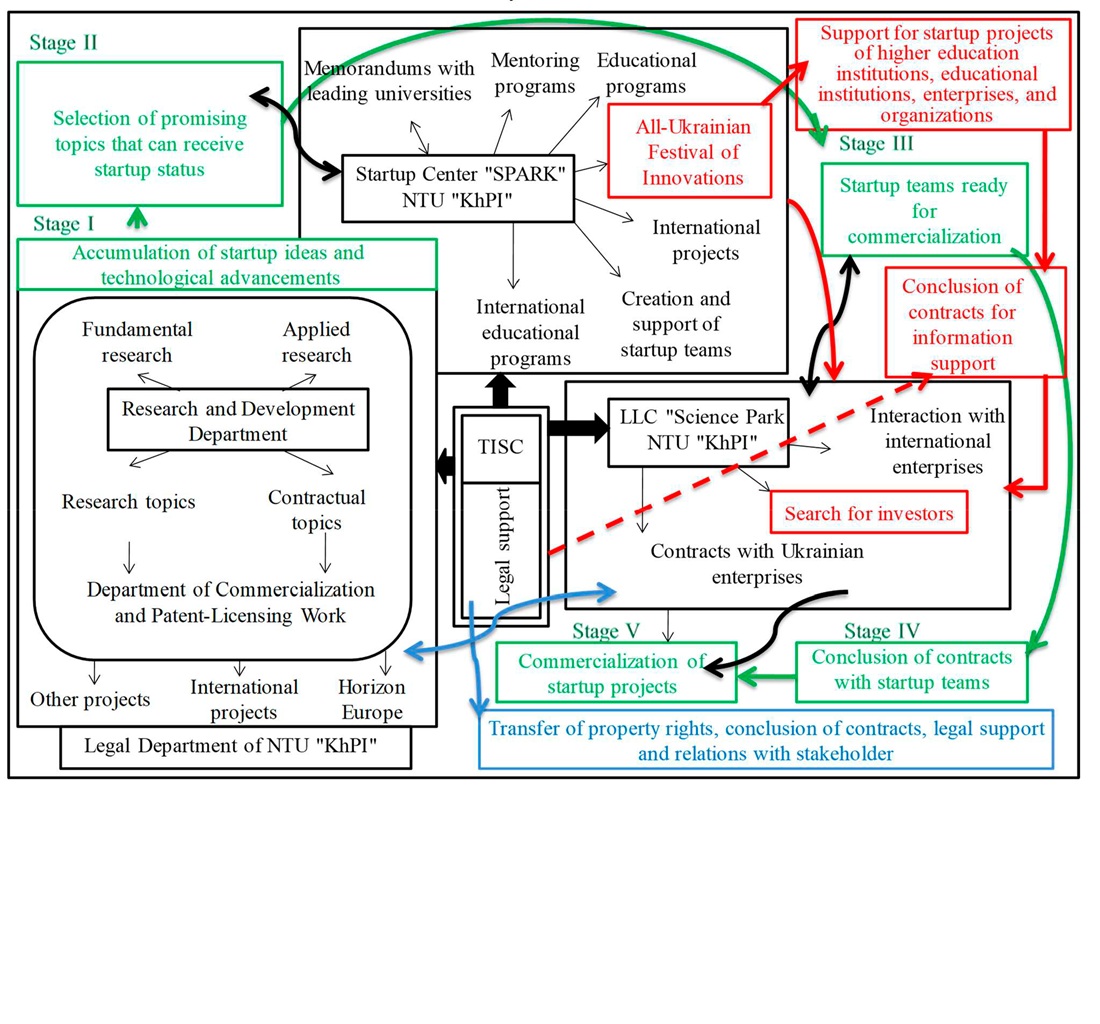
Розроблено модель сталої інноваційної екосистеми університету, яка включає три цикли взаємодії між інфраструктурними елементами. Запропонована модель дає змогу системно організувати процес відбору, супроводу та комерціалізації стартап-проєктів із залученням внутрішніх і зовнішніх інноваційних потоків. Важливою складовою моделі є юридичний супровід стартапів на всіх етапах і механізм повторного входження проєктів до системи для вдосконалення та підвищення їхньої ринкової готовності. Модель враховує глобальні цілі сталого розвитку (ЦСР 4, 9, 17), що посилює її стратегічну орієнтацію.
Запропоновано та апробовано трициклову модель сталої інноваційної екосистеми університету, яка забезпечує інтеграцію інноваційних підрозділів та сприяє ефективній комерціалізації стартапів. Особливість моделі полягає у її структурованості, циклічному характері, чіткому розмежуванні ролей інноваційних підрозділів і вбудованому юридичному механізмі, що забезпечує сталість розвитку та вирішує проблему роз’єднаності.
Модель придатна для впровадження в університетах, які мають базову інфраструктуру інноваційної діяльності та потребують підвищення ефективності комерціалізації розробок
Посилання
- Zakon Ukrainy «Pro naukovu i naukovo-tekhnichnu diyalnist» 26 lystopada 2015 r. No. 848-VIII. Available at: https://zakon.rada.gov.ua/laws/show/848-19#Text
- Bittencourt, B. A., Zen, A. C., Gazaro Dos Santos, D. A. (2020). Orchestrating university innovation ecosystem: the case of a Brazilian university. Revue Internationale d’Intelligence Économique. Available at: https://hal.science/hal-02865709
- Ozols, A., Sarkane, E. G., Avotins, V. (2024). Innovation ecosystem university model as a new generation 5.0 model. XXXV ISPIM Innovation Conference «Local Innovation Ecosystems for Global Impact». Tallinn. Available at: https://www.researchgate.net/publication/381482698_Innovation_ecosystem_university_model_as_a_new_generation_50_model
- Pedchenko, N., Nestulya, Y., Kudatskyi, O., Pedchenko, M. (2023). Innovative ecosystem of recovery of the national economy of Ukraine: theoretical aspect. Scientific Bulletin of Poltava University of Economics and Trade. A Series of “Economic Sciences”, 4 (110), 56–60. https://doi.org/10.37734/2409-6873-2023-4-8
- Audretsch, D. B., Belitski, M. (2016). Entrepreneurial ecosystems in cities: establishing the framework conditions. The Journal of Technology Transfer, 42 (5), 1030–1051. https://doi.org/10.1007/s10961-016-9473-8
- Podolchak, N., Karkovska, V., Levytska, Y. (2021). Ecosystems for startup development as a principle for implementing state innovation policy. Investytsiyi: Praktyka Ta Dosvid, 8, 82. https://doi.org/10.32702/2306-6814.2021.8.82
- Carayannis, E. G., Campbell, D. F. J. (2011). Mode 3 Knowledge Production in Quadruple Helix Innovation Systems. Mode 3 Knowledge Production in Quadruple Helix Innovation Systems, 1–63. https://doi.org/10.1007/978-1-4614-2062-0_1
- Piqué, J. M., Berbegal-Mirabent, J., Etzkowitz, H. (2020). The Role of Universities in Shaping the Evolution of Silicon Valley’s Ecosystem of Innovation. Triple Helix Journal, 1–45. https://doi.org/10.1163/21971927-bja10009
- Dedehayir, O., Mäkinen, S. J., Roland Ortt, J. (2018). Roles during innovation ecosystem genesis: A literature review. Technological Forecasting and Social Change, 136, 18–29. https://doi.org/10.1016/j.techfore.2016.11.028
- Sytnyk, N. I. (2017). The Ecosystem of Startups as a Component of the Innovation Ecosystem. Business Inform, 8, 89–94. Available at: http://jnas.nbuv.gov.ua/article/UJRN-0000798113
- Khaustov, M. M. (2023). Startapy: Stvorennia ta masshtabuvannia. Kharkiv: FOP Liburkina L. M., 224. Available at: https://ndc-ipr.org/media/publications/files/Mono_Startups_aWK106u.pdf
- Mironova, N., Koptieva, H., Liganenko, I., Sakun, A., Chernyak, D. (2022). Modeling the Selection of Innovative Strategy for Development of Industrial Enterprises. Wseas Transactions On Business And Economics, 19, 278–291. https://doi.org/10.37394/23207.2022.19.26
- Antoniuk, D., Antoniuk, K. (2023). Comparative analysis of startup ecosystems in the development models of Eastern European countries: experience for the post-war reconstruction of Ukraine. Management and Entrepreneurship: Trends of Development, 2 (24), 59–69. https://doi.org/10.26661/2522-1566/2023-2/24-06
- Global Startup Ecosystem Index 2023. Available at: https://www.startupblink.com/reports?filter=all
- Global Startup Ecosystem Index 2022. Available at: https://www.startupblink.com/reports?filter=all
- Krasnokutska, N., Koptieva, H., Cirella, G. T., Kruhlova, O. (2024). Examining the Link Between Corporate Sustainability and Financial Performance: An Empirical Study with Implications for Post-Conflict Ukraine. Handbook on Post-War Reconstruction and Development Economics of Ukraine, 177–194. https://doi.org/10.1007/978-3-031-48735-4_11
- Oh, D.-S., Phillips, F., Park, S., Lee, E. (2016). Innovation ecosystems: A critical examination. Technovation, 54, 1–6. https://doi.org/10.1016/j.technovation.2016.02.004
- Informatsiynyi portal Natsionalnoho universytetu «Lvivska politekhnika». Available at: https://tsus.lpnu.ua/
- Innovatsiyna ekosystema Sikorsky Challenge. Available at: https://kpi.ua/ecoino
- Beketov Startup School. Available at: https://bs.kname.edu.ua/
- Stanford Research Park. Available at: https://stanfordresearchpark.com/
- Aalto Startup Center is ranked among world's three best university business accelerators. Available at: https://www.enterespoo.fi/news/aalto-startup-center-ranked-among-worlds-three-best-university-business-accelerators
- SETsquared. Available at: https://www.setsquared.co.uk/
- Naukovo-doslidna chastyna NTU «KhPI». Available at: https://ndch.kpi.kharkov.ua/
- Inclusivity in Spark. Startap-tsentr «SPARK» NTU «KhPI». Available at: https://web.kpi.kharkov.ua/spark/en/inclusivity-in-spark/
- TOV “Naukovyi Park NTU «KhPI». Available at: https://ndch.kpi.kharkov.ua/naukovij-park/
- Stratehiya rozvytku Kharkivskoi oblasti na 2021 – 2027 roky. Available at: https://kharkivoda.gov.ua/oblasna-derzhavna-administratsiya/struktura-administratsiyi/strukturni-pidrozdili/717/102538
- Naukovtsi KhPI predstavyly masshtabnyi proiekt dlia vidbudovy Kharkova. Available at: https://www.kpi.kharkov.ua/ukr/2023/09/27/naukovtsi-hpi-prezentuvaly-masshtabnyj-proyekt-dlya-vidbudovy-harkova/
##submission.downloads##
Опубліковано
Як цитувати
Номер
Розділ
Ліцензія
Авторське право (c) 2025 Yevgen Sokol, Andrii Marchenko, Ruslan Kryvobok, Hanna Koptieva, Nataliia Shmatko

Ця робота ліцензується відповідно до Creative Commons Attribution 4.0 International License.
Закріплення та умови передачі авторських прав (ідентифікація авторства) здійснюється у Ліцензійному договорі. Зокрема, автори залишають за собою право на авторство свого рукопису та передають журналу право першої публікації цієї роботи на умовах ліцензії Creative Commons CC BY. При цьому вони мають право укладати самостійно додаткові угоди, що стосуються неексклюзивного поширення роботи у тому вигляді, в якому вона була опублікована цим журналом, але за умови збереження посилання на першу публікацію статті в цьому журналі.
Ліцензійний договір – це документ, в якому автор гарантує, що володіє усіма авторськими правами на твір (рукопис, статтю, тощо).
Автори, підписуючи Ліцензійний договір з ПП «ТЕХНОЛОГІЧНИЙ ЦЕНТР», мають усі права на подальше використання свого твору за умови посилання на наше видання, в якому твір опублікований. Відповідно до умов Ліцензійного договору, Видавець ПП «ТЕХНОЛОГІЧНИЙ ЦЕНТР» не забирає ваші авторські права та отримує від авторів дозвіл на використання та розповсюдження публікації через світові наукові ресурси (власні електронні ресурси, наукометричні бази даних, репозитарії, бібліотеки тощо).
За відсутності підписаного Ліцензійного договору або за відсутністю вказаних в цьому договорі ідентифікаторів, що дають змогу ідентифікувати особу автора, редакція не має права працювати з рукописом.
Важливо пам’ятати, що існує і інший тип угоди між авторами та видавцями – коли авторські права передаються від авторів до видавця. В такому разі автори втрачають права власності на свій твір та не можуть його використовувати в будь-який спосіб.