Identifying the industry-specific quantitative indicators for cloud migration strategy outcomes
DOI:
https://doi.org/10.15587/1729-4061.2025.337851Keywords:
imputation, information systems, quantitative analysis, classification, strategic planning, cloud migrationAbstract
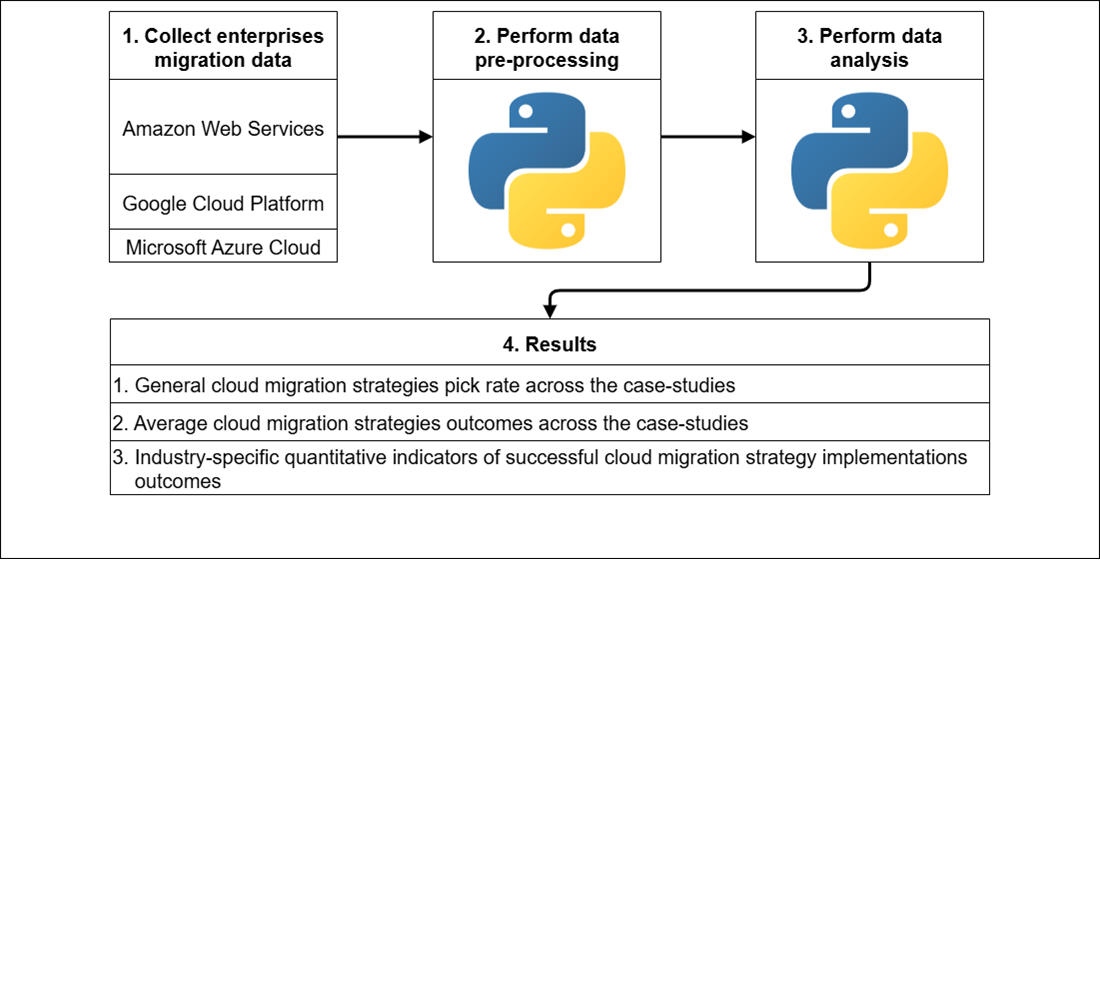
This study’s object is the cloud migration process of information systems (ISs). This paper aims to resolve the task of devising a quantitatively grounded classification of migration strategies while previous approaches relied on conceptual models without empirical validation of industry‐specific performance metrics.
Unlike existing categorizations, the proposed approach employs empirical data from 275 successful cloud migration cases, considering cost reduction, performance improvement, migration duration, as well as the number of cloud services used. Missing values are handled by multiple imputations via chained equations (MICE); outliers were removed using the interquartile range criterion, thereby enhancing result reliability. A taxonomy of three strategies – Lift-and-Shift, Re-platforming, and Reengineering – was established.
Quantitative results indicate that Lift-and-Shift was applied in 39.64% of cases with an average cycle of 5.94 months and cost reduction of 40.06%; Re-platforming in 38.55% of cases with 6.10 months and 38.12% cost savings; Reengineering in 21.82% with 6.28 months, 42% cost savings, and 141.66% performance gain. Further analysis revealed an industry dependence in strategy selection: Lift-and-Shift predominated in regulated sectors, whereas Re-platforming and Reengineering were preferred in high tech industries.
The findings could underpin automated decision support systems for planning cloud migration of IS at medium and large enterprises. The quantitative models enable forecasting of temporal and financial indicators based on system scale, technological landscape, and regulatory requirements. Implementation requires acquisition of performance and cost metrics and integration of MICE and outlier detection into pre-migration audits
References
- Mittal, M. (2024). The Great Migration: Understanding the Cloud Revolution in IT. International Journal of Scientific Research in Computer Science, Engineering and Information Technology, 10 (6), 2222–2228. https://doi.org/10.32628/cseit2410612423
- Amin, R., Vadlamudi, S. (2021). Opportunities and Challenges of Data Migration in Cloud. Engineering International, 9 (1), 41–50. https://doi.org/10.18034/ei.v9i1.529
- Indukuri, A. V. (2025). AI-Powered Cloud Migration: Transforming Enterprise Modernization Strategies. Journal of Computer Science and Technology Studies, 7 (2), 567–575. https://doi.org/10.32996/jcsts.2025.7.2.60
- Sharma, B. P. (2025). Optimizing Cloud Migration Strategies for Large-Scale Enterprises: A Comparative Analysis of Lift-and-Shift, Replatforming, and Refactoring Approaches. Advances in Theoretical Computation, Algorithmic Foundations, and Emerging Paradigms, 15 (2), 1–14. Available at: https://heilarchive.com/index.php/ATCAEP/article/view/2025-FEB-04
- Hosseini Shirvani, M., Amin, G. R., Babaeikiadehi, S. (2022). A decision framework for cloud migration: A hybrid approach. IET Software, 16 (6), 603–629. https://doi.org/10.1049/sfw2.12072
- Aslam, M., Rahim, L. bin A., Watada, J., Hashmani, M. (2018). Clustering-Based Cloud Migration Strategies. Journal of Advanced Computational Intelligence and Intelligent Informatics, 22 (3), 295–305. https://doi.org/10.20965/jaciii.2018.p0295
- Chanthati, S. R. (2024). Artificial Intelligence-Based Cloud Planning and Migration to Cut the Cost of Cloud Sasibhushan Rao Chanthati. American Journal of Smart Technology and Solutions, 3 (2), 13–24. https://doi.org/10.54536/ajsts.v3i2.3210
- Ankit, K. G., Apoorva, J. (2025). Efficient Strategies for S/4 HANA Cloud Migration in Large Enterprise Landscapes. International Journal of Innovative Science and Research Technology (IJISRT), 9 (11), 3628–3645. https://doi.org/10.5281/zenodo.14836417
- Althani, B. (2025). Migration challenges of legacy software to the cloud: a socio-technical perspective. Cogent Business & Management, 12 (1). https://doi.org/10.1080/23311975.2025.2503421
- Sahoo, K., Samal, A. K., Pramanik, J., Pani, S. K. (2019). Exploratory Data Analysis using Python. International Journal of Innovative Technology and Exploring Engineering, 8 (12), 4727–4735. https://doi.org/10.35940/ijitee.l3591.1081219
- Buuren, S. van, Groothuis-Oudshoorn, K. (2011). mice: Multivariate Imputation by Chained Equations inR. Journal of Statistical Software, 45 (3). https://doi.org/10.18637/jss.v045.i03
- Tukey, J. W. (1977). Exploratory Data Analysis. Addison-Wesley Publishing Company. Available at: https://consoleflare.com/blog/wp-content/uploads/2022/09/Exploratory-Data-Analysis-1977-John-Tukey.pdf
Downloads
Published
How to Cite
Issue
Section
License
Copyright (c) 2025 Viktor Shutko, Maksym Ievlanov, Ivan Iuriev

This work is licensed under a Creative Commons Attribution 4.0 International License.
The consolidation and conditions for the transfer of copyright (identification of authorship) is carried out in the License Agreement. In particular, the authors reserve the right to the authorship of their manuscript and transfer the first publication of this work to the journal under the terms of the Creative Commons CC BY license. At the same time, they have the right to conclude on their own additional agreements concerning the non-exclusive distribution of the work in the form in which it was published by this journal, but provided that the link to the first publication of the article in this journal is preserved.
A license agreement is a document in which the author warrants that he/she owns all copyright for the work (manuscript, article, etc.).
The authors, signing the License Agreement with TECHNOLOGY CENTER PC, have all rights to the further use of their work, provided that they link to our edition in which the work was published.
According to the terms of the License Agreement, the Publisher TECHNOLOGY CENTER PC does not take away your copyrights and receives permission from the authors to use and dissemination of the publication through the world's scientific resources (own electronic resources, scientometric databases, repositories, libraries, etc.).
In the absence of a signed License Agreement or in the absence of this agreement of identifiers allowing to identify the identity of the author, the editors have no right to work with the manuscript.
It is important to remember that there is another type of agreement between authors and publishers – when copyright is transferred from the authors to the publisher. In this case, the authors lose ownership of their work and may not use it in any way.







