Інтегроване рішення: каскадна флюїдизаційна сушарка й сушіння для продуктів нового покоління
DOI:
https://doi.org/10.15587/1729-4061.2025.339916Ключові слова:
каскадна сушарка, флюїдизація, низькотемпературний електронагрівач, елемент Пельтьє, адаптивний контроль, похіли каналиАнотація
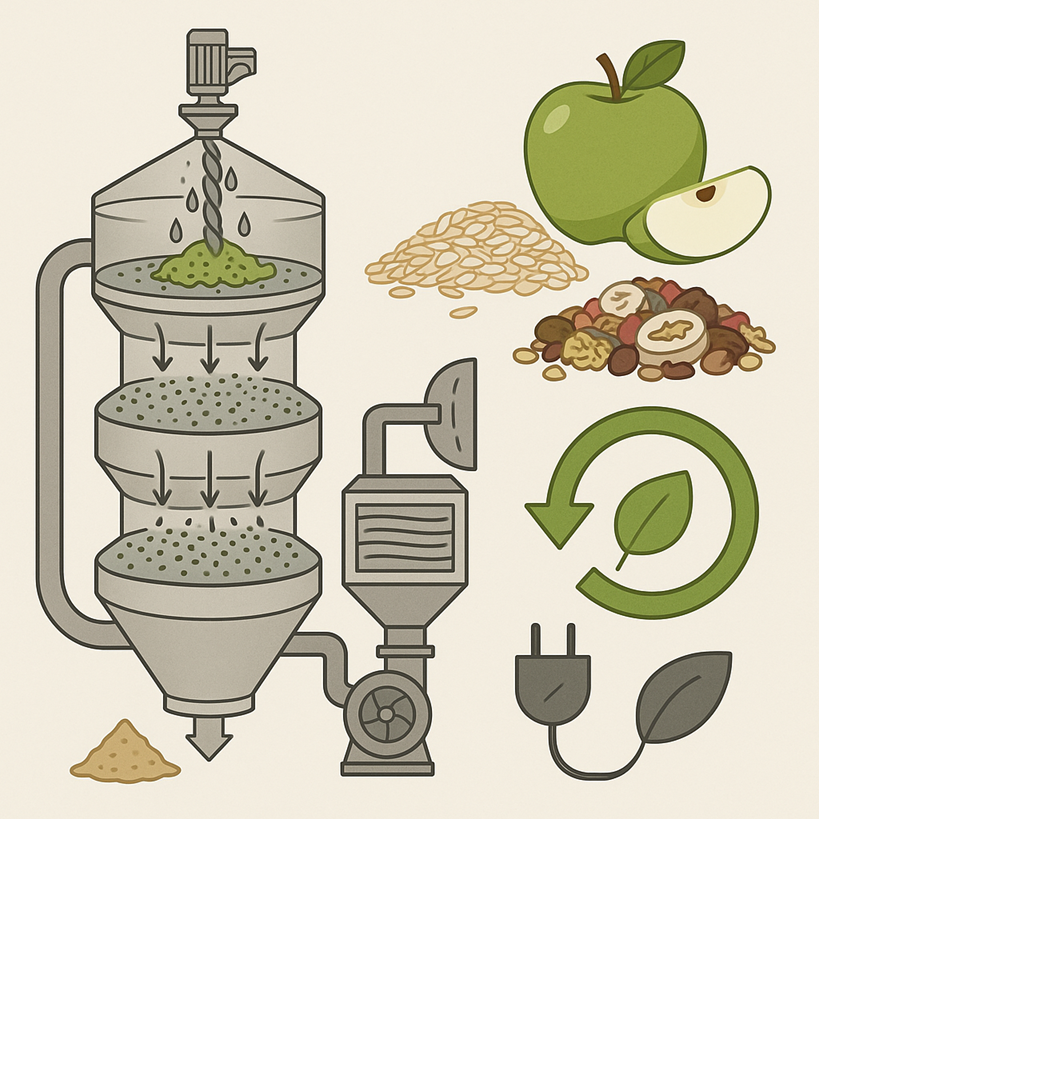
Об’єктом дослідження є процес сушіння сировини (фруктової, зернової, змішаної, молочної та рослинно-жирової) у вдосконаленій макетній конструкції каскадної флюїдизаційної сушарки, порівняно з базовою (контрольною) моделлю без елементів Пельтьє та плівкоподібних електронагрівачів. Основна проблема полягає у забезпеченні стабільної флюїдизації, ресурсоощадності та збереженні якісних характеристик сировини під час сушіння. Запропонована конструкція включає автономні вентиляторні системи, канали рециркуляції теплого повітря, підігрів повітря до 75°C і зонований температурний режим: секції А1 (68…75°C), А2 (58…65°C) та А3 (48…55°C) з терморегуляцією за допомогою Пельтьє-елементів. Сировина рухається гравітаційно через похилі канали, забезпечуючи послідовне сушіння з контролем вологості та швидкості повітря (2,3…2,6 м/с), що підтримує ефективну флюїдизацію.
Експериментальні дослідження для яблук, вівсяних пластівців, мюслів та лактозної суміші показали, що технологія забезпечує скорочення тривалості сушіння (від 22 до 60 хв) при збереженні поживних речовин і однорідності вологості (стандартне відхилення до 0,9…1,6%). Рециркуляція повітря (35…42%) і автономний контроль параметрів процесу підвищують ресурсоощадність без втрати якості.
Отримані результати підтверджують універсальність вдосконаленої каскадної флюїдизаційної сушарки для ресурсоощадного сушіння харчової сировини різного типу з оптимізованим температурним режимом і автоматизованим контролем процесу. Розроблена технологія може бути впроваджена у харчову промисловість для виробництва якісних сушених продуктів із збереженням функціональних властивостей
Посилання
- Venkateswarlu, K., Reddy, S. V. K. (2024). Recent trends on energy-efficient solar dryers for food and agricultural products drying: a review. Waste Disposal & Sustainable Energy, 6 (3), 335–353. https://doi.org/10.1007/s42768-024-00193-3
- Das, B., Singh, P., Kalita, P. (2025). Performance Evaluation of a Mixed-Mode solar dryer with PCM-based energy storage for efficient drying of Baccaurea ramiflora. Solar Energy, 288, 113279. https://doi.org/10.1016/j.solener.2025.113279
- Ostapenko, L., Vorontsova, A., Voronenko, I., Makarenko, I., Kozmenko, S. (2023). Coverage of the Russian armed aggression against Ukraine in scientific works: Bibliometric analysis. Journal Of International Studies, 16 (3), 9–33. https://doi.org/10.14254/2071-8330.2023/16-3/1
- Galenko, O., Shevchenko, A., Ceccanti, C., Mignani, C., Litvynchuk, S. (2024). Transformative shifts in dough and bread structure with pumpkin seed protein concentrate enrichment. European Food Research and Technology, 250 (4), 1177–1188. https://doi.org/10.1007/s00217-023-04454-z
- Nowacka, M., Matys, A., Witrowa-Rajchert, D. (2024). Innovative Technologies for Improving the Sustainability of the Food Drying Industry. Current Food Science and Technology Reports, 2 (2), 231–239. https://doi.org/10.1007/s43555-024-00026-8
- Chojnacka, K., Mikula, K., Izydorczyk, G., Skrzypczak, D., Witek-Krowiak, A., Moustakas, K. et al. (2021). Improvements in drying technologies - Efficient solutions for cleaner production with higher energy efficiency and reduced emission. Journal of Cleaner Production, 320, 128706. https://doi.org/10.1016/j.jclepro.2021.128706
- Majumder, P., Deb, B., Gupta, R., Sablani, S. S. (2022). A comprehensive review of fluidized bed drying: Sustainable design approaches, hydrodynamic and thermodynamic performance characteristics, and product quality. Sustainable Energy Technologies and Assessments, 53, 102643. https://doi.org/10.1016/j.seta.2022.102643
- Park, Y., Chang, Y.-S., Park, J.-H., Yang, S.-Y., Chung, H., Jang, S.-K. et al. (2016). Energy Efficiency of Fluidized Bed Drying for Wood Particles. Journal of the Korean Wood Science and Technology, 44 (6), 821–827. https://doi.org/10.5658/wood.2016.44.6.821
- Khanali, M., Banisharif, A., Rafiee, S. (2016). Modeling of moisture diffusivity, activation energy and energy consumption in fluidized bed drying of rough rice. Heat and Mass Transfer, 52 (11), 2541–2549. https://doi.org/10.1007/s00231-016-1763-z
- Haron, N. S., Zakaria, J. H., Mohideen Batcha, M. F. (2017). Recent advances in fluidized bed drying. IOP Conference Series: Materials Science and Engineering, 243, 012038. https://doi.org/10.1088/1757-899x/243/1/012038
- An, J., Xie, H., Yan, J., Wei, H., Wu, Y., Liao, X. (2024). A review of applications of energy analysis: Grain, fruit and vegetable drying technology. Energy Reports, 12, 5482–5506. https://doi.org/10.1016/j.egyr.2024.11.037
- Nejadi, J., Nikbakht, A. M. (2016). Numerical Simulation of Corn Drying in a Hybrid Fluidized Bed‐Infrared Dryer. Journal of Food Process Engineering, 40 (2). https://doi.org/10.1111/jfpe.12373
- Borel, L. D. M. S., Marques, L. G., Prado, M. M. (2020). Performance evaluation of an infrared heating-assisted fluidized bed dryer for processing bee-pollen grains. Chemical Engineering and Processing - Process Intensification, 155, 108044. https://doi.org/10.1016/j.cep.2020.108044
- Syahrul, S., Hamdullahpur, F., Dincer, I. (2002). Thermal analysis in fluidized bed drying of moist particles. Applied Thermal Engineering, 22 (15), 1763–1775. https://doi.org/10.1016/s1359-4311(02)00079-0
- Mishra, L., Hauchhum, L., Gupta, R. (2022). Development and performance investigation of a novel solar-biomass hybrid dryer. Applied Thermal Engineering, 211, 118492. https://doi.org/10.1016/j.applthermaleng.2022.118492
- Lv, W., Li, D., Lv, H., Jin, X., Han, Q., Su, D., Wang, Y. (2019). Recent development of microwave fluidization technology for drying of fresh fruits and vegetables. Trends in Food Science & Technology, 86, 59–67. https://doi.org/10.1016/j.tifs.2019.02.047
- Momenzadeh, L., Zomorodian, A., Mowla, D. (2011). Experimental and theoretical investigation of shelled corn drying in a microwave-assisted fluidized bed dryer using Artificial Neural Network. Food and Bioproducts Processing, 89 (1), 15–21. https://doi.org/10.1016/j.fbp.2010.03.007
- Golmohammadi, M., Assar, M., Rajabi-Hamaneh, M., Hashemi, S. J. (2015). Energy efficiency investigation of intermittent paddy rice dryer: Modeling and experimental study. Food and Bioproducts Processing, 94, 275–283. https://doi.org/10.1016/j.fbp.2014.03.004
- Nazghelichi, T., Kianmehr, M. H., Aghbashlo, M. (2010). Thermodynamic analysis of fluidized bed drying of carrot cubes. Energy, 35 (12), 4679–4684. https://doi.org/10.1016/j.energy.2010.09.036
- Ichise, T., Tatemoto, Y. (2022). Numerical analysis of drying characteristics of frozen material immersed in fluidized bed at low temperature under reduced pressure. Advanced Powder Technology, 33 (8), 103661. https://doi.org/10.1016/j.apt.2022.103661
- Potapskyi, O. V., Fesiun, S. V., Pylypenko, O. Yu., Babych, I. M. (2020). Pat. No. 147229 UA. Bahatozonalna termoelektrychna susharka. No. u202007428; declareted: 23.11.2020; published: 21.04.2021. Available at: https://sis.nipo.gov.ua/uk/search/detail/1589442/
- Lee, D.-J., Jangam, S., Mujumdar, A. S. (2013). Some Recent Advances in Drying Technologies to Produce Particulate Solids. KONA Powder and Particle Journal, 30, 69–83. https://doi.org/10.14356/kona.2013010
- Waskale, H., Bhong, M. (2019). Forced Convective Drying Of Potato Chips with Air Recirculation. Available at: https://www.researchgate.net/publication/333338784_Forced_Convective_Drying_Of_Potato_Chips_with_Air_Recirculation
- Usama, M., Ali, Z., Ndukwu, M. C., Sathyamurthy, R. (2023). The energy, emissions, and drying kinetics of three-stage solar, microwave and desiccant absorption drying of potato slices. Renewable Energy, 219, 119509. https://doi.org/10.1016/j.renene.2023.119509
- Rakshamuthu, S., Jegan, S., Joel Benyameen, J., Selvakumar, V., Anandeeswaran, K., Iyahraja, S. (2021). Experimental analysis of small size solar dryer with phase change materials for food preservation. Journal of Energy Storage, 33, 102095. https://doi.org/10.1016/j.est.2020.102095
- Zavidna, L., Trut, O., Slobodianiuk, O., Voronenko, I., Vartsaba, V. (2022). Application of Anti-Crisis Measures for the Sustainable Development of the Regional Economy in the Context of Doing Local Business in a Post-COVID Environment. International Journal of Sustainable Development and Planning, 17 (5), 1685–1693. https://doi.org/10.18280/ijsdp.170535
- Voronenko, I., Skrypnyk, A., Klymenko, N., Zherlitsyn, D., Starychenko, Y. (2020). Food security risk in Ukraine: assessment and forecast. Agricultural and Resource Economics: International Scientific E-Journal, 6 (4), 63–75. https://doi.org/10.51599/are.2020.06.04.04
- Nikolaienko, M., Bal-Prylypko, L. (2020). Development of an integrated food quality management system. Potravinarstvo Slovak Journal of Food Sciences, 14, 862–873. https://doi.org/10.5219/1434
- Bozhenko, V., Boyko, A., Voronenko, I. (2023). Corruption as an Obstacle of Sustainable Development. Leadership, Entrepreneurship and Sustainable Development Post COVID-19, 395–407. https://doi.org/10.1007/978-3-031-28131-0_27
- Cherednichenko, O., Bal-Prylypko, L. (2019). Modern condition and development of the specialized enterprises – rape producers. IOP Conference Series: Earth and Environmental Science, 315 (2), 022018. https://doi.org/10.1088/1755-1315/315/2/022018
##submission.downloads##
Опубліковано
Як цитувати
Номер
Розділ
Ліцензія
Авторське право (c) 2025 Andrii Zahorulko, Iryna Voronenko, Larysa Bal-Prylypko, Andrii Marynin, Iryna Bozhydai, Maksym Smilyk, Eldar Ibaiev, Nataliia Tytarenko

Ця робота ліцензується відповідно до Creative Commons Attribution 4.0 International License.
Закріплення та умови передачі авторських прав (ідентифікація авторства) здійснюється у Ліцензійному договорі. Зокрема, автори залишають за собою право на авторство свого рукопису та передають журналу право першої публікації цієї роботи на умовах ліцензії Creative Commons CC BY. При цьому вони мають право укладати самостійно додаткові угоди, що стосуються неексклюзивного поширення роботи у тому вигляді, в якому вона була опублікована цим журналом, але за умови збереження посилання на першу публікацію статті в цьому журналі.
Ліцензійний договір – це документ, в якому автор гарантує, що володіє усіма авторськими правами на твір (рукопис, статтю, тощо).
Автори, підписуючи Ліцензійний договір з ПП «ТЕХНОЛОГІЧНИЙ ЦЕНТР», мають усі права на подальше використання свого твору за умови посилання на наше видання, в якому твір опублікований. Відповідно до умов Ліцензійного договору, Видавець ПП «ТЕХНОЛОГІЧНИЙ ЦЕНТР» не забирає ваші авторські права та отримує від авторів дозвіл на використання та розповсюдження публікації через світові наукові ресурси (власні електронні ресурси, наукометричні бази даних, репозитарії, бібліотеки тощо).
За відсутності підписаного Ліцензійного договору або за відсутністю вказаних в цьому договорі ідентифікаторів, що дають змогу ідентифікувати особу автора, редакція не має права працювати з рукописом.
Важливо пам’ятати, що існує і інший тип угоди між авторами та видавцями – коли авторські права передаються від авторів до видавця. В такому разі автори втрачають права власності на свій твір та не можуть його використовувати в будь-який спосіб.