Building a model of water jet motion exiting a fire hose
DOI:
https://doi.org/10.15587/1729-4061.2025.341606Keywords:
two-phase jet, drop zone, fire hose, jet coreAbstract
This study investigates the process of water jet motion in the air; the subject is the trajectory of motion and the velocity vector of water droplets in a two-phase "droplets-air" flow. The task addressed is to construct a model of water jet motion in the air, which would take into account its destruction and transformation into a stream of droplets.
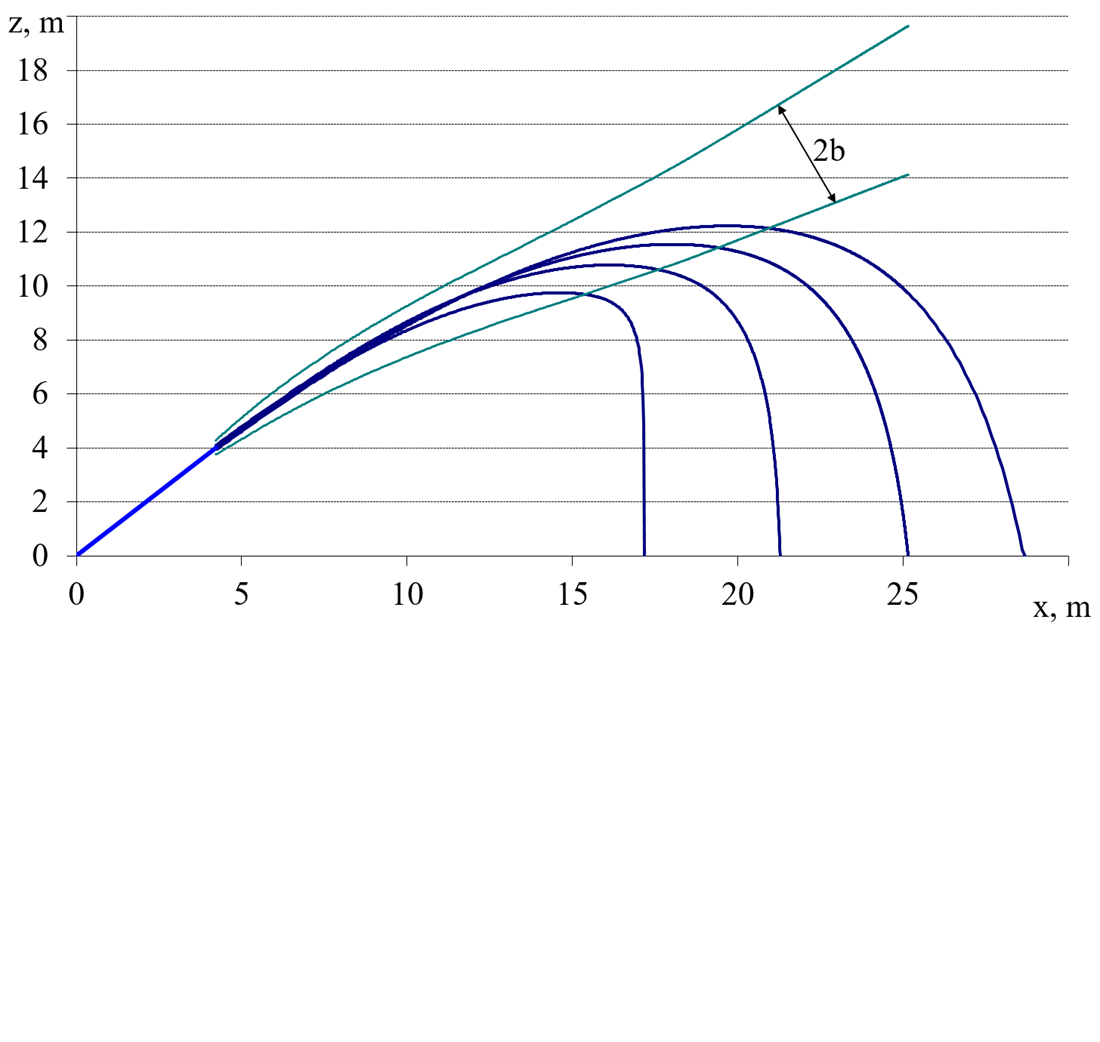
A model of water jet motion in the field of gravity after exiting the fire hydrant in the area of the jet core has been built. The jet expansion coefficient was experimentally determined to be 0.016. Estimates of the jet radius, water droplet velocity, and effective radius of the jet of trapped air at the boundary of the core zone and the droplet zone were constructed. The values obtained are the initial conditions for the model of the motion of the droplet and gas phases of the jet in the droplet zone. The droplet motion was modeled by using the Lagrangian approach, within which the dynamics of the motion of individual drops were considered, described by the equations of motion in three-dimensional space taking into account the forces of aerodynamic resistance and gravity. It was assumed that the distribution of the droplet diameter obeys the Rosin-Ramler law.
A model of the motion of the gas phase of the jet was constructed, based on the equations of mass and momentum balance; it also takes into account the curvature of the jet axis due to the capture of air by drops moving under the action of gravity. The model is based on the assumption of the axisymmetric nature of the jet and the Gaussian velocity distribution in its cross section. A feature of the model is the mutual influence of the droplet and gas phases of the jet on the motion of each other: drops, losing momentum due to aerodynamic resistance, give it to the air. It is shown that drops of smaller diameter have a shorter range compared to drops of larger diameter. As a result, the water falls to the ground not at a specific point but in a certain range. In particular, for a fire hose with a diameter of 19 mm, a delivery angle of 35° to the horizon and a water pressure of (40÷70) m, the width of the range into which 90% of the water falls was (8.7÷11.0) m
References
- Rahman, F. S., Tannous, W. K., Avsar, G., Agho, K. E., Ghassempour, N., Harvey, L. A. (2023). Economic Costs of Residential Fires: A Systematic Review. Fire, 6 (10), 399. https://doi.org/10.3390/fire6100399
- Kawade, A. U., Kawade, P. A., Kaware, A. P., Kkulthe, A. A., Amune, A. C. (2022). Smart Fire Fighting Robot. World Journal of Advanced Engineering Technology and Sciences, 7 (2), 157–162. https://doi.org/10.30574/wjaets.2022.7.2.0137
- Abramov, Y., Basmanov, O., Krivtsova, V., Khyzhnyak, A. (2020). Estimating the influence of the wind exposure on the motion of an extinguishing substance. EUREKA: Physics and Engineering, 5, 51–59. https://doi.org/10.21303/2461-4262.2020.001400
- Etzold, M., Deswal, A., Chen, L., Durst, F. (2018). Break-up length of liquid jets produced by short nozzles. International Journal of Multiphase Flow, 99, 397–407. https://doi.org/10.1016/j.ijmultiphaseflow.2017.11.006
- Fan, Q., Deng, Q., Liu, Q. (2024). Research and application on modeling and landing point prediction technology for water jet trajectory of fire trucks under large-scale scenarios. Scientific Reports, 14 (1). https://doi.org/10.1038/s41598-024-72476-y
- Hou, X., Cao, Y., Mao, W., Wang, Z., Yuan, J. (2021). Models for Predicting the Jet Trajectory and Intensity Drop Point of Fire Monitors. Fluid Dynamics & Materials Processing, 17 (5), 859–869. https://doi.org/10.32604/fdmp.2021.015967
- Sallam, K. A., Dai, Z., Faeth, G. M. (2002). Liquid breakup at the surface of turbulent round liquid jets in still gases. International Journal of Multiphase Flow, 28 (3), 427–449. https://doi.org/10.1016/s0301-9322(01)00067-2
- Rezayat, S., Farshchi, M., Berrocal, E. (2021). High-speed imaging database of water jet disintegration Part II: Temporal analysis of the primary breakup. International Journal of Multiphase Flow, 145, 103807. https://doi.org/10.1016/j.ijmultiphaseflow.2021.103807
- Liu, X., Wang, J., Li, B., Li, W. (2018). Experimental study on jet flow characteristics of fire water monitor. The Journal of Engineering, 2019 (13), 150–154. https://doi.org/10.1049/joe.2018.8950
- Trettel, B. (2020). Reevaluating the jet breakup regime diagram. Atomization and Sprays, 30 (7), 517–556. https://doi.org/10.1615/atomizspr.2020033171
- Trettel, B., Ezekoye, O. A. (2015). Theoretical Range and Trajectory of a Water Jet. Volume 7A: Fluids Engineering Systems and Technologies. https://doi.org/10.1115/imece2015-52103
- Zhu, J., Li, W., Lin, D., Zhao, G. (2018). Study on Water Jet Trajectory Model of Fire Monitor Based on Simulation and Experiment. Fire Technology, 55 (3), 773–787. https://doi.org/10.1007/s10694-018-0804-1
- Kooij, S., Sijs, R., Denn, M. M., Villermaux, E., Bonn, D. (2018). What Determines the Drop Size in Sprays? Physical Review X, 8 (3). https://doi.org/10.1103/physrevx.8.031019
- Privitera, S., Manetto, G., Pascuzzi, S., Pessina, D., Cerruto, E. (2023). Drop Size Measurement Techniques for Agricultural Sprays:A State-of-The-Art Review. Agronomy, 13 (3), 678. https://doi.org/10.3390/agronomy13030678
- Salyers B. E. (2010). Spray Characteristics From Fire Hose Nozzles. University of Maryland. Available at: https://drum.lib.umd.edu/items/bd81aff2-327f-4cfe-8047-58e5515c0396
- Valencia, A., Zheng, Y., Marshall, A. W. (2021). A Model for Predicting the Trajectory and Structure of Firefighting Hose Streams. Fire Technology, 58 (2), 793–815. https://doi.org/10.1007/s10694-021-01175-1
- Fan, X., Wang, J., Zhao, F., Li, J., Yang, T. (2018). Eulerian–Lagrangian method for liquid jet atomization in supersonic crossflow using statistical injection model. Advances in Mechanical Engineering, 10 (2). https://doi.org/10.1177/1687814018761295
- Semko, A., Rusanova, O., Kazak, O., Beskrovnaya, M., Vinogradov, S., Gricina, I. (2015). The use of pulsed high-speed liquid jet for putting out gas blow-out. The International Journal of Multiphysics, 9 (1), 9–20. https://doi.org/10.1260/1750-9548.9.1.9
- Zhang, C., Zhang, R., Dai, Z., He, B., Yao, Y. (2019). Prediction model for the water jet falling point in fire extinguishing based on a GA-BP neural network. PLOS ONE, 14 (9), e0221729. https://doi.org/10.1371/journal.pone.0221729
- Cheng, H., Zhu, J., Wang, S., Yan, K., Wang, H. (2024). A Study on Predicting the Deviation of Jet Trajectory Falling Point under the Influence of Random Wind. Sensors, 24 (11), 3463. https://doi.org/10.3390/s24113463
- Lin, Y., Ji, W., He, H., Chen, Y. (2021). Two-Stage Water Jet Landing Point Prediction Model for Intelligent Water Shooting Robot. Sensors, 21 (8), 2704. https://doi.org/10.3390/s21082704
- Vambol, S., Vambol, V., Abees Hmood Al-Khalidy, K. (2019). Experimental study of the effectiveness of water-air suspension to prevent an explosion. Journal of Physics: Conference Series, 1294 (7), 072009. https://doi.org/10.1088/1742-6596/1294/7/072009
- EN 15182-2. Portable equipment for projecting extinguishing agents supplied by firefighting pumps – Hand-held branchpipes for fire service use. Part 2: Combination branchpipes PN 16. Available at: https://www.normsplash.com/FreeDownload/115458135/DIN-EN-15182-2-2019-en.PDF
- Abramov, Y. A., Basmanov, O. E., Salamov, J., Mikhayluk, A. A. (2018). Model of thermal effect of fire within a dike on the oil tank. Naukovyi Visnyk Natsionalnoho Hirnychoho Universytetu, 2, 95–101. https://doi.org/10.29202/nvngu/2018-2/12
Downloads
Published
How to Cite
Issue
Section
License
Copyright (c) 2025 Oleksii Basmanov, Volodymyr Oliinyk, Oleh Zemlianskyi, Olexander Derevyanko, Daryna Karpova

This work is licensed under a Creative Commons Attribution 4.0 International License.
The consolidation and conditions for the transfer of copyright (identification of authorship) is carried out in the License Agreement. In particular, the authors reserve the right to the authorship of their manuscript and transfer the first publication of this work to the journal under the terms of the Creative Commons CC BY license. At the same time, they have the right to conclude on their own additional agreements concerning the non-exclusive distribution of the work in the form in which it was published by this journal, but provided that the link to the first publication of the article in this journal is preserved.
A license agreement is a document in which the author warrants that he/she owns all copyright for the work (manuscript, article, etc.).
The authors, signing the License Agreement with TECHNOLOGY CENTER PC, have all rights to the further use of their work, provided that they link to our edition in which the work was published.
According to the terms of the License Agreement, the Publisher TECHNOLOGY CENTER PC does not take away your copyrights and receives permission from the authors to use and dissemination of the publication through the world's scientific resources (own electronic resources, scientometric databases, repositories, libraries, etc.).
In the absence of a signed License Agreement or in the absence of this agreement of identifiers allowing to identify the identity of the author, the editors have no right to work with the manuscript.
It is important to remember that there is another type of agreement between authors and publishers – when copyright is transferred from the authors to the publisher. In this case, the authors lose ownership of their work and may not use it in any way.





