Виявлення впливу військових дій на безпечність сільськогосподарської продукції
DOI:
https://doi.org/10.15587/1729-4061.2025.343273Ключові слова:
продовольча безпека, важкі метали, радіонукліди, токсичні елементи, сільськогосподарська продукціяАнотація
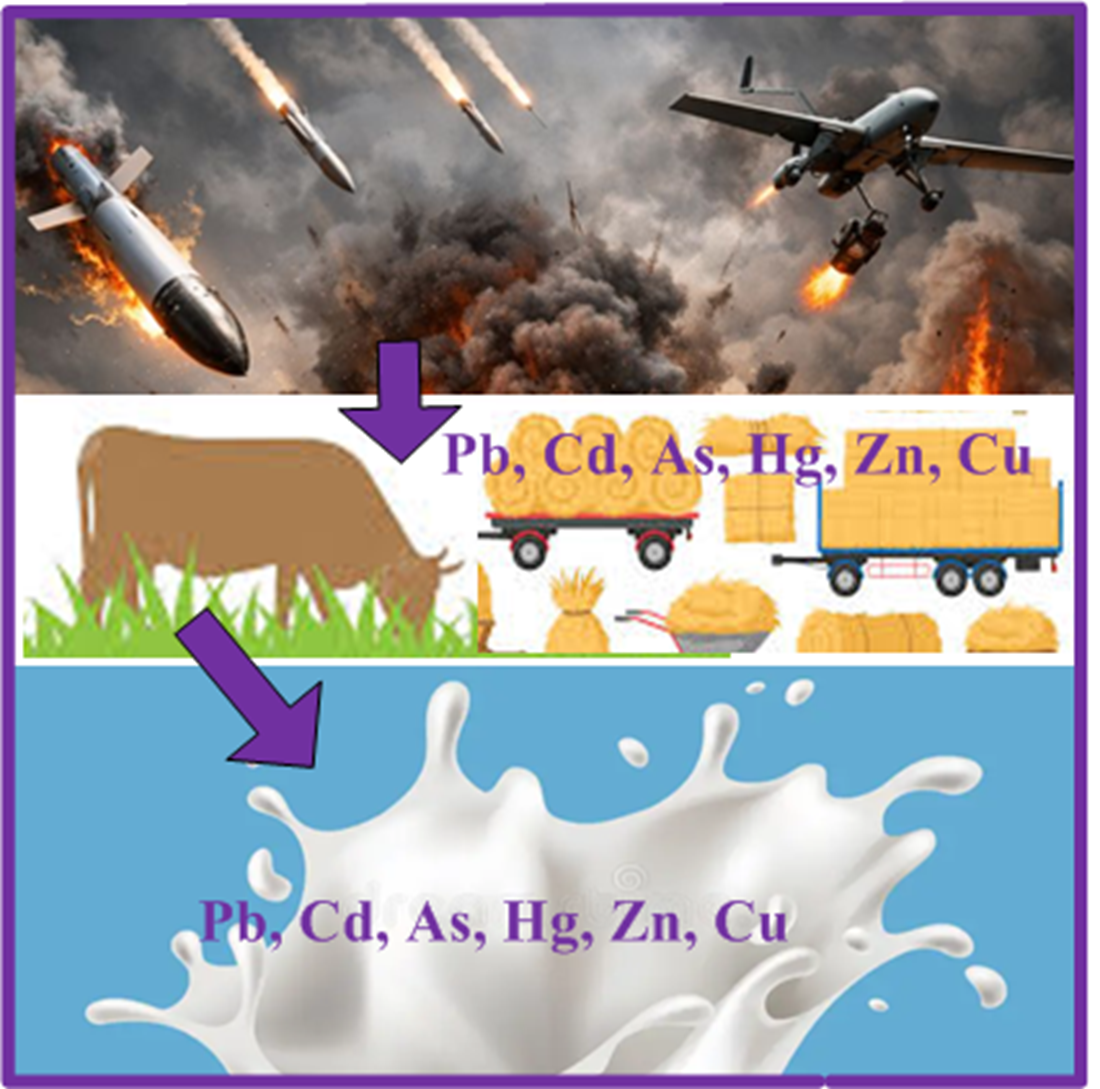
Об’єктом даного дослідження є процес оцінки безпечності сільськогосподарської продукції на території поблизу військових дій. Відомо, що військові дії призводять до забруднення екосистеми важкими металами. Проте, не досліджено, чи відбувається забруднення токсичними елементами та радіонуклідами сільськогосподарської продукції на територіях, де не ведуться бойові дії, але спостерігається постійний рух військових повітряних засобів. Дослідження проводилися у 2025 році на території, яке знаходиться в межах 50-кілометрової зони бойових дій. Проаналізовано вміст важких металів у кормах, які використовуються для вигодовування молочної худоби, та молоці, оскільки токсини можуть потрапляти у молоко через корм. Результати показали, що масова частка Pb (< 0,86 ± 0,26 ppm) та Zn (13,93 ± 4,32 мг/кг) у траві в значній мірі перевищує нормативні. Підвищений вміст Zn виявлено і в грубих кормах. Його частка у соломі становила 18,27 ± 5,49 мг/кг, а у сіні 8,72 ± 3,08 мг/кг. Спостерігається також забруднення коров’ячого молока. У ньому виявлено підвищений рівень Pb у травні (0,17 ± 0,08 мг/кг) та липні (0,18 ± 0,09 мг/кг). Виявлено підвищення рівня Cd у молоці (0,014 ± 0,01 мг/кг). Особливе підвищення частки важких металів у кормах та молоці спостерігалося у травні та липні, коли зросла інтенсивність повітряних загроз на Сумщині. При цьому, що у квітні масова частка Pb у молоці знаходилася в межах допустимих норм і не перевищувала 0,02 ppm. Радіологічні дослідження молока не виявили забруднення радіонуклідами. Питома активність Cs-137 знаходилася в межах 2,54 ± 2,54 – 4,25 ± 2,69 Бк/кг, а питома активність Sr-90 становила 0,56 ± 0,56 – 1,13 ± 0,7 Бк/кг. Тому, сільськогосподарську продукцію на територіях поблизу зони активних бойових дій не можна вважати безпечною
Посилання
- Samilyk, M., Kovalova, O., Yudina, T., Bolhova, N., Klochko, T. (2025). Assessment of the efficiency of processing non-traditional fruit raw materials at beet sugar plants. Agricultural and Resource Economics: International Scientific E-Journal, 11 (2), 183–217. https://doi.org/10.51599/are.2025.11.02.07
- Agboklou, K. E., Özkan, B., Gujrati, R. (2025). Geopolitical Instability and the Challenge of Achieving Zero Hunger: The Impact of the Russo-Ukrainian War on Global Food Security. Journal of Sustainable Institutional Management, 12, e0177. https://doi.org/10.37497/jsim.v12.id177.2025
- Certini, G., Scalenghe, R. (2024). War is undermining soil health and availability more than urbanisation. Science of The Total Environment, 908, 168124. https://doi.org/10.1016/j.scitotenv.2023.168124
- Filho, W. L., Fedoruk, M., Paulino Pires Eustachio, J. H., Splodytel, A., Smaliychuk, A., Szynkowska-Jóźwik, M. I. (2024). The environment as the first victim: The impacts of the war on the preservation areas in Ukraine. Journal of Environmental Management, 364, 121399. https://doi.org/10.1016/j.jenvman.2024.121399
- Rawtani, D., Gupta, G., Khatri, N., Rao, P. K., Hussain, C. M. (2022). Environmental damages due to war in Ukraine: A perspective. Science of The Total Environment, 850, 157932. https://doi.org/10.1016/j.scitotenv.2022.157932
- Xia, L., Robock, A., Scherrer, K., Harrison, C. S., Bodirsky, B. L., Weindl, I. et al. (2022). Global food insecurity and famine from reduced crop, marine fishery and livestock production due to climate disruption from nuclear war soot injection. Nature Food, 3 (8), 586–596. https://doi.org/10.1038/s43016-022-00573-0
- Altahaan, Z., Dobslaw, D. (2024). The Impact of War on Heavy Metal Concentrations and the Seasonal Variation of Pollutants in Soils of the Conflict Zone and Adjacent Areas in Mosul City. Environments, 11 (11), 247. https://doi.org/10.3390/environments11110247
- Deininger, K., Ali, D. A., Kussul, N., Shelestov, A., Lemoine, G., Yailimova, H. (2022). Quantifying War-Induced Crop Losses in Ukraine in near Real Time to Strengthen Local and Global Food Security. Policy Research Working Papers. https://doi.org/10.1596/1813-9450-10123
- Solokha, M., Demyanyuk, O., Symochko, L., Mazur, S., Vynokurova, N., Sementsova, K., Mariychuk, R. (2024). Soil Degradation and Contamination Due to Armed Conflict in Ukraine. Land, 13 (10), 1614. https://doi.org/10.3390/land13101614
- Zaitsev, Yu., Hryshchenko, O., Romanova, S., Zaitseva, I. (2022). Influence of combat actions on the content of gross forms of heavy metals in the soils of Sumy and Okhtyrka districts of Sumy region. Agroecological Journal, 3, 136–149. https://doi.org/10.33730/2077-4893.3.2022.266419
- Operational Command “North”. Available at: https://www.facebook.com/kommander.nord/?locale=uk_UA
- Zou, C., Wang, C., Huang, J., Li, Y., Zhao, Y., Liu, Y. et al. (2024). Patterns and causes of soil heavy metals and carbon stock in green spaces along an urbanization gradient. Ecological Indicators, 167, 112725. https://doi.org/10.1016/j.ecolind.2024.112725
- Chirinos-Peinado, D., Castro-Bedriñana, J., García-Olarte, E., Quispe-Ramos, R., Gordillo-Espinal, S. (2021). Transfer of lead from soil to pasture grass and milk near a metallurgical complex in the Peruvian Andes. Translational Animal Science, 5 (1). https://doi.org/10.1093/tas/txab003
- Busby, R. R., Douglas, T. A., LeMonte, J. J., Ringelberg, D. B., Indest, K. J. (2019). Metal accumulation capacity in indigenous Alaska vegetation growing on military training lands. International Journal of Phytoremediation, 22 (3), 259–266. https://doi.org/10.1080/15226514.2019.1658708
- Alinezhad, Z., Hashemi, M., Tavakoly Sany, S. B. (2024). Concentration of heavy metals in pasteurized and sterilized milk and health risk assessment across the globe: A systematic review. PLOS ONE, 19 (2), e0296649. https://doi.org/10.1371/journal.pone.0296649
- Ceballos-Rasgado, M., Lowe, N. M., Mallard, S., Clegg, A., Moran, V. H., Harris, C. et al. (2022). Adverse Effects of Excessive Zinc Intake in Infants and Children Aged 0–3 Years: A Systematic Review and Meta-Analysis. Advances in Nutrition, 13 (6), 2488–2519. https://doi.org/10.1093/advances/nmac088
- Samilyk, M., Synenko, T. (2025). Assessment of the impact of military actions on the safety of soil and agricultural products. EUREKA: Life Sciences, 2, 60–67. https://doi.org/10.21303/2504-5695.2025.003879
- Pšenková, M., Toman, R., Tančin, V. (2020). Concentrations of toxic metals and essential elements in raw cow milk from areas with potentially undisturbed and highly disturbed environment in Slovakia. Environmental Science and Pollution Research, 27 (21), 26763–26772. https://doi.org/10.1007/s11356-020-09093-5
- Zarif Gharaati Oftadeh, B., Tavakoly Sany, B., Alidadi, H., Zangouei, M, Barati, R., Naseri, A. (2021). Heavy Metals Contamination and Distribution in Drinking Water from Urban Area of Mashhad City in Northeast Iran: Implications for Water Quality Assessment. Journal of Chemical Health Risks, 11 (4), 403–18. http://doi.org/10.22034/jchr.2021.1931089.1312
##submission.downloads##
Опубліковано
Як цитувати
Номер
Розділ
Ліцензія
Авторське право (c) 2025 Maryna Samilyk, Serhii Bokovets, Oleksandr Kovalenko, Taisia Ryzhkova, Ihor Hnoievyі, Dmytro Hrinchenko, Alla Petrenko, Oleh Bakhmat, Uliana Nedilska

Ця робота ліцензується відповідно до Creative Commons Attribution 4.0 International License.
Закріплення та умови передачі авторських прав (ідентифікація авторства) здійснюється у Ліцензійному договорі. Зокрема, автори залишають за собою право на авторство свого рукопису та передають журналу право першої публікації цієї роботи на умовах ліцензії Creative Commons CC BY. При цьому вони мають право укладати самостійно додаткові угоди, що стосуються неексклюзивного поширення роботи у тому вигляді, в якому вона була опублікована цим журналом, але за умови збереження посилання на першу публікацію статті в цьому журналі.
Ліцензійний договір – це документ, в якому автор гарантує, що володіє усіма авторськими правами на твір (рукопис, статтю, тощо).
Автори, підписуючи Ліцензійний договір з ПП «ТЕХНОЛОГІЧНИЙ ЦЕНТР», мають усі права на подальше використання свого твору за умови посилання на наше видання, в якому твір опублікований. Відповідно до умов Ліцензійного договору, Видавець ПП «ТЕХНОЛОГІЧНИЙ ЦЕНТР» не забирає ваші авторські права та отримує від авторів дозвіл на використання та розповсюдження публікації через світові наукові ресурси (власні електронні ресурси, наукометричні бази даних, репозитарії, бібліотеки тощо).
За відсутності підписаного Ліцензійного договору або за відсутністю вказаних в цьому договорі ідентифікаторів, що дають змогу ідентифікувати особу автора, редакція не має права працювати з рукописом.
Важливо пам’ятати, що існує і інший тип угоди між авторами та видавцями – коли авторські права передаються від авторів до видавця. В такому разі автори втрачають права власності на свій твір та не можуть його використовувати в будь-який спосіб.