Експериментальне визначення впливу вогнегасних речовин на зниження температурних показників циліндричних літій-іонних елементів живлення
DOI:
https://doi.org/10.15587/1729-4061.2025.343574Ключові слова:
літій-іонний елемент, ефективність охолодження, зниження температури, засоби гасіння, вода, вуглекислотаАнотація
Об’єктом дослідження було визначено параметри пожежної небезпеки літій-іонних елементів живлення (ЛІЕЖ) Panasonic NCR18650B (LiNi0.8Co0.15Al0.05O2). Проблема отримання високоякісних вогнегасних речовин та матеріалів для попередження розповсюдження горіння полягає в отриманні відповідних даних експериментальним шляхом. Зокрема, встановлення теплофізичних характеристик та часових показники залежності зміни температурних показників ЛІЕЖ Panasonic NCR18650B (LiNi0.8Co0.15Al0.05O2) залежно від різних вогнегасних речовин є актуальним питанням, яке вирішено в роботі.
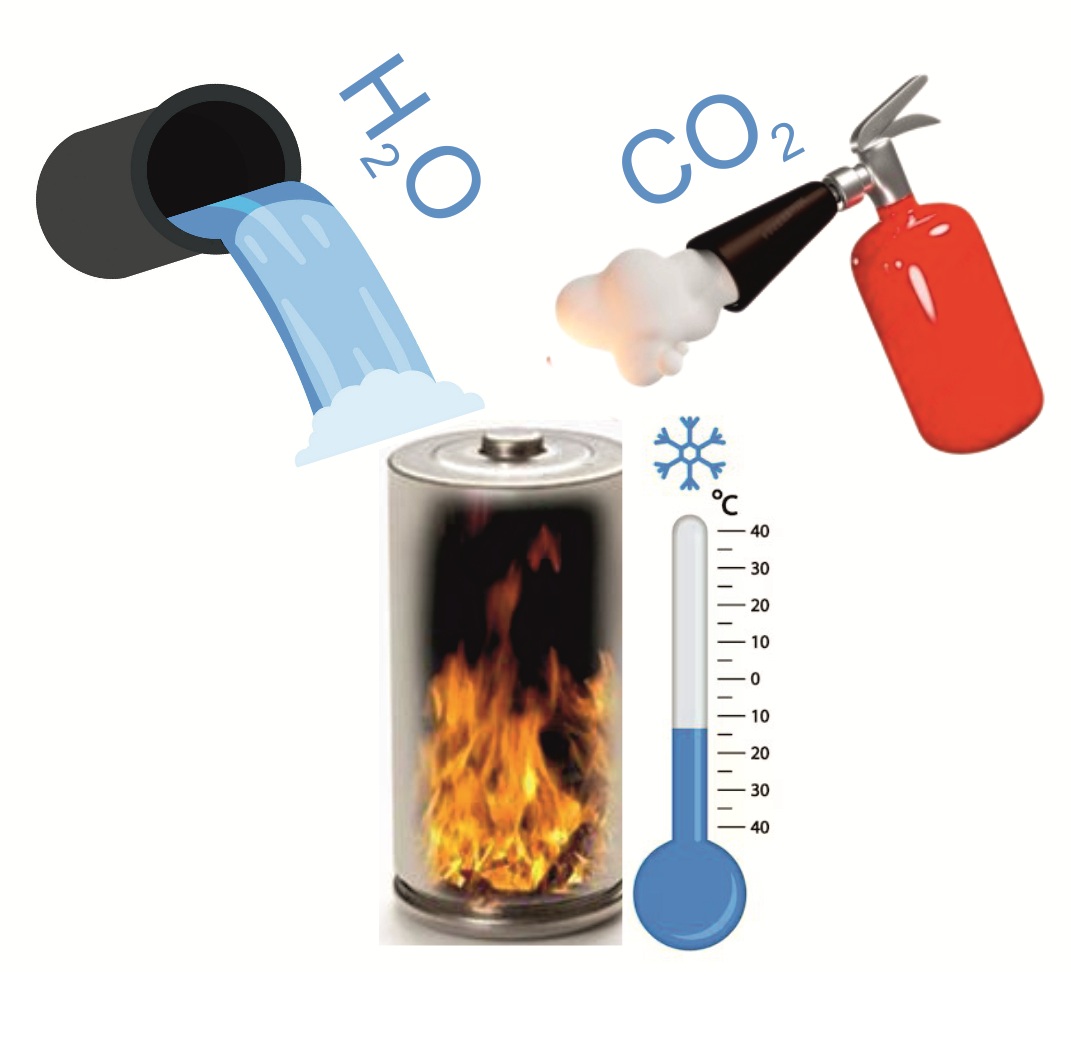
За результатами експериментальних досліджень було визначено, що час настання критичної температури в середині (~ 170°C) ЛІЕЖ за умов дії зовнішнього джерела енергії (~ 300°C) складає ~ 400 с. Експериментально встановлено ефективність використання води та вуглекислоти (CO2) на ефективність зниження (охолодження) температури внутрішнього наповнення. Відповідно час зниження температури елемента до 20°C водою складає 400 с, а за умови використання CO2 складає 280 с.
Математична модель задовільно описує процес охолодження внутрішнього наповнення ЛІЕЖ та відповідно верифікує експериментальні результати дослідження. Запропонована математична модель дає змогу здійснити прогнозування повного охолодження ЛІЕЖ залежно від типу вогнегасної речовини та першопочаткової температури речовини. Додатково, встановлено коефіцієнти тепловіддачі ЛІЕЖ α (Вт/м2· °C) за умови дії водою та CO2, що становлять 20 та 50 відповідно.
Отримані результати дають можливість здійснити розробку ефективних вогнегасних речовин та алгоритму їх застосування, зокрема встановити параметри часу гасіння та необхідного об’єму вогнегасної речовини відповідно до потужності та виду акумуляторної батареї. Додатково, представлена математична модель може бути використана для інших типів ЛІЕЖ з вже відомим теплофізичним характеристиками
Посилання
- Feng, X., Ouyang, M., Liu, X., Lu, L., Xia, Y., He, X. (2018). Thermal runaway mechanism of lithium ion battery for electric vehicles: A review. Energy Storage Materials, 10, 246–267. https://doi.org/10.1016/j.ensm.2017.05.013
- Nyamathulla, S., Dhanamjayulu, C. (2024). A review of battery energy storage systems and advanced battery management system for different applications: Challenges and recommendations. Journal of Energy Storage, 86, 111179. https://doi.org/10.1016/j.est.2024.111179
- Lai, X., Yao, J., Jin, C., Feng, X., Wang, H., Xu, C., Zheng, Y. (2022). A Review of Lithium-Ion Battery Failure Hazards: Test Standards, Accident Analysis, and Safety Suggestions. Batteries, 8 (11), 248. https://doi.org/10.3390/batteries8110248
- Murphy, M., Akrami, M. (2024). Advanced Thermal Management of Cylindrical Lithium-Ion Battery Packs in Electric Vehicles: A Comparative CFD Study of Vertical, Horizontal, and Optimised Liquid Cooling Designs. Batteries, 10 (8), 264. https://doi.org/10.3390/batteries10080264
- Liu, K., Liu, Y., Lin, D., Pei, A., Cui, Y. (2018). Materials for lithium-ion battery safety. Science Advances, 4 (6). https://doi.org/10.1126/sciadv.aas9820
- Altuntop, E. S., Erdemir, D., Kaplan, Y., Özceyhan, V. (2023). A comprehensive review on battery thermal management system for better guidance and operation. Energy Storage, 5 (8). https://doi.org/10.1002/est2.501
- Xie, L., Huang, Y., Lai, H. (2020). Coupled prediction model of liquid-cooling based thermal management system for cylindrical lithium-ion module. Applied Thermal Engineering, 178, 115599. https://doi.org/10.1016/j.applthermaleng.2020.115599
- Luo, W., Zhu, S., Gong, J., Zhou, Z. (2018). Research and Development of Fire Extinguishing Technology for Power Lithium Batteries. Procedia Engineering, 211, 531–537. https://doi.org/10.1016/j.proeng.2017.12.045
- Grandjean, T. R. B., Groenewald, J., Marco, J. (2019). The experimental evaluation of lithium ion batteries after flash cryogenic freezing. Journal of Energy Storage, 21, 202–215. https://doi.org/10.1016/j.est.2018.11.027
- Ghiji, M., Novozhilov, V., Moinuddin, K., Joseph, P., Burch, I., Suendermann, B., Gamble, G. (2020). A Review of Lithium-Ion Battery Fire Suppression. Energies, 13 (19), 5117. https://doi.org/10.3390/en13195117
- Wang, K., Ouyang, D., Qian, X., Yuan, S., Chang, C., Zhang, J., Liu, Y. (2023). Early Warning Method and Fire Extinguishing Technology of Lithium-Ion Battery Thermal Runaway: A Review. Energies, 16 (7), 2960. https://doi.org/10.3390/en16072960
- Majeed, F., Jamal, H., Kamran, U., Noman, M., Ali, M. M., Shahzad, T. et al. (2024). Review–Recent Advances in Fire-Suppressing Agents for Mitigating Lithium-Ion Battery Fires. Journal of The Electrochemical Society, 171 (6), 060522. https://doi.org/10.1149/1945-7111/ad5620
- Zhao, J., Xue, F., Fu, Y., Cheng, Y., Yang, H., Lu, S. (2021). A comparative study on the thermal runaway inhibition of 18650 lithium-ion batteries by different fire extinguishing agents. IScience, 24 (8), 102854. https://doi.org/10.1016/j.isci.2021.102854
- Tang, X., Hu, J., Liu, T., Hu, S., Zhu, P., Wang, X. (2024). Experimental investigation on the cooling effect of fully submerged fine water mist on lithium-ion batteries in confined space. Applied Thermal Engineering, 239, 122166. https://doi.org/10.1016/j.applthermaleng.2023.122166
- Xiao, X., Chen, B., Jin, X., Zeng, Q., Tian, Y., Li, Q. (2024). Experimental Study on the Effect of Synergistic Extinguishing Method Based on Liquid Nitrogen on Lithium-Ion Battery Fire After Thermal Runaway. Fire, 7 (12), 479. https://doi.org/10.3390/fire7120479
- Li, X., Li, X., Li, C., Wu, J., Liu, B. (2024). Study on the fire extinguishing effect of compressed nitrogen foam on 280 Ah lithium iron phosphate battery. Heliyon, 10 (11), e31920. https://doi.org/10.1016/j.heliyon.2024.e31920
- Ubaldi, S., Di Bari, C., Quinterno, M., De Rosa, A., Mazzaro, M., Ferrigno, G. et al. (2024). Suppression capacity and environmental impact of three extinguishing agents for lithium-ion battery fires. Case Studies in Chemical and Environmental Engineering, 10, 100810. https://doi.org/10.1016/j.cscee.2024.100810
- Lazarenko, O., Pazen, O., Velykyi, Y., Parkhomenko, R., Stepaniak, Y. (2024). Determination of Thermal Physical Characteristics of the Panasonic NCR18650b Lithium-Ion Power Supply Element. Proceedings of the Latvian Academy of Sciences. Section B. Natural, Exact, and Applied Sciences., 78 (5-6), 372–379. https://doi.org/10.2478/prolas-2024-0047
- Tatsii, R., Pazen, O., Shypot, L. (2021). Research of the temperature field in the system of multilayer cylindrical solid bodies under fire conditions. Fire Safety, 37, 64–71. https://doi.org/10.32447/20786662.37.2020.10
- Tatsii, R. M., Pazen, O. Yu. (2018). Direct (Classical) Method of Calculation of the Temperature Field in a Hollow Multilayer Cylinder. Journal of Engineering Physics and Thermophysics, 91 (6), 1373–1384. https://doi.org/10.1007/s10891-018-1871-3
- Zhao, C., Hu, W., Meng, D., Mi, W., Wang, X., Wang, J. (2024). Full-scale experimental study of the characteristics of electric vehicle fires process and response measures. Case Studies in Thermal Engineering, 53, 103889. https://doi.org/10.1016/j.csite.2023.103889
##submission.downloads##
Опубліковано
Як цитувати
Номер
Розділ
Ліцензія
Авторське право (c) 2025 Oleksandr Lazarenko, Oleg Pazen, Nadiia Ferents, Ivan Adolf, Volodymyr-Petro Parkhomenko

Ця робота ліцензується відповідно до Creative Commons Attribution 4.0 International License.
Закріплення та умови передачі авторських прав (ідентифікація авторства) здійснюється у Ліцензійному договорі. Зокрема, автори залишають за собою право на авторство свого рукопису та передають журналу право першої публікації цієї роботи на умовах ліцензії Creative Commons CC BY. При цьому вони мають право укладати самостійно додаткові угоди, що стосуються неексклюзивного поширення роботи у тому вигляді, в якому вона була опублікована цим журналом, але за умови збереження посилання на першу публікацію статті в цьому журналі.
Ліцензійний договір – це документ, в якому автор гарантує, що володіє усіма авторськими правами на твір (рукопис, статтю, тощо).
Автори, підписуючи Ліцензійний договір з ПП «ТЕХНОЛОГІЧНИЙ ЦЕНТР», мають усі права на подальше використання свого твору за умови посилання на наше видання, в якому твір опублікований. Відповідно до умов Ліцензійного договору, Видавець ПП «ТЕХНОЛОГІЧНИЙ ЦЕНТР» не забирає ваші авторські права та отримує від авторів дозвіл на використання та розповсюдження публікації через світові наукові ресурси (власні електронні ресурси, наукометричні бази даних, репозитарії, бібліотеки тощо).
За відсутності підписаного Ліцензійного договору або за відсутністю вказаних в цьому договорі ідентифікаторів, що дають змогу ідентифікувати особу автора, редакція не має права працювати з рукописом.
Важливо пам’ятати, що існує і інший тип угоди між авторами та видавцями – коли авторські права передаються від авторів до видавця. В такому разі автори втрачають права власності на свій твір та не можуть його використовувати в будь-який спосіб.