Ідентифікація динамічних процесів струму міжфазного короткого замикання вітрогенератора, що працює в автономному режимі
DOI:
https://doi.org/10.15587/1729-4061.2025.348861Ключові слова:
вітрова турбіна, генератор, коротке замикання, математична модель, імітаційне моделювання, динамічні процесиАнотація
Об'єктом дослідження є електромеханічна частина вітротурбіни з горизонтально розташованим безредукторним ротором та генератором змінного струму потужністю до 40 кВт. Дослідження вирішує задачу аналізу електромеханічних процесів, що відбуваються під час міжфазного короткого замикання у вітротурбінному генераторі.
У статті представлені результати теоретичних досліджень режиму короткого замикання силового кола генератора змінного струму безредукторної вітротурбіни потужністю до 40 кВт. Актуальність дослідження зумовлена необхідністю підвищення надійності та зменшення аварійності, спричиненої міжфазними короткими замиканнями у вітротурбінах.
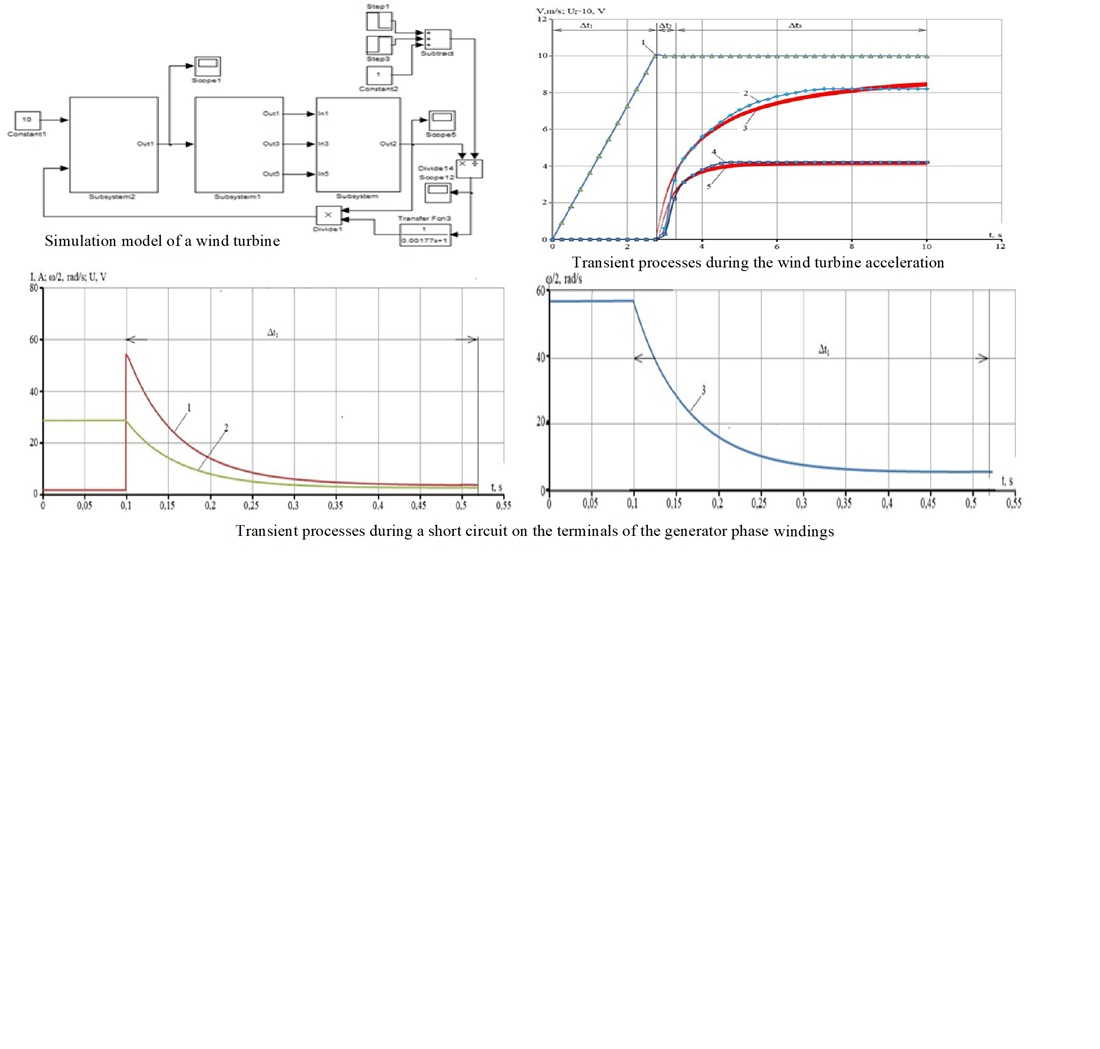
Обґрунтовано вибір рівнянь для математичної моделі електромеханічної частини турбіни; розроблено імітаційну модель за допомогою пакету MATLAB; адекватність імітаційної моделі оцінено шляхом порівняння перехідних процесів, отриманих теоретично та експериментально на лабораторному стенді за аналогічних початкових умов та моментів інерції механічної частини обертових елементів ротора та генератора вітротурбіни; проведено теоретичне дослідження перехідних процесів під час міжфазних коротких замикань.
Відмінні риси: запропоноване рівняння розряду енергії та розроблена модель дозволяють оцінити енергетичні характеристики вітрової турбіни з урахуванням динамічних характеристик ротора та генератора, що підвищує точність аналізу енергетичних характеристик у режимі міжфазного короткого замикання обмоток статора генератора.
Практичне значення: результати дослідження можуть бути використані при проєктуванні, модернізації та налагодженні систем захисту вітрових турбогенераторів потужністю до 40 кВт
Посилання
- Document 32022D0591. Decision (EU) 2022/591 of the European Parliament and of the Council of 6 April 2022 on a General Union Environment Action Programme to 2030. Available at: https://eur-lex.europa.eu/eli/dec/2022/591/oj
- Kaverin, V., Nurmaganbetova, G., Em, G., Issenov, S., Tatkeyeva, G., Maussymbayeva, A. (2024). Combined Wind Turbine Protection System. Energies, 17 (20), 5074. https://doi.org/10.3390/en17205074
- Hoen, B., Firestone, J., Rand, J., Elliot, D., Hübner, G., Pohl, J. et al. (2019). Attitudes of U.S. Wind Turbine Neighbors: Analysis of a Nationwide Survey. Energy Policy, 134, 110981. https://doi.org/10.1016/j.enpol.2019.110981
- Clausen, P. D., Wood, D. H. (1999). Research and development issues for small wind turbines. Renewable Energy, 16 (1-4), 922–927. https://doi.org/10.1016/s0960-1481(98)00316-4
- Arbella-Feliciano, Y., Trinchet-Varela, C. A., Lorente-Leyva, L. L., Peluffo-Ordóñez, D. H. (2023). Condition Monitoring of Wind Turbines: A Case Study of the Gibara II Wind Farm. Journal Européen Des Systèmes Automatisés, 56 (2), 329–335. https://doi.org/10.18280/jesa.560218
- Fischer, K., Stalin, T., Ramberg, H., Wenske, J., Wetter, G., Karlsson, R., Thiringer, T. (2015). Field-Experience Based Root-Cause Analysis of Power-Converter Failure in Wind Turbines. IEEE Transactions on Power Electronics, 30 (5), 2481–2492. https://doi.org/10.1109/tpel.2014.2361733
- Li, D., Sang, Y., Lv, Z., Wu, K., Lai, Z. (2025). Dynamic response analysis of wind turbine tower with high aspect ratio: Wind tunnel tests and CFD simulation. Thin-Walled Structures, 211, 113113. https://doi.org/10.1016/j.tws.2025.113113
- Issenov, S. S. (2012). Mathematical Model of Automatic Control System for Asynchronous Multimotor Drive. Elektronika Ir Elektrotechnika, 18 (8), 9–12. https://doi.org/10.5755/j01.eee.18.8.2602
- Nurmaganbetova, G., Issenov, S., Kaverin, V., Issenov, Z. (2023). Development of a virtual hardware temperature observer for frequency-controlled asynchronous electric motors. Eastern-European Journal of Enterprise Technologies, 3 (1 (123)), 68–75. https://doi.org/10.15587/1729-4061.2023.280357
- Issenov, S., Iskakov, R., Tergemes, K., Issenov, Z. (2022). Development of mathematical description of mechanical characteristics of integrated multi-motor electric drive for drying plant. Eastern-European Journal of Enterprise Technologies, 1 (8 (115)), 46–54. https://doi.org/10.15587/1729-4061.2021.251232
- Issabekov, D., Issenov, S. (2024). Alternative Resource-Saving Current Protections for Electric Motors. 2024 International Russian Smart Industry Conference (SmartIndustryCon), 19–24. https://doi.org/10.1109/smartindustrycon61328.2024.10515681
- Kerekes, Z., Restás, Á., Lublóy, É. (2019). The effects causing the burning of plastic coatings of fire-resistant cables and its consequences. Journal of Thermal Analysis and Calorimetry, 139 (2), 775–787. https://doi.org/10.1007/s10973-019-08526-9
- Morren, J., de Haan, S. W. H. (2007). Short-Circuit Current of Wind Turbines With Doubly Fed Induction Generator. IEEE Transactions on Energy Conversion, 22 (1), 174–180. https://doi.org/10.1109/tec.2006.889615
- Muljadi, E., Gevorgian, V. (2011). Short-circuit modeling of a wind power plant. 2011 IEEE Power and Energy Society General Meeting, 1–9. https://doi.org/10.1109/pes.2011.6039068
- Wang, X., Pan, X., Wan, J., Qi, J., Zhang, H., Li, S. (2014). A Wind Farm Short-Circuit Current Calculation Practical Model Applied to High Voltage Power Grid Simulation. Proceedings of the 2014 International Conference on Mechatronics, Electronic, Industrial and Control Engineering. https://doi.org/10.2991/meic-14.2014.330
- Margaris, I., Hansen, A. D., Bech, J., Andresen, B., Sørensen, P. E. (2012). Implementation of IEC Standard Models for Power System Stability Studies. In Proceedings of 11th International Workshop on Large-Scale Integration of Wind Power into Power Systems.
##submission.downloads##
Опубліковано
Як цитувати
Номер
Розділ
Ліцензія
Авторське право (c) 2025 Gulim Nurmaganbetova, Vladimir Kaverin, Sultanbek Issenov, Gennady Em, Yerlan Ualiyev, Elmira Sarsembiyeva, Zhanara Nurmaganbetova, Zhanat Issenov

Ця робота ліцензується відповідно до Creative Commons Attribution 4.0 International License.
Закріплення та умови передачі авторських прав (ідентифікація авторства) здійснюється у Ліцензійному договорі. Зокрема, автори залишають за собою право на авторство свого рукопису та передають журналу право першої публікації цієї роботи на умовах ліцензії Creative Commons CC BY. При цьому вони мають право укладати самостійно додаткові угоди, що стосуються неексклюзивного поширення роботи у тому вигляді, в якому вона була опублікована цим журналом, але за умови збереження посилання на першу публікацію статті в цьому журналі.
Ліцензійний договір – це документ, в якому автор гарантує, що володіє усіма авторськими правами на твір (рукопис, статтю, тощо).
Автори, підписуючи Ліцензійний договір з ПП «ТЕХНОЛОГІЧНИЙ ЦЕНТР», мають усі права на подальше використання свого твору за умови посилання на наше видання, в якому твір опублікований. Відповідно до умов Ліцензійного договору, Видавець ПП «ТЕХНОЛОГІЧНИЙ ЦЕНТР» не забирає ваші авторські права та отримує від авторів дозвіл на використання та розповсюдження публікації через світові наукові ресурси (власні електронні ресурси, наукометричні бази даних, репозитарії, бібліотеки тощо).
За відсутності підписаного Ліцензійного договору або за відсутністю вказаних в цьому договорі ідентифікаторів, що дають змогу ідентифікувати особу автора, редакція не має права працювати з рукописом.
Важливо пам’ятати, що існує і інший тип угоди між авторами та видавцями – коли авторські права передаються від авторів до видавця. В такому разі автори втрачають права власності на свій твір та не можуть його використовувати в будь-який спосіб.